Quick answer: Importers buying Japanese Car Brake Fluid should begin with the vehicles they actually serve, then create a controlled assortment based on the applicable owner’s manuals, DOT performance grades, local regulations, and documented test results. For many Toyota, Honda, and Nissan applications, DOT 3 or DOT 4 appears in official vehicle literature; that does not make every fluid interchangeable or establish a universal specification for all Japanese cars. A successful wholesale program connects each approved product to a defined market segment, a traceable batch, reliable packaging, and a clear workshop-facing recommendation.
Japanese-brand cars operate across very different markets. A Toyota used for urban transport in Southeast Asia, a Nissan SUV in a hot coastal region, a Honda sedan in North America, and a late-model performance vehicle in a cold climate do not necessarily share the same service instructions. Vehicle age, model year, trim, destination market, hydraulic control system, and the manufacturer’s maintenance literature may all affect the purchasing decision.
For a B2B importer, that complexity creates a commercial challenge. Too few SKUs can leave workshops without the required product. Too many near-identical bottles can tie up working capital, increase labeling costs, and create confusion at the service counter. The objective of this guide is to help you select a defensible starting range, qualify a manufacturer, organize private-label packaging, and prepare a quotation request that can lead to repeatable supply rather than a one-off purchase.
Explore GAFLE Brake Fluid Products → Discuss Your Wholesale Requirements →
1. Why Japanese Car Brake Fluid Is a Distinct Aftermarket Sourcing Opportunity
The phrase “Japanese car” describes a manufacturer's origin, not a single brake-system specification. Toyota, Honda, Nissan, Mazda, Subaru, Mitsubishi, Suzuki, and other Japanese vehicle brands sell passenger cars, hybrids, SUVs, pickups, and light commercial vehicles across many years and regional configurations. Their repair instructions can differ even when the brake-fluid reservoir looks similar.
That is why the useful commercial question is not, “Which brake fluid fits Japanese cars?” It is, “Which documented brake-fluid requirements occur most frequently in the part of the Japanese vehicle parc our customers service?” Here, vehicle parc means the population of vehicles in operation within a defined market. That population—not the brand logo on a bottle—should determine stock priorities.
A Japanese-vehicle-focused distributor often serves several customers at once: independent repair shops needing quick replenishment, regional parts wholesalers looking for predictable carton quantities, fleet maintenance operators controlling recurring service costs, and private-label resellers who need a coherent product story. Each group values accurate fitment guidance and dependable stock more than a long list of unverified compatibility claims.
This focus also differentiates the assortment from a generic automotive-fluid catalog. It provides an opportunity to create training materials around model-specific verification, common service mistakes, handling in humid regions, and selection rules for newer electronic brake systems. These assets can make a distributor more useful to customers without pretending to replace original vehicle service information.
2. Start With OEM Manuals, Not a Brand-Wide Compatibility Claim
The most reliable way to organize brake-fluid stock is to record what an actual owner’s manual or service publication says for the vehicle, model year, market, and system. Manufacturer statements from different models show why a brand-wide shortcut is risky.
For example, the official 2024 Toyota RAV4 Hybrid documentation for the U.S. market lists FMVSS No. 116 DOT 3/SAE J1703 and DOT 4/SAE J1704 brake-fluid options in its service information. In contrast, the 2025 Toyota GR Corolla service information calls out Toyota Genuine Brake Fluid DOT4 Class6, FMVSS No. 116 DOT4, or SAE J1704LV, and contains a model-specific contingency concerning DOT3 when the specified fluid is unavailable. That exception must never be generalized to other Toyota vehicles.
A 2022 Honda CR-V manual for a particular European-market version lists DOT3 or DOT4 under brake-fluid specifications. The 2024 Nissan X-Trail UK manual lists Genuine Nissan Brake Fluid or equivalent DOT3 or DOT4, while explicitly instructing owners not to mix the two types. These are examples of specific documentation, not proof that every Toyota, Honda, or Nissan follows identical rules.
| Vehicle-literature example | What the cited publication says | Distributor takeaway |
|---|---|---|
| Toyota RAV4 Hybrid, 2024, U.S. manual | DOT 3/SAE J1703 or DOT 4/SAE J1704 listed | Check both grade and destination-market document |
| Toyota GR Corolla, 2025, U.S. manual | DOT4 Class6 / DOT4 / SAE J1704LV identified, with specific fallback guidance | Do not ignore low-viscosity references or copy exceptions across models |
| Honda CR-V, 2022, selected UK-market manual | DOT3 or DOT4 specified | Store the manual revision and vehicle identifier with your coverage record |
| Nissan X-Trail, 2024, UK manual | Nissan fluid or equivalent DOT3/DOT4; manual warns against mixing types | Put model-specific handling restrictions into workshop documentation |
| Other Japanese-brand models | Not determined by the examples above | Obtain the correct manufacturer source before approving compatibility |
Important: This table is an illustration of a verification method, not a complete fitment list. It must not be reused as a vehicle-approval certificate or an instruction to substitute one product for another.
A good supplier or distributor records the source document, publication date, language, model year, region, relevant paragraph, and reviewer. Without these fields, a workshop might rely on information intended for a different vehicle generation. Fitment claims should be reviewed whenever a product label changes or new vehicle models enter the market.
3. DOT 3 vs DOT 4: What Wholesale Buyers Should Actually Compare
A performance grade is the starting point, not the end of technical selection. Under the U.S. FMVSS No. 116 regulation, standard DOT 3 and DOT 4 products have different minimum equilibrium reflux boiling-point and wet boiling-point requirements. Both must also satisfy additional requirements dealing with viscosity, corrosion, water tolerance, fluid stability, compatibility, rubber components, and labeling.
| Selected FMVSS No. 116 requirement | DOT 3 | DOT 4 | Meaning for procurement |
|---|---|---|---|
| Minimum dry equilibrium reflux boiling point | 205°C / 401°F | 230°C / 446°F | Compares the fresh-fluid minimum under the specified test |
| Minimum wet equilibrium reflux boiling point | 140°C / 284°F | 155°C / 311°F | Addresses boiling behavior after standardized moisture conditioning |
| Maximum kinematic viscosity at −40°C | 1,500 mm²/s | 1,800 mm²/s | General grade threshold; does not establish a special low-viscosity claim |
| Hot viscosity, corrosion, compatibility, rubber effects | Controlled by additional provisions | Controlled by additional provisions | Ask for the full applicable test profile, not only a headline number |
These are selected regulatory thresholds, not measured values for any GAFLE SKU. Refer to 49 CFR §571.116 for the full test methods and requirements.
DOT 4 has higher minimum dry and wet boiling temperatures than DOT 3, but the DOT number alone does not prove that a formulation is approved for an individual Japanese vehicle. Conversely, lower-temperature viscosity must be examined separately. A product advertised as “DOT 4 LV” may be designed for low-viscosity applications, yet LV is not a separate FMVSS DOT grade. Buyers must check the applicable SAE or ISO requirement and actual laboratory data.
There is also no universal reason for a distributor to replace its entire DOT 3 assortment with DOT 4. The decision depends on the local vehicle population and its maintenance requirements. Some buyers need a reliable entry-level DOT 3 program; others need a DOT 4 program with tighter technical documentation, and some will require a special low-viscosity SKU for documented applications.
If customers request DOT 5.1, examine that demand as a separate verified segment. Non-silicone DOT 5.1 must not be confused with silicone-base DOT 5. Never interpret a larger number as an automatic “upgrade,” and never recommend mixing grades where the vehicle manufacturer prohibits it.
4. JIS K 2233, FMVSS 116, SAE and ISO: Which Evidence Matters?
Japanese Car Brake Fluid procurement frequently introduces the abbreviation JIS K 2233. This is a Japanese Industrial Standard for non-petroleum-base automotive brake fluids. The published JIS K 2233:2017 text identifies classifications BF-3, BF-4, BF-5, and BF-6. These are JIS classifications and must be evaluated under the relevant standard and edition; a shorthand class designation is not itself a vehicle approval.
A distributor should not assume that a fluid labeled “DOT 4” automatically has a current JIS K 2233 conformity report. Nor should it infer a precise JIS classification from a general marketing description of synthetic or high-performance fluid. Request the supplier's declaration, relevant test report, applicable edition, and an exact cross-reference to the formulation being purchased.
The main standards and documents serve different purposes:
| Document or reference | What it helps establish | What it does not prove by itself |
|---|---|---|
| Vehicle owner’s/service manual | Required or permitted fluid for a specific vehicle | That any named aftermarket brand is automatically approved |
| FMVSS No. 116 | Regulatory grade requirements, tests, packaging and labeling for applicable products | Manufacturer endorsement of a particular vehicle application |
| JIS K 2233 | Japanese non-petroleum brake-fluid classifications and technical requirements | Universal compatibility with every Japanese-made car |
| SAE J1703 / J1704 / J1704LV | Referenced engineering specifications for relevant fluids | That one named bottle meets them without evidence |
| ISO 4925 | Fluid classes and technical performance framework | A substitute for reading the precise vehicle instruction |
| TDS, SDS and batch COA | Product profile, safety information and batch values, respectively | Unconditional approval across all markets and vehicles |
Buyer rule: A product's exact specification, manufacturing formula, tested revision, marketing label, and order contract must refer to the same material. Generic statements such as “JIS approved,” “OEM compatible,” or “meets all global standards” are not adequate if they cannot be tied to documentary evidence.
For a private-label importer, this distinction protects more than compliance. It reduces the chance that a sales representative promises one grade, the artwork shows another, and the factory releases a third under an ambiguous code. That type of mismatch can trigger relabeling, shipment delay, warranty dispute, and reputational harm.
5. A Practical Three-Tier SKU Strategy for Japanese-Vehicle Aftermarkets
Rather than start with every available variant, buyers can organize their Japanese-vehicle fluid program into three commercial tiers. The tiers below are assortment-planning recommendations, not declared GAFLE package sizes, guaranteed vehicle approvals, or fixed minimum order quantities.
Tier A: Documented DOT 3 coverage
Use this tier where a substantial share of the local car parc and official service information call for DOT 3. The customer might be a routine-maintenance workshop, a neighborhood parts shop, or a distributor servicing older vehicles. A clear label, recognizable grade, correct instructions, dependable seal, and stable refill availability are more useful here than an elaborate performance claim.
The product should be supported by an agreed TDS and current conformity evidence. If the local market has high turnover but limited storage capacity, a smaller practical retail bottle may make sense. If workshops buy in predictable volumes, larger workshop packaging could be evaluated. The right size follows buying behavior and moisture-control practice, not just the cheapest cost per liter.
Tier B: Documented standard DOT 4 coverage
Use this tier where specific Japanese-brand vehicles require or permit DOT 4 and the local workshop channel needs it. For mixed Japanese-and-international repair centers, DOT 4 can also be a commercially relevant stock family, provided the application claims remain vehicle-specific. Sales teams should not describe it as universally better or compatible with all DOT 3 systems.
A manufacturer’s published DOT 4 product page is an efficient starting point, but do not approve your label from a website description alone. Ask for the complete performance data, batch acceptance rules, package requirements, and any restrictions from applicable manufacturer literature.
Tier C: Documented specialty low-viscosity or performance coverage
Only add this tier when customer requests or vehicle manuals justify it. The 2025 Toyota GR Corolla example shows why a buyer might encounter a Class6 or J1704LV reference; it does not prove that every current Japanese car requires a low-viscosity fluid. A specialty SKU needs its own validation, sales guidance, distinct stock code, and controlled artwork so it cannot be mistaken for ordinary DOT 4.
| Assortment tier | Demand signal | Required validation | Commercial approach |
|---|---|---|---|
| A — DOT 3 | Proven older or current model population with DOT 3 instructions | Grade, actual TDS, relevant manual list and batch traceability | High-clarity everyday-service positioning |
| B — DOT 4 | Confirmed DOT 4 requirements or permissions | Full DOT 4 test evidence and vehicle-specific verification | Core workshop and distributor range |
| C — Specialty | Documented LV, class or performance requirement | Exact classification, low-temperature test data and application review | Limited, clearly differentiated technical SKU |
A disciplined distributor can begin with A and B, collect actual sales and workshop inquiries, and introduce Tier C only after confirming a real coverage gap. This is usually easier to manage than immediately launching six similar bottle designs with no historical demand data.
6. Segment Demand by Vehicle Type and Operating Environment
A single market can contain very different usage conditions. Those conditions affect the questions distributors should ask, but they do not override vehicle specifications. A tropical coastal fleet, a mountain taxi operator, and a cold-climate repair chain may all serve Japanese-brand cars while requiring different technical explanations and inventory policies.
City cars and daily commuters. Common purchasing considerations include simple grade identification, small-pack turnover, sealed-container quality, and quick workshop replenishment. The best message is dependable service and verified fit—not speculative racing performance.
SUVs, pickups, and light commercial vehicles. Buyers may face heavier loads, frequent stops, or long duty cycles. Discuss applicable heat performance, maintenance instructions, and service documentation, but distinguish passenger-car hydraulic systems from heavy vehicles using air brakes or other architectures.
High-temperature regions. Thermal load can make dry and wet boiling data especially important to explain. Ambient heat is only one factor; repeated braking, vehicle weight, terrain, system design, and maintenance condition matter. Do not promise that one product prevents brake fade in every use case.
Humid or coastal regions. Brake fluid storage deserves attention because many glycol-based formulations are hygroscopic. Inspect closure integrity, warehousing procedures, and exposure after opening. The commercial opportunity may be smaller pack options, more frequent replenishment, and practical workshop education—not a claim that a bottle is immune to water absorption.
Cold climates. Correct low-temperature viscosity requirements matter, especially where the manufacturer specifies a particular class or low-viscosity fluid. A supplier should present measured results at the relevant temperature and standard rather than relying on the label term “winter formula.”
Hybrid and electric vehicles. Regenerative braking changes how friction brakes are used, but it does not create one universal hybrid-vehicle brake-fluid grade. Models with integrated electronic control or different hydraulic hardware must be assessed individually. Follow the OEM procedure for servicing and bleeding; those operations may require special diagnostic processes.
The value of this segmentation is practical: it helps distributors explain why an application requires a documented SKU, select a sensible replenishment plan, and avoid marketing claims that are broader than the evidence.
7. Build a Workshop-Friendly Fitment and Stock-Control Database
A strong Japanese Car Brake Fluid wholesale program needs more than a printed compatibility poster. It benefits from a maintained product-data table that connects individual vehicle requirements to approved SKUs, the evidence used to authorize that connection, and the date of the last review.
Recommended database fields include the vehicle make, model, year, engine or powertrain, destination market, brake-system notes, source document, specified fluid, allowed alternative (if explicitly stated), reviewed product SKU, bottle size, reviewer, and revision date. Keep a place for restrictions such as a manufacturer instruction not to mix fluids.
Example structure:
| Field | Sample entry format | Why it matters |
|---|---|---|
| Vehicle identifier | Toyota / model / year / market | Prevents brand-wide assumptions |
| Official source | Manual title, revision, page | Enables audit and correction |
| Required grade | DOT 3 / DOT 4 / Class6 as written | Separates specification from marketing language |
| Restrictions | Exact manufacturer note | Prevents harmful substitution or mixing guidance |
| Proposed product SKU | Distributor stock code, pending approval | Links technical decisions to stock control |
| Evidence status | Under review / approved / withdrawn | Prevents unapproved sales claims |
| Review owner and date | Technician or product manager | Establishes accountability |
Treat the database as a controlled commercial asset. A new model year, changed formulation, supplier document revision, or changed country rule can require a new review. A generic vehicle-logo chart without these controls may be convenient for sales, but it is weaker evidence for a professional importer.
When the coverage file becomes accurate, it can support catalog descriptions, customer service replies, distributor training, sales-team scripts, and buyer-facing educational content. It also helps a customer find the correct document quickly when a mechanic asks about an unusual model.
8. Technical Qualification: Beyond the Boiling Point on the Bottle
An importer comparing Japanese car brake fluid suppliers should request a technical profile that matches the product being quoted. Begin with grade and relevant standards, then request the test methods, numerical results, and limits the supplier is willing to guarantee at batch release.
Dry equilibrium reflux boiling point (ERBP) assesses freshly prepared fluid under defined test conditions. It is an important high-temperature measurement, but the highest marketing number does not automatically establish a better purchase. The result must be connected to the right test method and specified grade.
ERBP Act measures boiling performance after a defined moisture-conditioning procedure. Since moisture exposure can degrade the high-temperature capability of typical glycol-based fluids, this value deserves prominent consideration, particularly for humid markets and longer maintenance cycles. It does not replace proper fluid-change practices.
Low-temperature kinematic viscosity is especially relevant when the manual identifies a particular low-viscosity class. Ask for the exact temperature, unit, method, and maximum requirement. A vague phrase such as “fast ABS response” is not a substitute for a test value.
Corrosion testing addresses the interaction of brake-fluid formulations with multiple metals used in hydraulic systems. Rubber compatibility and effects are equally important because hydraulic seals and hoses must behave as designed. Other useful checks include water tolerance, stability, pH under the applicable test, appearance, and oxidation-related behavior.
A well-structured supplier comparison should distinguish three columns: the standard threshold, the supplier's product specification or guarantee, and the latest batch result. Never copy a threshold value into the other two columns merely to fill a marketing table. Likewise, a TDS without a clearly identified product revision or a COA without the relevant lot number is weaker than the documentation a quality-led distributor should request.
9. How Packaging Affects Moisture Control, Shelf Management and Reorders
Brake-fluid packaging is part of the technical risk calculation, not merely a design expense. Importers should evaluate the bottle material, cap, inner seal, tamper-evident feature, label adhesion, carton protection, lot marking, pallet handling, and storage environment. The exact requirements depend on destination regulations and contract conditions.
For applicable U.S.-market products, FMVSS No. 116 includes container sealing and labeling provisions. For other markets, importers must check the locally applicable chemical and consumer-product rules instead of assuming a U.S.-compliant label is sufficient everywhere.
An elegant bottle is not useful if the closure allows excessive moisture ingress before first use. A large workshop container might reduce packaging cost per liter, but frequent opening and poor storage discipline can make it a poor choice for a low-volume customer. An importer should therefore calculate both distribution efficiency and actual consumption behavior.
Consider three types of packaging discussion during the first supplier meeting:
- Retail: easy identification, accurate specifications, durable label, practical shelf size, sealed unit, scannable lot information.
- Workshop: handling efficiency, controlled opening, clear grade differentiation, stocking frequency, and compatibility with local operating practice.
- Private label: original artwork, approved claims, barcode plan, language versions, cartons, brand protection, and a revision-control process.
A repeatable packaging program also benefits from retained approved samples. The supplier and buyer should retain a reference bottle, label proof, cap and seal specification, carton artwork, and packaging acceptance criteria. This makes it easier to investigate a future complaint or to keep successive orders consistent.
10. GAFLE DOT 3 and DOT 4 Options as Sourcing Candidates
FORK identifies Zhejiang Gafle Auto Chemical Co., Ltd. as a manufacturer of automotive chemicals with brake fluid among its core product categories. Its website lists DOT 3, DOT 4, DOT 5.1 and OEM options, and describes private-label packaging and manufacturing support. These are relevant starting points for a Japanese-brand aftermarket purchasing project, but they are not evidence that every listed product has been officially approved for a named Toyota, Honda, Nissan, Mazda, Subaru, or Mitsubishi vehicle.
Buyers can begin by reviewing the GAFLE brake fluid collection, then shortlist the GAFLE DOT3 product or the published DOT407 DOT 4 product based on their documented market requirements.
| GAFLE catalogue entry | Public product positioning | Useful buyer question before approval |
|---|---|---|
| GAFLE DOT3 | DOT 3 brake-fluid product category | Which exact SKU, TDS revision, FMVSS/JIS evidence and package options apply? |
| DOT407 FORKS | DOT 4 fluid for hydraulic brake and clutch systems | What are the certified or guaranteed boiling, viscosity and material-compatibility results? |
| GAFLE Brake Fluid Range | DOT 3, DOT 4 and other specialized families | Which products match the submitted vehicle-coverage and destination-market requirements? |
| GAFLE Private Label Program | Custom brand, label and packaging support described by GAFLE | What artwork, MOQ, sample, packaging and QA approvals must be completed? |
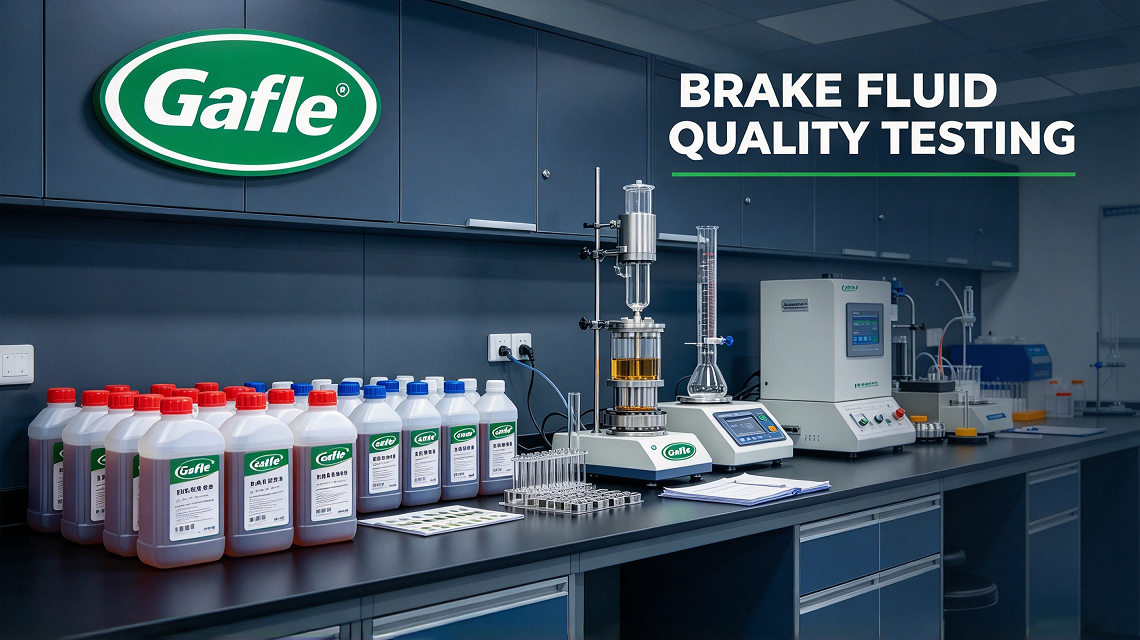
GAFLE's corporate website also describes controlled manufacturing, laboratory testing, and quality-management certifications. Importers should request current certificates showing scope and validity, plus the individual product's technical file. A supplier-level IATF 16949 or ISO 9001 certificate is valuable for quality-system evaluation, but it is not proof of approval of every brake fluid formula for every vehicle or national standard.
A productive first inquiry includes the target country, dominant vehicle models and model years, desired grade or standard, retail or workshop package, expected trial and annual volumes, and the documents required by the local market.
Request GAFLE DOT 3 / DOT 4 Technical Information →
11. Assess the Manufacturer’s Process, Batch Controls and Quality Records
A B2B buyer is purchasing repeatability. A well-presented sample proves that a supplier can deliver that sample; a well-designed quality system helps establish whether the same product can be produced and supplied consistently through future orders.
Start with incoming materials. How are base fluids and additives identified, approved, received, stored, and protected from contamination? Ask whether there are receiving records, supplier qualification criteria, and a way to prevent incorrect materials from entering a batch.
Next review formula management. A factory selling multiple DOT grades and specialty products must control formulation revisions, batching instructions, transfer lines, and product identification. Discuss how it manages change control, segregation, and cross-contamination prevention.
Move to processing and filling. Brake fluid's sensitivity to moisture and contaminants makes environmental controls especially relevant. Ask how tanks and lines are cleaned, how filling conditions are supervised, and whether the packaging operation can be traced back to a specific production lot.
Finally review laboratory release. Which tests are done on every lot, which are part of periodic validation, and which results are available to customers? Ask for sample COA formats, acceptance rules, retained samples, complaint investigation procedures, and the process used when a result falls outside specification.
GAFLE describes automated manufacturing and clean production conditions in its own manufacturing-quality discussion. These descriptions are useful context. For a purchase decision, the buyer should still ask for the current, project-specific procedures and supporting evidence instead of inferring that a particular manufacturing claim guarantees a particular performance number.
12. OEM and Private Label: Build a Brand Around Verified Coverage
A private-label brake fluid program aimed at Japanese-brand cars should begin with a credible promise: the bottle contains a clearly specified fluid, packaged and tested for defined applications. The brand should not imply Toyota, Honda, Nissan, or another manufacturer's endorsement unless the distributor has explicit authorization and documentary support.
GAFLE states that it provides private-label brake fluid services, including brand and packaging customization. A buyer should clarify which elements can be changed without altering the approved formula, which changes require validation, and which design features are subject to volume or tooling requirements.
A practical private-label launch has several approval gates. First, the buyer selects the technical grade using source documentation. Second, the supplier issues a written specification and sample. Third, the buyer checks the sample and relevant reports. Fourth, both sides approve bottle, closure, label and carton artwork. Fifth, the purchase order locks the formula revision, packaging version, labeling language, shipment requirements, and acceptable quality criteria.
Be careful with expressions such as “Japanese OEM formula,” “genuine Japanese car brake fluid,” or “approved by leading Japanese automakers.” Without the appropriate evidence, these phrases could mislead buyers. Safer and more useful marketing focuses on the actual verified performance grade, manufacturer test documentation, sourcing process and supported vehicle requirements.
For businesses launching a new regional brand, it may be wise to start with a limited number of SKUs before adding specialty variants. This reduces artwork complexity and makes it easier to train sales staff. Expansion can follow documented sales demand, customer feedback, and new model-specific technical opportunities.
Discuss Private Label Packaging With GAFLE →
13. Understand Total Landed Cost Instead of Comparing Bottle Prices Alone
Price matters, but it is not the only cost of a brake-fluid program. The lowest unit price can become an expensive choice if it requires oversized inventory, poorly differentiated labels, shipment corrections, retesting, or replacement of mismatched stock.
Build a landed-cost model with the ex-factory product quotation, bottle and cap, artwork and printing, secondary packaging, testing and required documentation, inland transport, international freight, insurance, import charges, customs processing, and local distribution. Customs and taxes are destination-specific and should be confirmed with the relevant professionals.
The economic effect of MOQ also deserves attention. A supplier may quote a low price for a single large bottle design while a distributor actually needs several region-specific languages and two grades. If the program is split across many packaging versions, the effective minimum purchase for each variation may change. Ask for the quotation by formulation × package × artwork version, not merely by total liters.
Inventory turnover often matters more than a small difference in purchase price. Unsold specialty fluids occupy warehouse space and can add handling and aging risks. High-turnover standard grades need replenishment reliability; slower-moving technical grades may benefit from smaller planned orders where commercially possible.
Before approving a supplier, evaluate likely repeat-order behavior as well: lead-time reliability, customer-service response, document availability, packaging continuity, change-control discipline, and complaint resolution. The goal is a supply program that can be operated without repeated emergency interventions.
14. A Japanese-Car-Focused RFQ That Produces Comparable Quotations
An effective request for quotation should give every supplier the same technical and commercial instructions. Otherwise one factory may quote an ordinary DOT 4 product and another a special low-viscosity product, producing prices that cannot reasonably be compared.
Provide the following information in the RFQ:
- Market and channel: importing country, workshop, retail, wholesale or fleet customer mix.
- Vehicle coverage: most common Japanese makes, models, years and any unusual technical systems.
- Official service requirements: DOT, SAE, JIS, ISO and original manufacturer instructions as applicable.
- Requested products: provisional DOT 3 and DOT 4 SKUs; specialty grades only if supported by demand.
- Required documents: TDS, SDS, test summaries, COA sample, certificates and labeling information.
- Testing expectations: guaranteed limits, test methods, batch inspection and traceability.
- Packaging: bottle size, closure, tamper evidence, label language, carton and pallet requirements.
- Branding: GAFLE brand or private label; approved artwork and trademark restrictions.
- Volumes: sample quantities, first order, yearly forecast and likely reorder frequency.
- Commercial terms: destination, requested Incoterm, target timeline and payment discussion.
- Acceptance rules: sampling, nonconformity handling, replacement or corrective-action process.
- Contact details: technical reviewer and purchasing decision-maker.
This structure makes supplier comparison far more reliable. It also lets GAFLE's team review the inquiry with enough context to propose an appropriate product and documentation package rather than guessing which grade your market wants.
Copy-ready RFQ example
Subject: RFQ — Japanese Car Brake Fluid DOT 3 / DOT 4 for [Destination Market]
We are an automotive aftermarket importer supplying workshops that service Toyota, Honda, Nissan and other Japanese-brand vehicles in [country]. We would like to evaluate DOT 3 and DOT 4 brake-fluid products for our documented vehicle coverage. Please provide applicable TDS/SDS, current standards evidence, available packaging options, trial-order MOQ, production lead-time quotation, sample arrangements, batch COA information and private-label conditions. Our initial order estimate is [quantity] and our anticipated annual requirement is [volume]. We will send our model-specific service-specification list for technical review before final product approval.
15. Common Sourcing Mistakes That Put Japanese-Vehicle Programs at Risk
Mistake 1: Describing one grade as suitable for every Japanese brand. A Toyota service publication is not a Honda or Nissan approval. Validate individual models and markets.
Mistake 2: Choosing only by the highest dry boiling point. Wet ERBP, cold viscosity, corrosion behavior, compatibility, and actual vehicle requirements can be equally relevant.
Mistake 3: Treating DOT 4 LV as another official FMVSS DOT grade. LV is a product descriptor. Ask for the actual grade, standard, class and measured data.
Mistake 4: Assuming JIS compliance from a DOT label. Request the relevant JIS K 2233 claim and supporting technical evidence if required for the project.
Mistake 5: Treating DOT 3 and DOT 4 mixing as a universal right. Some vehicle documents carry explicit restrictions. Follow the manufacturer's applicable instruction.
Mistake 6: Accepting factory quality-system certification as vehicle approval. Product performance claims must be verified at the correct formulation and SKU level.
Mistake 7: Using a universal bottle label across all destination markets. Local language, product safety, hazardous-substance, and import rules may differ.
Mistake 8: Failing to define bottle and seal acceptance. A moisture-sensitive product requires disciplined packaging control and storage instructions.
Mistake 9: Overloading the initial assortment. Too many low-turnover packages can reduce cash flow and make sales training harder.
Mistake 10: Quoting without an approved technical specification. Fix the formula, test criteria, packaging, artwork and document revision before production.
16. Frequently Asked Questions About Japanese Car Brake Fluid
FAQ 1. What brake fluid do Japanese cars use?
There is no single grade for every Japanese car. Depending on the model, year, market and brake system, the manufacturer may specify DOT 3, DOT 4 or a more particular fluid requirement. Always use the relevant owner’s or service manual, not a brand-wide marketing chart.
FAQ 2. Is DOT 3 or DOT 4 better for Toyota, Honda and Nissan?
Neither is universally better across these brands. DOT 4 has higher FMVSS minimum dry and wet boiling points, but selection still depends on the vehicle manufacturer's instructions. A distributor should maintain a model-specific coverage record and document any stated alternatives or restrictions.
FAQ 3. Can DOT 4 replace DOT 3 in a Japanese vehicle?
Do not assume so solely because DOT 4 has higher minimum boiling requirements. Confirm the exact vehicle manual and system requirements, including any restriction on mixing or substitution. When in doubt, consult the vehicle manufacturer or a qualified service professional.
FAQ 4. What is JIS K 2233 brake fluid?
JIS K 2233 is a Japanese Industrial Standard covering non-petroleum-base automotive brake fluids. Its 2017 edition identifies BF-3, BF-4, BF-5 and BF-6 classifications. A purchaser should verify the applicable edition, claimed class and supplier evidence rather than equating a JIS reference automatically with a specific vehicle approval.
FAQ 5. Do Japanese hybrid vehicles require special brake fluid?
Not universally. Hybrid and electric vehicles may use electronic or integrated braking systems and specific service procedures, but fluid requirements are vehicle-specific. Consult the applicable manual for the grade, viscosity and bleeding instructions before selecting or servicing the vehicle.
FAQ 6. What is the difference between DOT 4 and DOT 4 LV?
DOT 4 is a defined FMVSS performance grade. DOT 4 LV is a market descriptor typically indicating a low-viscosity formulation; it is not an independent FMVSS grade. Check actual low-temperature viscosity measurements and any referenced SAE or ISO class before accepting an LV claim.
FAQ 7. What documents should an importer ask a brake-fluid supplier to provide?
Start with a current TDS, SDS, exact grade and specification declaration, relevant test reports, and a sample COA. For private-label orders, also request batch traceability procedures, sample approval records, packaging specifications, label proofs and applicable quality-system certification details.
FAQ 8. Can GAFLE manufacture private-label brake fluid for Japanese-car aftermarket distributors?
GAFLE publicly offers DOT 3 and DOT 4 products alongside OEM/private-label solutions and packaging customization. For a particular project, buyers should contact the company with target vehicle requirements, desired formula, packaging, expected volume and compliance documents so it can confirm what is available and commercially feasible.
FAQ 9. What affects the wholesale price and MOQ of Japanese Car Brake Fluid?
Factors may include grade, performance requirements, bottle and closure, artwork, carton configuration, testing, order volume, market-specific labels, shipping terms and how many variants are required. Request an itemized quote by SKU and packaging version rather than relying on a general price per bottle.
FAQ 10. How should a distributor choose between competing brake-fluid manufacturers?
Send the same RFQ to each supplier and compare verifiable technical evidence, batch controls, packaging integrity, manufacturing documentation, communication, production terms, complaint handling and landed cost. A lower initial quotation does not outweigh missing product conformity evidence or unresolved application claims.
Conclusion
Japanese Car Brake Fluid should be sourced as a documented product program, not as a universal “fits all Japanese cars” bottle. For importers and aftermarket distributors, the strongest commercial approach is to map the actual Toyota, Honda, Nissan and other vehicle population in the destination market; validate grade requirements through the relevant vehicle manuals; build a focused DOT 3/DOT 4 stock range; and qualify each proposed SKU against credible standards evidence, packaging controls and batch records.
JIS K 2233, FMVSS No. 116, SAE references and product test documents are useful tools, but none replaces the manufacturer's instruction for a specific vehicle. Accurate technical positioning also supports better inventory decisions, more reliable workshop guidance and a clearer private-label brand proposition.
GAFLE offers brake-fluid products and OEM/private-label services that can be assessed as part of this process. Start with its brake fluid product collection, review the DOT3 and DOT407 DOT 4 catalogue entries, and share your target country, vehicle coverage, technical requirements, preferred packaging and expected order volumes through the GAFLE contact page. The next step is not simply to request a price—it is to approve a product and supply specification that your aftermarket business can confidently reorder.