Why brake fluid packaging becomes a shipping issue, not just a storage issue
Brake fluid is one of those products that seems straightforward until it has to cross an ocean. At that point, the chemistry, the packaging, and the transport route all start working against you. A brake fluid package is not only there to hold product; it has to protect a hygroscopic, performance-sensitive fluid from moisture ingress, temperature swings, vibration, and the rough handling that comes with containerized freight.
For sourcing managers and product teams, the real question is not simply how to pack it, but how to keep the fluid stable from filling line to destination. That matters because absorbed moisture can affect performance, shelf life, and ultimately customer trust. A drum that looks intact on arrival can still hide a quality problem if the barrier system was weak during transit.
What makes brake fluid vulnerable in transit
Brake fluid, especially common glycol-based types, has a well-known tendency to absorb water from the surrounding environment. That is normal chemistry, but it becomes a commercial risk when cartons sit in humid ports, containers sweat overnight, or pallets are exposed during transfer.
Sea freight adds a few predictable pressures:
Temperature changes create condensation inside containers.
Humidity at port or on deck can challenge closures and liners.
Long transit times increase the chance of small packaging failures turning into large product losses.
If the packaging is not designed carefully, even a tiny leak path or weak seal can allow moisture to enter over time. That is why many buyers focus not only on the container itself, but on the seal structure, liner compatibility, and secondary barrier layers.
Key packaging features buyers should look for
A stable brake fluid packaging system for export usually combines several protective elements rather than relying on one feature alone. The best choice depends on container size, destination climate, and whether the shipment is full-container load or mixed freight.
Barrier protection at the closure
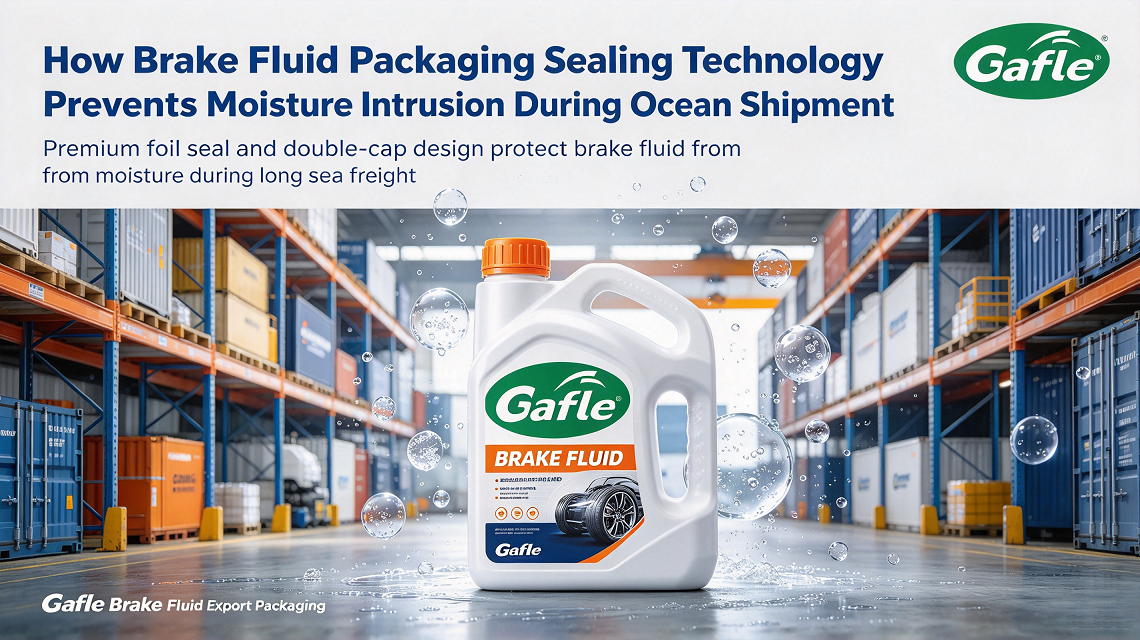
The closure area is often the most overlooked risk point. A brake fluid foil seal for ocean shipping can help reduce moisture exchange and provide a more reliable tamper-evident barrier than a cap alone. In practical terms, the foil layer acts as a defensive skin between the product and the outside environment.
That said, foil sealing only works if the seal application is consistent and the bottle neck, cap, and induction or heat-seal process are compatible. A good barrier on the wrong substrate is still a weak package.
Container and liner selection
The brake fluid package itself may be made from plastic, metal, or composite formats depending on the application. For bulk export, buyers often look for rigid containers with compatible liners and closures that hold up under pressure changes and handling.
If the shipment is destined for marine transport, packaging should be evaluated as a system: bottle or drum, liner, seal, cap, pallet pattern, and outer wrap. One weak link can compromise the whole route.
Outer packaging and pallet stability
Cartons and pallet wrap do more than keep goods neat. They help reduce scuffing, cap movement, and exposure during loading. For stable brake fluid packaging for bulk export, pallet integrity is a real quality issue, not just a logistics detail. A shifted pallet may not damage every unit, but it increases the odds of micro-damage and seal failure.
How to prevent brake fluid moisture during sea transport
Preventing moisture ingress starts before the container is sealed. Good practice usually includes a combination of dry filling conditions, verified closures, appropriate seal design, and shipment planning that avoids unnecessary dwell time at humid terminals.
A few practical cautions are worth keeping in mind:
Do not assume a tight cap is enough. Caps reduce exposure, but they are not always a complete moisture barrier.
Watch the handoff points. Product often spends more time at the dock than anyone wants to admit.
Check compatibility. Some liner or seal materials perform well in one fluid but poorly in another.
Use packaging validation, not guesswork. Simulated transit conditions can reveal weak points before a full export order is at risk.
For buyers, this is where engineering and procurement should sit at the same table. Procurement sees freight cost and carton count; engineering sees barrier performance and closure integrity. Both matter.
What to ask before placing a bulk export order
When evaluating brake fluid packaging for export, buyers should ask a few direct questions:
What moisture barrier is built into the closure?
Has the packaging been considered for humid, long-distance marine routes?
Is the package suitable for palletized bulk export or only domestic distribution?
Are the materials compatible with the specific brake fluid formulation?
What secondary packaging protects the units during container transport?
These questions are practical because they expose whether the supplier is thinking about real logistics conditions or just the fill line.
Common mistakes that cause avoidable loss
The most common mistake is treating brake fluid like a generic industrial liquid. It is not. The second mistake is overconfidence in the cap or carton while ignoring the closure seal. A third is choosing packaging based only on unit cost, then paying more later through claims, rework, or rejected shipments.
Another buyer-facing warning: do not approve a package based solely on appearance. A neat-looking bottle can still be a poor barrier system if the liner, foil, or closure process is under-specified.
FAQ: quick answers for sourcing teams
Is foil sealing always necessary?
Not always, but it is often a strong option when moisture protection matters during long-distance shipping.
Can one package work for all brake fluid routes?
Usually not. Domestic trucking, mixed freight, and ocean export present different risks.
What matters most for ocean shipping?
Barrier integrity, closure consistency, and pallet stability tend to matter more than cosmetic packaging features.
Choosing packaging that protects both product and reputation
For brake fluid exporters, packaging is part of product quality, not a separate concern. The right design reduces moisture risk, supports handling, and gives downstream distributors fewer reasons to complain. The wrong one can turn a routine shipment into a costly quality review.
If you are comparing options, start with the route, the climate, and the closure system. Then test the full package as shipped, not just as assembled. That is usually where the real answer shows up.
Welcome to contact GAFLE for more information & cooperation!
peter
ZHEJIANG GAFLE AUTO CHEMICL CO.,LTD
Tel:86-579-8222 1665
Fax:86-579-8246 4690
Cel/Wechart:86-13335993986
E-mail:peter@gafle.net
Web:www.gafle.net