EV brake fluid: why it deserves more attention than it usually gets
EV brake fluid is easy to overlook because electric vehicles rely so heavily on regenerative braking. That can make the hydraulic system seem less important than it is. In practice, the brake fluid still has to protect calipers, seals, valves, and the master cylinder through heat, moisture exposure, long idle periods, and cold-weather starts. For engineers, sourcing teams, and service operations, the question is not whether the fluid gets used less often. It is whether the fluid specification still fits the way an EV actually brakes.
That matters because EV brake systems tend to see a different duty cycle than conventional vehicles. Friction brakes may be used less frequently, but when they are called on, they still need to respond immediately and consistently. Add to that the torque blending used in modern brake control strategies, and the fluid becomes part of a very particular system: one that may sit for longer periods, then demand crisp hydraulic response on short notice.
What changes in an EV braking system
Regenerative braking reduces wear on pads and rotors, but it does not eliminate the hydraulic circuit. In many EVs, friction braking is still essential for emergency stops, low-speed maneuvering, parking functions, and blended braking transitions. That means the fluid must remain stable even when it is not being cycled as often as in an ICE vehicle.
For that reason, buyers often look closely at electric vehicle brake fluid with an eye toward viscosity, low-temperature response, and compatibility with brake system materials. A fluid that behaves acceptably in a warm shop may feel very different in winter, especially in regions where vehicles are parked outdoors and then asked to move and stop immediately.
Why viscosity and cold-flow behavior matter
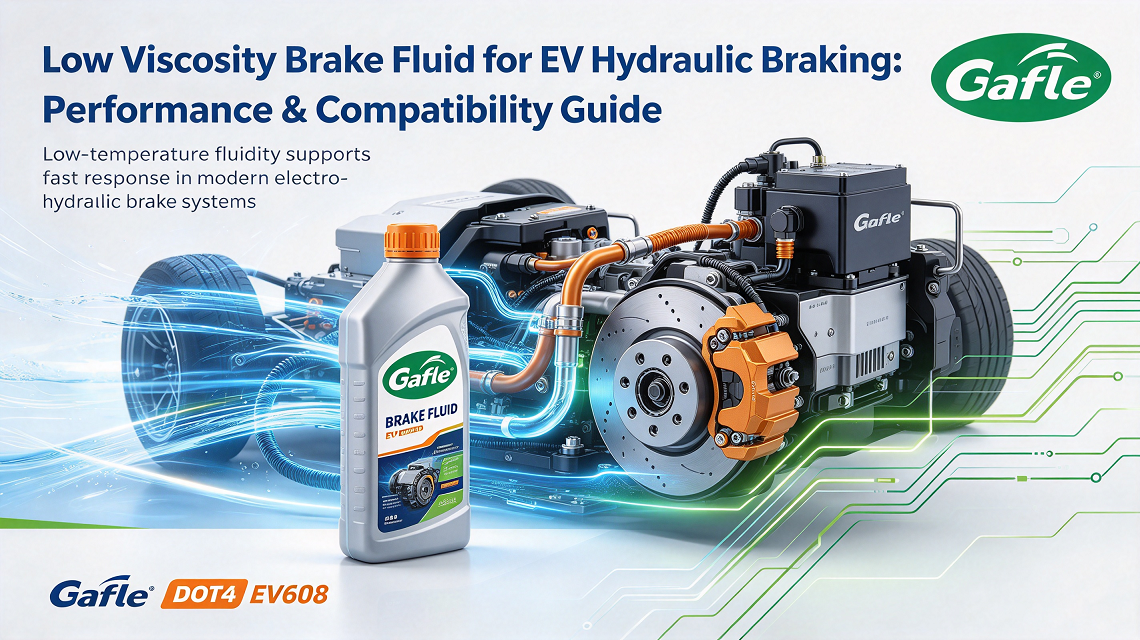
Low viscosity brake fluid is often discussed in the same breath as modern braking electronics because thinner fluids can support faster hydraulic response in systems that depend on precise valve control. In EV applications, this becomes even more relevant in cold conditions. Low temp flow EV brake fluid is not just a marketing phrase; it points to a practical need for the fluid to move quickly enough through narrow passages when temperatures drop.
That does not mean thinner is always better. A sourcing manager should resist the temptation to reduce selection to one data point. The fluid still has to fit the OEM specification, system design, and climate where the vehicle will operate. A fluid that flows well at low temperature but is poorly matched to the vehicle’s materials or service interval can create more problems than it solves. That is the sort of tradeoff that gets missed when buyers focus only on viscosity numbers.
Choosing brake fluid for EV regenerative braking system applications
When evaluating brake fluid for EV regenerative braking system use, start with the vehicle maker’s specification and then examine the real operating environment. Fleet operators in cold regions may prioritize low-temp response. Service centers that support mixed EV and hybrid platforms may need a product range that simplifies stocking without forcing one universal fluid into every job.
It is also worth paying attention to moisture control. Brake fluid naturally absorbs water over time, and a vehicle that uses its friction brakes less often may not get the same heat cycling that helps evaporate moisture. That does not create a reason to ignore replacement intervals; if anything, it strengthens the case for sticking to them. Brake fluid that sits too long can lose performance just when the system is asked to work hardest.
What wholesale buyers and service centers should watch
For wholesale EV brake fluid for auto service centers, stock planning is a little different from stocking fluids for a legacy fleet. Demand may be less predictable by volume, but the cost of using the wrong fluid is high. Mixed vehicle parks, technician turnover, and fast-moving repair bays all increase the risk of confusion. Clear labeling, capped product families, and disciplined storage practices help reduce that risk.
A practical caution: do not assume that because an EV has regenerative braking, any general-purpose brake fluid will do. The hydraulic system remains a safety-critical component. Buyers should confirm compatibility, container integrity, and shelf handling conditions before placing inventory on the rack.
Common mistakes in EV brake fluid selection
Assuming lower brake wear means lower fluid requirements
The brakes may wear more slowly, but the fluid still ages. Less frequent use can actually hide deterioration until a sudden demand reveals it.
Ignoring winter performance
In colder markets, low-temp flow matters as much as nominal specification. A fluid that responds sluggishly in cold weather can affect pedal feel and system response.
Stocking too many near-identical products
Service centers do not need a shelf full of lookalike containers with confusing labels. Simplicity reduces mistakes, especially when teams are busy.
A practical buyer’s checklist
Before purchasing EV brake fluid, confirm the OEM specification, expected operating temperature range, packaging size, storage practices, and service workflow. If the fluid will be used in a wholesale or multi-bay environment, ask whether the product line supports easy identification and consistent replenishment. Those details are mundane, but they matter when a brake job is due and a technician needs the right bottle now, not after a second trip to the stock room.
FAQs about EV brake fluid
Do EVs still need regular brake fluid replacement?
Yes. The hydraulic brake system still uses fluid, and the fluid still ages over time.
Is low viscosity always required?
Not always. It depends on the vehicle’s system design and OEM requirements. Match the specification first, then evaluate viscosity.
Does regenerative braking reduce brake fluid demand?
It can reduce how often the friction brakes are used, but it does not remove the need for a reliable hydraulic medium.
For product teams and buyers, the next step is straightforward: compare the vehicle specification against the operating climate and the service environment, then choose a fluid that fits both. In EV maintenance, the right bottle is the one that keeps the brake system predictable when the vehicle has spent most of its life doing the opposite of stopping.
Welcome to contact GAFLE for more information & cooperation!
peter
ZHEJIANG GAFLE AUTO CHEMICL CO.,LTD
Tel:86-579-8222 1665
Fax:86-579-8246 4690
Cel/Wechart:86-13335993986
E-mail:peter@gafle.net
Web:www.gafle.net