Can You Use Coolant Tap Water? What Engineers and Maintenance Buyers Need to Know
Questions about coolant tap water, come up often in maintenance shops, fleet yards, and plant engineering meetings, usually right after a truck overheats or a cooling circuit starts showing scale. The short answer is that plain tap water may seem harmless, but in many cooling applications it creates avoidable risk: mineral deposits, corrosion, unstable protection levels, and service problems that show up later, not immediately.
This matters because cooling systems are not just about moving heat. They are about protecting metal surfaces, seals, pumps, and radiators over time. If you are deciding what water quality is acceptable for antifreeze dilution, or whether local water can be used in an emergency, the right answer depends on the system design, the water chemistry, and how much margin you want to leave for maintenance.
Why tap water is not a neutral choice
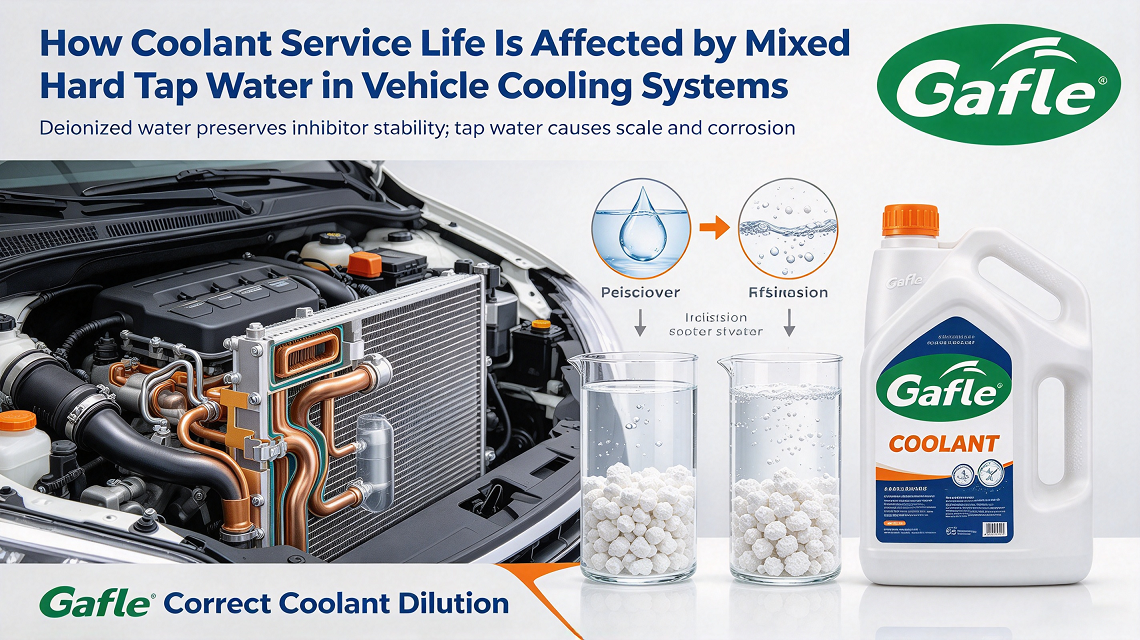
Tap water varies widely by region. Some supplies are moderately soft; others are loaded with calcium, magnesium, chlorides, or other dissolved minerals. In a cooling system, those minerals do not stay politely in suspension forever. Heat, evaporation, and long service intervals can turn them into cooling system scale on hot surfaces and narrow passages.
Scale is only part of the story. Water with higher mineral content can also contribute to corrosion, especially when mixed with coolant in a system that runs for months or years. That is why maintenance teams often ask about hard tap water mixed with coolant rather than just asking whether the mixture will “work.” It will often work in the moment. The question is whether it will keep working without creating hidden damage.
Antifreeze dilution: the chemistry behind the warning
Antifreeze is formulated to do more than lower freezing point. It also carries inhibitors that help protect metals and stabilize the cooling loop. When you dilute it, the water quality matters as much as the ratio. Using poor-quality water can reduce the effectiveness of those inhibitors, and that is one reason people emphasize why you cannot dilute antifreeze with tap water in a blanket way.
That does not mean every tap water source is unacceptable under every condition. In some service environments, technicians use local water in an emergency top-up and then correct the mixture later. But from a buyer’s or plant manager’s point of view, emergency practice is not the same as preferred practice. If the equipment is expensive, difficult to drain, or exposed to heat load for long periods, the safer habit is to control the water used for antifreeze dilution.
Where deionized water fits
Deionized water for coolant mixing is commonly preferred because it minimizes dissolved minerals that can trigger scale and conductivity-related corrosion. In practical terms, it gives coolant formulators and maintenance teams a cleaner starting point. That does not make it magical, and it does not fix a bad coolant choice, but it removes one variable that is hard to manage later.
For OEMs, service centers, and industrial buyers, the decision often comes down to process discipline. If your cooling system is sensitive, if warranty risk matters, or if the equipment sees high thermal cycling, deionized or similarly treated water is usually the more controlled choice. If the system is low-cost and easily serviced, the economics may be different, but the maintenance plan should still be deliberate.
Quick buyer guidance: when tap water is a bad bet
Tap water is more likely to cause trouble when the system has small passages, aluminum components, mixed metals, long service intervals, or a history of overheating. It is also a poor choice when the local supply is known to be hard. The phrase hard tap water mixed with coolant is not just a laboratory concern; it is a field problem that can shorten service life and increase unplanned downtime.
If you are evaluating a plant or fleet standard, ask three simple questions: What is the water quality? How sensitive is the system? How costly is failure? Those answers usually point the decision in one direction faster than a debate about convenience ever will.
Common mistakes maintenance teams make
Assuming “clear” means “clean”
Clear water can still carry enough dissolved minerals to create scale over time. Appearance tells you almost nothing about suitability for coolant mixing.
Using the same water source everywhere
One facility may have acceptable water and another may not. Standardizing on a water source without checking chemistry is a classic shortcut, and not a very good one.
Treating top-up practice as mix design
Emergency top-up is one thing. Filling a system or preparing a coolant blend is another. The standards should not be identical.
Practical decision rule
If you want the conservative answer, do not rely on tap water unless you know its hardness and impurity profile are acceptable for the coolant and the system. For most critical applications, deionized water or another controlled water source is the better route. That is especially true where corrosion, scale, or downtime would cost more than the water treatment itself.
For sourcing teams and maintenance engineers, the real decision is not whether tap water can ever be used. It is whether using it introduces a risk you will later have to clean out of pumps, radiators, and heat exchangers. That cleanup is usually slower and more expensive than choosing the right water up front.
FAQ
Can I use tap water for coolant in an emergency?
Sometimes, as a short-term measure. But it should be treated as temporary and corrected as soon as practical.
Is distilled water always required?
Not always, but controlled low-mineral water is often preferred. The exact requirement depends on the coolant specification and the equipment.
What is the safest default for antifreeze mixing?
If you do not have verified water-quality data, a treated water source such as deionized water is usually the safer default.
If you are setting a maintenance standard or revising a coolant-fill procedure, start with the water source first. It is one of the simplest controls in the system, and one of the easiest to ignore.
Welcome to contact GAFLE for more information & cooperation!
peter
ZHEJIANG GAFLE AUTO CHEMICL CO.,LTD
Tel:86-579-8222 1665
Fax:86-579-8246 4690
Cel/Wechart:86-13335993986
E-mail:peter@gafle.net
Web:www.gafle.net