logo

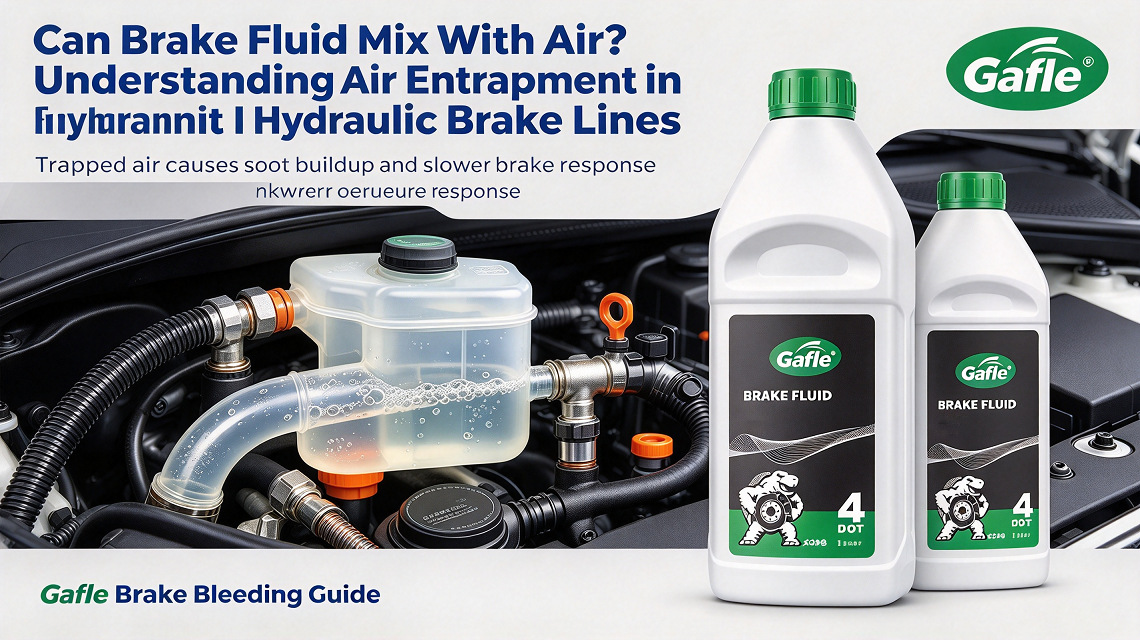
Can Brake Fluid Mix With Air? Understanding Air Entrapment in Hydraulic Brake Lines

logo

Published

Oct 13 2026

  • Buying Guide

Follow us

can-brake-fluid-mix-with-air-understanding-air-entrapment-in-hydraulic-brake-lines
air in brake line
Air and brake fluid behave completely differently in a hydraulic brake system, and trapped air is one of the most frequent causes of spongy brake pedals. Brake fluid is nearly incompressible. When you press the brake pedal, pressure transfers instantly through liquid to push caliper pistons. Air, however, is highly compressible. Any air bubbles trapped inside brake lines will compress when applying brakes. Pedal travel becomes longer and softer, delaying brake pressure build-up and increasing stopping distance. Unlike moisture contamination, air issues often appear immediately after brake service work.
The common ways air enters the closed brake hydraulic circuit.
The most frequent source is improper brake fluid replacement or bleeding procedures. When reservoirs run dry during fluid exchange, air gets sucked into the master cylinder. Damaged, cracked flexible brake hoses can also draw air inward during pedal release, even if there is no obvious external fluid leak. After brake line disassembly, caliper replacement or master cylinder overhaul, the sealed circuit opens up, introducing air into the whole hydraulic network. In rare cases, worn master cylinder seals allow air ingress inside the cylinder.
Distinguish air bubbles from moisture in brake fluid.
Many technicians confuse these two problems. Trapped air causes sudden soft pedal after repair, and performance can return fully after proper bleeding. Moisture absorption happens slowly over months or years; water lowers boiling point and causes vapor lock under heavy braking. Vapor bubbles form only at high temperature, and the spongy feeling comes and goes depending on brake heat. Correct diagnosis matters: bleeding removes air, but cannot remove dissolved water, which requires full fluid flush.
Challenges of air bleeding for modern vehicles with ABS/ESC modules.
Older vehicles with simple hydraulic systems use gravity bleeding or manual pedal bleeding easily. Newer cars with integrated electronic brake control units hold air trapped inside valve chambers. Standard gravity bleeding often fails to purge air completely. Some vehicle models require scan-tool activated automated bleeding cycles to cycle internal solenoids and release hidden air pockets. Workshops need to follow OEM service procedures to finish bleeding correctly.
Advice for auto parts distributors to support your garage clients.
You can share professional bleeding tips together with your brake fluid sales. Remind technicians never to let the master cylinder reservoir run empty during fluid exchange. Recommend full system flush rather than simple topping up. Gafle brake fluid works well with all standard and automated brake bleeding workflows. Educating customers reduces service errors and helps your buyers deliver safer brake repairs to vehicle owners.
Welcome to contact GAFLE for more information & cooperation!
peter
ZHEJIANG GAFLE AUTO CHEMICL CO.,LTD
Tel:86-579-8222 1665
Fax:86-579-8246 4690
Cel/Wechart:86-13335993986
E-mail:peter@gafle.net
Web:www.gafle.net
Featured Blogs
Windshield Washer Fluid Guide: Choosing the Right Formula

Windshield Washer Fluid Guide: Choosing the Right Formula

1. Why windshield washer fluid deserves more attention than it gets 2. What buyers are really comparing 3. Common formulation types and how they differ 4. Selection criteria that matter in the real world 5. Buying mistakes that lead to complaints 6. Practical advice for sourcing managers and product teams 7. Quick FAQ 8. What to do next

EV Brake Fluid: What Buyers and Service Teams Should Know

EV Brake Fluid: What Buyers and Service Teams Should Know

1. EV brake fluid: why it deserves more attention than it usually gets 2. What changes in an EV braking system 3. Why viscosity and cold-flow behavior matter 4. Choosing brake fluid for EV regenerative braking system applications 5. What wholesale buyers and service centers should watch 6. Common mistakes in EV brake fluid selection 7. A practical buyer’s checklist 8. FAQs about EV brake fluid

Coolant Tap Water: What You Need to Know Before Mixing

Coolant Tap Water: What You Need to Know Before Mixing

1. Can You Use Coolant Tap Water? What Engineers and Maintenance Buyers Need to Know 2. Why tap water is not a neutral choice 3. Antifreeze dilution: the chemistry behind the warning 4. Where deionized water fits 5. Quick buyer guidance: when tap water is a bad bet 6. Common mistakes maintenance teams make 7. Practical decision rule 8. FAQ

Brake Fluid OEM Sourcing: What Buyers Should Check First

Brake Fluid OEM Sourcing: What Buyers Should Check First

1. Why brake fluid OEM sourcing deserves more attention than it usually gets 2. What buyers should look for first 3. How brake fluid OEM compares with other private-label chemical programs 4. Quality inspection: what can go wrong and where to catch it 5. Selection criteria that actually affect long-term performance 6. Common mistakes buyers still make 7. FAQ for sourcing teams 8. A practical next step

Coolant Selection Guide: Corrosion, Electrolysis, and System Life

Coolant Selection Guide: Corrosion, Electrolysis, and System Life

1. What coolant really has to do in an engine or industrial system 2. Coolant versus antifreeze: useful distinction, but not the whole story 3. Why corrosion control is the part buyers should not skim past 4. Coolant electrolysis risks in mixed-metal systems 5. What good coolant selection looks like in practice 6. Where heavy-duty formulations fit 7. Common buyer mistakes that cost more later 8. Buyer checklist before you source coolant 9. Final practical note for engineering and procurement teams

Brake Fluid Packaging for Ocean Shipping: How to Prevent Moisture Damage

Brake Fluid Packaging for Ocean Shipping: How to Prevent Moisture Damage

1. Why brake fluid packaging becomes a shipping issue, not just a storage issue 2. What makes brake fluid vulnerable in transit 3. Key packaging features buyers should look for 4. How to prevent brake fluid moisture during sea transport 5. What to ask before placing a bulk export order 6. Common mistakes that cause avoidable loss 7. FAQ: quick answers for sourcing teams 8. Choosing packaging that protects both product and reputation