Why territory protection matters in distributor relationships
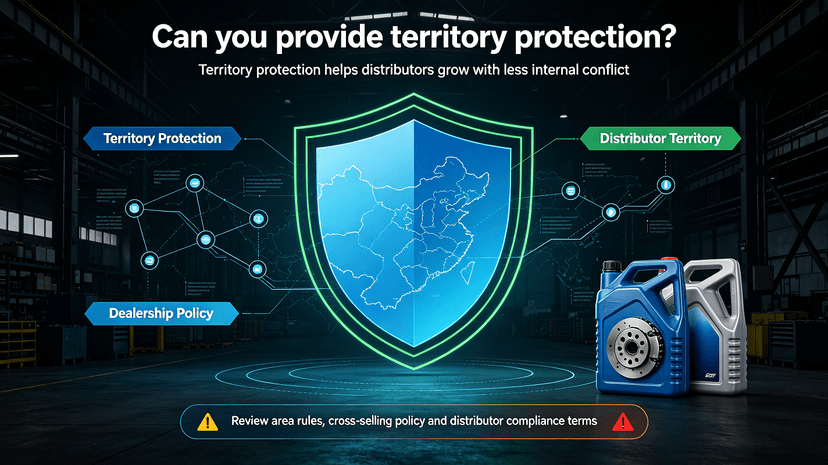
Territory protection is one of those commercial terms that sounds simple until a distributor starts investing in inventory, local sales calls, and service support. At that point, the question becomes practical: who gets to sell where, and what happens when two channels start reaching for the same customer? For manufacturers, the issue is about market coverage and control. For distributors, it is about protecting the time and money spent building demand in a defined area. If the boundaries are vague, the relationship usually gets tense faster than anyone expected.
In manufacturing and industrial supply, this is not just a contract detail. It affects pricing discipline, channel conflict, and how quickly a product can gain traction in a region. A distributor who believes an account is protected will usually work harder on promotion, stock planning, and technical support. Without that confidence, the incentive drops. Buyers on the manufacturer side should treat territory protection terms for distributorship as a commercial design problem, not a legal afterthought.
What territory protection actually does
At its core, territory protection defines the geographic area, customer segment, or account list a distributor can serve without interference from another appointed partner or direct sales team. In some programs, the protection is strict and bounded by postal codes, counties, or countries. In others, it is looser and tied to market segments, OEM accounts, or project-based opportunities. The structure depends on the product and the sales model.
For industrial consumables and vehicle service products, the logic is often straightforward. A distributor that holds a territory is expected to stock the product, support customers, and grow local share. If the product line includes items such as Brake fluid or Coolant, the channel may also need to handle replenishment cycles, shelf-life management, and basic technical questions. Those details matter because they influence how much value the distributor actually brings beyond order taking.
Common forms of territory protection
Geographic exclusivity
This is the classic model. A distributor receives rights for a defined region and is protected from other appointed distributors in that same area. It is easy to understand, which is one reason buyers like it. The drawback is that geography does not always match real sales behavior. Larger customers may buy across regional lines, and digital quoting can blur old boundaries quickly.
Account-based protection
Some manufacturers protect named accounts instead of a map boundary. This can work well when the buyer list is known and stable. It is less useful in fragmented markets where prospects appear and disappear through project bidding or aftermarket demand.
Segment or application protection
A distributor may be assigned a class of business rather than a place. For example, a partner might handle fleet service channels while another covers retail auto supply. This model can reduce conflict, but only if the rules are written clearly enough that both sides understand where the line is drawn.
What manufacturers should define before signing
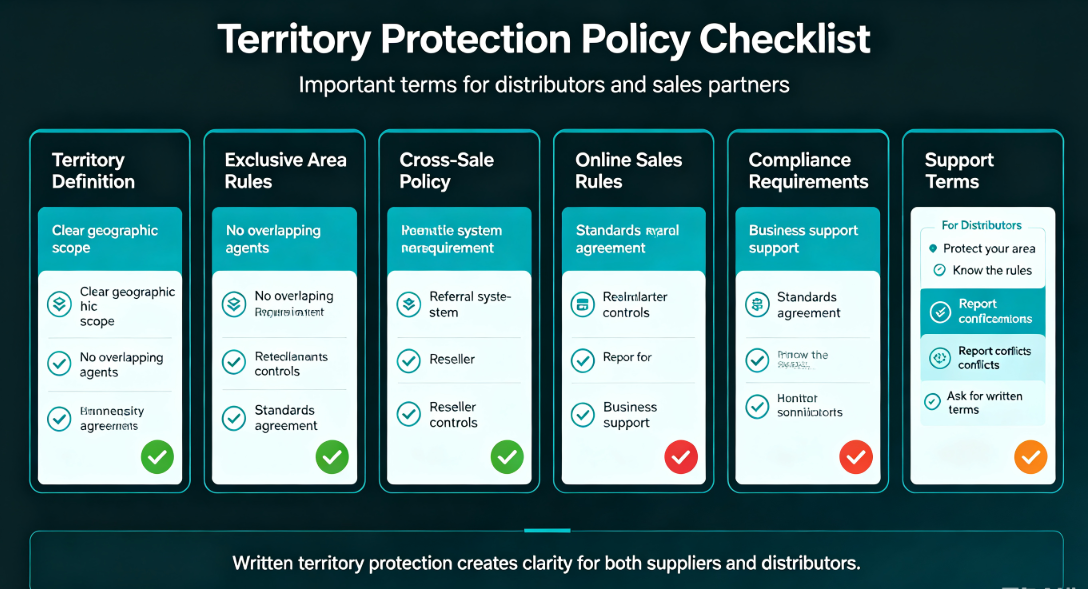
Clear territory protection depends on the fine print. A strong agreement usually answers questions that people forget to ask during the first enthusiastic meeting. Is the territory exclusive or merely preferred? Are house accounts excluded? Can direct sales bypass the distributor for strategic customers? What happens if the distributor fails to meet basic sales or service expectations? Those are uncomfortable questions, but they are cheaper to answer upfront than after a channel dispute.
Manufacturers should also decide whether online sales, cross-border inquiries, and multi-branch customers are included or exempt. If a distributor is asked to support local stock, aftersales service, and market development, the agreement should reflect that effort. Vague promises create resentment. Overly rigid promises can trap a manufacturer in a poorly performing region. The best agreements usually preserve some room for adjustment, even if that makes them less glamorous on paper.
What distributors should look for
Distributors should ask whether the protected area is meaningful in commercial terms, not just attractive on a map. A large territory with weak demand can be less valuable than a smaller area with repeat buyers and stable margins. They should also check whether the manufacturer has other channels active nearby, whether pricing is controlled, and whether the brand has enough support to justify field investment.
Another practical point: if the product needs education, handling discipline, or application support, the distributor should understand who pays for that work. Territory protection is often expected to reward that effort, but the mechanism is not automatic. If the manufacturer can sell directly into the same region after the distributor has built awareness, the arrangement may look balanced on paper and unfair in practice.
Common mistakes in territory arrangements
One frequent mistake is confusing exclusivity with success. Exclusive rights do not guarantee sales. They only define who has the chance to earn them. Another mistake is setting boundaries that do not reflect real purchasing patterns. A sales director may enjoy a neat regional chart, but customers rarely follow neat charts.
Another issue is failing to write down how exceptions work. Every channel has exceptions, but if they are left informal, they turn into arguments. Buyers should also avoid agreements that rely entirely on trust without performance review. Good territory protection terms for distributorship usually include review points, clear sales expectations, and a process for resolving overlap before it becomes a broken relationship.
Practical buyer advice
If you are evaluating a distribution deal, start with three questions: what exactly is protected, what is excluded, and what happens if the market changes? Then look at the product mix. For consumable lines like Brake fluid and Coolant, the commercial logic may depend on inventory turns and local technical support. That changes the value of the territory compared with a one-time capital item.
It also helps to ask how the manufacturer plans to manage future growth. A territory that looks generous today may be sliced differently later if the brand expands. That is not necessarily unfair, but it should be visible in the agreement. Surprises are expensive in channel business.
FAQ: short answers buyers ask most often
Is territory protection the same as exclusivity?
Not always. Territory protection may mean preferred or first-right access, while exclusivity usually means no other appointed distributor can sell there. The contract should say which one applies.
Can a manufacturer still sell directly?
Sometimes yes. Many agreements allow direct sales to strategic or house accounts. The key is to define those exceptions early.
Does a bigger territory always help?
No. A large area without demand, logistics support, or brand pull can be harder to defend than a smaller, focused region.
What to do next
Before finalizing any distributorship, review the territory protection language alongside pricing, service obligations, and sales channel rules. If the product depends on frequent replenishment or technical guidance, the territory structure should support that reality rather than fight it. For both manufacturers and distributors, the goal is not just to assign a map. It is to build a channel that can actually work without constant friction.
Welcome to contact GAFLE for more information & cooperation!
peter
ZHEJIANG GAFLE AUTO CHEMICL CO.,LTD
Tel:86-579-8222 1665
Fax:86-579-8246 4690
Cel/Wechart:86-13335993986
E-mail:peter@gafle.net
Web:www.gafle.net