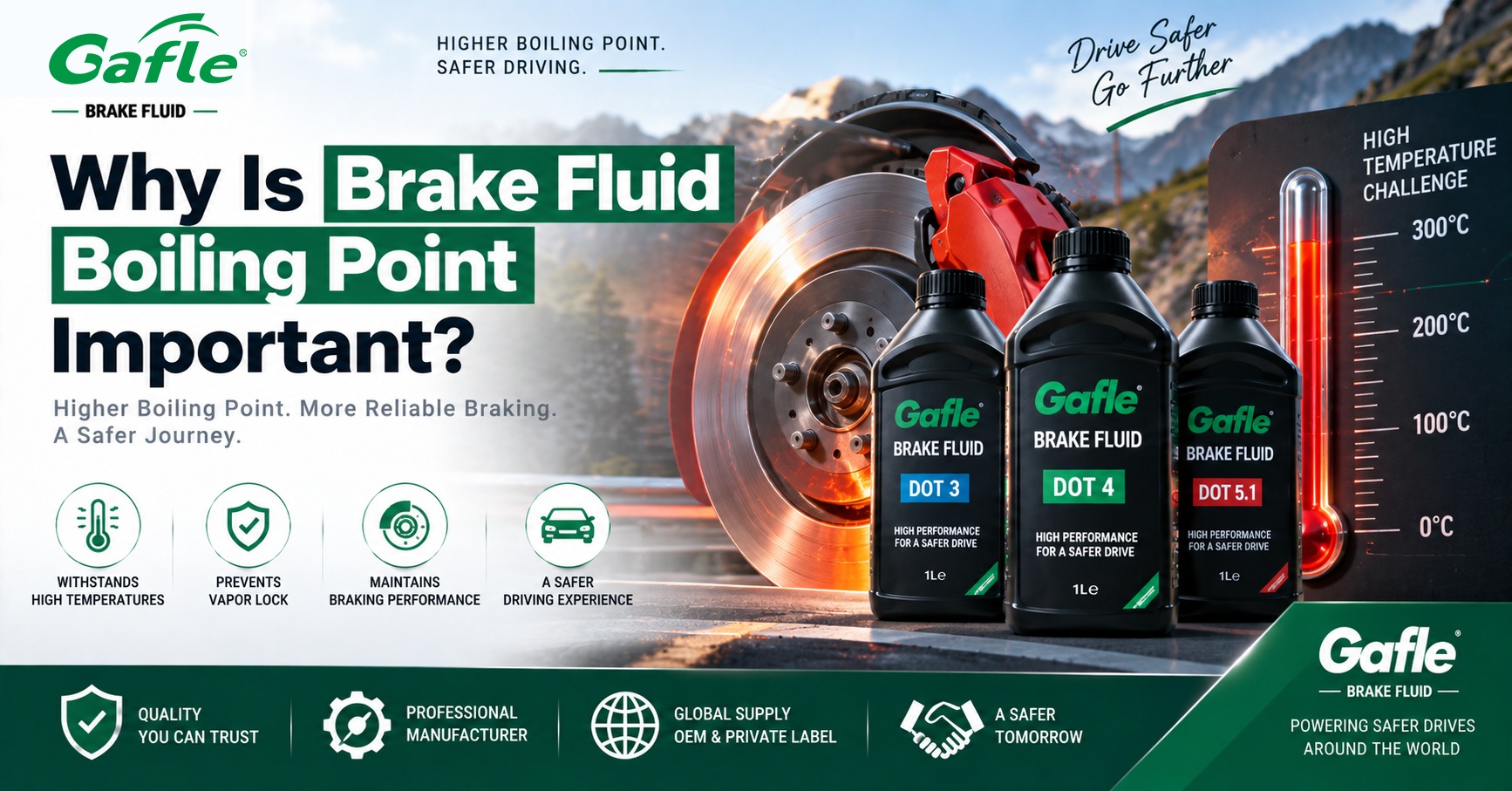
 Why Is Brake Fluid Boiling Point Important?
When it comes to vehicle safety, few components are as critical as the braking system. Every time you press the brake pedal, brake fluid transfers hydraulic pressure from the master cylinder to the brake calipers, allowing the vehicle to slow down safely. However, during heavy braking, this hydraulic fluid is exposed to extremely high temperatures.
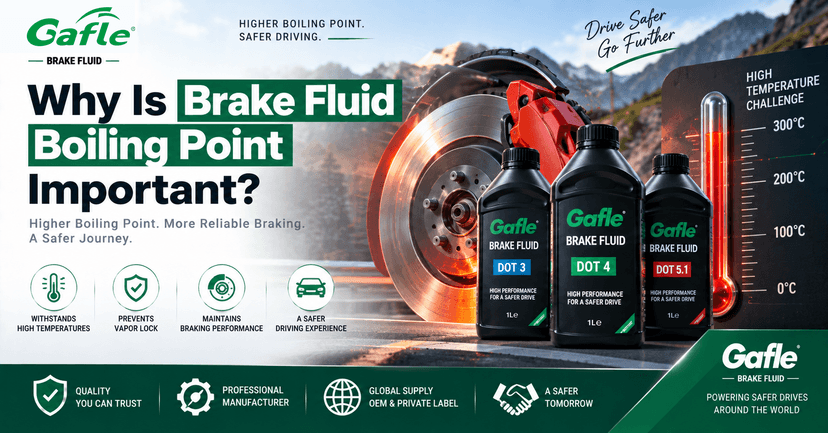
One of the most important indicators of brake fluid performance is its Brake Fluid Boiling Point. A brake fluid with a higher boiling point can better withstand heat, helping maintain stable braking performance under demanding driving conditions.
As a professional Brake Fluid Manufacturer, Gafle has more than 20 years of dedicated manufacturing experience, supplying premium brake fluid products to OEM customers, distributors, and automotive brands worldwide. In this guide, we'll explain why the brake fluid boiling point matters, how it affects braking safety, and what buyers should look for when selecting high-quality brake fluid.
What Is Brake Fluid Boiling Point?
The Brake Fluid Boiling Point is the temperature at which brake fluid begins to boil.
Brake fluid must remain in liquid form because liquids efficiently transfer hydraulic pressure throughout the braking system. If the fluid boils, vapor bubbles can form, reducing the system's ability to transmit pressure effectively.
Manufacturers typically measure two important boiling point values:
Dry Boiling Point
The dry boiling point refers to the boiling temperature of fresh brake fluid before it has absorbed moisture.
It represents the maximum thermal performance of new brake fluid.
Wet Boiling Point
Brake fluid naturally absorbs moisture during service because it is hygroscopic.
The wet boiling point measures brake fluid after it has absorbed a specified amount of moisture, providing a more realistic indication of long-term performance.
Both values are important for evaluating brake fluid quality.
Why Does Boiling Point Affect Braking Performance?
The braking system converts a vehicle's kinetic energy into heat.
Under demanding driving conditions such as:
- Long downhill roads
- Mountain driving
- Heavy commercial vehicle operation
- Repeated emergency braking
- High-performance driving
- Stop-and-go traffic
brake temperatures can increase significantly.
If brake fluid reaches its boiling point, vapor bubbles may develop inside the hydraulic system.
Because vapor is compressible while liquid brake fluid is not, hydraulic pressure may become less effective, reducing braking performance.
Maintaining a high Brake Fluid Boiling Point helps minimize this risk.
Understanding Vapor Lock
One of the primary reasons boiling point is so important is the risk of vapor lock.
When brake fluid boils:
- Vapor bubbles form inside the brake lines.
- Hydraulic pressure becomes less efficient.
- Brake pedal feel may become softer.
- Braking response can become less consistent.
Using high-quality brake fluid with a higher boiling point helps reduce the likelihood of vapor formation under demanding operating conditions.
Why High Temperature Brake Fluid Matters
Modern vehicles often operate under more demanding conditions than ever before.
Premium High Temperature Brake Fluid offers several important advantages.
Better Heat Resistance
A higher boiling point allows the brake fluid to maintain stable hydraulic performance during repeated braking.
More Consistent Braking
Stable hydraulic pressure contributes to predictable braking response, especially during demanding driving conditions.
Improved Safety Margin
High-temperature brake fluid helps reduce the possibility of vapor lock during heavy braking.
Longer Performance Stability
High-quality formulations are designed to maintain reliable performance throughout their service life when maintained according to the vehicle manufacturer's recommendations.
DOT 3 vs DOT 4 Brake Fluid
One common question is whether DOT 4 Brake Fluid offers advantages over DOT 3.
In general:
DOT 3 Brake Fluid
- Suitable for many standard passenger vehicles
- Reliable for everyday driving
- Meets established braking performance requirements
DOT 4 Brake Fluid
- Higher minimum dry and wet boiling point requirements than DOT 3
- Better suited for vehicles operating under higher thermal loads
- Commonly used in modern passenger vehicles, SUVs, and light commercial vehicles
Always use the brake fluid specification recommended by the vehicle manufacturer.
How Gafle Ensures High Boiling Point Performance
At Gafle, product performance begins with professional manufacturing and rigorous quality control.
Our production process focuses on delivering stable, high-performance brake fluid through:
Premium Raw Materials
Carefully selected raw materials contribute to consistent product quality and thermal stability.
Advanced Laboratory Testing
Every production batch undergoes comprehensive laboratory testing, including:
- Dry boiling point testing
- Wet boiling point testing
- Low-temperature viscosity testing
- Corrosion resistance testing
- Material compatibility testing
- Product stability verification
Strict Quality Management
Our manufacturing system follows the IATF 16949 Quality Management System, helping ensure consistent production and continuous improvement.
Modern Manufacturing Facilities
Advanced production equipment and standardized manufacturing procedures help maintain stable product quality across every batch.
Why Boiling Point Matters for OEM Customers
For OEM and private label customers, brake fluid performance directly affects brand reputation.
A high-quality brake fluid with reliable boiling point performance helps provide:
Consistent Product Quality
Stable formulations improve batch-to-batch consistency.
Better Customer Confidence
Reliable braking performance supports stronger customer satisfaction and brand trust.
Reduced Product Risk
Comprehensive testing helps verify performance before products reach the market.
Long-Term Business Success
Reliable product quality supports lasting partnerships between manufacturers and customers.
How to Choose the Best Brake Fluid Manufacturer in China
Many international buyers searching for the Best Brake Fluid Manufacturer in China understand that product quality depends on much more than competitive pricing.
When evaluating manufacturers, consider:
- Manufacturing experience
- Brake Fluid Boiling Point performance
- Professional laboratory testing
- Quality management systems
- Modern production facilities
- OEM manufacturing capability
- Private label solutions
- Stable production capacity
- Export experience
- Long-term technical support
Choosing a manufacturer with strong technical capabilities helps improve product quality while reducing sourcing risks.
Why Global Customers Choose Gafle
As a trusted Brake Fluid Manufacturer, Gafle provides premium brake fluid solutions for distributors, importers, and automotive brands around the world.
Our strengths include:
- 20+ Years of Dedicated Brake Fluid Manufacturing Experience
- High-Performance DOT 3, DOT 4, and DOT 5.1 Brake Fluid
- Professional Laboratory Testing
- Modern Manufacturing Facilities
- Advanced Brake Fluid Quality Control
- IATF 16949 Quality Management System
- OEM Brake Fluid Manufacturing
- Private Label Solutions
- Customized Bottles, Labels, and Cartons
- Stable Large-Scale Production
- Global Export Experience
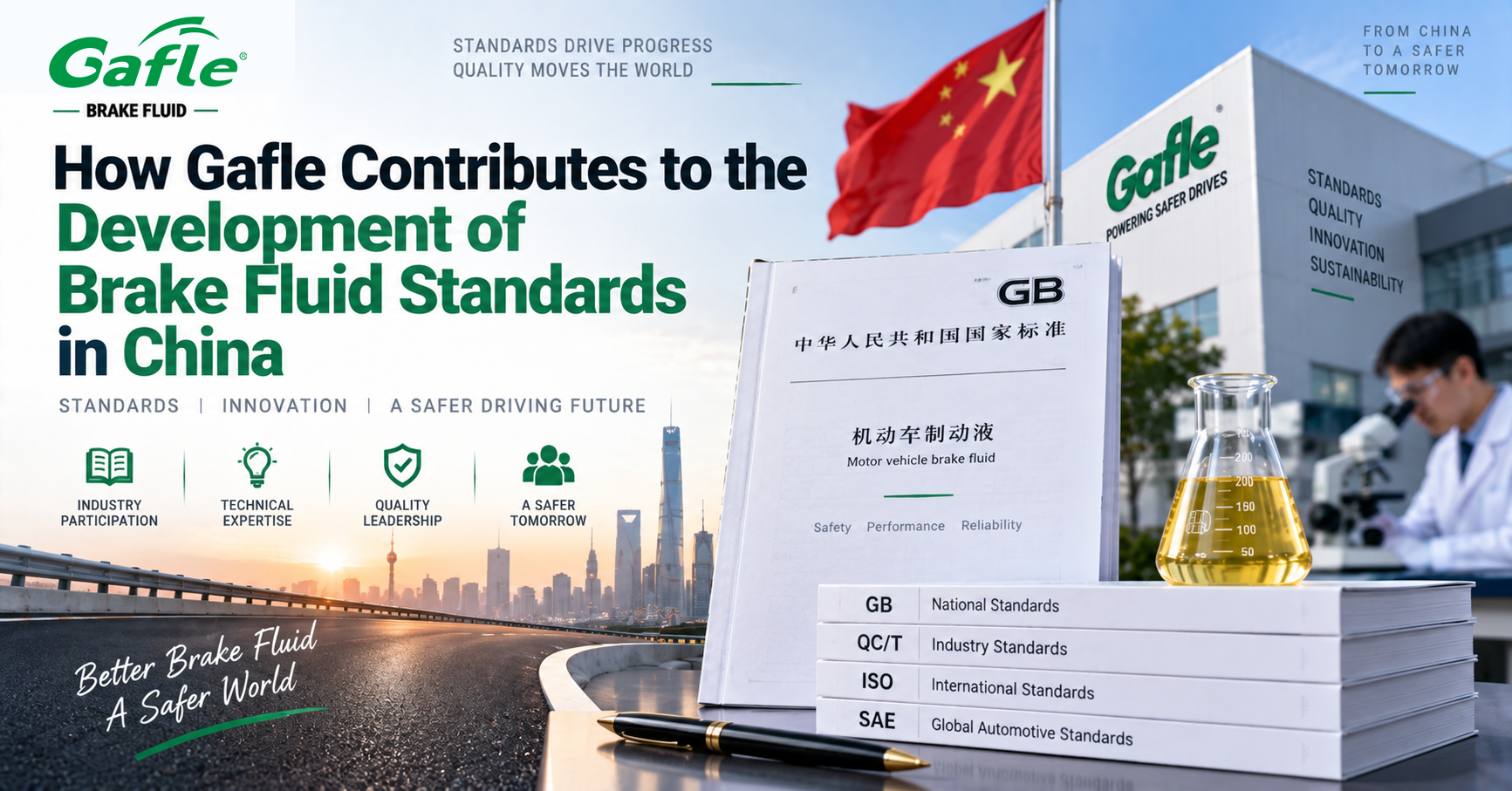
- Participation in Drafting China's National Brake Fluid Standards
These capabilities enable us to deliver reliable products that meet the needs of customers across global markets.
Frequently Asked Questions
What is the brake fluid boiling point?
The brake fluid boiling point is the temperature at which brake fluid begins to boil. Manufacturers typically measure both dry boiling point (new fluid) and wet boiling point (after moisture absorption).
Why is a higher boiling point important?
A higher boiling point helps the brake fluid remain in liquid form under high temperatures, reducing the risk of vapor formation and supporting more consistent braking performance.
What is the difference between dry and wet boiling points?
The dry boiling point measures new brake fluid before moisture absorption, while the wet boiling point measures brake fluid after it has absorbed a controlled amount of moisture to simulate real-world use.
Is DOT 4 better for high-temperature driving?
DOT 4 brake fluid generally has higher minimum dry and wet boiling point requirements than DOT 3, making it suitable for many vehicles that operate under higher thermal loads. Always follow the vehicle manufacturer's recommendations.
How should buyers choose the Best Brake Fluid Manufacturer in China?
Buyers should evaluate manufacturing experience, laboratory testing capabilities, boiling point performance, quality management systems, OEM services, production consistency, export experience, and long-term technical support rather than focusing only on price.
Conclusion
The Brake Fluid Boiling Point is one of the most important indicators of brake fluid performance. A higher boiling point helps brake fluid maintain stable hydraulic pressure under demanding conditions, reducing the risk of vapor lock and supporting safer, more consistent braking.
Whether for everyday driving, commercial vehicles, or high-performance applications, selecting a premium High Temperature Brake Fluid and maintaining it according to the manufacturer's recommendations are essential for reliable braking performance.
For distributors, importers, and automotive brands searching for the Best Brake Fluid Manufacturer in China, partnering with an experienced manufacturer that combines advanced laboratory testing, strict quality management, modern production facilities, and comprehensive OEM capabilities is key to long-term success.
With more than 20 years of dedicated manufacturing experience, Gafle continues to provide premium brake fluid products, customized OEM solutions, and dependable manufacturing support to customers worldwide.
At Gafle, we believe that a higher boiling point is more than a technical specification—it is a commitment to safer braking, reliable performance, and lasting customer confidence.