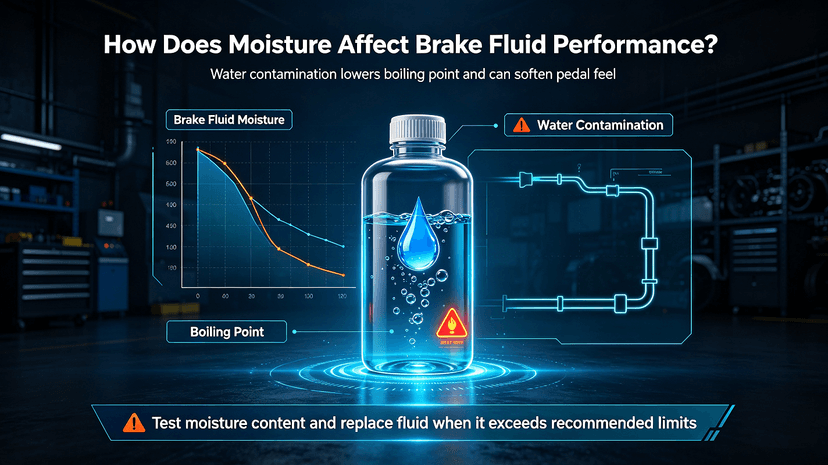
Why moisture in brake fluid deserves attention
Moisture in brake fluid is one of those maintenance issues that hides in plain sight. The pedal may still feel normal for a while, the reservoir may look clean enough, and the car may pass casual inspection. But brake fluid is hygroscopic in most common passenger-vehicle systems, which means it absorbs water over time. That absorbed water changes the fluid’s behavior in ways that matter during hard stops, long downhill braking, towing, or any situation where the system runs hot.
For engineers, sourcing teams, and maintenance planners, the real issue is not just contamination. It is what that contamination does to the brake system’s margin of safety. A fluid with rising water content usually has a lower boiling point, more corrosion risk, and less predictable performance after repeated heat cycles. If you are deciding when to service a fleet, specify a fluid type, or set a maintenance interval, this is the question worth answering first.
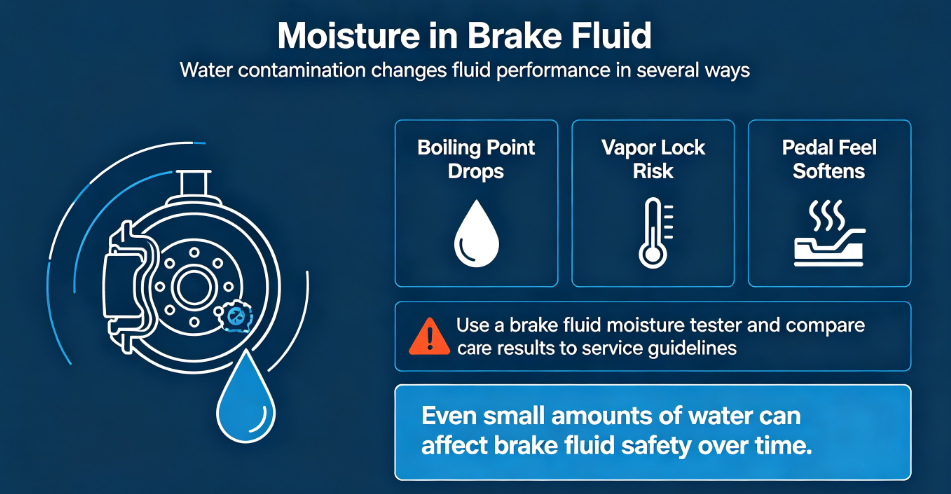
What water does inside the brake system
Water enters brake fluid gradually through vented reservoirs, hoses, seals, and during service events when the system is opened. Over time, water in brake fluid can collect throughout the circuit rather than staying in one place. That matters because brake systems do not heat evenly. Calipers, wheel cylinders, and long descents can create hot spots where the water content has the most noticeable effect.
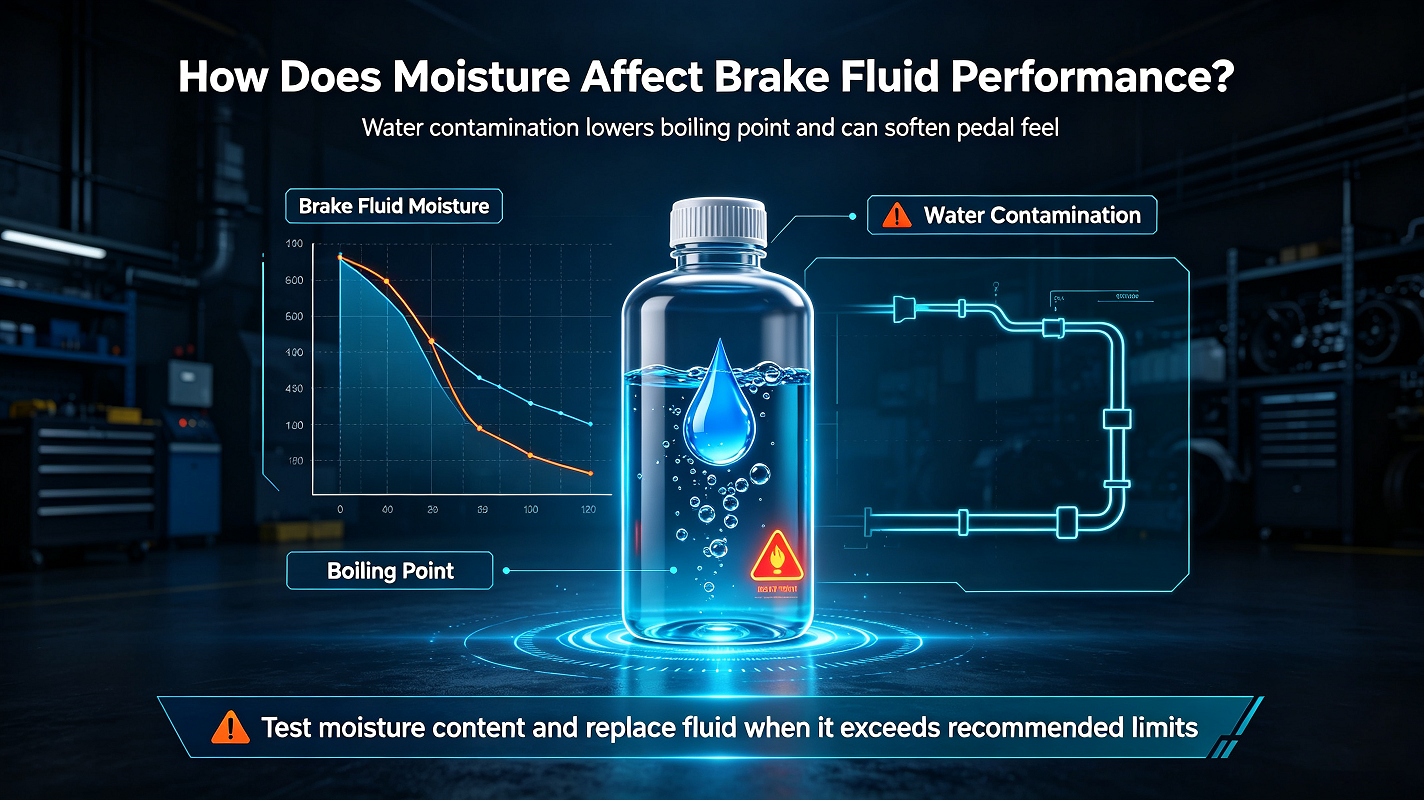
The most familiar consequence is a drop in boiling point. Brake fluid is designed to withstand heat, but moisture lowers that thermal headroom. Under severe braking, any water present can vaporize and create compressible gas pockets. The pedal can soften, travel farther, or fade unexpectedly. That is the practical answer to how moisture affects brake fluid performance: it reduces consistency right when the driver needs the system to remain firm and predictable.
Boiling point, fade, and real-world performance
The boiling point is not an abstract lab number. It is a useful proxy for whether the fluid can survive the thermal load the system will actually see. Fresh fluid is formulated to resist boiling, but as it ages and absorbs water, that margin shrinks. In everyday commuting, this may never be obvious. In stop-and-go delivery work, mountain driving, performance use, or heavy loads, the difference can become noticeable.
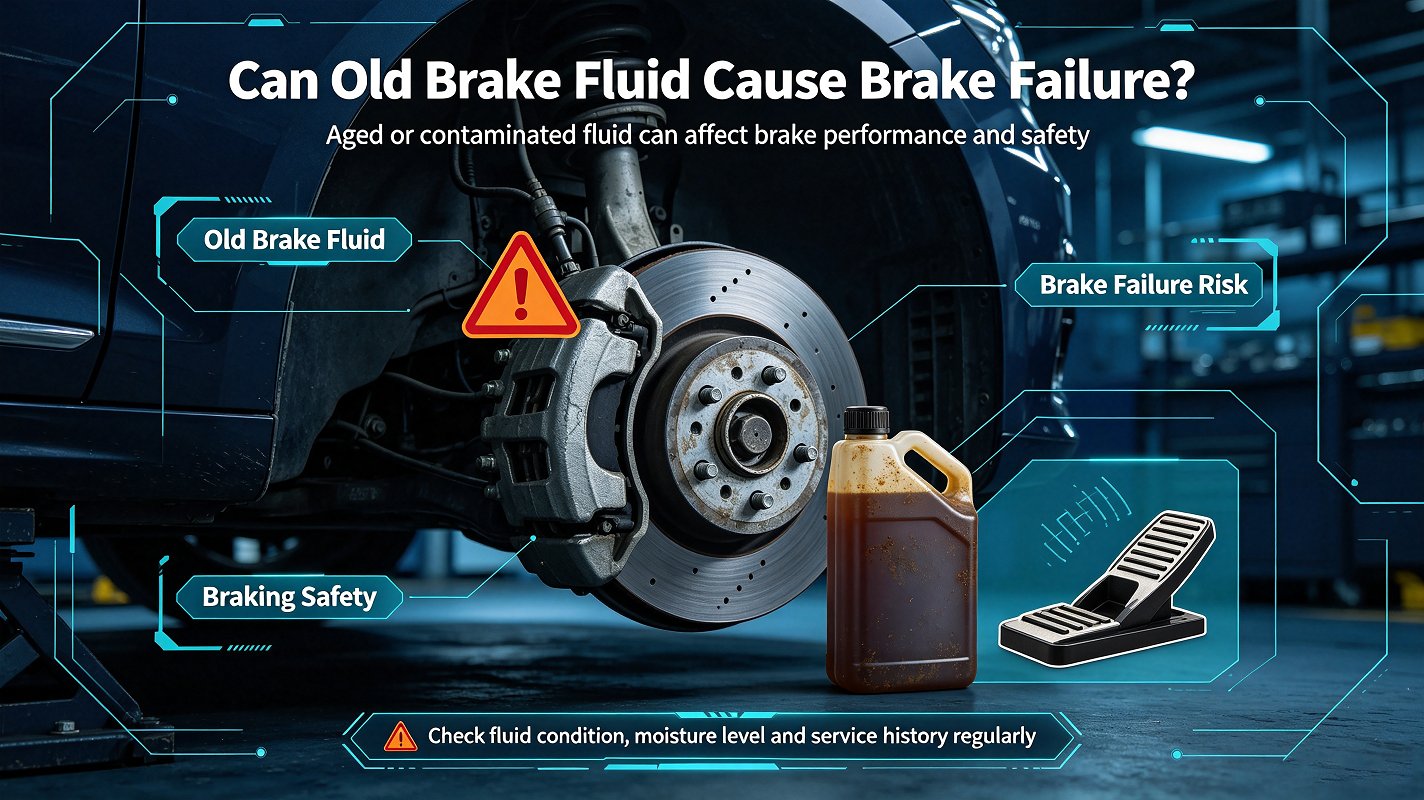
A lower boiling point is only part of the story. Moisture also contributes to internal corrosion in master cylinders, ABS components, steel lines, and caliper bores. That corrosion can generate debris, sticking valves, or seal wear. So when people ask whether water in brake fluid is “just a fluid issue,” the answer is no. It can become a hardware issue too, which is usually more expensive and more disruptive.
Which brake fluids are most affected
Most DOT 3, DOT 4, and DOT 5.1 fluids are glycol-based and absorb moisture to some degree. That is why service intervals matter. DOT 4 and DOT 5.1 typically offer higher dry boiling points than DOT 3, but they still need periodic replacement because the system will keep taking on water. Silicone-based DOT 5 behaves differently and is not interchangeable with the common glycol-based fluids used in most road vehicles. Mixing types is a mistake best avoided unless the vehicle manufacturer specifically allows it.
If you are selecting fluid for a program or parts catalog, do not choose by boiling point alone. Consider the vehicle duty cycle, ABS compatibility, the maintenance environment, and whether the fleet can support regular replacement. A high-performance fluid that is rarely changed may underperform in practice compared with a more ordinary fluid that is serviced on time.
Warning signs that moisture may be building up
Brake fluid does not always announce itself loudly. Still, a few signs deserve attention:
Longer pedal travel after repeated braking
Fade during downhill driving or towing
Darkened or cloudy fluid in the reservoir
Internal corrosion near calipers, lines, or the master cylinder
ABS-related irregularities that appear after age-related fluid degradation
None of these symptoms proves the problem on its own. But together they suggest the fluid deserves testing or replacement. A fluid test strip or electronic moisture meter can help, although results should be read carefully. Test tools are useful, but they are not a substitute for a sensible service schedule.
Practical selection and maintenance advice
For buyers and maintenance managers, the most useful rule is simple: match the fluid to the vehicle specification first, then build your service plan around the operating environment. Harsh duty cycles shorten the useful life of brake fluid. So do humid climates, frequent short trips, and systems that see infrequent maintenance.
Flush intervals should follow the manufacturer’s guidance where available. If the vehicle works harder than average, it is reasonable to review that interval more often. That is especially true for commercial fleets, where one overdue service can affect downtime and repair budgets downstream. Small preventive spend often avoids larger brake hardware costs later.
One practical caution: during service, keep containers sealed and minimize exposure to open air. Brake fluid left uncapped for long periods can absorb moisture before it ever enters the vehicle. That sounds obvious, but in busy workshops it still happens.
Common mistakes to avoid
A common mistake is assuming fluid color tells the whole story. Dark fluid may indicate age or contamination, but clear-looking fluid is not automatically healthy. Another mistake is topping off repeatedly instead of tracing the reason for fluid loss or wear. And of course, mixing incompatible fluid types can create more problems than it solves.
It is also easy to overlook the rest of the braking system. If moisture has already driven corrosion inside the cylinders or ABS unit, a simple flush may not restore full performance. That is why inspection matters alongside replacement.
FAQ: quick answers for buyers and technicians
How often should brake fluid be checked?
Check it during routine service and any time braking feel changes. In many vehicles, periodic replacement is more important than waiting for a visible symptom.
Can moisture be removed without changing the fluid?
Not reliably in normal service. Once water has been absorbed, a proper flush is usually the practical fix.
Does all brake fluid absorb water?
No, but most common passenger-vehicle glycol-based fluids do. That is why storage, service intervals, and correct specification all matter.
What to do next
If you are making a maintenance decision today, start with the vehicle specification, then look at service history and duty cycle. If the system is overdue, or if the fluid has been exposed to heavy use or humid conditions, testing and replacement are both reasonable next steps. The cost of ignoring moisture in brake fluid is rarely immediate, but when the margin disappears under heat, the problem becomes very real. For that reason alone, brake fluid deserves the same disciplined attention as pads, rotors, and hoses.
Welcome to contact GAFLE for more information & cooperation!
peter
ZHEJIANG GAFLE AUTO CHEMICL CO.,LTD
Tel:86-579-8222 1665
Fax:86-579-8246 4690
Cel/Wechart:86-13335993986
E-mail:peter@gafle.net
Web:www.gafle.net