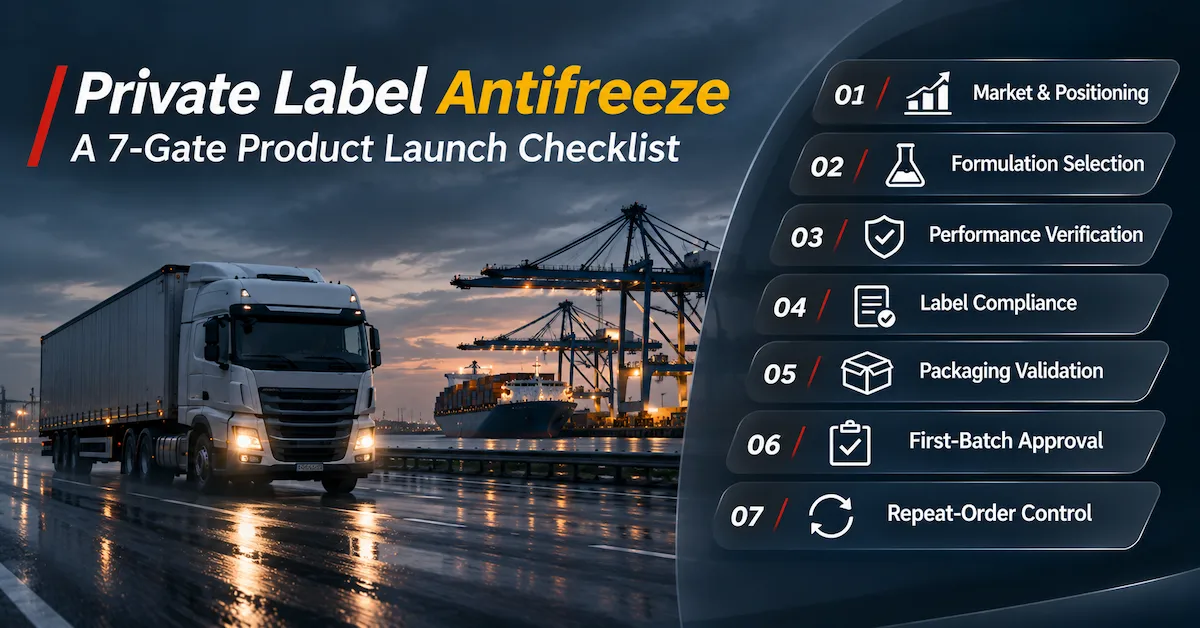
Quick Answer: A successful private label antifreeze program requires seven approval stages: market positioning, formulation selection, technical performance verification, label review, packaging validation, first-batch acceptance, and repeat-order control. Automotive brands and importers should approve the actual coolant specification and finished packaging before mass production, ensuring that every product claim is supported by appropriate documentation.
Launching an automotive coolant brand can create new commercial opportunities for distributors, automotive parts companies, lubricant brands, and international importers.
However, developing a competitive private label antifreeze product involves significantly more than placing a logo on an existing bottle.
A commercially attractive design may help a product stand out, but long-term customer confidence depends on whether the coolant performs according to its stated specification, whether the packaging protects the formulation, and whether subsequent shipments remain consistent with the approved sample.
For businesses developing their own coolant range, the most effective approach is to establish a structured product approval process before committing to bulk manufacturing.
This guide introduces seven practical approval gates that help buyers reduce development risks, control customization costs, and prepare their antifreeze products for commercial distribution.
Through its published OEM antifreeze and coolant solutions, GAFLE provides a starting point for brands seeking customized automotive coolant manufacturing and packaging.
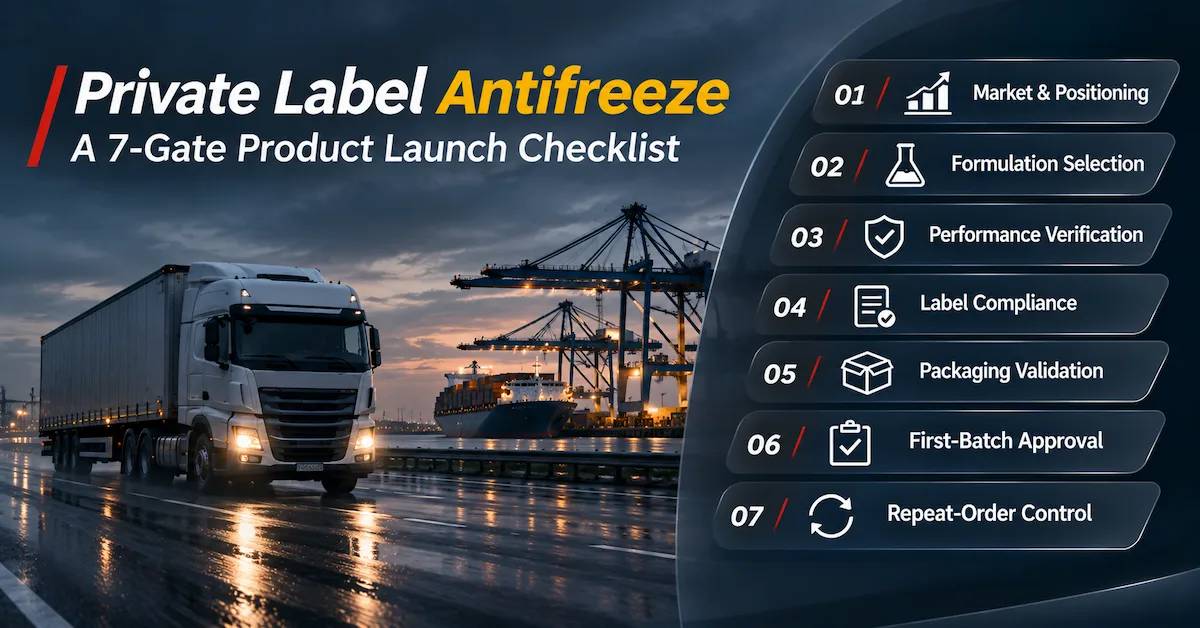
Table of Contents
-
What Is Private Label Antifreeze?
-
Who Should Launch a Private Label Coolant Brand?
-
Gate 1: Define the Target Market and Product Positioning
-
Gate 2: Select and Approve the Coolant Formulation
-
Gate 3: Verify Technical Performance and Product Claims
-
Gate 4: Review Antifreeze Labels and Market Compliance
-
Gate 5: Validate Bottles, Closures and Packaging
-
Gate 6: Approve the First Production Batch
-
Gate 7: Establish Repeat-Order and Change Controls
-
How Much Does Private Label Antifreeze Development Cost?
-
How GAFLE Supports Private Label Antifreeze Projects
-
Private Label Antifreeze RFQ Checklist
-
Frequently Asked Questions
-
Conclusion
1. What Is Private Label Antifreeze?
Private label antifreeze is an automotive coolant manufactured by a third-party producer and marketed under the purchasing company's own brand.
Depending on the agreed manufacturing arrangement, the buyer may select an existing qualified coolant formulation or request additional development based on specific market and technical requirements.
Private label manufacturing allows businesses to develop branded coolant products without establishing their own chemical production facility.
Potential customization requirements include:
-
Coolant formulation and inhibitor technology
-
Target freeze-protection performance
-
Concentrated or ready-to-use product format
-
Product color
-
Bottle and closure configuration
-
Brand identity and label design
-
Multilingual packaging
-
Outer cartons and shipment markings
-
Technical and safety documentation
The exact scope of customization depends on the manufacturer's capabilities, technical feasibility, order quantity, and project agreement.
Private label antifreeze vs OEM coolant manufacturing
| Manufacturing model | Typical customization | Suitable buyer |
|---|---|---|
| Existing branded antifreeze | Manufacturer's established product and packaging | Distributors entering a new market |
| Standard-formula private label | Buyer's brand applied to an agreed existing formulation | Retailers and importers seeking a focused product launch |
| Customized OEM antifreeze | Agreed changes to product specifications or packaging | Established automotive chemical brands |
| Application-specific coolant development | Additional formulation development and qualification | Technical buyers with defined system requirements |
These categories describe common commercial arrangements rather than universally standardized manufacturing terms.
For most brands entering the automotive coolant market, starting with a technically suitable existing formulation may reduce development complexity.
A more customized product becomes appropriate when a genuine customer requirement cannot be satisfied by the manufacturer's existing range.
2. Who Should Launch a Private Label Coolant Brand?
Private label antifreeze manufacturing is particularly relevant to businesses that already have access to automotive distribution channels or an identifiable customer base.
Automotive parts distributors
Parts distributors can introduce branded coolant alongside filters, brake components, lubricants, and other maintenance products.
A differentiated coolant range can support a more complete automotive maintenance offering.
Lubricant and automotive chemical brands
Companies already selling engine oils, transmission fluids, or brake fluids may expand into engine coolant to serve existing distributors and workshops.
Their main challenge is maintaining a consistent technical and visual identity across different automotive chemical categories.
Automotive retail chains
Retailers may develop exclusive branded antifreeze products with packaging sizes, instructions, and price positioning suited to their customers.
Product identification and clear application guidance are particularly important in retail environments.
Fleet and workshop suppliers
Professional maintenance suppliers may prioritize practical packaging, documented performance, consistent product specifications, and reliable replenishment.
Who may not be suitable for private label manufacturing?
Private label production may not be commercially appropriate for individual consumers, buyers without predictable sales demand, or companies that cannot manage the relevant chemical safety and distribution responsibilities.
A branded product introduces additional obligations involving product documentation, market communication, inventory management, and customer support.
3. Gate 1: Define the Target Market and Product Positioning
The first approval gate establishes what the product needs to achieve commercially and technically.
Before discussing label colors or bottle designs, buyers should identify the vehicles, customers, and distribution channels they intend to serve.
Build a customer-focused product brief
| Product planning item | Question to answer |
|---|---|
| Destination market | Which countries will receive the product? |
| Target vehicles | Passenger cars, commercial vehicles, or specific equipment? |
| Sales channel | Retail stores, workshops, fleets, or distributors? |
| Product positioning | Economy, mainstream, or specialized technical range? |
| Coolant requirement | Which vehicle or industry specifications apply? |
| Climate conditions | What freeze-protection requirements are necessary? |
| Product format | Concentrate or ready-to-use? |
| Annual demand | How much volume is realistically expected? |
For example, a brand serving passenger-car workshops may require a different product portfolio from a distributor supplying heavy-duty diesel fleets.
Similarly, a retailer selling directly to vehicle owners may need clearer application instructions and different packaging from a professional industrial supplier.
Avoid launching too many products initially
Every additional formulation, bottle size, packaging language, and label design can create a separate stock-keeping unit.
A launch consisting of two formulations, two bottle sizes, and two separate regional label versions can already generate eight finished-product SKUs.
Each SKU may require its own artwork, packaging procurement, inventory allocation, and quality-control records.
Instead of maximizing product variety immediately, prioritize products supported by actual customer demand.
Gate 1 approval: Confirm the target markets, customer segments, intended applications, and initial SKU list.
4. Gate 2: Select and Approve the Coolant Formulation
The formulation is the technical foundation of a private label antifreeze product.
A professional coolant supplier should help buyers identify an appropriate formulation based on the intended cooling system, rather than selecting a product solely according to color or advertised freezing point.
Understand the main coolant technologies
| Coolant technology | General characteristics | Buyer considerations |
|---|---|---|
| IAT | Inorganic corrosion-inhibitor technology | Relevant where specified by the vehicle manufacturer |
| OAT | Organic acid inhibitor technology | Evaluate the actual inhibitor system and application |
| HOAT | Combines organic and inorganic inhibitor approaches | Confirm the specific hybrid technology |
| Si-OAT | Organic acid technology incorporating silicate | Relevant to certain manufacturer-specific requirements |
| P-OAT | Organic acid technology incorporating phosphate | Evaluate suitability for the target vehicle population |
| Specialized coolant | Designed for particular thermal-management systems | Requires separate application qualification |
Coolant technology names provide useful formulation categories, but they do not establish compatibility with every product using the same technology description.
Vehicle manufacturer requirements should always guide application selection.
Concentrated vs ready-to-use private label antifreeze
Concentrated antifreeze may offer greater logistics and dilution flexibility for qualified professional users.
Ready-to-use coolant can simplify retail distribution and reduce the need for downstream preparation.
The selected product format should be clearly identified in the technical specification, packaging, and operating instructions.
Do not use identical front-label wording for concentrated and premixed products if customers could confuse their intended use.
Approve a technical specification before requesting artwork
The purchasing file should identify:
| Technical parameter | Required approval information |
|---|---|
| Base fluid | Glycol or other specified base-fluid chemistry |
| Inhibitor system | Agreed technology or formulation reference |
| Product format | Concentrate or prediluted coolant |
| Concentration | Defined product composition or dilution requirement |
| Freezing point | Target value, test method and concentration |
| Boiling point | Target value and test conditions |
| pH | Agreed specification range |
| Density | Agreed range at a defined temperature |
| Corrosion protection | Applicable qualification requirements |
| Material compatibility | Relevant system and material evidence |
| Product color | Approved visual identification |
| Formula identification | Product code and controlled formulation reference |
These are proposed purchasing requirements, not confirmed measured specifications for every GAFLE product.
Gate 2 approval: Agree on the coolant formulation reference, product format, application, and technical acceptance criteria.
5. Gate 3: Verify Technical Performance and Product Claims
A private label coolant brand must be able to support the technical statements printed on its packaging.
A product description such as "long-life," "OEM equivalent," or "extreme temperature protection" should be linked to appropriate technical evidence.
Use applicable industry standards
For passenger cars and light-duty applications, ASTM D3306-21 provides a recognized performance specification for relevant glycol-based engine coolants, including concentrates and prediluted products.
Its scope addresses performance related to freezing, boiling, and corrosion protection.
However, an ASTM performance claim does not automatically establish approval by a particular vehicle manufacturer.
Buyers targeting heavy-duty engines or specialized thermal-management systems should identify the separate technical requirements applicable to those systems.
Match every important marketing claim to supporting evidence
| Proposed product claim | Evidence to review |
|---|---|
| Freeze protection to a stated temperature | Applicable freezing-point test report for the specified concentration |
| Ready-to-use coolant | Approved finished-product concentration and instructions |
| Corrosion protection | Relevant corrosion qualification results |
| Extended service life | Applicable durability evidence and manufacturer requirements |
| Meets ASTM D3306 | Product-specific conformity evidence against the applicable edition |
| OEM equivalent | Documented comparison with the relevant technical specification |
| OEM approved | Authentic approval evidence covering the exact product |
A supplier's general product brochure should not be treated as independent evidence for every claim.
Similarly, a company-level quality-management certificate does not prove that a specific coolant formulation meets a particular vehicle specification.
Establish a claim register
A claim register connects the wording used on the label with the document that supports it.
For example, a proposed low-temperature claim should identify the approved formula, the tested concentration, the relevant report number, and the permitted wording.
If a claim cannot be supported, it should be revised, removed, or held until appropriate qualification is completed.
Gate 3 approval: Confirm the performance evidence and approved commercial claims before finalizing the label.
6. Gate 4: Review Private Label Antifreeze Labels and Market Compliance
Antifreeze packaging serves both marketing and technical communication purposes.
An attractive label is commercially useful, but it must also communicate essential product information and applicable safety requirements.
Chemical classification and labeling obligations vary according to the actual formulation and destination market.
Front-label information
A practical front-label design may include the buyer's brand, product identification, concentrate or ready-to-use status, net content, and supported performance claims.
Where vehicle compatibility or manufacturer specifications are mentioned, those statements should reflect the available evidence.
Back-label information
The back label may need to accommodate application instructions, dilution guidance where relevant, storage information, safety warnings, responsible supplier information, and applicable regulatory elements.
The exact legal requirements must be determined for the destination market and chemical classification.
EU CLP labeling and packaging requirements
For brands targeting the European Union, the European Chemicals Agency's CLP labelling and packaging guidance explains the hazard communication requirements applicable to substances and mixtures classified as hazardous.
Depending on the formulation and classification, required information can include product identifiers, supplier details, relevant pictograms, signal words, hazard statements, and precautionary information.
This means that the regulatory review should take place before the label is printed.
A private label brand should not assume that copying another coolant label produces a compliant design.
UFI and poison centre notification considerations
Private labeling may introduce additional responsibilities when a hazardous chemical mixture is imported, rebranded, relabeled, or distributed into different European markets.
A Unique Formula Identifier (UFI) links an applicable mixture to its poison centre notification information.
The official ECHA guidance on poison centre notification obligations distinguishes the responsibilities of importers, formulators, repackagers, distributors, and rebranders.
For mixtures within scope, the responsible economic operator must establish whether the relevant formulation, product identifiers, and destination-market information are properly covered.
A non-EU manufacturer can support the necessary documentation, but importing or rebranding a product does not automatically transfer all regulatory responsibilities to that manufacturer.
The buyer should arrange a qualified regulatory review for the specific formulation and destination.
Private label artwork approval checklist
| Label element | Approval requirement |
|---|---|
| Brand name and logo | Correct authorized artwork |
| Product identity | Matches the approved coolant formulation and documentation |
| Product format | Clearly identifies concentrate or ready-to-use |
| Performance statements | Supported by relevant technical evidence |
| Application instructions | Appropriate for the specified product |
| Hazard communication | Reviewed against actual classification and destination rules |
| UFI information | Included and verified where applicable |
| Language | Meets relevant destination-market requirements |
| Net content | Consistent with the packaging specification |
| Batch coding area | Suitable for traceability |
| Barcode | Correctly assigned and readable |
These requirements should be evaluated for each market rather than applied as a universal international label template.
Gate 4 approval: Complete technical, brand, and applicable regulatory reviews before authorizing label printing.
7. Gate 5: Validate Bottles, Closures and Finished Packaging
Packaging quality affects product presentation, warehouse handling, transportation, and customer confidence.
A successful private label antifreeze program should validate the complete packaging system rather than approve a bottle and label separately.
Choose between standard and custom packaging
| Packaging approach | Main advantage | Main commercial consideration |
|---|---|---|
| Existing bottle with custom label | Lower development complexity | Less structural differentiation |
| Existing bottle with customized closure or label | Greater visual distinction | Additional packaging procurement requirements |
| Newly developed bottle | Stronger structural brand identity | Tooling, development and qualification costs |
| Professional bulk packaging | Suitable for predictable high-volume use | Handling, storage and dispensing requirements |
These are general manufacturing approaches. Actual bottle designs, tooling availability, and packaging customization options should be confirmed with the supplier.
Important packaging validation points
Container compatibility: The bottle and closure system must be suitable for the actual coolant formulation and intended storage conditions.
Closure integrity: Agree on appropriate closure specifications, sealing checks, and leakage acceptance criteria.
Label adhesion: Verify that printed information remains legible and labels remain suitably attached during expected handling and storage.
Filling accuracy: Confirm net-content requirements and the inspection method used for filled containers.
Carton protection: Evaluate whether the outer carton and internal arrangement provide appropriate protection for handling and transport.
Shipment configuration: Review pallet arrangements, gross weight, stacking considerations, and destination logistics requirements.
Where regulations require child-resistant closures or tactile warnings for the particular chemical classification and packaging, those requirements must also be assessed.
Approve a complete packaging reference sample
The most useful sample includes the approved coolant, bottle, cap, printed label, batch-code location, and final outer packaging.
A signed packaging reference can help resolve disagreements later concerning label placement, color matching, packaging dimensions, or printing quality.
Gate 5 approval: Authorize the finished packaging configuration after the agreed physical and regulatory checks.
8. Gate 6: Approve the First Production Batch
The first commercial batch is an important transition between product development and repeat manufacturing.
A sample may be acceptable, but the buyer still needs evidence that the actual commercial shipment matches the approved product.
What should a private label antifreeze manufacturer verify?
A suitable inspection plan can include raw-material identification, controlled batching, filling, packaging inspection, and finished-product testing.
The actual manufacturing controls should be agreed with the supplier and supported by relevant records.
| Inspection stage | Recommended acceptance evidence |
|---|---|
| Incoming materials | Approved material references and traceability |
| Formulation preparation | Batch identity and approved formula reference |
| Mixing and processing | Relevant process-control records |
| Finished coolant | Agreed physical and chemical test results |
| Filling | Net-content inspection |
| Closure | Agreed sealing and integrity checks |
| Labeling | Correct artwork version and placement |
| Carton packing | Approved carton configuration and shipment markings |
| Batch release | COA or agreed release documentation |
Not every technical qualification test needs to be performed on every production batch.
The buyer and manufacturer should distinguish initial formula qualification from routine production-release testing.
First-batch acceptance documents
Depending on the project, the purchasing file may include:
-
Technical Data Sheet (TDS)
-
Safety Data Sheet (SDS)
-
Certificate of Analysis (COA)
-
Applicable performance test reports
-
Approved packaging specification
-
Batch identification records
-
Inspection results
-
Shipment and packing documentation
The documentation should refer to the exact product being manufactured.
If a formula was qualified under one product code but the commercial shipment uses another code, the supplier should explain how those identities correspond.
Handling a failed inspection
Agree in advance on how deviations will be classified and resolved.
Examples of issues requiring review include an incorrect formulation, unsupported label claim, incorrect net content, leaking containers, or artwork that differs from the approved version.
Do not authorize shipment of a nonconforming batch without a documented technical and commercial disposition. Safety-critical or legally noncompliant discrepancies must be resolved before market release.
Gate 6 approval: Release the first commercial batch only after the agreed technical, packaging, and documentation requirements have been satisfied.
9. Gate 7: Establish Repeat-Order and Change Controls
The long-term value of a private label antifreeze program depends on maintaining a consistent product after launch.
A successful first shipment does not establish that every subsequent batch will automatically match the original qualification.
Maintain a controlled product identity
Each approved SKU should have a consistent relationship between:
| Controlled item | Example of a record to maintain |
|---|---|
| Coolant formulation | Approved formula reference and revision |
| Technical specification | Current TDS and acceptance criteria |
| Product label | Approved artwork file and revision |
| Packaging | Bottle, cap and carton specifications |
| Batch identity | Production and release records |
| Destination market | Applicable labeling and regulatory information |
| Purchasing agreement | Approved commercial and quality requirements |
Identify changes that require technical review
A manufacturer or brand owner may eventually need to modify raw materials, inhibitor chemistry, product color, bottle material, closures, or label content.
Not every modification requires the same amount of testing. However, changes should be reviewed according to their potential effects on performance, safety, packaging, and regulatory obligations.
For example, a new bottle supplier may require packaging checks without changing the coolant formula. A change to the inhibitor chemistry may require additional technical qualification and a review of related product claims.
A formulation change may also affect chemical classification or poison centre notification obligations.
Illustrative example: expanding an established product line
Consider a distributor that launches a ready-to-use coolant in one bottle size and later introduces a larger workshop package.
The second package may use the same approved coolant formulation, but the closure, net content, label layout, shipping arrangement, and applicable regulatory information still need review.
This is a hypothetical purchasing scenario rather than a documented GAFLE customer project.
The objective is to extend an approved product without creating inconsistencies between the formula, packaging, and commercial claims.
Gate 7 approval: Agree on repeat-order specifications, change-notification responsibilities, complaint handling, and relevant requalification requirements.
10. How Much Does Private Label Antifreeze Development Cost?
Private label antifreeze pricing depends on the complete project configuration, not just the cost of the coolant inside the bottle.
Two quotations may appear comparable but include different technical, packaging, and development requirements.
Main private label antifreeze cost factors
| Cost factor | Potential effect on the quotation |
|---|---|
| Base fluid and formulation | Influences finished-product material cost |
| Existing or customized formula | May affect development and testing costs |
| Standard or custom bottle | Influences tooling and packaging expenses |
| Label design and printing | Depends on artwork, materials and printing requirements |
| Number of finished SKUs | Can increase setup and packaging commitments |
| Technical qualification | Depends on the required tests and documentation |
| Order quantity | Influences purchasing and production economics |
| Export packaging and freight | Affects delivered cost |
Reduce initial launch costs without compromising quality
A new brand can often simplify its launch by selecting an existing suitable coolant formula, using an available packaging format, and limiting the initial product range.
However, necessary technical testing and applicable regulatory requirements should not be removed simply to reduce costs.
Buyers should also establish whether artwork setup, tooling, additional testing, and unused printed packaging are included in the product quotation or charged separately.
For further information about minimum order quantities and project budgeting, review GAFLE's Private Label Coolant MOQ and Cost Guide.
Actual MOQ, sample charges, development costs, and production lead times should be confirmed according to the selected project.
Request a Private Label Antifreeze Project Quotation
11. How Can GAFLE Support Private Label Antifreeze Projects?
Zhejiang Gafle Auto Chemical Co., Ltd. manufactures automotive chemical products and provides private label packaging and customized specification services.
Its published coolant OEM information identifies opportunities to discuss formulation, product color, packaging, branding, and market-specific product requirements.
Start with a suitable coolant product
GAFLE's published range includes conventional automotive coolant and specialized thermal-management product directions.
For example, buyers can review the GAFLE OE-equivalent Coolant (Purple) as one potential starting point for a technical sourcing discussion.
The product name and color should not be interpreted as proof of formal approval by any specific vehicle manufacturer.
The relevant formulation, application, technical documents, and approval status should be confirmed before incorporating related claims into private label packaging.
A practical cooperation workflow
| Project stage | Buyer responsibility | Manufacturer discussion |
|---|---|---|
| Initial inquiry | Define market, application and expected volume | Identify feasible product directions |
| Technical review | Confirm specifications and performance requirements | Propose relevant formulations and available evidence |
| Packaging development | Provide brand identity and packaging requirements | Discuss available containers and artwork options |
| Sample approval | Review coolant and packaging samples | Agree on adjustments and acceptance criteria |
| Order confirmation | Approve commercial and technical terms | Confirm project-specific production arrangements |
| Production release | Review agreed inspection documentation | Provide applicable batch and shipment records |
| Repeat supply | Forecast demand and report changes | Maintain the agreed specification and communication |
This workflow represents a recommended project structure for buyers to discuss with GAFLE, rather than a guarantee of specific development timelines or manufacturing arrangements.
For brands planning international distribution, GAFLE's existing antifreeze wholesale inventory planning guide also provides useful information on landed costs, seasonal stock, and replenishment.
Discuss Your Custom Coolant Brand With GAFLE
12. Private Label Antifreeze RFQ Checklist
A well-prepared inquiry helps the manufacturer understand your commercial objective and reduces unnecessary quotation revisions.
Use the following template to begin a private label coolant project.
Private label antifreeze manufacturing inquiry
Subject: Private Label Antifreeze Manufacturing and Packaging Inquiry
Dear GAFLE Sales and Technical Team,
We are developing a private label automotive coolant range for our distribution market and would like to discuss suitable manufacturing and packaging options.
Our preliminary project requirements are as follows:
Destination market: [Country or region]
Target applications: [Passenger cars, commercial vehicles, workshops or fleets]
Required coolant specification: [Applicable industry or vehicle manufacturer specification]
Preferred coolant technology: [IAT, OAT, HOAT or other defined technology]
Product format: [Concentrate or ready-to-use]
Required freeze-protection performance: [Target temperature]
Packaging: [Bottle size, closure and carton requirements]
Brand requirements: [Logo, artwork, label language and visual preferences]
Initial purchase quantity: [Quantity per SKU]
Estimated annual demand: [Forecast]
Technical documentation: [TDS, SDS, COA and relevant test reports]
Market compliance requirements: [Applicable labeling and regulatory requirements]
Target delivery schedule: [Required delivery date]
Please recommend suitable product formulations and confirm available samples, packaging options, customization costs, MOQ, production lead time, and quality-control documentation.
We would also like to establish a product and artwork approval process before authorizing commercial production.
Kind regards,
[Name]
[Company]
[Contact Information]
Submit Your Private Label Antifreeze RFQ
13. Frequently Asked Questions About Private Label Antifreeze
FAQ 1. What is private label antifreeze?
Private label antifreeze is automotive coolant manufactured by a third-party producer and supplied under the purchasing company's brand. Depending on the project, customization may include formulation, packaging, labels, and market-specific product information.
FAQ 2. Can I launch my own antifreeze brand without owning a factory?
Yes. Automotive distributors and brand owners can work with a qualified contract manufacturer. However, they still need to manage technical specifications, branding, applicable regulatory responsibilities, distribution, and customer support.
FAQ 3. Can GAFLE customize antifreeze formulations and packaging?
GAFLE's published OEM coolant information describes opportunities for formula, color, packaging, and branding customization. The technical feasibility, available options, and commercial conditions should be confirmed for each project.
FAQ 4. What is the minimum order quantity for private label antifreeze?
MOQ depends on the selected formulation, bottle size, artwork, packaging configuration, and customization requirements. Request a project-specific quotation identifying the minimum quantity for each finished SKU.
FAQ 5. Can I use an existing coolant formulation under my own brand?
Yes, where the manufacturer offers a suitable existing formula and the buyer approves its technical specification. The private label packaging must accurately represent the actual product and comply with applicable market requirements.
FAQ 6. Is custom-colored antifreeze compatible with every vehicle?
No. Coolant color does not reliably establish formulation chemistry, technical performance, or vehicle compatibility. Select coolant according to the vehicle manufacturer's requirements and product-specific evidence.
FAQ 7. Does private label antifreeze require a UFI code?
For the EU market, a UFI may be required when the mixture falls within the applicable poison centre notification rules. The determination depends on the actual chemical classification, product use, and regulatory circumstances. Buyers should review the specific project with qualified regulatory personnel.
FAQ 8. What documents should a private label coolant manufacturer provide?
Depending on the product and destination, relevant documents may include TDS, SDS, COA, applicable test reports, formulation references, packaging specifications, batch records, and quality documentation.
FAQ 9. How long does it take to launch a private label antifreeze product?
The timeline depends on whether the project uses an existing formulation and packaging configuration or requires additional development, testing, custom tooling, artwork preparation, and regulatory review. Confirm the actual schedule with the manufacturer after the project requirements are established.
FAQ 10. How can I receive an accurate private label antifreeze quotation?
Provide your target market, coolant requirements, desired packaging, branding information, expected purchase quantity, and required technical documentation. A detailed inquiry allows the manufacturer to evaluate the project more accurately than a general request for the lowest unit price.
14. Conclusion
Building a successful private label antifreeze brand requires a coordinated approach to formulation, performance verification, packaging development, market compliance, and manufacturing consistency.
The strongest automotive coolant brands are not built through attractive packaging alone. They are built around products with documented technical requirements, accurate commercial claims, consistent quality, and reliable supply arrangements.
By following the seven-stage approval process, importers and distributors can reduce unnecessary development risks while establishing a stronger foundation for commercial growth.
GAFLE provides automotive chemical manufacturing and private label project opportunities for businesses looking to develop or expand their own coolant product ranges.
Whether you are launching a new automotive chemical brand, expanding an established lubricant range, or developing exclusive coolant products for regional distributors, contact GAFLE to discuss your formulation requirements, packaging preferences, technical documentation, and manufacturing arrangements.
Approve the formula. Validate the packaging. Control the production batch. Build a coolant brand designed for long-term growth.