
Quick Answer: Successful antifreeze wholesale purchasing requires distributors to match coolant specifications to vehicle demand, compare concentrate and premix costs per usable liter, and schedule inventory around regional service requirements. Buyers should verify formulation consistency, freeze protection, corrosion performance, packaging integrity, and supplier documentation before ordering. A dependable supply program combines technical qualification with realistic demand forecasts, controlled inventory levels, and planned repeat orders.
For automotive chemical distributors, antifreeze is not simply a winter product. It is a year-round maintenance fluid that supports engine temperature management, freezing protection, and corrosion control.
However, wholesale buyers face several recurring commercial challenges:
-
Seasonal demand can create temporary stock shortages.
-
Excessive inventory ties up working capital.
-
Different vehicle specifications require separate product lines.
-
Shipping ready-to-use coolant can increase logistics costs.
-
Incorrect coolant selection can generate customer complaints.
-
Inconsistent formulations can undermine repeat-order reliability.
The most competitive distributors are not necessarily those purchasing the cheapest antifreeze. They are those that combine appropriate product specifications with efficient logistics, reliable inventory turnover, and consistent supplier quality.
For importers and private-label automotive brands, GAFLE Antifreeze/Coolant products provide a starting point for developing a structured wholesale supply program.

Table of Contents
-
What Makes an Antifreeze Wholesale Program Profitable?
-
Building a Coolant Portfolio Around Customer Demand
-
Technical Specifications for Wholesale Antifreeze
-
Concentrated vs Ready-to-Use Antifreeze
-
Calculating the Actual Landed Cost per Usable Liter
-
Regional Climate and Seasonal Demand Planning
-
Inventory Forecasting and Reorder Management
-
Manufacturing Quality and Batch Consistency
-
Packaging and International Logistics
-
GAFLE Wholesale and Private-Label Coolant Solutions
-
Building a Long-Term Supply Agreement
-
Frequently Asked Questions
-
Conclusion
1. What Makes an Antifreeze Wholesale Program Profitable?
A profitable antifreeze wholesale program balances four commercial factors: product suitability, landed cost, inventory turnover, and supply reliability.
Buying larger quantities may improve unit pricing, but it can also increase warehouse requirements and financial exposure if the products do not match actual customer demand.
For example, a distributor may purchase a large shipment of one coolant specification at an attractive price. However, if local workshops primarily service vehicles requiring a different inhibitor technology or manufacturer specification, the inventory may sell slowly.
The apparent purchasing advantage disappears when additional storage costs, discounts, and working-capital requirements are considered.
Who should purchase antifreeze wholesale?
Wholesale coolant sourcing is particularly suitable for:
| Buyer type | Primary purchasing objective |
|---|---|
| Automotive chemical importers | Build competitive regional product portfolios |
| Auto parts distributors | Maintain reliable workshop and retail supply |
| Fleet maintenance suppliers | Reduce supply interruptions and maintenance costs |
| Automotive retail chains | Maintain consistent products across multiple locations |
| Lubricant brands | Expand into automotive coolant products |
| Private-label brands | Develop differentiated coolant product lines |
| Industrial equipment suppliers | Source application-specific cooling fluids |
Wholesale importing may be less suitable for individual vehicle owners or small workshops without predictable consumption, appropriate chemical storage facilities, or established distribution channels.
For buyers entering a new market, a focused selection of technically qualified products is often more manageable than launching an extensive catalogue immediately.
2. How Should Distributors Build an Antifreeze Product Portfolio?
The first step is to organize products by customer application rather than coolant color.
Modern cooling systems may use aluminum, cast iron, steel, copper, elastomers, and various plastic components. Coolant formulations must be selected according to the applicable system requirements.
IAT, OAT and HOAT coolant technologies
| Coolant technology | General formulation approach | Wholesale purchasing consideration |
|---|---|---|
| IAT | Inorganic corrosion-inhibitor technology | Relevant where the vehicle manufacturer specifies this chemistry |
| OAT | Organic acid corrosion-inhibitor technology | Evaluate specific modern engine requirements |
| HOAT | Combination of organic and inorganic inhibitors | Verify the particular hybrid formulation and OEM specification |
| Si-OAT | Organic acid technology incorporating silicate | Relevant for selected manufacturer-specific applications |
| P-OAT | Organic acid technology incorporating phosphate | Evaluate requirements for the intended vehicle population |
| Specialized thermal-management coolant | Formulated for a defined thermal-management system | Requires separate system-specific qualification |
These technology descriptions are useful for organizing inventory, but they do not establish interchangeability.
Two products described as OAT may have different inhibitor packages, material compatibility, or manufacturer approvals.
A three-tier wholesale inventory strategy
Distributors can divide their coolant portfolio into three practical groups.
Core products: High-turnover products supported by the most common documented vehicle requirements in the distributor's market.
Specialized products: Lower-volume coolants intended for specific manufacturer requirements, severe climates, or specialized service channels.
Project-based products: Customized formulations or packaging supplied against confirmed customer orders.
This structure helps prevent excessive investment in slow-moving products while maintaining flexibility for higher-value technical applications.
For a broader introduction to wholesale coolant categories, see GAFLE's Antifreeze Wholesale Supplier Guide.
3. What Technical Specifications Should Antifreeze Wholesale Buyers Verify?
A reliable coolant purchasing specification should include more than freezing-point and color information.
Engine coolant must provide appropriate temperature-management performance while remaining suitable for the metals, seals, and other materials within its intended cooling system.
Recommended technical specification table
| Parameter | Information to request | Procurement importance |
|---|---|---|
| Base fluid | Ethylene glycol, propylene glycol, or other specified base | Determines fundamental formulation characteristics |
| Product format | Concentrate or ready-to-use | Affects dilution, storage, and transportation |
| Inhibitor technology | IAT, OAT, HOAT, or other defined technology | Supports application matching |
| Freezing point | Measured result and test concentration | Supports climate-based selection |
| Boiling point | Measured value and test conditions | Supports thermal-performance evaluation |
| pH | Specified acceptance range and test method | Helps monitor formulation consistency |
| Density | Measured result at a defined temperature | Supports identification and quality checks |
| Corrosion performance | Relevant test results | Evaluates cooling-system protection |
| Water quality | Suitable water requirements for dilution or premixing | Helps control contamination and deposits |
| Manufacturer specification | Applicable requirement and supporting evidence | Supports vehicle-specific selection |
| Packaging | Net content, closure, label, and carton details | Supports safe handling and distribution |
These are recommended purchasing data fields rather than confirmed specifications for every GAFLE coolant product.
ASTM D3306 for passenger cars and light-duty vehicles
The official ASTM D3306-21 engine coolant specification defines requirements for glycol-based coolants used in automotive and light-duty cooling systems, including concentrated and prediluted product formats.
The standard establishes a useful framework for evaluating freeze protection, boiling protection, and corrosion-related performance.
However, meeting an applicable ASTM specification does not automatically establish suitability for every vehicle manufacturer or cooling system.
Importers should verify both the general performance standard and any additional manufacturer-specific requirements.
ASTM D6210 for heavy-duty engine applications
Heavy-duty diesel engines may have additional coolant requirements, including protection against cavitation-related damage in applicable engine designs.
The official ASTM D6210-25 heavy-duty engine coolant specification addresses fully formulated glycol-based coolants for heavy-duty service, including corrosion, cavitation, freezing, and boiling protection.
Distributors supplying trucks, construction equipment, agricultural machinery, or commercial fleets should therefore verify the applicable engine requirements instead of assuming that a passenger-car coolant can automatically cover these applications.
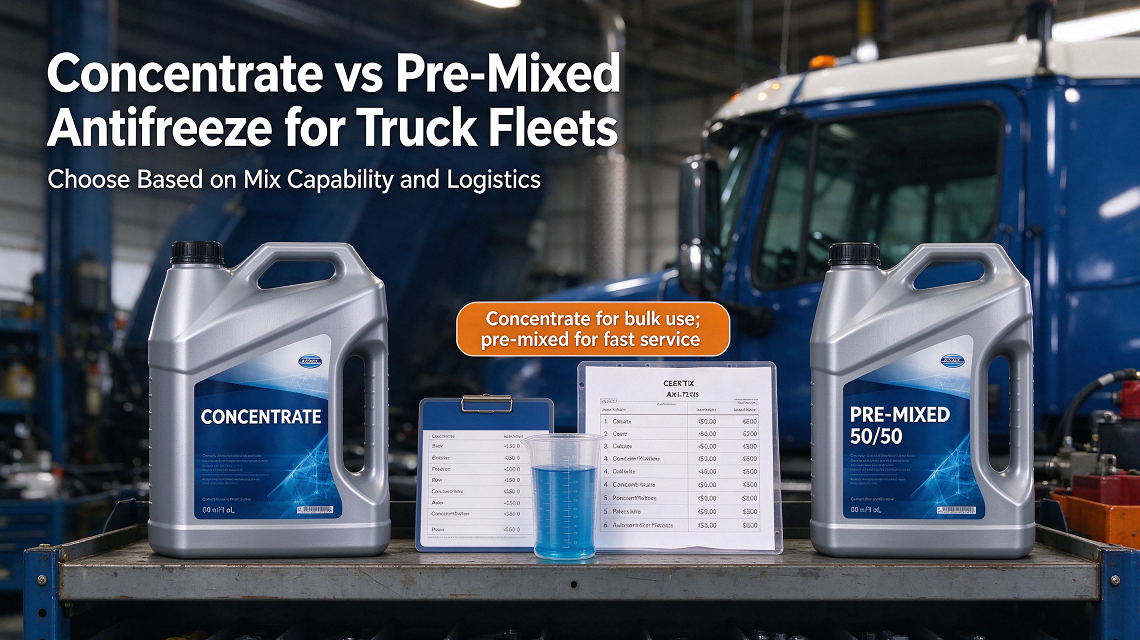
4. Antifreeze Concentrate vs Ready-to-Use Coolant: Which Is Better for Wholesale?
Concentrated and ready-to-use antifreeze serve different distribution models.
Concentrate can be commercially attractive when buyers have suitable local dilution facilities or professional customers capable of preparing coolant correctly.
Ready-to-use coolant simplifies product handling and can be more convenient for retail stores, workshop networks, and maintenance teams.
Concentrate and premix comparison
| Comparison factor | Concentrated antifreeze | Ready-to-use antifreeze |
|---|---|---|
| Imported liquid volume | Potentially lower for equivalent usable output | Higher because water is included |
| Local preparation | Required according to instructions | Normally unnecessary |
| Water quality management | Buyer or professional user responsibility | Managed during manufacture |
| Dilution flexibility | Available within approved formulation limits | Fixed supplied concentration |
| Retail convenience | Requires clear dilution instructions | Generally easier for direct service use |
| Quality-control responsibility | Includes local preparation controls | Primarily finished-product verification |
| Typical distribution channel | Professional importers and qualified workshops | Retail and workshop networks |
| Main purchasing risk | Incorrect dilution or unsuitable water | Higher transport and storage requirements |
When should distributors choose concentrate?
Concentrate may be appropriate when:
-
International freight is a significant cost factor.
-
Customers have suitable coolant preparation processes.
-
Water quality can be controlled.
-
The intended formulation permits the planned dilution.
-
Local chemical handling and packaging requirements can be satisfied.
When should distributors choose ready-to-use coolant?
Premixed coolant may be preferable when:
-
Customers require convenient service products.
-
The distributor lacks qualified local blending facilities.
-
Workshops want to reduce dilution-related errors.
-
The market requires consistent finished-product specifications.
-
Retail sales account for a substantial share of demand.
The best commercial strategy may involve supplying both formats to different customer segments.
Importers should not choose concentrate purely because it offers more potential finished volume. The local preparation process must also be technically appropriate and commercially viable.
5. How Can Buyers Calculate the Actual Landed Cost per Usable Liter?
One of the most important antifreeze wholesale purchasing decisions is whether to compare products by imported volume or finished, usable coolant volume.
A lower price per imported liter does not necessarily indicate a lower final supply cost.
A practical comparison is:
Cost per usable liter = Total applicable purchasing, logistics and preparation costs ÷ Saleable finished coolant volume
Relevant costs may include:
-
Factory product price
-
Packaging and labeling
-
International freight
-
Insurance
-
Customs duties and non-recoverable taxes
-
Inland transportation
-
Local preparation and water costs
-
Quality inspection
-
Handling and expected production losses
Illustrative wholesale cost comparison
Consider a distributor evaluating concentrate and ready-to-use coolant for an equivalent finished volume.
For this example only, assume the selected concentrate permits an approximately 1:1 volume-based preparation under its approved instructions.
| Cost item | Concentrate option | Ready-to-use option |
|---|---|---|
| Imported product volume | 2,000 L | 4,000 L |
| Illustrative factory price per liter | $1.35 | $0.80 |
| Product purchasing cost | $2,700 | $3,200 |
| Freight, duties and handling | $800 | $1,600 |
| Local preparation and related costs | $400 | $0 |
| Total estimated cost | $3,900 | $4,800 |
| Assumed saleable finished volume | 4,000 L | 4,000 L |
| Estimated cost per usable liter | $0.975 | $1.20 |
In this hypothetical example, concentrate has a lower finished-volume cost.
However, if local preparation costs rise from $400 to $1,300, the two options would have the same estimated total cost under these assumptions.
Actual costs depend on formulation, packaging, freight quotations, customs treatment, preparation requirements, and realized saleable output.
These figures are illustrative purchasing calculations, not GAFLE product prices or freight quotations.
The key lesson is that concentrate is not automatically cheaper once all relevant costs are included.
For a meaningful comparison, request quotations using the same technical requirements, destination, packaging format, and commercial terms.
Request a GAFLE Antifreeze Wholesale Quotation
6. How Should Antifreeze Inventory Match Regional Climate and Seasonal Demand?
Climate affects coolant demand, but it should not be used as the only product-selection criterion.
A distributor must also consider vehicle manufacturer requirements, local maintenance practices, fleet composition, customer preferences, and historical sales.
Regional inventory planning
| Market characteristics | Product planning priority | Inventory strategy |
|---|---|---|
| Severe winter conditions | Verified low-temperature protection | Build qualified winter stock before demand increases |
| Moderate seasonal climate | Year-round engine cooling and winter protection | Maintain core stock with seasonal adjustments |
| Hot-climate markets | Appropriate heat-transfer and corrosion protection | Maintain year-round supply |
| Mixed passenger and commercial fleets | Separate light-duty and heavy-duty requirements | Forecast independently by application |
| Specialized EV markets | System-specific thermal-management fluids | Use dedicated qualified products |
| New distribution markets | Uncertain product mix and demand | Begin with validated core products and controlled quantities |
Why hot regions still need antifreeze coolant
Antifreeze is not exclusively intended for freezing conditions.
Appropriate engine coolant also supports heat transfer and corrosion protection throughout the cooling system.
Consequently, distributors in hot climates should not select products based only on the assumption that freeze protection is unnecessary.
Vehicle specifications and overall cooling-system performance remain important.
How to verify advertised freezing-point claims
A product marketed with a specific low-temperature rating should be supported by identifiable test evidence.
The official ASTM D1177-22(2026) freezing-point test method describes laboratory determination of the freezing point of aqueous engine coolants.
This provides a useful basis for checking whether an advertised freeze-protection claim is supported by a defined test.
Purchasers should confirm whether the reported value applies to the supplied product or a specified diluted mixture.
For severe winter applications, explore GAFLE's Low-Temperature Antifreeze Guide.
7. How Can Distributors Forecast Demand and Prevent Stock Shortages?
Antifreeze inventory planning should consider the complete replenishment cycle, not simply factory production time.
International purchasing may involve specification approval, packaging preparation, production scheduling, shipment booking, customs clearance, and warehouse receiving.
Each stage can affect product availability.
Build a rolling demand forecast
A useful forecast separates demand by:
-
Coolant formulation and specification
-
Concentrate or premixed format
-
Packaging size
-
Customer segment
-
Destination region
-
Expected seasonal demand
-
Confirmed and anticipated purchase commitments
Historical sales can provide a baseline, while customer forecasts and maintenance schedules can help identify future changes.
Distributors should update their forecasts regularly rather than relying entirely on the previous year's purchasing quantities.
Establish a reorder point
A simple inventory-planning model is:
Reorder point = Expected demand during replenishment lead time + Safety stock
Consider the following illustrative distributor scenario.
| Inventory planning parameter | Example |
|---|---|
| Average weekly demand | 1,200 L |
| Total replenishment lead time | 8 weeks |
| Expected demand during lead time | 9,600 L |
| Safety stock | 2,400 L |
| Calculated reorder point | 12,000 L |
If the inventory position reaches approximately 12,000 liters, the distributor should review replenishment requirements.
Inventory position should account for available stock, confirmed inbound orders, and outstanding customer commitments.
For example, 8,200 liters in stock plus 5,000 liters on order, less 1,800 liters already committed to customers, gives an inventory position of 11,400 liters.
In this example, the inventory position is below the planned reorder point.
This signals the need to review replenishment, but it does not independently determine the purchase quantity.
These figures are planning examples, not actual GAFLE production or delivery commitments.
Plan purchasing around seasonal peaks
| Planning stage | Recommended activity |
|---|---|
| Before the peak season | Review forecasts, confirm formulas and approve packaging |
| Initial replenishment | Order qualified core products based on demand |
| During peak demand | Monitor inventory position and inbound shipments |
| After the peak | Reduce unnecessary replenishment and review remaining stock |
| Annual review | Compare sales, forecast accuracy, margins and product performance |
This approach helps reduce both stock shortages and unnecessary inventory accumulation.
8. How Does Manufacturing Quality Affect Repeat Wholesale Orders?
The first antifreeze shipment may meet the buyer's expectations, but long-term distribution depends on whether subsequent shipments remain consistent.
An importer selling coolant under the same product name should receive a product that continues to meet the agreed technical specification.
Raw material control
A purchasing team should ask how the supplier identifies and qualifies relevant raw materials, including glycol, inhibitor packages, water used for premixed products, and packaging materials.
Raw material changes may affect finished-product performance and should be managed through an appropriate review process.
Formulation and production control
Important manufacturing controls can include:
-
Approved formulation identification
-
Material traceability
-
Controlled batching and mixing
-
Relevant process monitoring
-
Filling consistency
-
Packaging inspection
-
Finished-batch identification
These are recommended supplier-audit topics. Buyers should confirm the manufacturer's actual coolant production and inspection procedures rather than assume every control is implemented identically.
Finished-product quality verification
| Quality check | Recommended evidence |
|---|---|
| Product identification | Approved specification and SKU reference |
| Freeze protection | Relevant measured results |
| Physical characteristics | Agreed pH, density, or other relevant measurements |
| Corrosion protection | Applicable qualification test documentation |
| Formulation consistency | Batch records and change-control procedures |
| Filling accuracy | Defined net-content inspection |
| Packaging integrity | Closure and leakage inspection records |
| Traceability | Readable batch identification |
| Shipment release | Agreed inspection or release documentation |
What documents should wholesale buyers request?
A complete purchasing file may include a Technical Data Sheet (TDS), Safety Data Sheet (SDS), Certificate of Analysis (COA), applicable test reports, packaging specifications, and batch traceability information.
Not every qualification test necessarily needs to be performed on every commercial production lot. Establish which properties are tested during routine release and which are supported by formulation qualification or periodic verification.
GAFLE's company information describes automated production facilities, quality management, and customized manufacturing services.
Buyers should request the relevant current certification documents, their scope, and coolant-specific quality evidence when required by the procurement project.
Company-level management-system certification should not be interpreted as proof that every coolant meets a particular vehicle specification.
9. How Do Packaging and International Logistics Affect Antifreeze Wholesale Profitability?
Antifreeze is a relatively heavy liquid product. Packaging configuration can therefore influence freight efficiency, storage utilization, customer convenience, and handling costs.
The appropriate package should match the actual distribution channel.
Selecting the right packaging format
| Typical packaging format | Potential customer channel | Main consideration |
|---|---|---|
| 1 L bottles | Retail and vehicle maintenance | Convenient small-volume purchases |
| 4–5 L containers | Automotive retail and workshops | Practical service packaging |
| 1-gallon containers | Markets using gallon-based packaging | Local customer preferences |
| 18–20 L containers | Professional workshops and fleet suppliers | Handling and consumption patterns |
| Drum formats | Qualified bulk users and industrial customers | Storage, dispensing, and transport requirements |
The formats above represent common market options. Actual GAFLE packaging availability, net content, MOQ, and customization arrangements should be confirmed for the selected product.
Reduce packaging-related losses
Distributors should request packaging details covering:
-
Bottle or drum material and capacity
-
Closure design
-
Net-content tolerance
-
Carton strength
-
Pallet configuration
-
Batch identification
-
Destination-market labeling requirements
Container loading should account for gross shipment weight as well as volume. Increasing the number of packages per shipment is not beneficial if it compromises applicable weight limits or packaging protection.
Chemical safety and export documentation
Some glycol-based antifreeze products contain substances that require careful handling.
The buyer should review the current product SDS and confirm applicable storage, workplace safety, labeling, transportation, and waste-management requirements for the destination market.
Shipping classification should be determined from the actual formulation and applicable transport rules rather than a generic assumption about all antifreeze products.
10. How Can GAFLE Support Antifreeze Wholesale and Private-Label Projects?
Zhejiang Gafle Auto Chemical Co., Ltd. supplies automotive chemical products, including antifreeze, coolant, brake fluid, and other automotive fluids.
Its current Antifreeze/Coolant product portfolio includes conventional coolant, specialized thermal-management products, and an OEM category.
This allows buyers to start a sourcing discussion based on their intended market and application rather than requesting an undifferentiated coolant quotation.
GAFLE coolant product selection
| GAFLE product direction | Potential sourcing application | Information to confirm |
|---|---|---|
| Conventional coolant | Automotive aftermarket distribution | Formula, concentration, and applicable specifications |
| OE-equivalent coolant | Buyers targeting defined vehicle requirements | Product-specific technical evidence and approval status |
| Energy Vehicles Coolant | Specialized vehicle thermal-management projects | Exact system compatibility |
| Energy Storage Battery Thermal Management Coolant | Battery thermal-management projects | Application-specific requirements and testing |
| OEM coolant solutions | Private-label and customized distribution programs | Available formulations, packaging, and commercial terms |
For example, the GAFLE OE-equivalent Coolant (Purple) is a publicly listed coolant product that buyers can review as part of their sourcing process.
Its color and OE-equivalent positioning alone do not establish approval for a particular vehicle. Request the current technical specification and relevant supporting documents for the proposed application.
Develop a differentiated private-label coolant range
Private-label antifreeze can help distributors develop products around their customer channels, market languages, packaging preferences, and brand positioning.
Depending on project feasibility, discussions may include:
-
Target coolant specification
-
Concentrated or ready-to-use format
-
Product color
-
Bottle and closure configuration
-
Label and carton artwork
-
Multilingual product information
-
Batch identification
-
Technical documentation
Customization should be planned around commercial value. Excessive packaging variations may increase minimum order requirements and create additional inventory commitments.
For detailed project planning, read GAFLE's Antifreeze OEM and Private Label Guide.
Explore GAFLE Coolant Products
Discuss Your Wholesale or Private-Label Project
11. How Should Buyers Establish a Long-Term Antifreeze Supply Agreement?
An effective supply agreement should connect the approved product specification with realistic purchasing and replenishment arrangements.
Instead of negotiating only the first shipment, buyers should establish how repeat orders will be managed.
Confirm commercial and production arrangements
| Agreement item | Buyer requirement |
|---|---|
| Approved products | Exact SKU, specification and formulation reference |
| Minimum order quantity | Confirm separately by product and packaging configuration |
| Lead time | Confirm production, packaging and shipment assumptions |
| Forecast | Provide expected demand by month or quarter |
| Product quality | Define acceptance criteria and required documents |
| Packaging | Maintain approved artwork and configuration |
| Formula changes | Agree on notification and technical review |
| Nonconforming products | Define complaint and investigation procedures |
| Commercial terms | Confirm quotation validity and delivery terms |
| Repeat orders | Establish replenishment communication and review intervals |
MOQ, production availability, and delivery timing should be confirmed directly with GAFLE for the specific purchasing project.
Copy-ready antifreeze wholesale RFQ
To receive a more useful quotation, send the supplier the following information.
Subject: Antifreeze Wholesale and Seasonal Supply Inquiry
Dear GAFLE Sales Team,
We are an automotive chemical importer or distributor serving the following market:
Destination country: [Country]
Customer channels: [Retailers / Workshops / Fleets / Distributors]
Required coolant specifications: [ASTM or applicable vehicle manufacturer requirements]
Coolant technology: [IAT / OAT / HOAT / Other specified technology]
Product format: [Concentrate / Ready-to-use]
Required freeze protection: [Target performance]
Packaging requirements: [Bottle or bulk format]
Initial order quantity: [Quantity per SKU]
Estimated annual demand: [Annual forecast]
Required delivery period: [Expected arrival date]
Private-label requirements: [Branding / Label language / Carton design]
Required documentation: [TDS / SDS / COA / Applicable test reports]
Please recommend suitable GAFLE products and confirm the available technical documentation, packaging options, MOQ, pricing, estimated lead time, and repeat-order arrangements.
We would also appreciate a comparison of concentrated and ready-to-use coolant options based on the same application requirements.
Kind regards,
[Company Name]
[Contact Information]
Submit Your Antifreeze Wholesale RFQ
12. Frequently Asked Questions About Antifreeze Wholesale
FAQ 1. What is antifreeze wholesale?
Antifreeze wholesale refers to purchasing engine coolant or other specified antifreeze products in commercial quantities for distribution, retail, professional maintenance, or private-label supply. Buyers typically evaluate technical specifications, packaging, pricing, inventory requirements, and repeat-order consistency.
FAQ 2. Is concentrated antifreeze cheaper than premixed coolant?
Not always. Concentrate may reduce imported liquid volume, but buyers must include local preparation, water, packaging, quality control, and handling costs. Compare products by the cost per saleable finished liter rather than imported liter alone.
FAQ 3. What is the best antifreeze for wholesale distributors?
The most suitable antifreeze depends on customer vehicles, applicable manufacturer requirements, regional climate, and sales channels. Distributors should build their portfolio around documented demand instead of selecting a single coolant for every application.
FAQ 4. What is the difference between ASTM D3306 and ASTM D6210?
ASTM D3306 addresses glycol-based coolants for automotive and light-duty service. ASTM D6210 addresses fully formulated glycol-based coolants for heavy-duty engines, including relevant cavitation protection requirements. Buyers should follow the applicable engine and vehicle specifications.
FAQ 5. Can antifreeze color determine vehicle compatibility?
No. Color is not a reliable indicator of coolant chemistry or manufacturer approval. The buyer must verify the exact formulation technology, technical specification, and intended vehicle application.
FAQ 6. When should distributors order winter antifreeze?
Orders should be planned according to expected seasonal demand, production and packaging arrangements, international transportation, customs clearance, and safety stock requirements. The appropriate ordering date depends on the complete replenishment lead time.
FAQ 7. What is the minimum order quantity for wholesale antifreeze?
MOQ varies according to product specification, packaging size, customization requirements, and production arrangements. Buyers should request an MOQ for each proposed product and packaging configuration directly from the manufacturer.
FAQ 8. Can GAFLE supply private-label antifreeze?
GAFLE publicly presents OEM coolant services within its product portfolio. Buyers can discuss available formulations, packaging, label development, and commercial requirements. Specific customization options and associated order quantities should be confirmed for each project.
FAQ 9. What quality documents should antifreeze importers request?
Depending on the application and destination market, buyers should request the product TDS, SDS, available COA, applicable test reports, packaging specifications, and batch traceability information. Manufacturer approvals should be verified separately whenever claimed.
FAQ 10. How can I receive an accurate antifreeze wholesale quotation?
Provide the destination market, vehicle or equipment applications, required coolant specifications, product format, packaging, initial purchase volume, annual forecast, and private-label requirements. This allows the supplier to recommend relevant products and prepare a more comparable quotation.
13. Conclusion
A successful antifreeze wholesale strategy requires more than finding an attractive factory price.
Importers and distributors must understand their target market, establish a technically appropriate coolant portfolio, compare concentrate and premix costs, and maintain effective inventory and replenishment controls.
The most sustainable purchasing programs combine:
-
Correct vehicle and coolant specification matching
-
Documented product performance
-
Competitive total landed costs
-
Appropriate packaging
-
Seasonal demand forecasting
-
Consistent batch quality
-
Reliable repeat-order communication
For businesses developing automotive coolant distribution or private-label product lines, GAFLE provides a starting point for reviewing conventional and specialized coolant products.
Whether you are expanding an existing distribution network, preparing seasonal inventory, or launching a branded antifreeze range, contact GAFLE to discuss your technical requirements, packaging preferences, expected purchasing quantities, and wholesale supply arrangements.
Build the right coolant portfolio, control your actual procurement costs, and establish a scalable supply program with GAFLE.