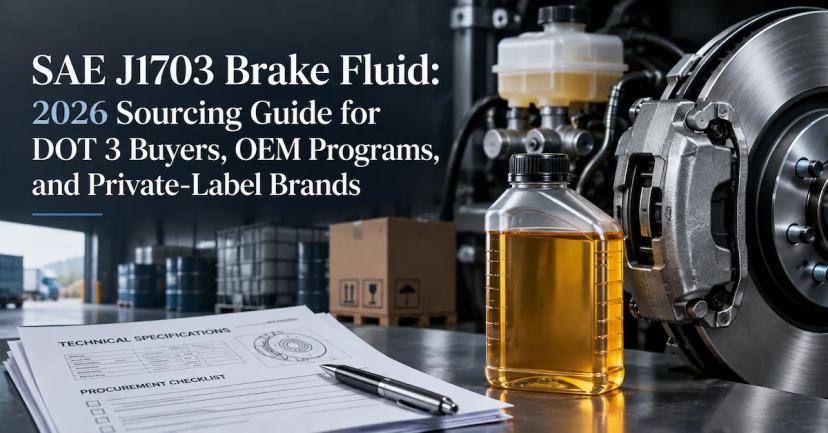
SAE J1703 is an SAE International specification for non-petroleum motor-vehicle hydraulic brake fluids based on glycols, glycol ethers, and suitable inhibitors, for use in compatible automotive braking systems.
For a B2B buyer, however, that definition is only the beginning.
An importer does not purchase a technical standard. A distributor purchases an identifiable commercial fluid, in a particular bottle or drum, produced from a controlled formulation, tested against agreed requirements, labeled for a particular market, and expected to perform consistently across repeated orders.
That is why an RFQ saying only:
“Please quote SAE J1703 Brake Fluid.”
is not detailed enough for a serious supplier comparison.
A better purchasing brief identifies:
- the exact vehicle or market application;
- the SAE J1703 revision required by the project;
- any DOT, ISO, OEM, national, or customer specifications that also apply;
- packaging size;
- private-label requirements;
- test documentation;
- batch-release requirements;
- expected order volume;
- destination market;
- and whether the project is an aftermarket, fleet, workshop, OEM, or private-label program.
GAFLE currently offers a broader brake fluid portfolio covering DOT 3, DOT 4, DOT 5.1, OEM, performance-oriented, energy-vehicle, and off-road categories. For buyers, that portfolio is useful only when the selected product is matched to the actual technical requirement instead of being chosen by catalogue position alone.
Why SAE J1703 Matters to Importers, Distributors, and OEM Buyers
A brake fluid standard serves two different purposes.
From an engineering perspective, it establishes a controlled framework for fluid behavior. From a procurement perspective, it creates a language that buyers and suppliers can use to define minimum expectations.
The problem begins when the standard name becomes a marketing label.
A bottle may say “SAE J1703,” but the buyer still needs to know:
Which formulation was tested?
Which revision was used?
When was it tested?
Which laboratory produced the result?
Which batch-control limits are used in production?
Does the shipped product match the tested formulation?
These questions become especially important when a buyer is putting its own brand on the bottle.
A private-label automotive chemical is not just another purchased component. Once your company name appears on the package, the fluid affects:
- distributor confidence;
- warranty discussions;
- workshop reputation;
- regulatory exposure;
- product returns;
- repeat orders;
- and long-term brand value.
For that reason, SAE J1703 should be treated as part of a product-qualification system, not as a single line of sales copy.
What Does SAE J1703 Actually Cover?
The standard addresses motor-vehicle brake fluids of the non-petroleum type based on glycols, glycol ethers, and suitable inhibitors.
These fluids are intended for hydraulic braking systems in vehicles such as:
- passenger cars;
- trucks;
- buses;
- trailers;
- and other compatible motor vehicles.
The scope also connects the fluid to braking systems that use compatible elastomeric cups and seals, notably SBR and EPDM materials.
That point deserves attention. Brake fluid does not operate by itself.
It continuously interacts with:
- master-cylinder seals;
- wheel-cylinder seals;
- caliper seals;
- hydraulic lines;
- valves;
- ABS hydraulic modules;
- metal components;
- and moisture that may enter the system over time.
A technically credible brake fluid must therefore provide more than a high boiling point.
Its formulation needs to balance:
thermal performance + viscosity + corrosion control + water behavior + material compatibility + chemical stability.
That balance is one reason professional sourcing cannot be reduced to finding the highest number on a TDS.
SAE J1703 Is Commonly Associated With DOT 3—But Do Not Treat the Names as Automatically Interchangeable
One of the most common buyer questions is:
Is SAE J1703 the same as DOT 3?
The most useful answer is:
They occupy closely related performance territory, but they are separate specifications and should be listed separately when a purchase requirement calls for both.
DOT 3 is a performance classification defined under FMVSS No. 116 in the United States. SAE J1703 is an SAE technical standard.
Historically and commercially, SAE J1703 is strongly associated with conventional glycol-based DOT 3 brake-fluid performance, which is why the two frequently appear together on technical data sheets and product labels.
But for B2B qualification, similarity is not proof of equivalence.
If your customer requires FMVSS No. 116 DOT 3 + SAE J1703, write both into the RFQ.
Do not change it to DOT 3 simply because the requirements overlap.
The opposite is also true. If the vehicle or customer specification requires only DOT 3, do not automatically add an SAE compliance claim to artwork unless the supplier has suitable evidence.
FORK's DOT 3 product category can be used as a starting point for buyers evaluating conventional DOT 3 programs. Confirm the exact formulation, intended application, and supporting evidence before selection.
SAE J1703 vs SAE J1704 vs FMVSS No. 116 vs ISO 4925
For purchasing teams, these standards often appear in the same quotation. They should not be collapsed into one specification.
| Reference | Buyer Should Understand It As | Typical Procurement Question |
|---|---|---|
| SAE J1703 | Motor-vehicle non-petroleum glycol/glycol-ether brake-fluid standard | Does the exact fluid have current evidence against the requested J1703 revision? |
| SAE J1704 | A separate SAE brake-fluid standard covering glycol/glycol-ether fluids and corresponding borates | Is J1704 actually required by the vehicle or customer? |
| FMVSS No. 116 | U.S. regulatory performance framework defining DOT fluid categories | Which DOT grade is required for the destination market/application? |
| ISO 4925 | International brake-fluid standard using performance classes | Which ISO edition and class are required? |
| OEM Specification | Vehicle-maker-specific requirement | Is formal OEM approval required or only performance equivalence? |
A disciplined RFQ preserves the exact wording of the customer's requirement.
If a tender says:
SAE J1703 + FMVSS DOT 3
the supplier should quote against those references.
If an OEM specification names another fluid or higher performance level, the purchasing department should not downgrade it to J1703 because a lower-cost product happens to be available.
The Key Performance Areas Buyers Should Review
SAE J1703 contains far more technical content than can reasonably fit on a retail label. For purchasing purposes, it helps to separate the requirements into practical groups.
1. Equilibrium Reflux Boiling Point
Brake fluid can be exposed to substantial heat during braking. Under heavy use, heat generated at the wheel-end braking components can eventually influence fluid temperature.
If the fluid boils, vapor can form. Unlike liquid, vapor is compressible.
This can reduce the efficiency with which pedal force is transmitted through the hydraulic system and can contribute to a soft or spongy pedal.
For this reason, boiling performance is one of the most visible brake-fluid specifications. But the mistake is treating it as the only one.
A product with an impressive fresh-fluid boiling point may still be unsuitable if its viscosity, corrosion behavior, water tolerance, seal compatibility, or batch consistency is inadequate.
2. Wet Boiling Performance
Conventional glycol-based brake fluid is hygroscopic. That means it can absorb moisture.
Over time, moisture can influence the boiling behavior of the fluid. Wet boiling performance therefore gives buyers another perspective on thermal capability after prescribed moisture conditioning.
For:
- humid markets;
- workshops;
- vehicle fleets;
- long distribution chains;
- products stored for significant periods;
- and private-label aftermarket programs,
this parameter deserves real attention.
The procurement team should distinguish:
standard requirement
vs product release limit
vs typical product value
vs actual batch result.
These are not interchangeable.
3. Low-Temperature Viscosity
Brake fluid must flow through narrow hydraulic passages. At lower temperature, fluid becomes more viscous. The colder the operating environment, the more relevant this becomes.
That said, the public scope of SAE J1703 specifically notes that these fluids are not intended for arctic conditions.
This is an important purchasing signal. If a distributor operates in an extremely cold market, “SAE J1703” by itself should not be treated as proof that the fluid is optimal for that environment.
Buyers should check:
- vehicle-maker requirements;
- required low-temperature viscosity;
- climate conditions;
- ABS/ESC hydraulic requirements;
- and whether a lower-viscosity fluid specification is called for.
For applications requiring modern low-viscosity DOT 4 products, GAFLE's DOT 4 portfolio may be a more relevant starting point. Confirm that the selected SKU meets the required viscosity and vehicle specification; a DOT 4 category name alone does not establish low-viscosity performance.
pH, Stability, and Chemistry Matter Too
A reliable brake fluid is a chemical system, not merely a high-boiling liquid. Its components must work together over time.
Important technical considerations include:
- chemical stability;
- inhibitor performance;
- acidity/alkalinity control;
- resistance to degradation;
- evaporation behavior;
- contamination control;
- and interaction with moisture.
A poor formulation can appear acceptable during a simple initial boiling test while creating problems elsewhere.
For example, an aggressive additive package might improve one measurement while negatively affecting compatibility or corrosion behavior.
This is why professional manufacturers balance multiple parameters rather than optimizing one headline number.
For buyers, the lesson is simple: Never qualify brake fluid using one laboratory result.
Corrosion Protection Is a System Requirement
A hydraulic braking system contains different metallic materials. Fluid may contact components made with:
- steel;
- cast iron;
- aluminum;
- brass;
- copper-containing components;
- and other alloys depending on system design.
Brake fluid therefore needs an effective inhibitor package.
A professional corrosion evaluation asks:
- Which test method was used?
- Which metals were evaluated?
- What was the acceptance limit?
- What was the actual result?
- Did the test use the same commercial formulation?
- How is corrosion performance maintained across future batches?
The phrase:
“Excellent anti-corrosion performance”
is a marketing statement.
The phrase:
“Tested against the applicable corrosion requirement using the approved commercial formulation”
is a technical statement. B2B buyers should learn to distinguish them.
Why SBR and EPDM Compatibility Matters
The J1703 scope specifically references brake systems fitted with SBR or EPDM cups and seals.
That is significant because braking performance depends on the fluid and elastomer functioning together.
A brake fluid can influence:
- seal swelling;
- hardness;
- dimensions;
- surface condition;
- and long-term reliability.
Too much swelling is a problem. Too little compatibility can also be a problem.
The requirement is not simply:
“The rubber did not dissolve.”
The objective is controlled compatibility within the prescribed test conditions.
When reviewing a supplier, ask whether:
- the exact commercial fluid was tested;
- both relevant elastomer systems were considered where required;
- test records are traceable;
- and formulation changes trigger technical review.
This becomes particularly important for an OEM/private-label program running for several years.
Water Tolerance Should Not Be Ignored
Water behavior is one of the least glamorous brake-fluid topics and one of the most important. Conventional glycol-based brake fluid is designed with water interaction in mind.
A complete technical evaluation can examine whether controlled water exposure leads to:
- precipitation;
- separation;
- sediment;
- excessive viscosity change;
- or other undesirable behavior.
For importers, this matters because the fluid may pass through:
factory → export warehouse → ocean transport → distributor warehouse → workshop → vehicle.
Each step introduces handling and storage variables. A technically sound formula and moisture-resistant packaging work together to manage that risk.
Brake Fluid Packaging Is Part of Product Quality
Private-label buyers sometimes spend weeks reviewing bottle colors and label artwork but only minutes discussing the closure system. That priority should be reversed.
A brake-fluid package has several jobs:
- Keep the fluid clean.
- Limit unwanted moisture exposure.
- Prevent leakage.
- Protect the product during transport.
- Preserve batch identification.
- Carry accurate technical information.
- Resist workshop handling conditions.
A private-label specification should therefore cover:
- bottle material;
- bottle capacity;
- bottle weight/tolerance if relevant;
- cap design;
- liner or seal;
- tamper evidence;
- label substrate;
- printing method;
- batch code position;
- carton strength;
- pallet configuration;
- and storage requirements.
A successful test of the bulk fluid does not automatically validate every future packaging configuration.
If the closure or package changes, the project team should decide whether revalidation is needed.
What Documents Should a SAE J1703 Brake Fluid Buyer Request?
A supplier's sales quotation should not be the entire technical file. Depending on your market and project, the document package may include:
TDS — Technical Data Sheet
The TDS should identify the product and summarize relevant technical properties.
Check:
- document revision;
- product name;
- standard claims;
- units;
- typical versus guaranteed values;
- and whether the data belongs to the exact product being quoted.
SDS — Safety Data Sheet
The SDS supports safe handling, transport, storage, worker information, and market compliance. Make sure the SDS belongs to the actual formula and target market.
Test Report
A test report is stronger when it identifies:
- sample;
- date;
- method;
- standard revision;
- result;
- acceptance criterion;
- laboratory;
- and report number.
COA — Certificate of Analysis
A COA becomes especially useful when it can be connected to the shipped lot. A generic template does not provide the same level of confidence.
Batch Record / Traceability Information
The supplier should be able to connect:
finished product → filling batch → bulk batch → production record → raw material record.
This does not mean the customer must receive every internal manufacturing file. It means the manufacturer should have a working traceability system.
What a Good COA Should Tell a Buyer
When discussing a COA, buyers often ask for “all test data.” That is not always necessary or efficient.
Instead, agree which critical parameters will be used for production release.
A useful COA structure can include:
| COA Field | Why It Helps |
|---|---|
| Product name/code | Prevents confusion between formulations |
| Batch number | Connects test data to shipped goods |
| Production date | Supports traceability |
| Test parameter | Defines what was measured |
| Specification limit | Shows acceptance criterion |
| Actual result | Demonstrates batch status |
| Test method | Improves technical clarity |
| Release result | Confirms approval |
| Authorized sign-off | Establishes responsibility |
For a repeated private-label program, define the COA fields before mass production.
Do not wait until the container has been loaded to ask what documentation is available.
Quality Control Should Begin With Raw Materials
A final product test cannot compensate for uncontrolled inputs.
A professional brake-fluid factory should manage:
- raw material supplier approval;
- incoming inspection;
- batch identification;
- storage conditions;
- material release;
- formulation records;
- production instructions;
- and change control.
GAFLE's own brake-fluid quality-control process describes quality control as extending from raw-material inspection through laboratory testing, filling, packaging, and batch traceability rather than being limited to final inspection.
That is the correct manufacturing mindset for a safety-critical automotive fluid.
Controlled Blending Matters More Than Most Buyers Realize
Brake fluid production requires repeatability. An approved laboratory formula still has to be reproduced at manufacturing scale.
The production team must manage:
- weighing/dosing accuracy;
- material sequence;
- mixing time;
- process temperature where relevant;
- tank cleanliness;
- moisture control;
- filtration;
- transfer;
- and sampling.
Inconsistent blending can create batch variation even when the raw materials are correct.
For a distributor placing recurring orders, the question should therefore be:
“How is the approved formula locked and reproduced?”
not merely:
“Do you have an automatic machine?”
Automation can improve repeatability, but process control is what matters.
Laboratory Capability Is a Supplier-Selection Factor
Not every supplier needs to perform every possible third-party certification test internally.
But a serious manufacturer should understand the tests governing its product and maintain appropriate internal verification capability.
For brake fluid, laboratory work may involve:
- boiling characteristics;
- viscosity;
- appearance;
- pH;
- corrosion-related evaluation;
- chemical stability;
- moisture-related behavior;
- formulation verification;
- and other batch-release parameters.
GAFLE discusses internal testing, process monitoring, and batch verification across its brake-fluid quality content.
For B2B buyers, an in-house laboratory creates value when it is integrated into production decisions—not simply photographed for marketing.
SAE J1703 Brake Fluid Is Not Automatically Right for Every Vehicle
This is one of the most important conclusions in the entire article.
A product can legitimately fit the SAE J1703 category and still be the wrong fluid for a specific vehicle.
Why? Because the vehicle manufacturer may require:
- DOT 4;
- DOT 4 LV;
- DOT 5.1;
- ISO Class 6;
- ISO Class 7;
- an OEM-specific specification;
- or another hydraulic fluid system entirely.
A buyer should never replace the vehicle requirement with a generic standard just because a product is cheaper or more readily available.
Use this hierarchy:
Vehicle/OEM requirement
→ destination-market regulatory requirement
→ customer/tender specification
→ applicable industry standards
→ supplier technical data
Confirm that all applicable requirements are satisfied together. That process prevents many sourcing mistakes.
Who Is SAE J1703 Brake Fluid Most Relevant For?
Automotive Aftermarket Distributors
A distributor serving older and conventional vehicle populations may see strong demand for DOT 3-type products associated with SAE J1703 requirements.
Its priority is usually:
- stable specification;
- competitive landed cost;
- retail packaging;
- multilingual labeling;
- shelf readiness;
- traceability;
- and repeat supply.
Importers
Importers need stronger documentation because they bridge the manufacturer and local market.
They should verify:
- standard claims;
- SDS/TDS;
- destination requirements;
- packaging;
- labels;
- shipping documentation;
- and batch evidence.
Private-Label Brands
A brand owner needs both technical and marketing control. The bottle must be attractive, but every claim also needs technical support.
Fleet Maintenance Buyers
A fleet may care less about retail design and more about:
- vehicle compatibility;
- repeatability;
- bulk packaging;
- service consistency;
- maintenance procedures;
- and total operating cost.
Workshop Chains
Workshop chains need product selection to be simple and defensible. A single fluid cannot automatically cover every vehicle entering the shop.
OEM and Tier Projects
These buyers may impose:
- change-control requirements;
- audit expectations;
- sample approval;
- PPAP-like documentation;
- special packaging;
- customer-specific tests;
- and tighter traceability.
Who Should Not Buy Solely by SAE J1703?
Do not use SAE J1703 alone as the purchasing decision when:
- the vehicle specifies DOT 4 or DOT 5.1;
- the system requires a low-viscosity fluid;
- the application operates in extreme arctic conditions;
- an OEM-specific approval is mandatory;
- the system uses silicone DOT 5;
- the system uses mineral hydraulic fluid;
- a tender specifies another standard;
- or the proposed supplier cannot provide evidence for the exact product.
The phrase “meets SAE J1703” cannot override a vehicle manual.
A Practical SAE J1703 Supplier Qualification Checklist
Use the following table during supplier comparison.
| Qualification Item | Buyer Question | Red Flag |
|---|---|---|
| Standard revision | Which SAE J1703 revision supports the claim? | “Any version is the same.” |
| Product identity | Which exact SKU/formula was tested? | Unidentified sample |
| DOT classification | Which DOT grade is claimed? | Vague “universal” fluid |
| TDS | Is it current and product-specific? | Old or generic document |
| SDS | Does it match the commercial formula? | Different product name |
| Test evidence | Which laboratory/method/date? | Screenshot without traceability |
| Batch QC | What tests release each lot? | Only visual inspection |
| Raw materials | How are incoming materials controlled? | No batch records |
| Formula control | How are changes managed? | Uncontrolled substitution |
| Packaging | What protects the fluid from moisture? | Lowest-cost closure only |
| COA | Is it shipment-specific? | Generic template |
| Traceability | Can product be traced by lot? | No batch code |
| OEM/private label | What can be customized? | Artwork only, no tech control |
| Lead time | What drives the schedule? | Unsupported fixed promise |
| Complaint process | How is a field issue investigated? | No retained records |
SAE J1703 vs DOT 3: What Should Buyers Put on the RFQ?
If your customer needs both, use both.
A strong line item may look like:
Product: Glycol-based motor vehicle brake fluid
Performance Requirement: FMVSS No. 116 DOT 3 + SAE J1703, latest/customer-specified revision
Application: Passenger vehicle aftermarket
Market: [Country]
Pack Size: 500 mL / 1 L / 4 L / 20 L, subject to supplier confirmation
Branding: Private Label
Required Documents: TDS, SDS, agreed test report, batch COA
Quantity: Initial order + annual forecast
This approach creates comparable supplier quotations.
Without it, Supplier A may quote a basic retail DOT 3 formulation while Supplier B prices a different technical and packaging package.
The prices look different because the products are different.
How to Evaluate a Brake Fluid Manufacturer Beyond the Certificate Wall
Certifications matter, but they need context.
A framed certificate on the wall does not tell you:
- whether the formula is controlled;
- whether each batch is tested;
- whether the filling line is clean;
- whether the cap protects against moisture;
- whether records are traceable;
- or whether the shipped product matches the approved sample.
Evaluate the manufacturing system. Look at:
Production Environment
Brake fluid is sensitive to contamination and moisture. Cleanliness matters.
Process Standardization
The process should be documented and repeatable.
Laboratory Integration
QC results should influence release decisions.
Filling Control
Correct fill volume, package integrity, cap installation, and labeling are part of final quality.
Batch Traceability
A field complaint should be traceable backward.
Change Control
Formula or packaging changes should not happen silently in a long-term OEM project.
GAFLE describes these manufacturing stages in its OEM brake-fluid workflow, which covers requirement confirmation, manufacturing, quality inspection, customized packaging, traceability, loading, and export delivery.
OEM and Private-Label SAE J1703 Projects: A Better Workflow
A successful B2B program should be structured from the beginning.
Stage 1 — Market and Vehicle Definition
Specify:
- country;
- vehicle population;
- intended channel;
- operating climate;
- regulatory requirements;
- and customer specification.
Stage 2 — Standard Confirmation
Confirm:
- SAE J1703 revision;
- DOT grade;
- ISO requirement if any;
- local requirement;
- OEM requirement.
Stage 3 — Formula Selection
Choose an existing product if it meets the project.
Custom development is not automatically better. A proven formulation may reduce risk and development time.
Stage 4 — Technical Documentation
Review:
- TDS;
- SDS;
- available test evidence;
- acceptance limits;
- and internal production specifications.
Stage 5 — Packaging Definition
Confirm:
- bottle;
- cap;
- seal;
- label;
- barcode;
- carton;
- languages;
- pallet.
Stage 6 — Sample Approval
Approve both the fluid and the physical pack.
Stage 7 — Artwork Review
Do not allow the graphics team to add unsupported claims.
Stage 8 — Production
Manufacture to the approved reference.
Stage 9 — Batch Testing and Release
Complete agreed QC before shipment.
Stage 10 — Export and Repeat-Order Control
Maintain approved specifications for future batches.
What Determines SAE J1703 Brake Fluid Cost?
There is no responsible universal price per litre. A quotation depends on the full project.
Key variables include:
- formulation;
- performance requirement;
- packaging volume;
- bottle design;
- cap/seal;
- printed label;
- carton;
- order quantity;
- number of SKUs;
- testing requirements;
- private-label design;
- shipping terms;
- destination;
- palletization;
- documentation;
- and annual forecast.
A buyer should therefore compare normalized quotations.
If one supplier quotes:
- bulk fluid;
- plain bottle;
- no custom label;
- no batch COA;
while another quote includes:
- private-label packaging;
- custom carton;
- agreed testing;
- batch documentation;
- export pallet,
the unit prices are not directly comparable.
The correct purchasing question is:
What does each price include?
MOQ and Lead Time: Ask the Right Question
MOQ is not just a factory preference. It may be influenced by:
- production batch size;
- packaging purchase quantity;
- custom bottle requirements;
- printed label MOQ;
- carton MOQ;
- number of SKUs;
- filling-line setup;
- and export logistics.
Similarly, lead time may include:
technical confirmation
+ artwork
+ packaging production
+ fluid production
+ testing
+ filling
+ inspection
+ shipment preparation.
For this reason, avoid asking:
“What is your fastest lead time?”
Ask:
“What is the lead time after technical and artwork approval, and which project elements can extend it?”
That produces a much more useful answer.
Five Common SAE J1703 Brake Fluid Sourcing Mistakes
Mistake 1: Treating SAE J1703 as a Product Name
It is a technical standard, not a brand or universal formula.
Mistake 2: Assuming SAE J1703 and DOT 3 Are Automatically Identical
They may appear together, but your purchase order should preserve every required standard.
Mistake 3: Selecting by Dry Boiling Point Alone
Brake fluid must also perform across wet boiling, viscosity, corrosion, water behavior, stability, and material compatibility.
Mistake 4: Approving the Label Before the Technical Product
The technical specification should control the artwork—not the other way around.
Mistake 5: Accepting an Old Test Report Without Checking Revision or Formula
A historical report may not represent:
- the current standard;
- current formulation;
- current packaging;
- or current production batch.
Why Repeat-Order Consistency Is More Important Than a Perfect Sample
A supplier can prepare one excellent sample. A real commercial program may require:
- 20 containers;
- dozens of batches;
- multiple years;
- and several packaging updates.
The buyer therefore needs a system that keeps future production close to the approved product.
That means controlling:
- raw materials;
- formula;
- process;
- laboratory checks;
- packaging;
- artwork;
- change notifications;
- and batch records.
GAFLE discusses this approach in its article on consistent brake-fluid formulations, emphasizing controlled materials, standardized production, testing, and quality management.
For procurement teams, consistency is not a secondary benefit. It is part of product performance.
What Makes GAFLE Relevant to SAE J1703 Brake Fluid Buyers?
GAFLE is positioned as a manufacturer of automotive chemical products with an established brake-fluid portfolio.
Its website currently presents:
- DOT 3;
- DOT 4;
- DOT 5.1;
- OEM;
- performance/racing;
- energy-vehicle;
- and off-road brake-fluid categories.
For DOT 4 product and manufacturing content, GAFLE publicly references major standards including SAE J1703/J1704 alongside FMVSS, ISO, and other brake-fluid specifications.
However, a buyer should still verify the exact proposed product.
Do not assume that because a manufacturer references SAE J1703 somewhere in its portfolio, every SKU automatically carries every standard claim.
A technically correct purchasing process asks for:
- the exact product;
- current TDS;
- current standard reference;
- test evidence;
- production-release criteria;
- packaging specification;
- and batch documentation.
That transparency helps both buyer and manufacturer avoid misunderstandings.
You can first review the GAFLE brake fluid range, then compare its DOT 3 category, and finally submit your project through the contact page.
What Information Should You Send GAFLE for an Accurate Quote?
A high-quality inquiry should contain:
Destination Market
Country or region.
Application
Passenger cars, commercial vehicles, fleet, workshop, aftermarket, OEM, etc.
Required Standard
SAE J1703 revision plus any DOT, ISO, JIS, GB, or OEM requirements.
Grade
DOT 3, DOT 4, DOT 5.1, or project-specific.
Package
250 mL, 500 mL, 1 L, 4 L, 20 L, drum, etc., according to actual availability.
Brand
GAFLE or Private Label.
Initial Quantity
Annual Forecast
Target Delivery Date
Required Documents
Artwork Status
Target Price Position
Economy, mainstream, premium, fleet, performance.
When these details are available, the manufacturer can evaluate the actual project instead of sending a generic catalogue.
Frequently Asked Questions About SAE J1703 Brake Fluid
1. What is SAE J1703 Brake Fluid?
SAE J1703 is an SAE International technical standard covering non-petroleum motor-vehicle brake fluids based primarily on glycols and glycol ethers with suitable inhibitors. It is intended for compatible hydraulic brake systems and addresses performance areas relevant to fluid behavior, materials, and system reliability.
2. Is SAE J1703 the same as DOT 3?
Not exactly. SAE J1703 and FMVSS No. 116 DOT 3 are separate references, although they are closely related in conventional glycol-based brake-fluid applications and frequently appear together on product documentation. If a customer requires both, list both requirements separately.
3. What is the current SAE J1703 revision?
When preparing a current procurement project, buyers should check the latest SAE catalogue and specify the required edition in the RFQ instead of using an undated “SAE J1703” reference. This prevents suppliers from relying on historical documentation without clarification.
4. Is SAE J1703 suitable for arctic conditions?
The published scope states that J1703 fluids are not intended for arctic conditions. For severe cold environments, the vehicle specification and required low-temperature viscosity should be reviewed before selecting the fluid.
5. What vehicles can use SAE J1703-type brake fluid?
The standard covers fluids intended for compatible motor-vehicle braking systems such as those found in passenger cars, trucks, buses, and trailers. That does not mean every such vehicle should use J1703 fluid; the vehicle manufacturer's requirement remains the primary selection reference.
6. Is SAE J1703 a glycol-based brake fluid?
Yes. The standard scope describes non-petroleum fluids based on glycols, glycol ethers, and appropriate inhibitors. Buyers should not confuse this type of fluid with silicone DOT 5 or mineral hydraulic fluids.
7. What should a distributor test before buying?
A distributor should review the complete applicable standard rather than one property. Useful areas include boiling behavior, viscosity, corrosion, stability, water tolerance, material compatibility, TDS/SDS, batch QC, package integrity, and traceability.
8. Can a private-label brand print “SAE J1703” on its bottle?
Only when the exact commercial formula and relevant technical evidence support the claim and the label is appropriate for the destination market. Artwork should be approved after technical qualification.
9. What is the difference between SAE J1703 and SAE J1704?
They are separate SAE brake-fluid standards. J1703 covers conventional glycol/glycol-ether motor-vehicle brake fluids, while J1704 also includes corresponding borates within its scope. Buyers should follow the exact vehicle/customer requirement rather than treating J1704 as an automatic “upgrade.”
10. How can I request OEM SAE J1703 Brake Fluid from GAFLE?
Send the target market, grade, standards, vehicle application, packaging format, quantity, private-label requirements and document list through the GAFLE contact page. For projects where the required standard is uncertain, provide the original customer or vehicle specification rather than guessing.
Conclusion
SAE J1703 Brake Fluid sourcing is not simply about finding a bottle carrying a familiar standard number. For importers, distributors, workshop networks, fleets, OEM programs, and private-label brands, the real purchasing decision includes the correct standard revision, intended vehicle application, DOT or other supporting requirements, boiling behavior, low-temperature viscosity, corrosion protection, water tolerance, elastomer compatibility, formulation control, batch testing, packaging integrity, traceability, and repeat-order consistency.
The strongest buying process begins with the vehicle or customer requirement and works backward to the exact commercial product. It does not assume that SAE J1703 automatically equals every DOT 3 product, and it does not assume that one test report proves every future batch. Buyers should ask which formula was evaluated, which standard edition applies, which properties are controlled during production, which documents accompany the shipment, and how formulation or packaging changes are managed.
For private-label projects, this discipline becomes even more important because technical quality and brand reputation become inseparable. Fluid, bottle, closure, label, carton, batch code, test evidence, and production records all belong to the same product.
FORK's brake fluid portfolio gives B2B buyers access to DOT 3, DOT 4, DOT 5.1 and application-oriented brake-fluid categories, while its manufacturing content emphasizes raw-material inspection, controlled production, laboratory verification, filling, packaging, and batch traceability. If your next project requires SAE J1703, DOT 3, OEM packaging, private labeling, or a broader brake-fluid program, prepare a structured specification and contact GAFLE for a product and sourcing review rather than requesting price alone.