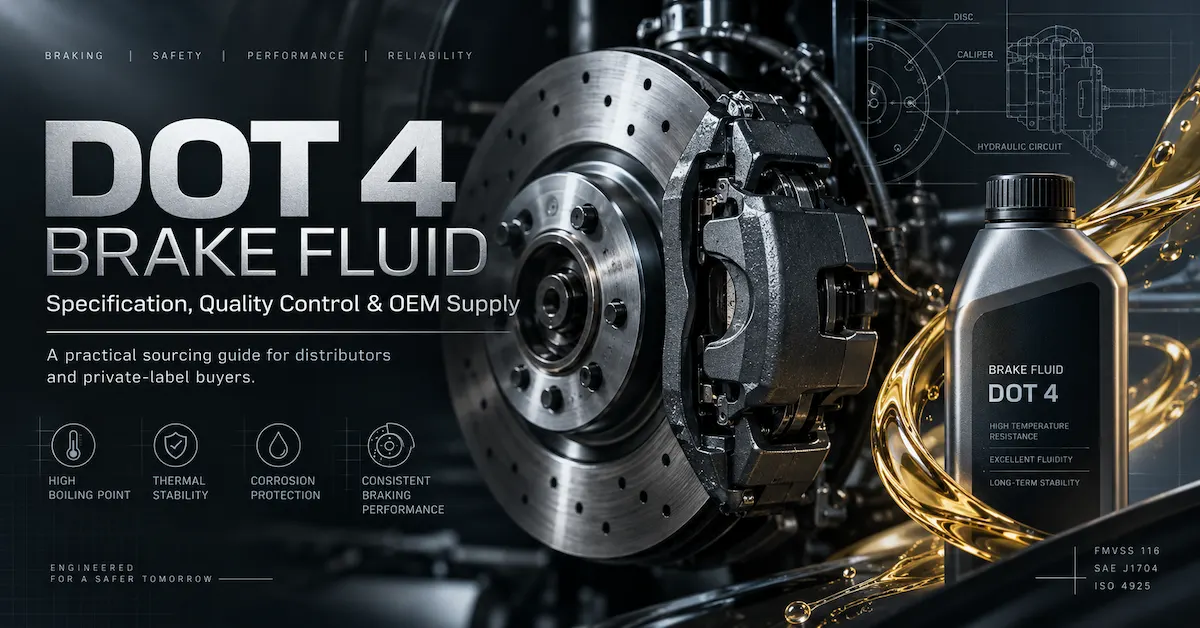
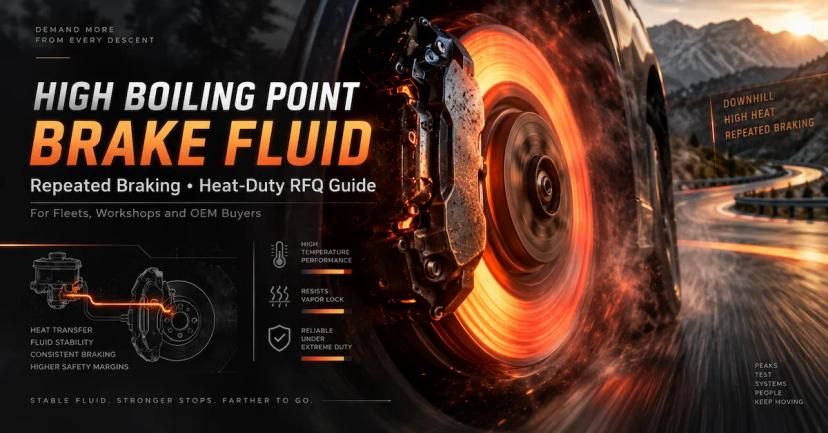
A coach descending the same mountain road every afternoon, a pickup towing close to its rated load, and a track car entering a twenty-minute session all put heat into their brakes. Yet those vehicles do not create identical fluid requirements. The coach has long service intervals and varied drivers. The tow vehicle must also behave on cold starts and ordinary roads. The track car may be bled between events. Buying all three from a catalogue headline such as “325°C” skips the questions that determine whether the fluid is suitable.
For procurement, High Boiling Point Brake Fluid is not a separate DOT grade. It is a useful commercial description only after the buyer defines the vehicle requirement, the heat-producing duty cycle, the condition in which boiling performance is measured, the low-temperature response needed by the hydraulic controls, and the evidence that will accompany each production lot. A large new-fluid result can add thermal margin, but it cannot compensate for the wrong chemistry family, an unmet OEM requirement, weak wet performance, or moisture introduced during storage.
The scope here is deliberately narrow: brake fluid used in motor-vehicle hydraulic circuits. A compressed-air service brake has no DOT fluid reservoir, so mixed, air-over-hydraulic, clutch, and auxiliary layouts must be broken down circuit by circuit before anyone writes the specification.
This guide turns that distinction into a purchasing method. The reader may be a fleet engineer, distributor, importer, workshop buyer, motorsport purchaser, or private-label team; the shared job is to separate a webpage claim from a limit the factory will actually guarantee. Regulatory thresholds below are reference values, not test results for any named GAFLE item. Public product-page figures are treated as claims to be confirmed against the current TDS, SDS, test method, specification limits, COA format, and lot records before approval.
The short answer: buy thermal reserve as a complete profile
A defensible High Boiling Point Brake Fluid selection follows six gates. First, confirm what the vehicle or brake-system maker permits. Second, describe the hardest credible service condition with route, load, speed, climate, and maintenance facts. Third, compare guaranteed equilibrium reflux boiling point (ERBP) and wet ERBP under identified methods. Fourth, check cold and hot viscosity, corrosion, stability, water tolerance, elastomer behavior, and the remaining applicable requirements. At gate five, ask whether commercial production and its package can repeat what the approved sample did. The last gate follows the can or drum beyond dispatch: it must stay closed, dry, and uncontaminated through storage and dispensing.
There is no prize for the largest number on the comparison sheet; the figure earns its place only when it controls a real heat risk. A buyer needs enough margin for the actual thermal duty, backed by evidence the supplier is willing to place in the contract. Excess margin may be welcome, but it should not displace more important requirements. If a winter fleet needs rapid ABS or ESC modulation, a thick fluid at very low temperature can be the controlling issue. If stock sits in a humid workshop after opening, the closure and pack size may decide how much of the laboratory advantage reaches the vehicle.
| Decision gate | Question the buyer must close | Acceptable evidence | Warning sign |
|---|---|---|---|
| Vehicle permission | Which grade, fluid family, and OEM specification apply to each model? | Vehicle manual, service data, or written system requirement | A universal-fit answer without model information |
| Thermal duty | What repeated braking event creates the credible worst case? | Route, mass, trailer, speed, session, temperature, and service records | “Heavy duty” appears with no operating definition |
| Fluid profile | Are dry, wet, viscosity, material, and stability results sufficient together? | Dated specification, named methods, actual results, and clear limits | One typical temperature is the entire technical proposal |
| Production proof | Will the commercial lot match the approved sample? | Master specification, release plan, lot COA, traceability, retained sample | Sample and shipment use different or unexplained formula codes |
| Moisture control | Can the sealed condition survive filling, freight, storage, and workshop use? | Closure drawing, leak test, transit check, and handling procedure | Open transfer or partly used packs have no written control |
Translate repeated braking into an RFQ instead of an adjective
Heat at the friction interface does not become a brake-fluid requirement through a single conversion formula. The path from rotor heat to fluid temperature changes with the hardware and the way the vehicle is used: pad and rotor design, caliper layout, airflow, axle load, brake balance, regenerative strategy, driver input, and maintenance condition all move the result. Purchasing can turn that field history into a measurable target, but permission to change fluid belongs with the vehicle or brake-system engineering authority.
For a mountain fleet, useful facts include maximum gross mass, gradient, descent length, stop frequency, ambient temperature, retarder use, observed brake temperatures, current change interval, and any history of soft pedal or boiling-related diagnosis. “Mountain use” by itself tells a formulator very little. Even identical gradients can produce different outcomes: one descent may include cooling stretches, while another feeds straight into slow traffic and repeated stops.
A towing brief should list the tow vehicle, trailer and combined mass, terrain, climate, frequency of use, and how the trailer is braked. Occasional light towing is not the same duty as daily loaded descents. Fluid selection also cannot replace brake inspection, correct operating practice, or an authorized maintenance plan.
Track buyers should record session length, circuit, vehicle and brake setup, measured temperatures, event frequency, bleeding practice, and any public-road use. Fresh-fluid margin may carry more weight when the system is serviced before each event, but wet performance still belongs in the comparison. Competition positioning does not establish road suitability.
| Application | Heat pattern | Evidence to emphasize | Operational facts to collect | Common purchasing error |
|---|---|---|---|---|
| Hydraulic-brake coach or shuttle | Long, repeated energy input with limited cooling | Guaranteed ERBP, wet ERBP, stability, corrosion, lot consistency | Route profile, gross mass, brake history, maintenance records | Trying to solve a mechanical or operating problem with fluid alone |
| Tow vehicle | High load during descents mixed with normal road use | Vehicle approval, dry and wet reserve, cold response where relevant | Combined mass, trailer brakes, terrain, season, frequency | Buying for the heaviest imagined trailer rather than the permitted setup |
| Track or competition car | Short, intense cycles with planned service windows | New-fluid margin, wet result, repeatability, package integrity | Session, circuit, setup, temperature data, bleed schedule | Treating a racing label as proof of road or OEM suitability |
| Urban delivery fleet | Frequent modest events with variable drivers and service quality | Model-specific fit, retained performance, handling controls | Stops per shift, payload, climate, opened-pack turnover | Using one premium product across an incompatible mixed fleet |
| Off-road or work vehicle | Load, grade, low speed, contamination, and broad temperature swings | Equipment requirement, full fluid profile, pack durability | Cycle time, slope, load, dust, storage, service access | Assuming “off-road” specifies a fluid grade |
A search for High Boiling Point Brake Fluid for Automotive Applications often begins with vehicle type, but the usable specification ends with much finer detail. Model year, control system, permitted grade, actual load, minimum start temperature, service interval, and package turnover convert a broad product category into a shortlist.
Dry ERBP and wet ERBP answer different purchasing questions
Commercial literature often calls ERBP the dry boiling point. It is an atmospheric-pressure equilibrium reflux laboratory result for new fluid, not a measured caliper temperature. It helps describe the margin of fresh, sealed material, but proposals are comparable only when sample state and method are clear.
Wet ERBP follows a prescribed humidification process rather than an informal water addition. In FMVSS No. 116, separate candidate-fluid and SAE TEGME referee-material samples are humidified in paired desiccators; when the average referee water content reaches 3.70±0.05 percent by weight, the candidate samples are removed, their own water content is measured, and their ERBP is determined. It is inaccurate to claim that every candidate simply contains exactly 3.7 percent added water.
The two figures should be read as a pair. Fresh ERBP helps with initial thermal margin. Wet ERBP offers a standardized way to compare retained boiling behavior after moisture conditioning. Neither value predicts an exact field boiling temperature, because the vehicle, local pressure, contamination, installation, and service history differ from the laboratory. Wet ERBP also does not establish a universal replacement interval. The vehicle maker's instructions and the fleet's controlled maintenance data still govern service decisions.
When two suppliers present the same headline, the details can reveal different commercial value. One may state a typical fresh result from a development batch. Another may guarantee a lower minimum on every released lot and report it on the COA. The typical number looks stronger on a brochure, but the guaranteed minimum is the value the buyer can enforce. A useful bid table keeps “typical,” “minimum,” “maximum,” and “range” in separate columns.
| Statement in a proposal | What it may mean | Question to return | Contract-ready form |
|---|---|---|---|
| “Boiling point 325°C” | Could be a fresh typical result, threshold claim, or rounded marketing figure | ERBP or wet ERBP? Which method, sample, date, and acceptance rule? | Named method; new-fluid ERBP; minimum value; production release frequency |
| “Wet boiling point tested” | A wet result exists, but conditioning and limit are unknown | Which humidification procedure and standard edition were used? | Named wet ERBP method; minimum; report and lot linkage |
| “Meets DOT 4” | Manufacturer asserts conformity with the grade | Can the complete current conformity evidence and labeling basis be reviewed? | Manufacturer declaration, applicable test file, specification, and compliant label |
| “Typical 280°C” | Representative performance, not necessarily a release commitment | What minimum will appear in the signed master specification? | Typical value marked informative; separate guaranteed production minimum |
| “Test report available” | Some sample was tested at some time | Does the report identify the offered formula, method, laboratory, and issue date? | Report code tied to sample, formula revision, and approval record |
Use DOT thresholds as gates, not as a complete product ranking
U.S. buyers should start with the public rule at 49 CFR §571.116, FMVSS No. 116. The selected thresholds below help a buyer recognize the grade floor. They are not a substitute for the complete standard, and they do not mean that every fluid above a boiling threshold is suitable for every vehicle carrying that grade.
| U.S.label family | Minimum ERBP | Minimum wet ERBP | Maximum viscosity at -40°C | Important distinction |
|---|---|---|---|---|
| DOT 3 | 205°C / 401°F | 140°C / 284°F | 1,500 mm²/s | A product may exceed the boiling floor while remaining a DOT 3 offer |
| DOT 4 | 230°C / 446°F | 155°C / 311°F | 1,800 mm²/s | The grade limit alone does not establish a low-viscosity claim |
| DOT 5 silicone base | 260°C / 500°F | 180°C / 356°F | 900 mm²/s | Silicone chemistry must not be confused with DOT 5.1 |
| DOT 5.1 non-silicone base | 260°C / 500°F | 180°C / 356°F | 900 mm²/s | The decimal identifies a different family from DOT 5 silicone fluid |
FMVSS No. 116 also sets a 1.5 mm²/s minimum viscosity at 100°C for these grades and addresses pH where applicable, stability, corrosion, low-temperature behavior, water tolerance, compatibility, oxidation, rubber effects, stroking, packaging, and labeling. U.S. container labeling includes the product's own minimum wet boiling point in degrees Fahrenheit, not merely the grade floor. For ISO or OEM programs, name the standard edition and class in the contract; a standard number alone is incomplete.
In the U.S. system, the manufacturer furnishes conformity certification, and the packager must place the required certification and markings on the retail container; NHTSA does not pre-approve the bottle. “DOT approved” should not be used as though a government agency approved the product. Ask who makes the conformity determination, what product code it covers, which report supports it, and how the marketed label is controlled. A registration, quality-management certificate, or laboratory accreditation may be useful, but none of those documents alone proves that a particular lot meets every fluid requirement.
Why a 325°C High Boiling Point Brake Fluid headline is incomplete
A headline such as 325°C immediately attracts a heat-duty buyer, but it leaves four commercial questions open. Is the figure ERBP or wet ERBP? Is it a typical result or a guaranteed minimum? Which test method and standard edition apply? Does the evidence belong to the exact formula and production site offered in the quotation? Until those points are answered, the number is useful for discovery, not final approval.
The product page for High Performance Brake Fluid with High Boiling Point states a boiling point above 325°C and positions Racing 325 for demanding conditions. The public copy does not define that number as dry or wet under a named method. A serious buyer should request the current technical sheet, full claimed grade, ERBP definition, wet result, method, production tolerance, road-use status where relevant, and a representative or lot-specific report.
The distinction makes bids comparable. A 326°C development result and a 315°C production minimum are different statements; only the latter describes a release obligation. Ask how the catalogue, specification, label, report, and COA relate, and resolve inconsistent terms before approval.
High ERBP does not cool the brake assembly, guarantee stopping distance, or prevent every kind of fade. Vapor formation in hydraulic fluid is different from loss of friction at overheated pads, discs, or drums. Investigate hardware condition, loading, cooling, operating technique, and system faults alongside the fluid.

High boiling performance and low-temperature viscosity must coexist
High thermal margin and low cold viscosity describe different parts of the operating envelope. The first concerns resistance to vapor formation under the defined boiling test. The second concerns how readily fluid moves at a specified low temperature. Modern ABS and ESC units can make rapid pressure changes through narrow passages and valves, so a cold-climate buyer cannot assume that the product with the highest fresh boiling result will also provide the required cold response.
A proposal for Low Viscosity High Boiling Point Brake Fluid needs numbers, temperatures, methods, and the controlling vehicle specification. “Low viscosity” without a measured limit at -40°C is not enough. Nor should the buyer judge a low-viscosity product by cold flow alone. Its ERBP, wet ERBP, hot viscosity, stability, corrosion performance, material behavior, and grade conformity still require review.
This balance is especially important in fleets that cross climates. A coach may face a steep descent in summer and an overnight cold soak in winter. A distributor serving several countries may need separate, clearly positioned SKUs rather than one product presented as optimal everywhere. Build a temperature-and-duty matrix from actual markets, then ask candidates to document both ends of the range. A premium fluid is the one that meets the complete application, not the one that wins the most photogenic column.
Build an evidence ladder before comparing products
Buyers often receive many documents but still lack a coherent evidence chain. Start with the signed master specification. It defines what production must meet. A TDS communicates selected properties and uses, while an SDS addresses hazard and handling information; neither should silently replace the contract specification. A laboratory report shows what happened to an identified sample. A COA shows agreed results or conformity for a specific production lot. The label and package then carry the approved identity and required statements into the market.
| Evidence item | What it should establish | Identity details to check | What it does not prove alone |
|---|---|---|---|
| Master specification | Grade, formula revision, limits, methods, and release rules | Product code, revision, issue date, signatures | That a particular shipped lot passed |
| TDS and SDS | Published properties, intended use, safety, handling, and storage information | Exact name, language, revision, market, supplier | Lot release or every marketing claim |
| Test report | Results for an identified sample under named methods | Sample code, formula, laboratory, dates, methods | Unchanged production forever or all-market approval |
| Lot COA | Agreed release data for the batch being shipped | Batch, product, manufacture date, results, authorization | Tests omitted from the agreed COA panel |
| Package and label file | Identity, claims, warnings, closure, code, and market presentation | Artwork revision, drawing, material, cap, liner, barcode | The chemical result inside the pack |
A useful claim-support matrix puts each label statement on one row and identifies the source document, applicable SKU, method, result, owner, and review date. “High boiling point,” “DOT 4,” “Class 6,” “racing,” and “suitable for [application]” do not have the same evidentiary basis. If the package, webpage, and TDS quote different values, the product should remain on hold until one approved master is established.
Use public product pages as a shortlist, not as certificates
GAFLE's current catalogue provides several starting points for a high-heat discussion. The pages differ in positioning and in the amount of numerical information shown. That is normal for public catalogue copy, but purchasing should not fill the gaps by assumption. The table below records only what the cited pages publicly claim and the questions that remain open for technical qualification.
| Catalogue candidate | Public positioning | Public numerical statement | Qualification questions |
|---|---|---|---|
| Racing 325 | Racing, demanding driving, and high-load use | Website says boiling point above 325°C | Dry or wet definition, method, guaranteed minimum, grade, road-use status |
| EV-608 | New-energy and heavy-duty themes; 1 L metal can shown | Page claims ERBP at least 268°C and wet ERBP at least 175°C | Method, grade, vehicle requirement, tolerance, current COA fields |
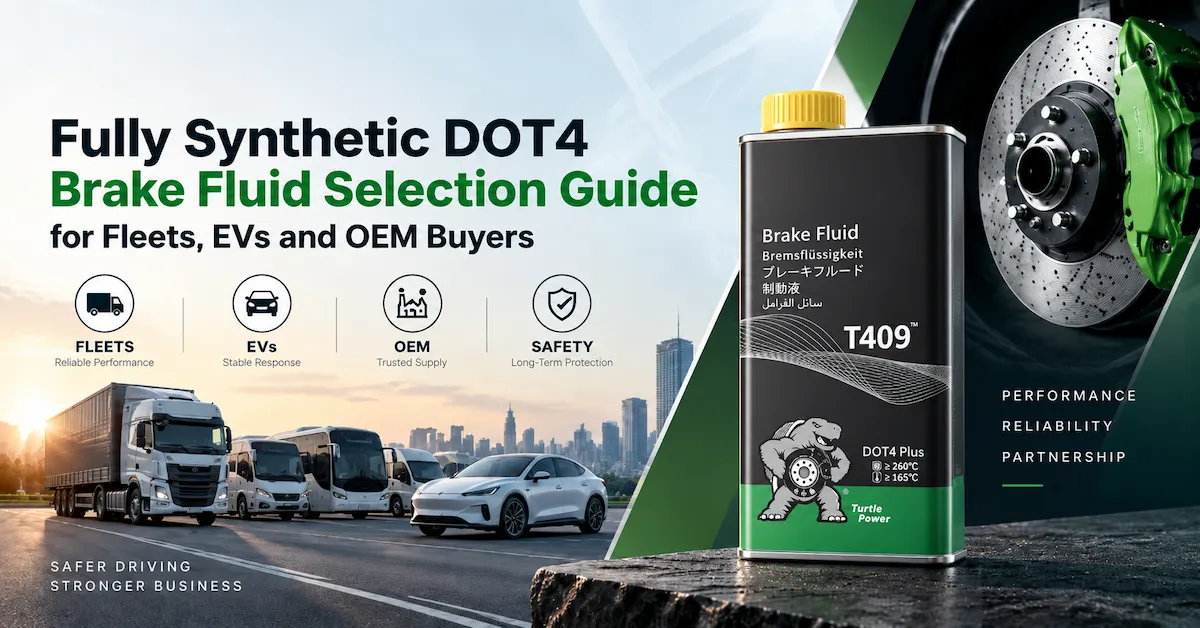
| T409 / DOT409 | Website positions it as DOT4 Plus for steep grades, trucks, and off-road conditions | Page copy says up to 260°C | Typical versus minimum, governing document, package-copy consistency |
| 703 / T703 | DOT 5.1 category and modern hydraulic systems | Public body copy does not provide a complete test table | Grade evidence, ISO class and edition where claimed, guaranteed profile |
| DOT407 | General DOT 4 passenger and light-commercial reference | Page describes higher boiling performance than DOT 3 without a full numerical table | Exact SKU, full limits, method, production data, availability |
A buyer looking for Synthetic High Boiling Point Brake Fluid should also remember that “synthetic” is not a DOT grade or an approval. The proposal must still identify the chemistry family and exact performance claim. DOT 5 silicone and DOT 5.1 non-silicone are distinct despite the similar numbers. Mineral-oil hydraulic fluids form another family. Never infer compatibility or an upgrade path from the word synthetic.
Request a Heat-Duty Brake Fluid ShortlistTrace the headline temperature to an accountable factory lot
A High Boiling Point Brake Fluid Supplier may own the customer relationship, quotation, export file, and stock plan without operating the blending line. That arrangement can be workable, but the buyer needs a visible responsibility chain. Identify the legal seller, formula owner, blending site, filling site, batch-release authority, complaint contact, and party responsible for destination-market claims.
During qualification of a High Boiling Point Brake Fluid Manufacturer, follow one representative lot through the real process. Review incoming identity controls, moisture-sensitive material handling, charge records, blending parameters, intermediate checks, filling, closure application, coding, laboratory sampling, release, retained samples, and dispatch. Equipment photographs may help orient the review, but records show whether the process was controlled.
Certificates should be checked for issuer, validity, address, and scope. A quality-management certificate can support confidence in the system; it does not certify the boiling point of a named product. Laboratory accreditation can show competence for listed methods; it does not automatically cover every test in the catalogue. The audit should connect each document to the offered formula, relevant site, and person authorized to release production.
| Audit topic | Evidence to sample | Why it matters for heat-duty fluid | Contract output |
|---|---|---|---|
| Formula control | Approved bill, revision history, substitute-material authorization | Unreviewed changes can alter the whole performance balance | Named formula revision and advance change notice |
| Method control | Current procedures, training, calibration, quality-control records | A number is comparable only when its method is controlled | Agreed methods and handling of outside-lab tests |
| Batch release | Recent records, deviations, COAs, electronic or signed authorization | The approved sample must be reproduced under commercial timing | Release test panel, frequency, limits, and authority |
| Traceability | Finished code back to filling, blend, and key raw-material lots | Complaints require a narrow, reliable investigation scope | Coding format, record period, retained-sample rule |
| Package control | Bottle or can, cap, liner, torque, leak checks, freight trials | Moisture protection preserves the tested fluid condition | Approved component drawings and inspection plan |
Freeze the heat claim before OEM artwork begins
An OEM High Boiling Point Brake Fluid project joins technical performance to brand claims, market rules, pack design, and repeat supply. The liquid should be selected before the label promises are frozen. Otherwise, a dramatic mock-up can pressure the technical team to support a temperature or application that the final formula does not guarantee.
Begin with an application brief that names destination countries, vehicle segments, required standards, severe-duty examples, minimum climate, service channel, annual volume, and pack sizes. Then freeze a technical target containing the chemistry family, grade, standard edition, class where applicable, guaranteed ERBP and wet ERBP, viscosity limits at named temperatures, required material tests, methods, and COA fields. Mark each value as minimum, maximum, range, or typical.
Approve the coded sample and its documents together. The sample identifier should appear on the relevant report and be linked to the proposed formula revision. Next, test the actual pack: fill, cap, liner, tamper feature, print, batch code, barcode, carton, pallet, orientation, and intended freight route. Finally, issue a signed golden file that connects formula, specification, artwork, packaging drawing, quality plan, and change-control rule.
| OEM gate | Buyer decision | Supplier output | Release record |
|---|---|---|---|
| 1. Application | Markets, vehicles, duty, climate, channel, volume | Fit assessment, exclusions, candidate products | Approved brief |
| 2. Formula | Grade, complete limits, methods, claims | Coded sample, TDS, SDS, test file | Signed master specification |
| 3. Package | Fill, material, closure, channel, route | Drawings, filled samples, integrity proposal | Approved components and transit result |
| 4. Artwork | Brand, claims, languages, importer data, code | Print proof and claim-support matrix | Signed artwork master |
| 5. Production | PO, quantity, release, delivery, inspection | Lot COA, codes, pack records, shipment file | Authorized batch release |
Protect wet boiling reserve across every bulk transfer
A Bulk High Boiling Point Brake Fluid Supplier should ask what happens after the container reaches the receiving site. A conforming batch released in its sealed condition can be compromised by a wet transfer hose, an open vent, a shared pump, an unsealed partly used drum, or a filling line that previously handled an incompatible product. Those are not minor warehouse details; they affect whether the fluid delivered to the final pack still resembles the tested batch.
Map every boundary where ambient air or another material can enter. Specify compatible transfer equipment, drying or cleanliness verification, hose and pump dedication, connection caps, sampling method, resealing, opened-container identification, maximum handling period under the supplier's written instruction, and segregation from silicone fluids, mineral oils, petroleum products, water, and dirt. If the buyer uses a contract packer, the quality agreement must connect the incoming bulk batch to each finished-goods lot.
Bulk economics should use landed usable volume, not the lowest ex-works unit price. Include freight, port charges, local classification, pallets, drum or IBC residue, transfer loss, quality sampling, damaged units, filling cost, disposal, and remaining shelf life. A large MOQ can increase cost when stock turns slowly or when a partly used container needs repeated opening. Sometimes a smaller sealed pack is the better technical and financial choice.
| Bulk control point | Question before shipment | Required record | Failure prevented |
|---|---|---|---|
| Container | Is the material, closure, venting, and fill suitable for the fluid and route? | Approved drawing, component lot, fill and seal check | Leakage, moisture entry, loss of identity |
| Transfer | Are lines dry, clean, compatible, and dedicated or validated? | Pre-use inspection and line-clearance record | Water, oil, silicone, dirt, or prior-product carryover |
| Sampling | How will a representative sample be taken without adding contamination? | Sampling procedure, seal status, sample code | Misleading receipt result or contaminated retained sample |
| Partial use | What closure and time rule applies after first connection? | Open date, remaining amount, reseal and disposition log | Uncontrolled aging and repeated humid-air exposure |
| Repacking | Can each retail code be traced to the incoming batch and filling run? | Batch genealogy, fill record, in-process checks, retained samples | Broken traceability when a complaint reaches the brand |
Prove the temperature claim at three scale-up points
A hand sample can be useful, but only when its identity is controlled. Record its code, formula revision, manufacture or sampling date, seal condition, and associated document revisions before testing. Set the method and pass-or-fail line before the bottle goes to the laboratory. When outside testing is planned, check the laboratory's scope first and require the report to carry an unambiguous sample code.
The pilot should use intended production materials, equipment, and packaging wherever practical. Compare relevant test results with the signed specification, then inspect fill, cap, tamper evidence, coding, carton, and pallet. A vehicle trial should be authorized by the responsible technical team and recorded by vehicle ID, former fluid, service procedure, installed batch, route or event, distance or hours, and observations. A small pilot is a process check, not a basis for sweeping performance claims.
Give the first commercial lot more attention than a routine repeat. Match the COA to the physical codes, confirm quantities and package integrity, and retain representative samples according to the agreement. At receipt, quarantine leaking packs, damaged closures, wet cartons, unreadable codes, or unexpected appearance. Once a first lot is accepted, capture every correction in the master file so that the next order does not depend on memory.

Do not lose wet boiling reserve at the workshop
Glycol-based brake fluid is moisture sensitive. Each opening exposes the container to the workshop environment, and a partly used large pack may experience more exposure than a small pack consumed in one service. Keep fluid in its original clean container with the closure tight, follow the current product-specific opened-pack instruction, and never return service fluid to the supply pack. Familiar rules of thumb should not replace the supplier's instruction for the actual formula and package.
Wipe dirt away from the cap and confirm the specification while the supply container is still sealed. Reserve a clearly marked tool set for glycol-fluid jobs; workshop water, petroleum residue, silicone fluid, and mineral hydraulic oil must not cross into that kit. When the reservoir is unexpectedly low, inspect for lining wear or leaks instead of treating a top-up as the repair. Bleeding and flushing must follow the vehicle maker's procedure and be performed by trained personnel.
Record the product, lot, date, vehicle, mileage or hours, and technician. For a fleet, those simple fields allow an engineer to distinguish a product trend from a route, vehicle, or workshop issue. They also help locate every affected unit if a supplier later issues a batch notice. High-temperature performance is a property of the controlled system, not just the unopened liquid.
Put ERBP evidence and duty cycle into one RFQ
The best first inquiry is specific enough to expose conflicts. State the vehicle or equipment group, governing requirement, grade and chemistry family, repeated-braking scenario, climate, target values, annual volume, package, market, documentation, and timing. Ask suppliers to mark every exception rather than silently quoting the nearest catalogue product. A precise RFQ may produce fewer proposals, but those proposals are much easier to evaluate.
| RFQ field | Buyer input | Supplier response requested | Decision use |
|---|---|---|---|
| Vehicle and permission | Models, years, system, current fluid, OEM code | Fit assessment, exclusions, unresolved information | Reject incompatible candidates before price comparison |
| Heat-duty case | Mass, route, gradient, event, temperatures, frequency | Recommended profile and reasoning, not a universal claim | Match reserve to credible exposure |
| Technical limits | Standard edition, grade, dry, wet, viscosity, full tests | Guaranteed limits, typicals separated, named methods | Create an apples-to-apples bid sheet |
| Quality evidence | TDS, SDS, reports, COA, traceability, change notice | Sample documents, timing, revision and responsible party | Verify that shipment can match approval |
| Package and market | Fill, closure, language, barcode, carton, route, destination | Pack proposal, artwork process, trial, legal responsibilities | Protect fluid and avoid relabeling surprises |
| Commercial plan | Trial quantity, annual forecast, Incoterm, requested date | MOQ, lead time, quantity tolerance, price basis, validity | Compare landed usable cost and implementation time |
Attach a one-page response template and require suppliers to use the same units. Celsius and Fahrenheit should not share an unlabeled column. Viscosity needs both unit and temperature. For each result, make the bidder tick one box: minimum, maximum, range, or typical. Those small disciplines prevent a purchasing meeting from comparing a guaranteed wet minimum in one bid with a typical fresh result in another.
Send Your Duty Cycle and Request a Technical QuoteHeat-duty questions buyers ask before approval
Is high boiling point a separate brake-fluid grade?
No. It is a performance description. The bottle still needs a defined fluid family, applicable DOT grade or other specification, and evidence for the complete set of requirements. A buyer should convert “high” into a guaranteed ERBP and wet ERBP under named methods, then verify vehicle fit and the rest of the performance profile.
Should the fleet always choose the highest dry ERBP?
No. More new-fluid thermal margin can be useful in severe repeated braking, but the vehicle specification comes first.Wet ERBP, cold and hot viscosity, stability, corrosion behavior, material compatibility, batch consistency, package protection, and maintenance practice remain relevant. The best candidate meets the full application with a realistic guaranteed specification.
What is the practical difference between dry and wet boiling point?
ERBP represents new fluid tested by the prescribed reflux method. Wet ERBP is measured after controlled humidification. The first helps assess fresh-fluid margin; the second helps compare retained boiling behavior after moisture conditioning. Neither number by itself predicts the exact temperature in a particular caliper or sets a universal change interval.
Does wet ERBP mean exactly 3.7% water was poured into the fluid?
No. The shortcut leaves out the part that makes the comparison repeatable. FMVSS No. 116 humidifies separate candidate and referee samples under controlled conditions, with the referee result setting the stopping point. Write that cited method and edition into the RFQ; do not replace it with a workshop instruction to add a chosen amount of water.
Why are DOT 5 and DOT 5.1 not interchangeable names?
The decimal does real work here. U.S. labels use DOT 5 for silicone-base fluid and DOT 5.1 for the non-silicone designation. Similar numbers are not permission to mix. Before service, identify both the vehicle requirement and the material already in the circuit. Use separate, clearly marked storage and tools for silicone fluids, glycol fluids, mineral hydraulic oils, petroleum products, or any other incompatible material.
Can a higher grade automatically replace the fluid named in the manual?
Do not assume so. Grade numbers are not a universal upgrade ladder. Chemistry family, viscosity, electronic-control behavior, seals, OEM requirements, warranty, and service procedure all matter. A substitution should be authorized for the exact vehicle or system. If a permitted change is made, document the flush or replacement procedure instead of relying on an uncontrolled top-up.
What should appear on a production-lot COA?
The agreed format should identify the supplier, exact product, batch, manufacture date where applicable, specification revision, reported release tests, units, limits, results, disposition, and authorized release. The panel depends on the quality agreement; it may not repeat every qualification test. A generic undated sample COA should not be treated as evidence for a shipped batch.
How often should severe-duty brake fluid be replaced?
Follow the vehicle or equipment maker's service instruction. Racing schedules, repeated mountain work, climate, system condition, and controlled fluid-condition data may justify a more intensive program, but a seller should not invent one interval for all vehicles. Record each change by vehicle and lot so the maintenance decision can be reviewed.
Are product-page numbers enough to approve a supplier?
No. They are useful for building a shortlist. Final approval needs the exact product identity, current TDS and SDS, signed specification, applicable test evidence, COA plan, package information, traceability, and commercial terms. If a public page and package image use different qualifiers, the supplier should clarify which controlled document governs.
What information should be sent with the first inquiry?
Send the destination, vehicle or equipment group, specified grade or OEM code, repeated-braking scenario, lowest operating temperature, target dry and wet values, pack size, quantity, branding need, and required delivery date. Include the standards and documents your importer or customer expects. That information lets the technical team identify gaps before a price is mistaken for a complete offer.
Approve the thermal case, not the largest number
Choose the fluid that fits the named vehicle requirement and the hardest credible repeated-braking duty, then verify that its wet reserve, viscosity, material behavior, and production controls remain adequate. Read every temperature with its sample condition, method, qualifier, and release status. A number without those four details is a lead for further discussion, not a procurement specification.
For a catalogue purchase, confirm the exact SKU, current documents, availability, and lot evidence. For OEM or bulk supply, freeze the application brief, formula specification, test plan, artwork, package, quality agreement, and change-notice process before mass production. Protect the sealed condition through transport and service. That discipline gives fleets, distributors, and brands a heat-duty choice they can explain, reproduce, and investigate when conditions become difficult.
Technical note: Use this page as a procurement checklist, not as a service instruction for a safety-critical fluid. The current vehicle or equipment manual comes first, followed by destination-market law and the exact product's TDS, SDS, COA, test reports, storage directions, and service procedure. Public web pages, package images, prices, and availability indicators are not certificates, warranties, or formal quotations.