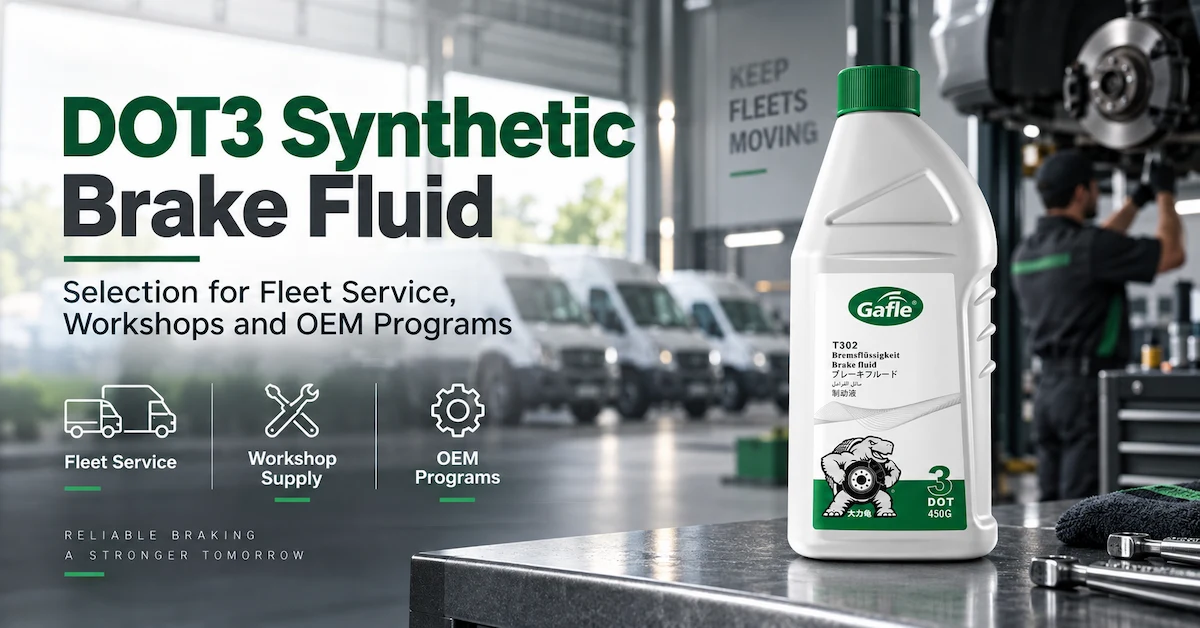
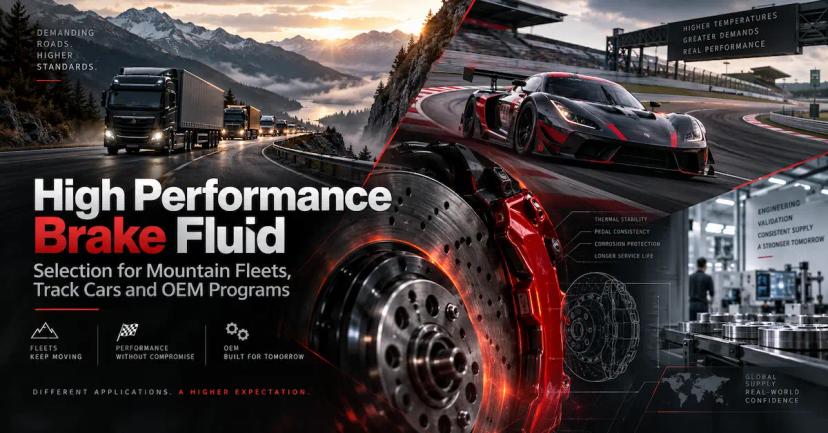
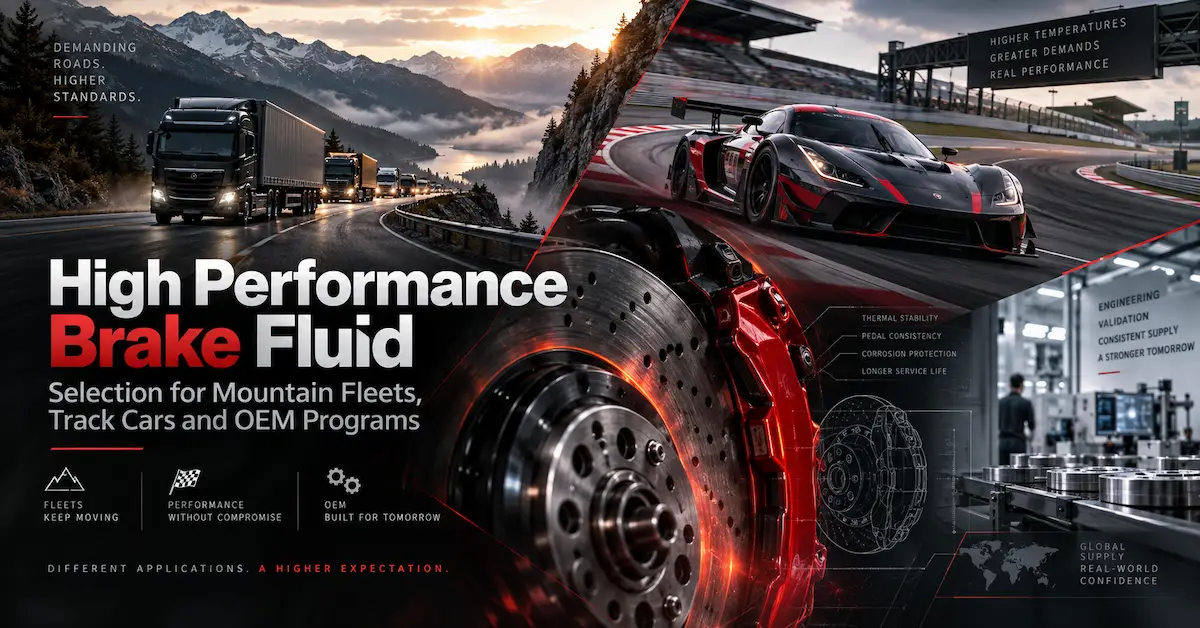
A mountain coach, a track car and a delivery van on a winter morning can all be described as demanding applications, but they do not ask the same thing from brake fluid. The coach repeatedly turns motion into heat on long descents. The track car may receive fresh fluid before an event and run through severe temperature cycles. The van needs dependable electronic brake modulation after a night outdoors. A buyer who searches for High Performance Brake Fluid must therefore define the hard part of the job before comparing labels.
The direct answer is that "high performance" is not an official DOT grade. It is a purchasing description that should be translated into measured requirements: the vehicle maker's specified fluid family and grade, fresh and wet boiling performance, viscosity at the relevant temperatures, corrosion and material compatibility, production consistency, and packaging that protects the fluid from contamination. A spectacular dry boiling point can be useful for one duty cycle and still be the wrong basis for a cold-climate ABS or ESC application.
This guide is for fleet maintenance teams, importers, distributors, workshop groups, motorsport buyers and private-label owners who need a defensible specification rather than a bigger adjective. Regulatory values are treated as reference thresholds, not as the measured result of a particular GAFLE product. Product-page statements are identified as website claims and should be confirmed against the current TDS, SDS, COA, test method and production-lot records before an order is approved.
The buyer's answer in sixty seconds
Start with the exact vehicle or system requirement. Then describe the hardest credible duty cycle, not the most dramatic one imaginable. Compare guaranteed values under named methods, look at wet performance beside the new-fluid result, and read cold viscosity beside the hot-viscosity minimum. After the formula fits, qualify the batch documents, closure, label, shelf life, handling plan and supplier's change-control process.
Those steps prevent a common sourcing mistake: selecting the fluid that wins one column while losing the application. A circuit team may accept frequent fluid replacement in exchange for a high heat margin. A winter fleet may care more about cold hydraulic response and predictable workshop handling. An aftermarket distributor needs a portfolio that covers verified vehicle requirements without implying that every customer should buy the most expensive grade.
| Selection gate | Question to answer | Evidence that closes the gate | Reason to stop |
|---|---|---|---|
| Vehicle fit | What fluid family, grade and approval does the exact model require? | Vehicle manual, service data or written OEM specification | Candidate conflicts with the named requirement |
| Duty cycle | Is the controlling risk heat, cold response, moisture exposure, load or service frequency? | Route, climate, vehicle mass, braking pattern and maintenance record | Supplier recommends one fluid without asking about use |
| Measured profile | Do boiling, viscosity and material tests match the target? | Dated specification, methods, limits and representative test report | Only a marketing phrase or one typical number is offered |
| Production control | Will the shipped lot match the approved sample? | Master specification, COA plan, traceability and retained sample | No defined release authority or change notice |
| Delivery and service | Can the pack stay sealed, dry, legible and traceable through use? | Approved pack drawing, transit trial, storage rule and workshop procedure | The handling plan undermines the laboratory result |
What High Performance Brake Fluid means when the adjective is removed
Brake fluid carries pedal force through a hydraulic circuit, and it must keep doing that across temperature changes while contacting metals, elastomers and residual moisture. A useful performance profile therefore has several dimensions. ERBP, often called dry boiling point in commercial literature, describes new fluid under a controlled reflux method. Wet ERBP examines retained boiling margin after a prescribed humidification procedure. Kinematic viscosity shows how the fluid moves at a stated temperature, while corrosion, stability, water-tolerance and rubber tests examine behavior that one boiling result cannot reveal.
The term "synthetic" also needs discipline. Glycol and glycol-ether brake fluids are commonly described as synthetic, but the word is not another DOT class and does not prove compliance. A proposal for High Performance Synthetic Brake Fluid should identify the exact formulation family and claimed standard, then supply product-specific evidence. The same caution applies to phrases such as racing, plus, low viscosity, EV and heavy duty: each phrase should lead to a testable requirement, not end the discussion.
High performance can mean a larger thermal reserve, quicker cold modulation, better retained behavior after moisture conditioning, tighter production variation or a package designed for a particular service pattern. Often it means a balanced combination. It never means that a fluid is universally suitable, and it does not give a workshop permission to ignore the reservoir cap or vehicle manual.
Begin with the vehicle requirement, not the largest number
DOT 3, DOT 4 and DOT 5 are performance grades in the U.S. framework. The labeling provisions distinguish DOT 5 silicone-base fluid from DOT 5.1 non-silicone-base fluid. Mineral-oil hydraulic systems are another family. These names are not a staircase that allows an automatic upgrade, because chemistry, cold viscosity, seal design, electronic control behavior and OEM approval all matter. A higher actual boiling point in one product does not erase an incompatible family or an unmet vehicle specification.
For the United States, the current 49 CFR Section 571.116, FMVSS No. 116 is the primary public reference. It is a manufacturer self-certification framework; NHTSA does not pre-approve a bottle. Accordingly, a supplier should not use "DOT approved" as a substitute for evidence. The buyer should request the manufacturer's conformity statement, the applicable grade, current test data and the controls that connect those results to production.
| U.S. label family | Minimum ERBP | Minimum wet ERBP | Maximum viscosity at -40°C | Buyer caution |
|---|---|---|---|---|
| DOT 3 | 205°C / 401°F | 140°C / 284°F | 1,500 mm²/s | Use only where the system permits this grade |
| DOT 4 | 230°C / 446°F | 155°C / 311°F | 1,800 mm²/s | The grade ceiling alone does not prove a low-viscosity claim |
| DOT 5 silicone base | 260°C / 500°F | 180°C / 356°F | 900 mm²/s | Different chemistry; never confuse it with DOT 5.1 |
| DOT 5.1 non-silicone base | 260°C / 500°F | 180°C / 356°F | 900 mm²/s | Confirm OEM fit and the full measured profile |
The table lists selected FMVSS thresholds, not complete conformity requirements. FMVSS No. 116 also addresses hot viscosity, pH where applicable, stability, corrosion, low-temperature behavior, water tolerance, compatibility, oxidation, rubber effects, stroking performance, packaging and warnings. Every value must be read with its test method. The threshold is not the same thing as a supplier's guaranteed release limit or a measured batch result.
Match the fluid to the hardest credible duty cycle
A useful application brief describes what the vehicle repeatedly does. "High-performance car" is vague. "A 1,900 kg vehicle completing twenty-minute circuit sessions, with fluid changed before each event" gives the supplier something to evaluate. So does "a 12-ton coach descending a mountain route twice a day" or "delivery vans parked at -30°C with ABS and ESC." The purpose is not to design a laboratory torture test. It is to identify the condition most likely to expose the wrong fluid choice.
| Buyer and duty profile | Dominant risk | Performance evidence to emphasize | Operational evidence | Bad shortcut |
|---|---|---|---|---|
| Mountain coach or towing fleet | Repeated heat input and uncertain moisture history | Guaranteed ERBP and wet ERBP, corrosion, stability | Route grade, mass, brake temperatures, change records | Selecting by a dry typical value alone |
| Track-day or competition team | High thermal cycling and short service windows | Heat profile, product consistency, fresh and wet test data | Session length, vehicle setup, flush frequency, inspection notes | Assuming racing wording proves road approval |
| Cold-climate ABS or ESC fleet | Slow fluid movement through rapid-control valves | Viscosity at -40°C under the named method plus hot performance | Minimum soak temperature and exact controller requirement | Using "low viscosity" without a number or temperature |
| Urban delivery or municipal fleet | Frequent stops, mixed vehicles and variable maintenance | Vehicle-specific fit, wet reserve, lot consistency | VIN or model-year matrix, routes, open-pack procedure | Forcing one grade across an incompatible mixed fleet |
| EV or hybrid service program | Infrequent friction-brake use, electronic control and OEM specificity | Exact OEM code, viscosity, corrosion and material data | Model-specific service information and diagnostic procedure | Assuming every EV needs the same brake fluid |
| Aftermarket distributor or workshop chain | Misapplication, open-container contamination and stock complexity | Clear grades, fitment limits, closure integrity and traceability | Sales mix, pack turnover, technician procedure and training | Turning a premium label into a universal-fit claim |
The phrase High Performance Brake Fluid for Automotive Applications should open this duty-cycle discussion. It should not close it. Passenger car, racing car, truck, coach and off-road vehicle are only starting categories; model, year, system design, mass, climate and maintenance practice determine whether a candidate is suitable.
Read the data sheet without letting one number dominate
A serious comparison begins by asking whether each value is a specification limit, a guaranteed release minimum, a typical result or a single sample. Those categories are not interchangeable. If a catalogue reports 280°C as a typical ERBP but the signed specification guarantees only 260°C, the purchase agreement should use the value the supplier will release production against. The method and sample condition also belong beside the number.
Dry and wet performance answer different questions. The wet ERBP procedure in FMVSS does not simply mean that exactly 3.7 percent water is poured into the candidate fluid. The candidate and a reference fluid undergo controlled humidification, and the reference determines the stopping point. Marketing copy that reduces this to a casual water-addition test misses the procedure. For procurement, the safe approach is to name the standard, edition and method, then ask for the actual result and release limit.
| Data-sheet item | What it can tell the buyer | What it cannot prove alone | Useful RFQ wording |
|---|---|---|---|
| ERBP / new-fluid boiling result | Thermal margin for new fluid under a defined reflux method | Retained margin after moisture exposure or vehicle approval | State method, minimum release value and COA field |
| Wet ERBP | Boiling reserve after prescribed humidification | A universal service interval for every vehicle and climate | Name conditioning procedure, minimum and report format |
| Viscosity at -40°C | Cold fluidity under the stated test condition | Shorter stopping distance or compatibility with every controller | Set a maximum, method, tolerance and OEM reference |
| Viscosity at 100°C | Whether the fluid stays above the required hot-viscosity floor | Complete lubricity, durability or seal behavior | Set minimum value and release method |
| Corrosion and material tests | Behavior with specified metals and elastomers under test conditions | Fit with an unlisted system material or contaminated circuit | List standard, materials, acceptance limits and report date |
| Typical value | Normal development or recent production tendency | A contractual guarantee for every supplied batch | Ask for the guaranteed specification and release range separately |
High boiling point and low viscosity solve different problems
A request for High Boiling Point Brake Fluid normally begins with heat. The buyer wants more margin before vapor can form during repeated braking. That does not mean the fluid creates more braking force, and it does not make a poorly maintained system safe. The useful questions are whether the figure is ERBP or wet ERBP, whether it is guaranteed or typical, which method produced it, and whether the current vehicle specification allows that product.
A search for Low Viscosity High Performance Brake Fluid usually begins with cold hydraulic modulation. ABS, ESC and related systems can require the fluid to pass quickly through small control passages at low temperature. The -40°C number is relevant only when the temperature, method and OEM limit are known. Lower is not automatically better if hot viscosity, lubricity, seals or durability fall outside the system requirement.
These goals are not mutually exclusive, but products can be optimized differently. A severe-heat DOT 4 product can report a higher actual ERBP than a general DOT 5.1 product, while the DOT 5.1 or ISO Class 7 candidate may flow much more readily at -40°C. Calling one fluid "better" without naming the duty cycle conceals the engineering decision the buyer is supposed to make.
Use ISO classes when the contract actually calls for them
An international RFQ written today should identify ISO 4925:2026 by edition and class. ISO published this fourth edition in June 2026 for non-petroleum road-vehicle brake and clutch fluids used in systems with SBR and EPDM components. Classes 3, 4, 5-1, 6 and 7 remain, but the revision introduced pass-or-fail lubrication work for friction-related noise and wear. An old 2020 report may still be useful history; it is not, without further evidence, a report to the revised edition.
Classes 6 and 7 often appear when cold fluidity must sit beside substantial boiling reserve. At headline level, Class 6 pairs 250°C ERBP and 165°C wet ERBP minimums with a 750 mm²/s maximum at -40°C. Class 7 keeps that cold ceiling and moves the two boiling minimums to 260°C and 180°C. These three figures are convenient for screening, but they are not the whole class. Contract language should point to the purchased normative edition and all applicable requirements.
Marketing terms such as DOT 4 LV and DOT 4 Plus can help identify a market segment, but they are not separate FMVSS legal grades. Write the actual FMVSS grade, ISO class where applicable, OEM code and guaranteed values into the contract. That approach remains clear even when two suppliers use different trade names for similar targets.
Turn the GAFLE range into a shortlist, not an automatic approval
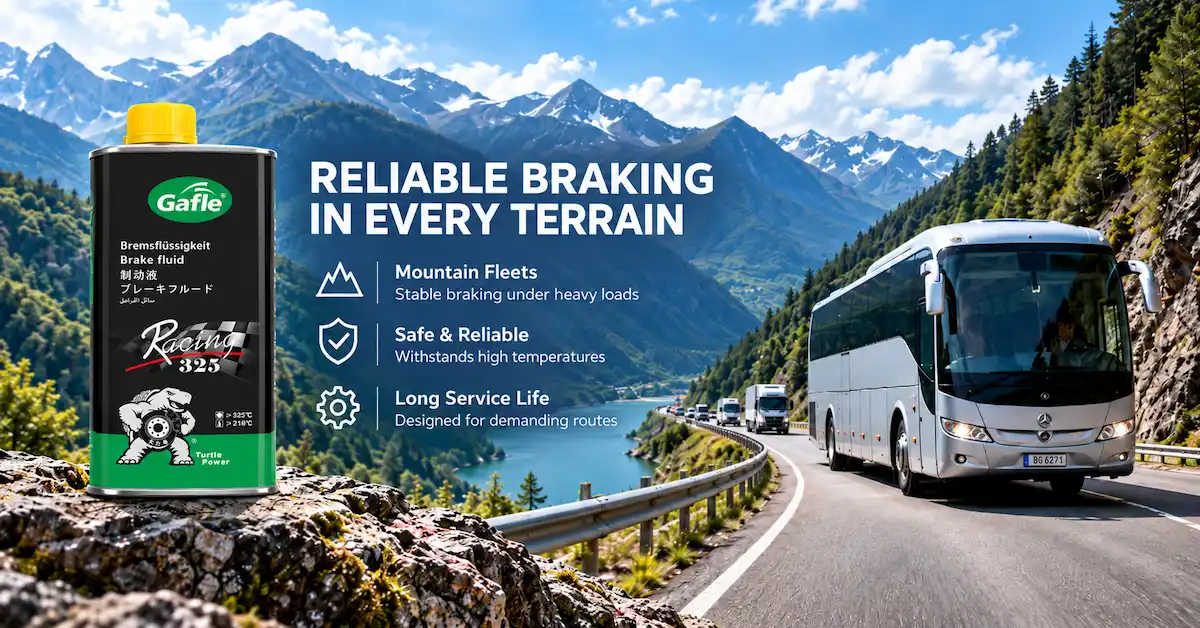
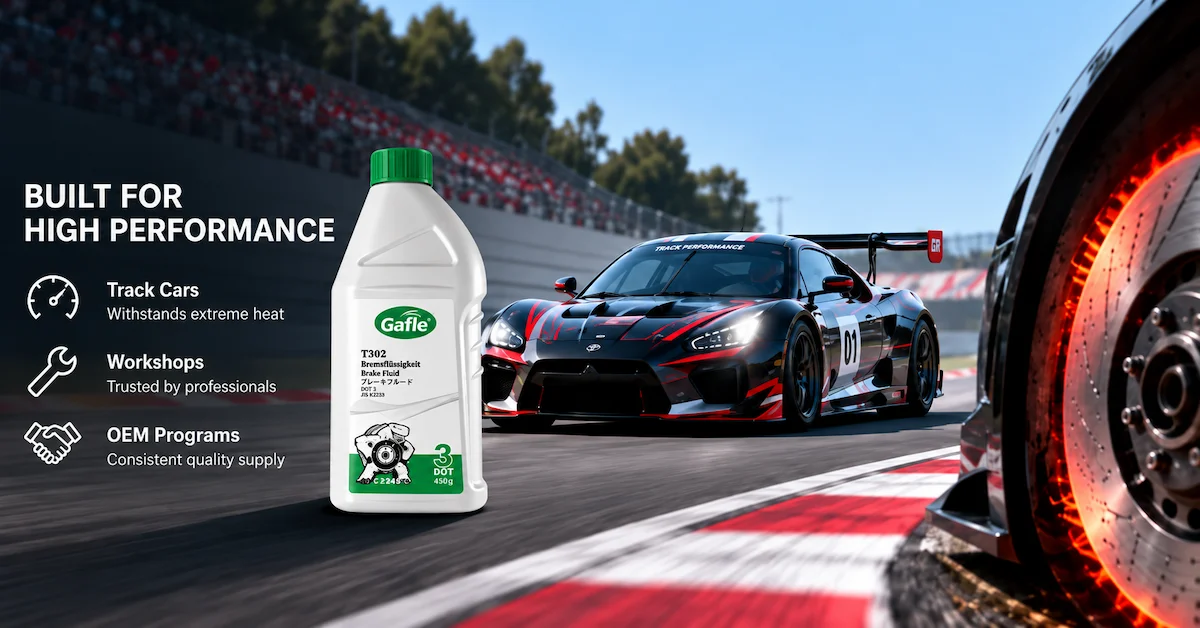
The GAFLE website provides several starting points for a performance-fluid discussion. DOT407 is presented as a DOT 4 product for modern hydraulic brake and clutch systems. The 703 page sits in the site's DOT 5.1 category and describes high- and low-temperature performance. T409 is positioned as DOT4 Plus for demanding road and off-road use. EV-608 is presented for new-energy and heavy-duty contexts, while Racing 325 is aimed at severe braking. Those pages help a buyer choose which technical file to request; they do not replace the file.
| Website entry | Current public positioning | Published figure on page or pack image | What must be confirmed |
|---|---|---|---|
| DOT407 | DOT 4; passenger cars, SUVs and light commercial vehicles | Page describes higher dry and wet boiling performance than DOT 3, without a complete product table | Exact SKU, availability, TDS limits, methods and batch release data |
| 703 / T703 | DOT 5.1 category; modern hydraulic systems and cold fluidity | Product image carries Class 7 and performance figures not fully defined in page copy | ISO edition, class report, guaranteed values and label consistency |
| EV-608 | New-energy and heavy-duty positioning in a 1 L metal can | Page claims ERBP at least 268°C and wet ERBP at least 175°C | Vehicle approval, test method, production tolerance and current COA format |
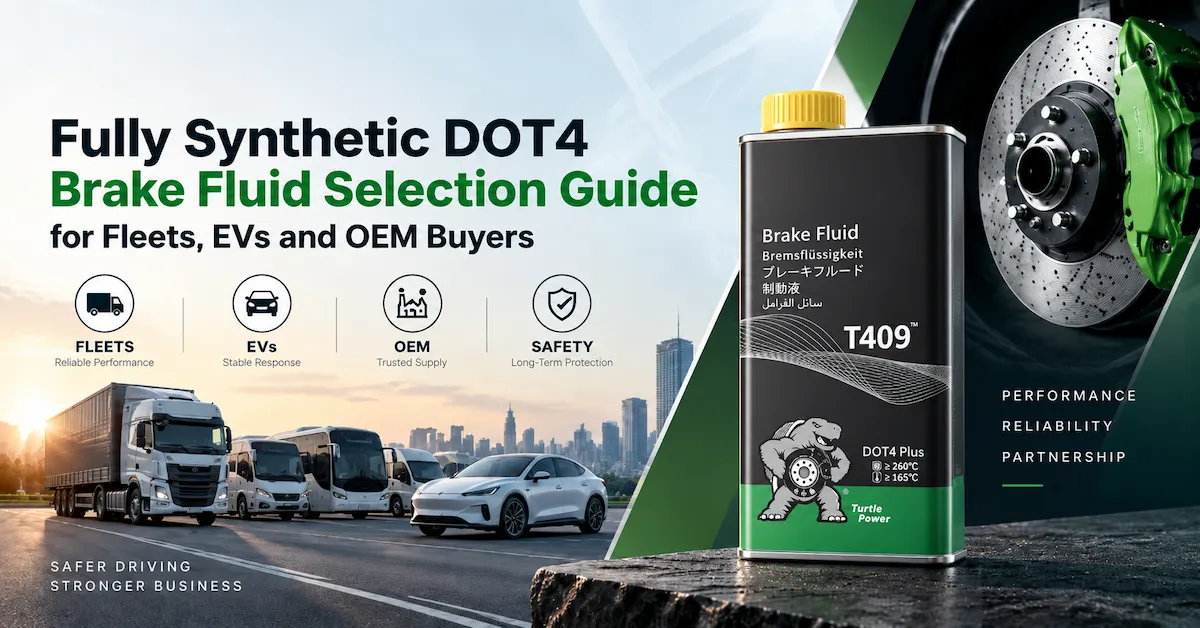
| T409 / DOT409 | DOT4 Plus; steep grades, speed, off-road and truck themes | Page says up to 260°C, while the pack graphic uses threshold-style symbols | Whether the number is typical or guaranteed and which document governs |
| Racing 325 | Track, performance and high-load positioning | Website states a boiling point above 325°C without defining dry or wet method in the public copy | Fluid grade, ERBP definition, wet result, road-use status and current test report |
The public pages were reviewed as catalogue material, not as certificates. Availability indicators and displayed prices can change and do not create a binding quotation. A formal order should name the precise formula or SKU, document revision, package, quantity, destination, Incoterm and release requirements. If a package image and page text present the same figure differently, resolve the difference before artwork or procurement approval.
Qualify the supplier and the manufacturing site separately
A High Performance Brake Fluid Supplier may manage the quotation, export documents, stock plan and customer service even when another facility blends or fills the product. That arrangement can work well, but the chain of responsibility must be visible. The order file should identify the formula owner, actual production and filling sites, batch-release authority, complaint contact and party responsible for regulatory claims in the destination market.
A High Performance Brake Fluid Manufacturer should be able to trace a finished code back through filling, in-process records and raw-material lots. During qualification, follow one representative batch from receipt of key materials through identity checks, controlled charging, blending, any filtration step, filling, closure, sampling, laboratory release, retention and dispatch. The purpose is to understand the real process boundary, not to collect a longer list of equipment.
Management-system certificates can support this review, but they do not prove a product's boiling point, viscosity or vehicle approval. Check that the certificate is current and that its scope and address cover the site named on the quotation. Then review calibration status for the relevant methods, handling of out-of-specification results, retained-sample period, complaint investigation and advance notification for changes to formula, raw material, test method, site or package.
Build an OEM program around approval gates
An OEM High Performance Brake Fluid project is more than a standard liquid behind a new label. The private-label owner becomes responsible for choices about the target market, formula, claims, package, languages, traceability and change control. These decisions should be made in a fixed order so that commercial pressure does not turn a draft claim into a printed commitment.
First, write the application brief. Record the vehicle classes, model years or OEM codes, destination countries, duty cycles, temperature range, expected annual quantity and service channel. A mixed fleet or broad aftermarket program may need several approved products. It is better to discover that while the brief is still one page than after labels and cartons have been ordered.
Second, freeze the technical target. Name the standard and edition, fluid family, grade, ISO class where relevant, guaranteed ERBP and wet ERBP, viscosity limits at stated temperatures, corrosion and elastomer requirements, color, test methods and lot-release fields. Mark every number as minimum, maximum, range or typical. This small notation prevents a development average from becoming an accidental guarantee.
Third, approve a coded sample and its file together. The sample code should appear on its TDS, SDS, test report and preliminary COA. If testing is performed by an outside laboratory, the report should identify the sample, method and issue date. A bottle with attractive graphics and a generic certificate is not a technically approved sample.
Fourth, prove the package. Put a filled sample beside the drawing and handle it as the customer will. Open the cap, inspect the liner and tamper feature, find the batch code, scan the label and check the declared fill. Then follow the pack into its carton, onto the pallet and through the planned transport orientation. The closure protects moisture-sensitive fluid, so it belongs in technical approval. A shipping trial is particularly useful when moving from a retail bottle to a metal can, drum or other bulk format.
Finally, release production against a signed master. The golden sample, approved artwork, packaging drawing, test plan and formula revision should point to one another. Define who can approve deviations and how much notice is required before a change. The first commercial lot deserves a fuller review because it tests whether the development controls work at production scale.
| OEM gate | Buyer input | Supplier deliverable | Approval record |
|---|---|---|---|
| Application | Vehicle matrix, markets, climate and duty cycle | Fit assessment, exclusions and open questions | Agreed application brief |
| Formula | Grade, class, limits, methods and claims | Coded sample, TDS, SDS and test evidence | Signed master specification |
| Package | Fill size, channel, freight route and shelf-life need | Drawing, materials, samples and transit proposal | Approved pack and transport trial |
| Artwork | Brand, languages, importer data, barcode and legal text | Print proof and claim-support matrix | Signed final artwork |
| Production release | PO, quantity tolerance, delivery and inspection plan | Lot COA, pack records, codes and shipment documents | Authorized batch release |
Bulk supply is a moisture-control project as well as a price decision
A Bulk High Performance Brake Fluid Supplier should ask how the receiving site will unload, store and dispense the product. A clean batch can be compromised by a wet hose, shared pump, open vent or poorly sealed partly used drum. The transfer plan should specify compatible equipment, cleanliness and dryness checks, segregation from silicone and mineral-oil products, identification of the opened container and the maximum permitted handling period under the supplier's current instruction.
Bulk economics also deserve a realistic denominator. Compare landed usable fluid rather than ex-works price per kilogram. Container residue, transfer loss, local classification, freight, pallets, port handling, inspection, damaged packs, remaining shelf life and disposal can reverse an apparent saving. MOQ should be evaluated against actual turnover; buying twelve months of supply is not economical if the package is opened repeatedly or stock ages beyond the approved plan.
The COA for a bulk lot should identify the exact batch and report the agreed release tests. The drum, IBC or other container needs a durable code that remains with it after outer wrapping is removed. Where a contract packer fills retail bottles from bulk delivery, the quality agreement should explain how the incoming batch connects to each finished-goods code and which party retains samples.
Request a Brake Fluid Qualification ReviewValidate the sample, pilot lot and first production lot
Supplier samples are useful, but they can hide a weak approval process if the formula code and test history are unclear. Before testing, agree on acceptance criteria and the action for a failure. Record the sample code, date, seal condition and document revision. Where an existing fluid is being replaced, plan a controlled service procedure and compatibility review instead of relying on a casual top-up.
A pilot lot should use the intended raw-material controls, production equipment and package wherever practical. Compare its appearance, relevant test results, closure and code against the approved master. For fleet evaluation, record the vehicle ID, previous fluid, flush or bleed procedure, installed batch, mileage or hours, route, technician and any observations. A pilot is not a license to make performance promises from a handful of vehicles; it is a controlled way to catch process and service problems before scale.
During first production, verify quantity, fill, cap, seal, print, carton and pallet as well as the laboratory release. Photographs can confirm visible packaging but cannot prove chemistry. The COA must match the shipped lot, and the retained sample should be stored under a defined policy. After receipt, quarantine leaks, broken seals, wet cartons, unreadable codes or unexpected appearance before any fluid reaches a workshop.
Storage and workshop practice can erase a laboratory advantage
Opening a glycol-based brake-fluid container changes its exposure to moisture. A workshop that uncaps a large bottle ten times on a humid day presents a different case from a sealed small pack used for one service. Headspace and the condition of the closure matter too. Keep the original container clean and close it promptly, then use the supplier's current storage and opened-pack instruction. A familiar shelf-life figure is not enough when the formula or package has changed.
FMVSS labeling requires warnings about following the vehicle manufacturer's recommendation, keeping fluid clean and dry, avoiding contamination by water, dirt, petroleum products or other materials, and storing it in the original container with the closure tight. These warnings are operational controls, not fine print. A high measured boiling point at the factory does not protect a workshop bottle left open between services.
Before opening the reservoir, clean the surrounding area and identify the required fluid. Use dedicated equipment, record the product and lot, and never return unused service fluid to the supply container. A low level can signal wear or leakage, so topping up without diagnosis is incomplete maintenance. Bleeding, flushing and replacement should follow the vehicle maker's procedure and be performed by trained personnel.
Seven purchasing mistakes that cost more than the fluid
Choosing the highest dry number. It ignores wet reserve, viscosity, material behavior and actual vehicle fit. Compare a complete profile under named methods.
Treating synthetic as certification. Synthetic describes formulation or market positioning; it is not a separate DOT approval. Ask for the grade, chemistry family and supporting evidence.
Reading DOT 5.1 as a small variation of DOT 5. The U.S. label uses DOT 5 for silicone-base fluid and DOT 5.1 for a non-silicone fluid. That decimal separates chemistry families, not package sizes.
Calling every thin fluid suitable for ABS or ESC. Cold viscosity is important, but the exact OEM requirement and the rest of the performance profile still govern.
Approving artwork before evidence. Once labels are printed, teams become tempted to defend a claim that should have been corrected. Freeze the formula and claim-support file first.
Buying bulk without a transfer procedure. Moisture or incompatible residue in a pump can undo careful manufacturing. Approve the receiving equipment and method with the fluid.
Accepting a generic COA. A polished template that cannot be tied to the shipped code provides little traceability. Define which batch results and authorization must appear.
Three sourcing scenarios show why one premium claim is not enough
A coach fleet working long mountain descents
The fleet reports a soft pedal after repeated downhill work, but the vehicles include two model years with different service instructions. Procurement first separates the fleet by specified grade and investigates the system condition instead of treating fluid as the only possible cause. For compatible vehicles, it compares guaranteed dry and wet values, route temperatures, change history and technician handling. The pilot logs each vehicle and lot. Only fleet evidence, not a website headline, supports a later change in maintenance policy.
A distributor serving warm and cold regions
One high-boiling SKU cannot automatically cover customers operating far below freezing. The distributor maps vehicle requirements and sales climate, then considers a severe-heat product and a low-viscosity product as distinct positions where the market justifies both. Labels state grade and limitations clearly. Small packs are chosen for workshops with slow turnover, while higher-volume customers receive an opened-container procedure. The result is a deliberate range rather than an expensive product with an unsupported universal claim.
A private-label motorsport launch
The brand wants a headline boiling point and racing artwork before it has selected the formula. The approval team reverses that order. It defines track use, service frequency, road-use position and destination markets; receives a coded sample and full test file; then writes claims that match guaranteed values and stated methods. A package trial checks the metal can, closure, code and carton. The launch takes longer than printing a mock-up, but it is far quicker than correcting thousands of unsupported labels.
Questions buyers raise before approving performance brake fluid
What makes brake fluid high performance?
There is no standalone high-performance grade. The phrase becomes meaningful when it is tied to an approved application and measured requirements such as dry and wet ERBP, viscosity at stated temperatures, stability, corrosion control, water tolerance, elastomer behavior, batch consistency and protective packaging.
Is a higher dry boiling point always better?
Not by itself. A higher ERBP can add thermal margin for severe braking, but the fluid must still match the vehicle specification and perform after moisture conditioning. Cold viscosity, hot viscosity, material compatibility and service practice remain part of approval. A large typical value is also less useful than a realistic guaranteed minimum.
Why does wet ERBP matter to a fleet buyer?
New fluid does not spend its service life in an unopened laboratory bottle. Wet ERBP provides a standardized view of retained boiling margin after humidification. It does not predict every vehicle or set a universal replacement interval, but it gives fleets a more relevant comparison than the new-fluid figure alone.
When is low-temperature viscosity a priority?
It becomes important when the specified system must modulate hydraulic pressure quickly at low temperature, particularly through ABS or stability-control valves. Procurement needs the measured viscosity at the required temperature and method, plus the exact OEM limit. The phrase "fast response" without those details is not evidence.
When may a buyer move from DOT 3 to DOT 4 or DOT 5.1?
Only after the exact vehicle requirement and service guidance permit the change. A laboratory miscibility result for two non-silicone fluids does not promise that their blend keeps the better product's properties, nor does it settle warranty questions. Where a planned supplier or grade change is allowed, record the decision and use the specified flush-and-refill procedure. An undocumented top-up leaves the workshop with a fluid mixture it cannot describe precisely.
What does the decimal change between DOT 5 and DOT 5.1?
It changes the identified family. Under U.S. labeling, DOT 5 is silicone based; DOT 5.1 is the non-silicone designation. Keep silicone fluid and mineral hydraulic oil away from a glycol-fluid system unless the vehicle maker provides a specific, documented conversion. Similar-looking grade numbers are not a mixing instruction.
What batch paperwork should purchasing expect before shipment?
At minimum, the buyer normally needs the current TDS and SDS, an agreed lot-specific COA, approved package and artwork references, and the commercial and transport documents required for the route. Certification or declarations should identify their scope. The final list depends on the destination, importer and contract.
How should the first OEM or bulk order be qualified?
Approve the application brief, formula specification, coded sample, package and artwork before production. Define release tests and pass-or-fail criteria, inspect the first commercial lot, match the COA to its codes and review receipt conditions. Capture corrections before the repeat order so the process becomes reproducible.
How should opened brake fluid be stored?
Use the supplier's current product and package instruction. Keep the fluid in its original clean container, close it tightly, protect it from moisture and other contamination, record the opening date where the workshop procedure requires it, and never return service fluid to the supply pack. Discard questionable material according to local rules.
How often should high-performance brake fluid be replaced?
Use the vehicle or equipment maker's interval and service procedure. Track use, severe duty, climate, system condition and measured fluid condition may justify a more intensive program, but a seller should not invent one universal time or mileage. Record replacements by vehicle and lot so the interval can be audited.
RFQ worksheet for a useful quotation
| RFQ field | Information from the buyer | Expected supplier response |
|---|---|---|
| Vehicle and system | Models, years, brake or clutch system, current fluid and OEM requirement | Fit assessment, exclusions and information still needed |
| Operating profile | Climate, route, vehicle mass, braking pattern, storage and service interval | Relevant heat, wet, cold, stability and handling evidence |
| Technical target | Fluid family, grade, standard edition, class, limits and methods | Dated specification, typical values clearly marked and exceptions |
| Quality file | TDS, SDS, COA fields, reports, retained sample and change notice | Sample documents, issue timing and responsible contact |
| Package and market | Destination, channel, fill size, closure, languages, barcode, carton and pallet | Pack proposal, artwork process, samples and integrity controls |
| Commercial plan | Trial quantity, forecast, destination, target date, Incoterm and payment needs | MOQ, price basis, lead time, tolerance, validity and milestones |
Send the vehicle class, required grade, target dry and wet values, -40°C viscosity requirement, destination market, package size and annual quantity in the first inquiry. A supplier can then identify conflicts and missing information before it quotes an attractive but unsuitable product.
Send Your Specification for an OEM or Bulk QuoteThe final selection rule
The right performance fluid is the one that matches the named vehicle requirement and hardest credible duty cycle, then arrives with evidence for the formula, lot, package and service plan. Compare wet data beside new-fluid data. Read viscosity with its temperature and method. Keep chemistry families distinct. Treat the closure, label and transfer equipment as technical components rather than decoration.
For a catalogue order, verify the exact item, current documents and availability. For OEM or bulk supply, freeze the specification, artwork, quality plan, package and change-control rules before mass production. Price and lead time belong in the decision, but only after technical fit and delivery controls are clear. That sequence gives a fleet, workshop, distributor or brand owner a purchase it can explain when conditions are difficult or a complaint must be investigated.
Technical note: This article provides general sourcing guidance for a safety-critical automotive fluid. Always follow the vehicle or equipment manufacturer's instructions, the current law and standard in the destination market, and the supplier's product-specific TDS, SDS, COA and test reports. Public product pages, packaging images, availability fields and displayed prices are not certificates, warranties or formal quotations.