What Should B2B Buyers Check Before Sourcing DOT 4 Brake Fluid?
For a professional buyer, DOT 4 Brake Fluid should be purchased against a defined vehicle requirement and product specification rather than a grade name alone. Importers, distributors, workshop chains, fleets, and private-label brands need to confirm the intended applications, technical requirements, supporting test evidence, batch controls, packaging, documentation, and repeat-order conditions before comparing prices. GAFLE's brake fluid product range includes DOT 3, DOT 4, DOT 5.1, OEM, and application-oriented categories, but the correct purchasing decision still depends on matching the exact product to the target vehicle or hydraulic system.
A strong supplier qualification process therefore asks a more useful question than “Do you sell DOT 4?” It asks: Which identifiable product are you offering, what requirements does it meet, what evidence supports those claims, how is it controlled during production, and how will future batches remain consistent with the approved sample? Those questions are especially important when the buyer's own brand will appear on the final bottle.
Who Is This DOT 4 Brake Fluid Guide For?
This guide is written for B2B buyers responsible for product approval or commercial sourcing rather than individual vehicle diagnosis. Typical users include automotive chemical importers, aftermarket distributors, parts wholesalers, workshop chains, fleet-maintenance purchasing teams, brake-service networks, and brands developing private-label fluid programs. Their priorities extend beyond whether a fluid can be poured into a braking system; they need stable specifications, traceable supply, packaging consistency, documentation, and a practical way to manage repeat orders.
It is not intended to replace a vehicle manufacturer's service information. If a vehicle specifies a particular brake-fluid grade, viscosity characteristic, OEM specification, or other requirement, that information should remain the starting point. A distributor should not create a broad compatibility list merely because several products share the words “DOT 4.” The final application must be supported by the relevant vehicle requirement and product data.
What Does DOT 4 Define—and What Does It Not Define?
DOT 4 is a performance classification for non-silicone automotive brake fluid. Under FMVSS No. 116, DOT 4 includes minimum requirements such as a dry equilibrium reflux boiling point of 230°C, a wet equilibrium reflux boiling point of 155°C, and a maximum kinematic viscosity of 1,800 mm²/s at -40°C. These numbers are regulatory reference limits, not measured values for a specific GAFLE product, and they should not be presented as universal operating temperatures or replacement intervals.
The grade also does not tell a buyer everything about a commercial product. It does not by itself identify the formulation, batch-control system, package integrity, current test report, vehicle-specific approval, private-label artwork, MOQ, or production lead time. For this reason, B2B buyers should use the DOT designation as the beginning of the purchasing specification rather than the end of the qualification process.
DOT 3 vs DOT 4 vs DOT 5.1: Do Not Treat the Numbers as a Simple Ranking
A useful comparison should show what changes between fluid classes without implying that a higher number automatically makes the product suitable for every braking system. The reference values below provide a technical framework; actual product selection still depends on the intended vehicle and documented requirements.
| Brake Fluid Class | Minimum Dry Boiling Point | Minimum Wet Boiling Point | Maximum Viscosity at -40°C | Main Procurement Question |
|---|---|---|---|---|
| DOT 3 | 205°C | 140°C | 1,500 mm²/s | Does the target vehicle require or permit DOT 3? |
| DOT 4 | 230°C | 155°C | 1,800 mm²/s | Are standard or additional viscosity/performance requirements involved? |
| DOT 5.1, non-silicone | 260°C | 180°C | 900 mm²/s | Does the target system require or permit this grade? |
The comparison illustrates why boiling point and viscosity should be reviewed separately. DOT 4 has higher minimum dry and wet boiling-point requirements than DOT 3, while the standard viscosity limits follow a different pattern. Individual formulations can also be engineered for specific applications. Buyers should additionally keep DOT 5.1 separate from silicone-based DOT 5, because the similar numbering does not make them the same fluid.
Where Is DOT 4 Brake Fluid Commonly Used?
DOT 4 is widely relevant to hydraulic braking and clutch systems where the vehicle or component manufacturer specifies or permits it. B2B demand can therefore come from passenger-car service networks, SUVs, light commercial vehicles, workshop groups, automotive distributors, fleet-maintenance channels, and private-label aftermarket brands. However, the application should never be written simply as “all modern vehicles.” Different platforms can require additional low-viscosity, OEM-specific, or system-specific characteristics.
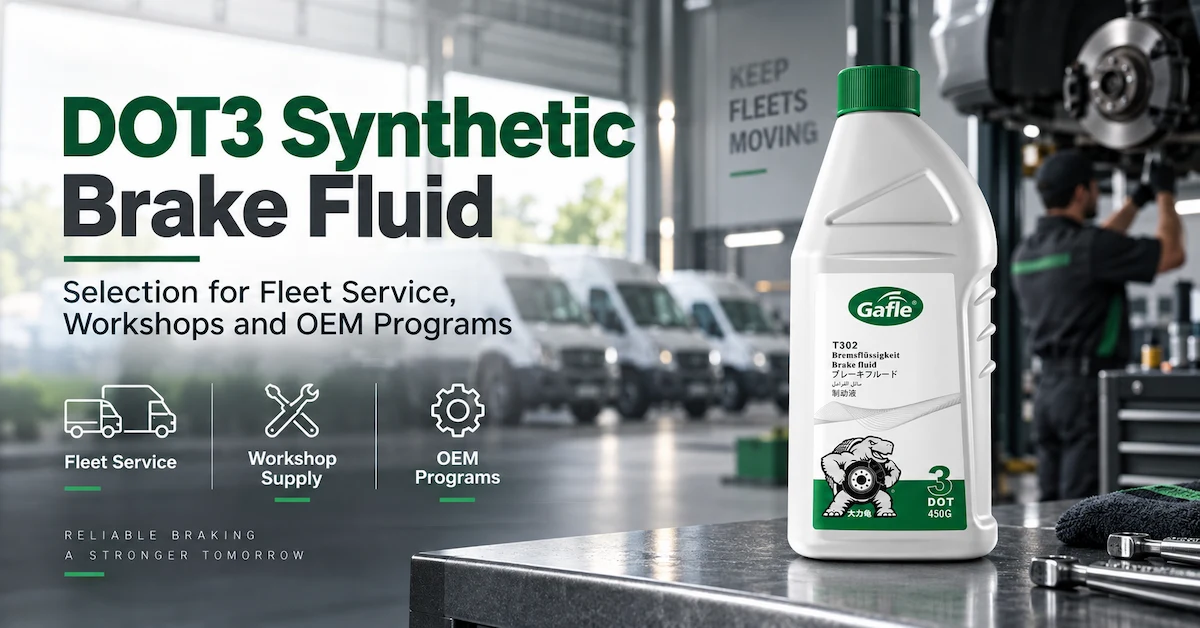
For buyers evaluating a concrete product, GAFLE's DOT407 Brake Fluid provides an identifiable DOT 4 product reference described for hydraulic braking and clutch applications. It can be used as a starting point for technical discussion, but the current product data and intended vehicle requirements should still be reviewed before commercial approval.
Build a Purchasing Specification Before Asking for the Lowest Price
A professional RFQ converts “DOT 4 Brake Fluid” into a controlled product definition. Without this step, one supplier may quote a basic stock product, another may include private-label packaging, and another may base the price on a different fluid configuration. The resulting prices will appear comparable while actually representing different offers.
| Specification Area | What the Buyer Should Define or Request | Why It Matters |
|---|---|---|
| Product identification | Supplier model/code and buyer SKU | Connects samples, reports, orders, and repeat supply |
| Fluid classification | DOT 4 plus any additional requirements | Defines the technical baseline |
| Dry boiling performance | Requirement and reported result | Supports thermal-performance review |
| Wet boiling performance | Requirement and reported result | Evaluates performance after controlled moisture conditioning |
| Low-temperature viscosity | Test temperature, limit, and result | Important for low-temperature hydraulic behavior |
| Corrosion performance | Relevant product evidence | Supports protection of system metals |
| Material compatibility | Applicable seal/material tests | Reduces unsupported compatibility claims |
| Test documentation | Sample identity, method, result, date | Connects technical claims to an identifiable product |
| Packaging | Capacity, bottle, cap, seal, label, carton | Controls handling, branding, and logistics |
| Batch traceability | Lot coding and record requirements | Supports investigation and repeat orders |
| Change control | Conditions requiring notification/reapproval | Protects the approved product definition |
The buyer should separate requirements, supplier proposals, approved values, and unresolved items. Doing so prevents information from an early quotation from silently becoming part of the production specification.
Dry and Wet Boiling Point Must Be Compared on the Same Basis
Brake-fluid marketing often emphasizes a high boiling point, but a B2B buyer should first determine what the number actually represents. Is it a minimum guaranteed value, a typical formulation value, or an actual laboratory result from a specific sample? Does it refer to dry or wet testing? Which method and units were used? Without those details, apparently precise numbers may not be commercially comparable.
Common glycol-based brake fluids are hygroscopic, so moisture exposure can influence boiling performance. This is why wet boiling data should not be ignored when suppliers promote an impressive dry figure. Buyers should compare like with like and avoid creating a supplier ranking from data generated under different definitions or test conditions. GAFLE's broader brake fluid quality-control information can be used as background when discussing the testing scope for a specific order.
Low-Viscosity DOT 4 Requires Its Own Qualification
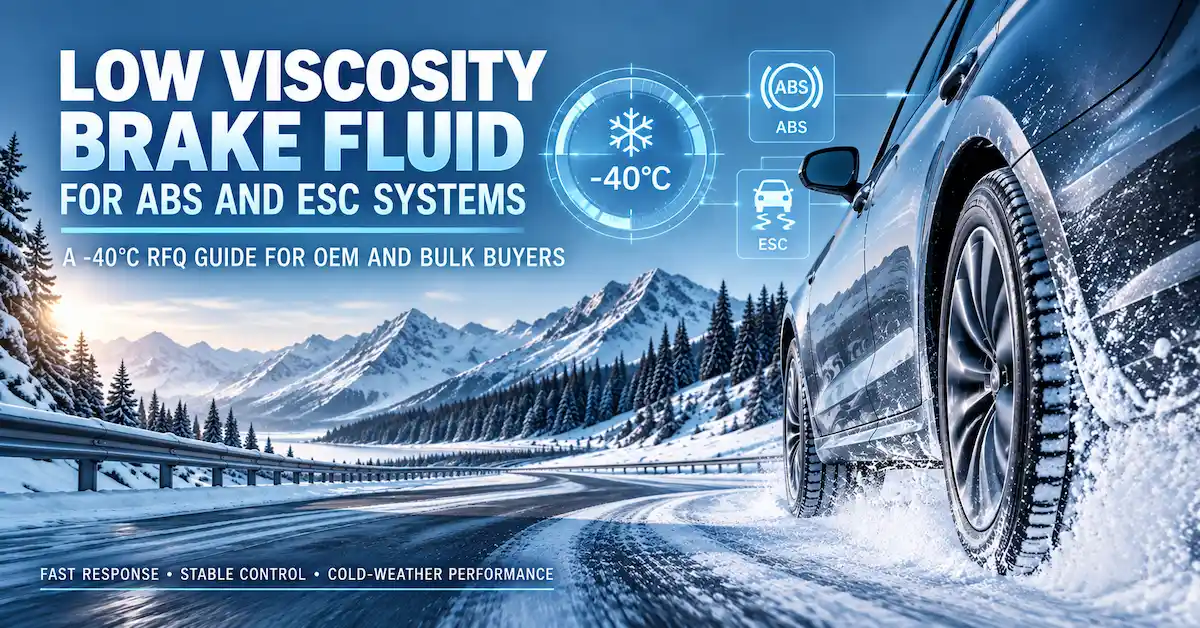
Some modern braking systems place additional emphasis on low-temperature fluid behavior because ABS, stability-control systems, and other electronically actuated hydraulic functions can require rapid fluid movement through control valves. This means “DOT 4” alone may not define everything the buyer needs to know.
If a market or vehicle platform requires a low-viscosity product, the RFQ should identify that requirement separately. Request the viscosity value, test temperature, specification basis, and model-specific technical information. Do not assume that every standard DOT 4 product is equivalent to a DOT 4 LV or other low-viscosity formulation simply because both carry the same basic grade designation. Likewise, strong low-temperature performance does not replace evaluation of boiling point, corrosion behavior, stability, and material compatibility.
Formulation Consistency Matters More Than a One-Time Sample
A successful sample proves that a supplier can deliver an acceptable product once; a successful B2B supply program requires the approved characteristics to remain controlled across repeated batches. That means procurement teams should look beyond the finished bottle and examine how formulation, raw materials, process conditions, testing, packaging, and revisions are managed.
GAFLE's article on brake fluid formulation consistency describes controls around formulation management, raw materials, standardized production, laboratory verification, packaging inspection, and batch traceability. For an actual DOT 4 project, buyers should connect those general controls to the quoted model: identify which formulation is approved, what production records are maintained, which changes trigger review, and how a finished lot can be traced back to its production information.
Manufacturing Process Should Be Auditable, Not Merely Described as “Strict”
Statements such as “advanced production” or “strict quality control” have limited purchasing value unless the buyer can understand what is being controlled. A more useful supplier discussion follows the process from incoming materials through preparation, mixing, in-process verification, filling, closure inspection, labeling, packing, final testing, and batch release.
GAFLE's published brake fluid manufacturing process can serve as a framework for those questions. B2B buyers should then ask which steps apply to the exact DOT 4 product, what parameters are checked, how out-of-specification results are handled, and which records can be linked to the finished batch. The objective is not to collect marketing photographs of equipment; it is to determine whether the approved product can be reproduced reliably.
Qualification Testing and Routine Batch Testing Are Not the Same Thing
A comprehensive test report may contain many performance evaluations, but that does not mean every listed item is repeated on every production lot. Product qualification, periodic verification, and routine batch-release testing can serve different purposes. Buyers should therefore request a clear explanation of which tests establish the formulation, which checks are performed routinely, what limits apply, and which results or documents can be supplied with production orders when agreed.
This distinction is especially useful for private-label brands. If a future complaint occurs, the buyer needs to know which batch information is available rather than assuming an original development report represents every subsequent shipment.
Review Company Certificates and Product Evidence Separately
A management-system certificate supports one aspect of supplier evaluation; a product test report supports another. B2B buyers should not treat the two as interchangeable. When reviewing company credentials, verify the legal entity, manufacturing location, certificate scope, issuing body, and current status. When reviewing product evidence, check the sample identification, model, test method, result, and scope.
GAFLE's About Us page can support the initial company review, but a buyer should request current project-relevant documents before reproducing certification or compliance claims in private-label catalogues and packaging. This is particularly important when the end product will be sold under the buyer's own brand.
How Should Buyers Evaluate an Actual DOT 4 Product?
The table below shows how an identifiable product reference can be separated from general category claims. It does not represent an independent performance ranking.
| Product Reference | Published Positioning | Suitable Buyer Review | Still Requires Confirmation |
|---|---|---|---|
| GAFLE DOT407 | DOT 4 product for hydraulic brake and clutch applications | Compare with target vehicle specification and required technical characteristics | Current TDS, relevant test results, packaging, order terms |
| Standard DOT 4 category | General DOT 4 product family | Distributor and aftermarket program evaluation | Exact model, specifications and supporting evidence |
| Low-viscosity DOT 4 type | Application where additional low-temperature fluidity is required | ABS/ESP or vehicle-specific technical review | Actual viscosity data and required vehicle specification |
| OEM/private-label DOT 4 | Customer-branded supply route | Brand, package, technical and commercial approval | Final formulation, artwork, MOQ, schedule, documentation |
A B2B buyer should avoid comparing an identified model with a generic marketing category as though both represent the same level of product definition.
Packaging Is Part of Brake Fluid Quality, Not Just Branding
Because conventional glycol-based brake fluid can absorb moisture after exposure to the atmosphere, packaging integrity matters throughout storage and distribution. The buyer should define bottle size, bottle construction, cap, seal, label, batch-code position, carton, and pallet requirements as controlled components of the finished product.
For private-label projects, approve the physical package separately from the fluid. A correct DOT 4 formulation inside a leaking, incorrectly labeled, or poorly sealed container is still a commercial failure. If a bottle, cap, or seal changes after approval, determine whether a new packaging check is necessary instead of treating the change as purely cosmetic.
How Should an OEM or Private-Label DOT 4 Project Be Managed?
A private-label program should begin with the product and technical requirements before moving into graphic design. GAFLE's custom brake fluid packaging guide describes a workflow that includes requirement communication, product selection, packaging design, sample confirmation, production, inspection, and delivery. For B2B buyers, that sequence should be turned into explicit approval milestones.
First confirm the fluid and supporting data, then define bottle capacity, closure, label language, barcode, carton, and branding. Technical wording should be reviewed before artwork is printed. Claims such as “DOT 4,” “low viscosity,” “high performance,” or application-specific compatibility should match the evidence for the actual product. OEM DOT 4 Brake Fluid should therefore be treated as a controlled product-development and supply project rather than simply replacing the manufacturer's logo with the buyer's logo.
Bulk Orders Require Stronger Version and Batch Control
A small sample order can hide inconsistencies that become expensive when thousands of bottles are produced. For bulk DOT 4 Brake Fluid, verify that the purchase order references the exact approved product, packaging revision, quantity, inspection requirements, documents, and delivery terms. If several package sizes or languages are involved, give each configuration a clear identity.
The supplier should also explain how batches are identified and how finished products connect to manufacturing and inspection records. If multiple batches are loaded into one shipment, buyers may want the packing or shipping documentation to preserve that traceability. These controls make later complaint investigation more manageable and reduce the need to quarantine unrelated inventory.
MOQ and Lead Time Should Be Project-Specific
MOQ and lead time can vary with the fluid configuration, packaging size, custom bottle or stock bottle, label, carton, number of SKUs, artwork approval, documentation, and production schedule. A generic number published without these conditions provides limited value to procurement teams.
For an OEM order, divide timing into specification confirmation, sample preparation, sample approval, packaging and artwork approval, production planning, manufacturing, inspection, and shipment preparation. GAFLE's OEM brake fluid order workflow provides a useful framework for this stage-based discussion. Buyers should request the actual MOQ and timeline for their chosen configuration instead of assuming one number applies to every DOT 4 order.
Compare Total Commercial Risk, Not Only Price per Liter
The lowest fluid price is not automatically the lowest-cost supply program. A professional comparison should include product specification, packaging, customization, testing, artwork, freight, pallet efficiency, inventory, inspection, rework, potential relabeling, complaint handling, and the cost of changing suppliers after launch.
| Cost or Risk Area | Question to Ask |
|---|---|
| Fluid price | Are suppliers quoting the same technical product? |
| Package price | Are bottle, cap, seal, label, and carton equivalent? |
| Testing | Which tests and documents are included? |
| MOQ | Is the minimum per SKU, package, or total order? |
| Lead time | Which approval starts the production schedule? |
| Artwork | Are design revisions and printing included? |
| Logistics | Is the same shipping basis being compared? |
| Quality risk | How is an out-of-specification batch handled? |
| Change control | Can the supplier change agreed components without approval? |
| Repeat orders | How will future shipments remain tied to the approved configuration? |
This approach is particularly important for distributors because downstream complaints affect the distributor's own reputation even when the product carries the manufacturer's brand.
What Should Buyers Send in a DOT 4 Brake Fluid RFQ?
A productive inquiry should include the destination market, customer channel, target vehicles or service segment, required DOT 4 specification and any additional requirements, preferred package size, label language, private-label needs, expected initial quantity, annual forecast, technical-document requirements, delivery destination, and target schedule. If a current product is being replaced, provide its approved specification rather than only a photograph of the packaging.
The purpose of an RFQ is to reduce assumptions. With a defined requirement, the supplier can identify whether an existing DOT 4 product is suitable or whether a different formulation or application-specific solution requires discussion. Buyers can submit project requirements through GAFLE Contact Us.
Frequently Asked Questions About DOT 4 Brake Fluid
1. What is DOT 4 Brake Fluid?
DOT 4 Brake Fluid is a non-silicone automotive hydraulic brake-fluid classification with defined performance requirements including boiling behavior, viscosity, corrosion performance, and other test criteria. Product selection should still follow the vehicle manufacturer's requirements.
2. Is DOT 4 always better than DOT 3?
No. DOT 4 has different minimum performance requirements, but “higher number” is not a universal replacement rule. Buyers should first verify what the target vehicle or system specifies or permits.
3. Can DOT 4 Brake Fluid be used in hydraulic clutch systems?
It can be used where the clutch system specifies or permits the relevant DOT 4 product. GAFLE's DOT407 is described for hydraulic braking and clutch applications, but application suitability should still be confirmed.
4. What is the difference between standard DOT 4 and low-viscosity DOT 4?
A low-viscosity version is designed around additional fluidity requirements, particularly relevant to certain electronically controlled braking systems. Buyers should compare the specified viscosity value and vehicle requirement rather than assuming every DOT 4 product is equivalent.
5. What documents should a B2B buyer request?
Depending on the project, buyers may request a current technical data sheet, safety data sheet, relevant product test evidence, agreed batch documents, packaging specifications, and current company certificates. Each document should be connected to a specific purchasing requirement.
6. Does a high dry boiling point prove that one DOT 4 product is better?
No. Dry boiling point is one performance characteristic. Wet boiling behavior, viscosity, corrosion resistance, stability, material compatibility, application requirements, and production consistency also matter.
7. Can GAFLE provide private-label DOT 4 Brake Fluid?
GAFLE supports OEM and private-label brake-fluid projects. Buyers should confirm the exact fluid, packaging, artwork, documentation, quantities, MOQ, and schedule for their individual program rather than relying on general service descriptions.
8. How should buyers check batch consistency?
Create an approved product specification, confirm the supplier's routine production and release controls, use clear batch identification, and agree which changes require notification or reapproval. This provides a stronger basis for repeat-order verification.
9. What determines MOQ for a DOT 4 Brake Fluid order?
MOQ can depend on formulation, package size, bottle and cap, label, carton, number of SKUs, languages, customization, and production planning. Request a project-specific minimum for the actual configuration.
10. What information should I send before requesting a bulk quote?
Provide the target market, required DOT 4 specification, application, package sizes, branding requirements, quantity, annual forecast, required documents, destination, and schedule. The more clearly these are defined, the easier it is to compare the proposed product and commercial terms.
Conclusion
Sourcing DOT 4 Brake Fluid for a B2B market is a specification, evidence, manufacturing-control, and supply-chain decision before it becomes a price negotiation. Distributors, importers, workshop networks, fleets, and private-label brands should identify the required vehicle applications, review the correct technical characteristics, connect test evidence to an identifiable product, understand batch controls, approve packaging and artwork, and define repeat-order requirements before releasing bulk production. GAFLE's brake fluid product range and DOT407 product provide useful starting points for product evaluation, while final technical data, current documentation, packaging, MOQ, and delivery conditions should be confirmed for the individual order. Buyers preparing a distribution or private-label program can send their specification, target market, package requirements, quantities, and documentation needs through GAFLE Contact Us for project-specific evaluation.