Mineral Oil Brake Fluid can be the correct working medium in a hydraulic brake system designed around petroleum-based fluid. It can also be the fastest way to damage seals, contaminate service equipment, and immobilize a vehicle when the same words are applied to the wrong circuit. The name identifies a broad chemistry family. It does not identify an approved formula, an interchangeable product, or a DOT grade.
That distinction matters to purchasing teams. A buyer may receive a request that says only “red mineral oil,” a drawing that cites an old internal code, or a competitor bottle presented as the specification. None is enough to release a purchase order. The file needs the exact equipment and model, the system maker's fluid code, permitted base chemistry, elastomer and material requirements, operating temperatures, performance limits, destination market, package, and evidence expected from each lot.
This guide is for OEM programs, distributors, importers, private-label teams, maintenance networks, bicycle and motorcycle specialists, and purchasers of pails, drums, or larger deliveries. It explains how to turn an imprecise mineral-oil request into a compatibility-controlled RFQ. It also shows why a high-performance or low-viscosity claim has no purchasing value until it is tied to a named system, test method, temperature, limit, and production control.
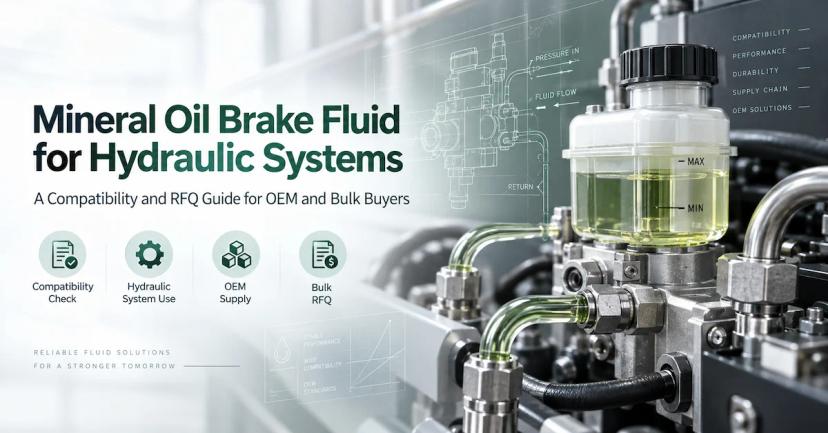
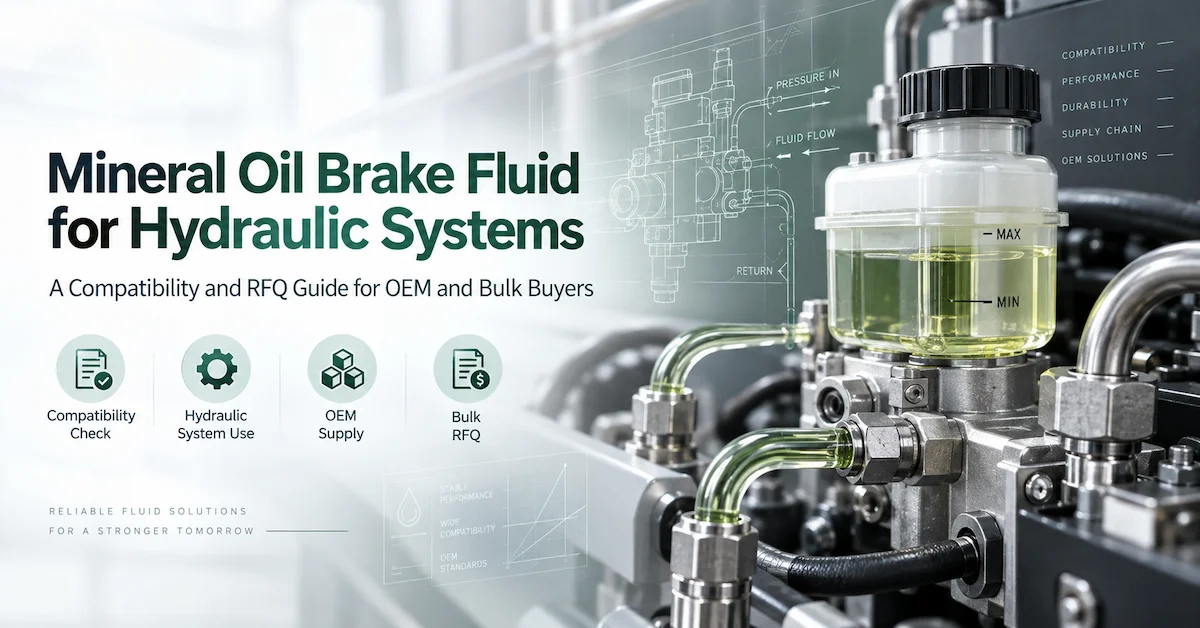
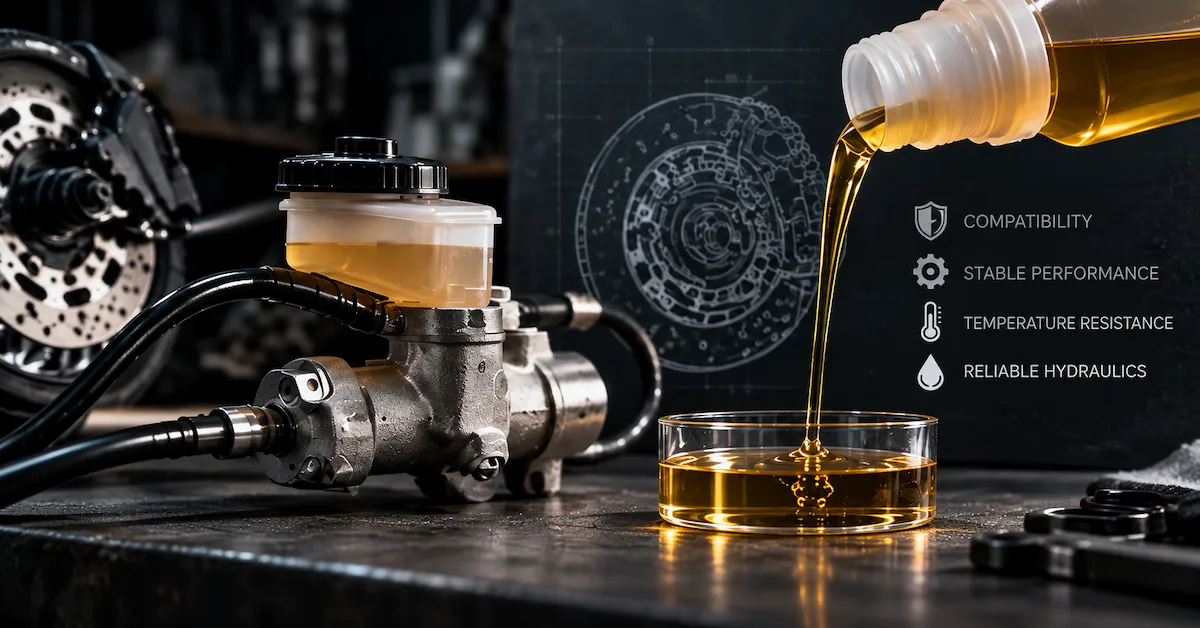
One commercial limit is worth stating before we go further. Look through GAFLE's public catalogue and you will find DOT 3, DOT 4, and DOT 5.1 fluids, racing products, and other automotive liquids. You will not find a product page for a mineral-oil brake fluid. That is why the photographs in this guide should be read only as illustrations of public processes and sourcing topics. They do not show that GAFLE has a suitable formula in stock, much less one approved for a buyer's system. The first conversation, therefore, is about technical feasibility and availability.
The sixty-second Mineral Oil Brake Fluid buying answer
The code in the system documentation is the starting point. Imagine two drums whose labels both say “mineral brake oil.” Until the equipment maker's requirement is on the desk, neither drum is a valid choice. Once that permission is clear, the buyer can agree the exact product identity and check its material fit, viscosity across the required temperatures, test plan, packaging, lot records, and rules for later changes. The shop side matters too. Its funnels, pumps, hoses, and filling containers need clear segregation from anything used with DOT fluids.
There is a firm stop on either side of that rule. DOT 3, DOT 4, and DOT 5.1 do not belong in a circuit built for mineral oil; mineral oil does not belong in a circuit built for those DOT fluids. Nor does a matching color turn two mineral products into substitutes. When a reseller's description conflicts with the current manual, service bulletin, approved-fluid list, or a written engineering decision, the controlled system document wins.
| Approval gate | Question to close | Evidence that can close it | Reason to stop |
|---|---|---|---|
| System permission | Does the exact equipment specification permit this chemistry and fluid code? | Current manual, service data, drawing, or written OEM requirement | Only “mineral oil compatible” is offered |
| Materials | Which seals, hoses, coatings, metals, and plastics contact the fluid? | Material list plus test protocol and results for the offered formula | Compatibility is inferred from base-oil family alone |
| Performance | What limits apply at the system's real temperatures and duty? | Named methods, temperatures, units, limits, and dated results | Only “high performance” or “low viscosity” appears |
| Production | Will commercial lots match the approved sample? | Controlled formula, release plan, COA, traceability, and retained sample | Sample, TDS, and quotation carry unmatched identities |
| Delivery integrity | Can filling and use prevent cross-contamination and misidentification? | Dedicated or validated-clean equipment, sealed packs, labels, and lot records | Shared transfer equipment has no verified cleaning procedure |
“Mineral oil” is a family name, not a universal approval
The trouble often starts with an ordinary piece of vocabulary. Ask five industries for “mineral oil” and the samples on the bench may include a refined petroleum base, an industrial hydraulic medium, a bicycle brake oil, a medicinal product, and a compressor lubricant. They may look alike in a beaker. Inside, their additives and viscosity behavior can be quite different, as can their effect on seals, resistance to oxidation, lubricating behavior, air release, purity controls, and regulatory purpose. The family resemblance does not grant service equivalence.
The U.S. rule uses the words more narrowly. In FMVSS No. 116, “hydraulic system mineral oil” has a definition of its own. Under that definition, the medium has a mineral-oil base and belongs in a motor-vehicle hydraulic brake circuit where it stays away from three rubber families: SBR, EPR, and natural rubber. That exclusion is a real compatibility boundary. It also leaves no grade called “DOT mineral oil”; the performance tables for DOT 3, DOT 4, and DOT 5.1 are not transplanted into this category.
ISO 7308 takes the discussion into stored-energy hydraulic brakes and their petroleum-based fluid. Bicycle and powered-cycle service takes it somewhere else: a maker may name one oil for a defined group of levers, calipers, seals, and tools. The broad language sounds similar, but the equipment specification must make any connection between the two.
| Fluid description | Typical specification route | What the name does not prove | Purchasing rule |
|---|---|---|---|
| DOT grades 3, 4, and 5.1 | Requirements written around non-petroleum motor-vehicle fluid | Suitability for a circuit designed for mineral oil | Use only where that grade and chemistry are specified |
| DOT 5 silicone fluid | Separate silicone-based DOT category | Interchangeability with glycol or mineral-oil systems | Treat as its own chemistry and follow the vehicle instruction |
| Hydraulic system mineral oil | System specification plus applicable legal labeling | A DOT number or fit with conventional brake-fluid rubber | Verify exact circuit, materials, destination, and label |
| ISO 7308 petroleum-based fluid | Stored-energy hydraulic-brake requirement | Universal fit in every mineral-oil brake circuit | Confirm the current standard and equipment requirement |
| Proprietary cycle brake oil | Named brake-maker service specification | Interchangeability with another brand's mineral oil | Follow the exact lever/caliper maker's instruction |
| General hydraulic, ATF, power-steering, or pharmacy oil | A different industrial, automotive, or consumer purpose | Brake-system safety, seal fit, or approved performance | Never substitute by appearance or base-family name |
Let the machine have the first and last word
Leave the bottle aside for a moment and identify the machine. Write down who built it, the model and variant, its build or serial range, the brake-system maker, and its destination market. Photograph the cap and warnings, then type out their wording; a fuzzy suffix may hide the important difference. Find the current service manual too. Neither a forum answer nor a label on an unknown replacement part is a sound basis for the order.
Now trace the circuit. A conventional master cylinder, a pump-fed stored-energy brake, a centralized system shared with steering or suspension, and a compact bicycle lever/caliper arrangement present quite different questions. Mark every function fed by the reservoir and note accumulators, proportional valves, ABS modulators, servo units, and flexible diaphragms. On a complex vehicle, fluid accepted for one circuit can still be forbidden in the one beside it.
Materials connect the hardware to its fluid. “Rubber” is too vague, so use the elastomer family and grade whenever drawings allow it. From there, trace every wetted item, including hoses and membranes, cups and bladders, adhesives, sealants, plastics, paint, plated metal, and assembly grease. A mineral base by itself answers very little. Additives and contamination matter, as do heat, contact time, stress, and part shape.
The reason for the search belongs in the file too. Supplying an already approved code is one job; replacing an obsolete product, reducing cost, supporting a new platform, or developing a private label are others. “Same as the original” gives a laboratory nothing it can measure. Attach the original code, the controlled drawing, the target specification, and the reason for change. A bidder can then respond to the project actually being considered.
| System record | Minimum detail | Why it changes the decision | Source owner |
|---|---|---|---|
| Equipment identity | Maker, model, build range, brake-system variant, destination | Similar models can carry different circuits | OEM engineering or controlled service data |
| Required fluid | Exact code, standard, revision, and approved-product list | Prevents selection by generic description | System maker or vehicle maker |
| Wetted materials | Named elastomer grades plus metals, plastics, coatings, and sealants | Reveals where swelling, shrinkage, extraction, corrosion, or leakage could begin | Component engineering and suppliers |
| Operating envelope | Cold start, normal range, peak exposure, pressure, cycle rate | Sets viscosity, stability, air, and durability needs | Vehicle validation and field data |
| Service process | Fill tools, flush method, interval, pack size, waste route | Determines contamination and misfill exposure | After-sales and maintenance network |
Why mineral oil and DOT-fluid assumptions cannot be mixed
A circuit calling for DOT 3, DOT 4, or DOT 5.1 normally pairs non-petroleum fluid with materials chosen for it. Mineral-oil hardware begins from another pairing. Cross between them and a seal may swell or shrink, turn harder or softer, and lose strength. Lubrication and leakage can shift too. Fluid caught in a small valve, hose, or absorbent elastomer may remain after the reservoir looks empty.
The familiar DOT shorthand does not travel across that divide. Wet equilibrium reflux boiling point is central to conventional glycol-fluid standards, yet it is not automatically the main acceptance model for a mineral-oil circuit. Be equally careful with the word “approved.” The U.S. system places conformity certification on the manufacturer where a standard applies. It does not provide a general Department of Transportation approval badge for the fluid.
Picture a technician finding the wrong bottle beside an open reservoir. That is a safety event, not an ordinary fluid change. Park the equipment and establish what belonged there, what went in, roughly how much, and for how long. Give those facts to the vehicle or brake-system maker. One drain is not a reset: residue can remain and parts may already be affected. Some circuits will need controlled cleaning or replacement of seals, hoses, even assemblies. The decision belongs to the owner of that exact system.
Use the standards map without turning it into a shortcut
A standard sorts the evidence; the machine still decides what may be used. For U.S. sales, read the live 49 CFR 571.116 text, which gives hydraulic system mineral oil separate treatment. It addresses color, identity and lot information, cautions, and labeling for the category. Capacity then matters at one specific threshold. From 177 mL upward, a container is also subject to the resealable-closure, impervious-inner-seal, and tamper-proof provisions. Check the live wording against the real pack and destination before artwork approval.
ISO 7308:1987 carries the title Road vehicles — Petroleum-based brake-fluid for stored-energy hydraulic brakes. The ISO scope associates it with petroleum-fluid systems and compatible elastomers, giving butadiene-acrylonitrile copolymer or an equivalent as an example. It also says the fluid is not intended for arctic conditions. Obtain the authorized standard and check its current status; search-page summaries are no place to invent numeric limits.
Another ISO number can easily send a comparison down the wrong path. The subject of ISO 4925:2026 is non-petroleum brake and clutch fluid for road vehicles, so it offers no approval route for a mineral-oil candidate.
Labeling has a separate reference, ISO 3871:2000. Its minimum container-label provisions span petroleum and non-petroleum fluids for road-vehicle braking and hydraulic systems, with mopeds and motorcycles included in scope. Testing brings in ISO 7309:1985 and its reference petroleum-base fluid. “Reference” is decisive: this alone is not a commercial service specification, an OEM approval, or permission to fill a vehicle.
| Reference | Useful purchasing role | It does not establish | Buyer action |
|---|---|---|---|
| FMVSS No. 116 | U.S.definitions and applicable packaging, color, identity, and warning requirements | A DOT grade or government approval for mineral oil | Review current legal text for the exact product and pack |
| ISO 7308 | Petroleum fluid for compatible stored-energy hydraulic brakes | Universal mineral-oil interchangeability or arctic suitability | Use the authorized edition and system requirement |
| ISO 4925 | Classification and requirements for non-petroleum brake and clutch fluids | A qualification route for petroleum-based mineral-oil fluid | Keep the chemistry families and their evidence routes separate |
| ISO 3871 | Container-labeling framework for road-vehicle fluid | Complete formulation performance or application approval | Map label content with destination-market rules |
| ISO 7309 | Reference petroleum-base test fluid | Automatic commercial service-fluid acceptance | State clearly whether the requirement is test or service use |
| OEM or brake-maker code | Defines the actual approved application and often additional tests | Approval of an unnamed alternative formula | Verify code, revision, product identity, and approval status |
Color is a label aid, not a compatibility test
The U.S. rule specifies green for hydraulic system mineral oil in its regulatory context. The color helps visually distinguish the regulated category, but it does not make every green liquid suitable for every system. Proprietary cycle products can use other colors, and dyes can fade, darken, or be confused under workshop lighting. A red, blue, green, or clear appearance is never a substitute for reading the approved code.
Color can still support error prevention when it is treated as one control among several. Use unique labels, container shapes where practical, keyed couplings, dedicated fill equipment, barcode checks, controlled storage locations, and clear work instructions. Record the lot and product code at fill. If the fluid in a reservoir differs from the documented product, quarantine the equipment and investigate rather than guessing from the hue.
Build a complete performance profile around the system
Plot viscosity across the temperatures the machine will actually see. At a cold start, the oil still has to pass through small ports and moving valves. Once the system is hot, it must retain the behavior needed for control and lubrication. Both ends of the curve come from the system specification. A petroleum liquid does not become brake fluid merely by meeting a popular headline number.
Heat asks another set of questions. Oil that lingers near a hot surface, circulates for hours, or passes through repeated pressure cycles should be checked for deposits, acidity movement, viscosity drift, and additive loss under an agreed procedure. Put the system's actual metals into the corrosion plan. Where pumps, valves, or sliding faces rely on the fluid, wear and lubrication deserve their own evidence. Air release, foaming, and compressibility can then be considered in terms of the hydraulic response a driver or operator will feel.
Water deserves a practical answer rather than the slogan that mineral oil “never absorbs” it. A careless service job, condensation, a damp transfer line, or damaged packaging can still introduce water. Some may remain free or form an emulsion instead of dissolving as it would in another chemistry. Ask what that means for rust, cold behavior, filtration, and separation in the particular circuit. The RFQ should name a method and an acceptance point, not lean on a sweeping hygroscopicity claim.
| Property area | RFQ must state | Evidence to request | Weak answer |
|---|---|---|---|
| Viscosity | Temperatures, method, units, minimum/maximum, sample state | Dated results plus production-control limit | “Flows well in winter” |
| Thermal and oxidation stability | Exposure, duration, oxygen condition, evaluation limits | Method report with before/after identity and measurements | An unspecified “high temperature” claim |
| Materials and corrosion | Actual elastomers, metals, plastics, temperatures, duration, limits | Change in volume, hardness, strength, appearance, mass, and corrosion | “Safe for rubber and metal” |
| Lubricity and wear | Component or bench method, load, speed, temperature, limit | Named test and component validation where required | Base oil type offered as proof |
| Air, foam, and water behavior | Agitation, temperature, contamination state, settling time, limits | Method-specific data tied to the offered formula | “Non-hygroscopic” used as the complete answer |
| Cleanliness | Particle method, size bands, limits, sampling point, package condition | Fill-line and final-container results if the system requires them | Visual clarity alone |
Low viscosity needs a temperature, method, and approval
The label Low Viscosity Mineral Oil Brake Fluid leaves most of the purchasing question unanswered. One quotation may mean -40°C while another means -20°C; their figures cannot be set side by side. Check the test method, unit, sample condition, and rounding rule. Most importantly, find out whether a number is a typical development result or the maximum that routine production must meet.
Cold flow can matter in rapid valve movement, fine passages, long lines, pump inlet conditions, or winter starts. Yet a thinner candidate may alter leakage, lubrication, damping, film strength, or hot operation. The system maker must define the permitted viscosity envelope across the complete temperature range. A lower cold result is useful only when every other approval requirement remains satisfied.
Ask bidders for a viscosity-temperature table, not one preferred number. Mark each value as typical or guaranteed. State sample conditioning, test method, equipment precision, and retest rule. For a new application, compare candidate curves and then validate hydraulic response, pump behavior, seal leakage, modulation, noise, and durability on representative hardware.
Map the application before choosing a product
The relevant question is not “Where is mineral oil used?” but “Which controlled specification governs this exact circuit?” Some stored-energy road-vehicle brakes were designed around petroleum fluid. Certain centralized systems use a system-specific oil across more than one function. Many bicycle brakes and some powered-cycle systems specify proprietary mineral oils. Other vehicles use conventional DOT fluid, and many industrial hydraulic circuits are not brake-fluid applications at all.
The following matrix is a routing tool, not an approval list. An application belongs in the “possible” column only after the authoritative equipment requirement is found. Age, region, component replacement, and model-year changes can alter the specified fluid.
| Application group | Possible specification path | Critical questions | Do not assume |
|---|---|---|---|
| Stored-energy road-vehicle brake | OEM code and potentially ISO 7308-related requirement | Pump, accumulator, elastomers, climate, pressure, shared functions | Every petroleum hydraulic fluid qualifies |
| Centralized vehicle hydraulic circuit | Vehicle-specific code, often revision-sensitive | Which systems share the reservoir and which material set applies? | A steering-fluid label grants brake approval |
| Bicycle or e-bike hydraulic brake | Lever/caliper maker's named service fluid | Exact component family, hose, service kit, warranty rule | All cycle mineral oils can be mixed |
| Motorcycle, moped, or light electric vehicle | Exact brake-maker or vehicle-maker requirement | Does the manual call for mineral oil, a DOT grade, or another code? | Vehicle type predicts the fluid family |
| Off-highway or specialty equipment | Equipment drawing and component supplier requirements | Brake architecture, ambient range, contamination, service access | Ordinary industrial oil is suitable |
| Ordinary road-car hydraulic brake circuit | Usually the DOT or OEM fluid stated on cap/manual | What does current service information require? | Mineral oil is an upgrade or universal substitute |
The makers' own instructions show how narrow approval can be. For the products it covers, a current Shimano dealer manual describes replacement with Shimano genuine mineral oil. Open the MAGURA GUSTAV PRO manual and it names MAGURA Royal Blood mineral oil while expressly excluding DOT brake fluid. Each passage governs the products in its own manual. Neither passage cross-approves the other brand's oil or an unnamed substitute.
Write an RFQ that a laboratory and factory can execute
A useful request for quotation is short enough to read and precise enough to test. Begin with the equipment table and attach controlled source documents. State whether bidders may quote only an already approved product, propose an equivalent for engineering validation, or develop a new formula. Never let those three routes collapse into one price column.
The copy-ready outline below can be adapted. Replace every bracketed item; do not leave “TBD” in a safety-critical acceptance field:
Application: [equipment maker, model, brake-system variant, build range, destination market]
Required identity: [OEM or system fluid code and revision; existing approved product if applicable]
Project route: [approved-product supply / equivalent validation / new development]
Contact-material schedule: [named elastomers and metals; hose, plastic, coating, sealant, and assembly-aid details]
Operating envelope: [minimum ambient, startup condition, normal and peak fluid temperature, pressure, duty cycle]
Performance: [property, method and edition, temperature, units, limit, sample condition, reporting rule]
Regulatory and label: [countries, languages, package sizes, mandatory marks and warnings]
Evidence: [TDS, SDS, test reports, declarations, approval letters, sample COA, audit documents]
Production control: [release tests, COA fields, sampling, traceability, retained samples, change notification]
Commercial: [annual demand, order profile, pack, label owner, Incoterm, destination, target timing]
Separate qualification limits from routine release tests. Some compatibility or endurance tests are too long for every batch, but the control plan must show how raw materials, blending, in-process checks, final release, periodic verification, and change control preserve the qualified design. Define which COA values are actual lot results and which are conformity statements.
Build an evidence ladder before approving a claim
Evidence has levels. A brochure can help a buyer discover a candidate, but it cannot carry the same weight as an approval letter tied to an exact product code. A technical data sheet provides useful declared properties, yet it may list typical figures rather than guaranteed limits. A test report is stronger only when the sample, formula revision, method, laboratory, date, and result are traceable.
System validation sits above isolated bench values because it observes the offered fluid in representative hardware and duty. The strongest commercial control then connects qualification to production: the master specification identifies the formula; purchasing controls incoming materials; batch records document manufacture; release results identify the lot; the package preserves identity; and a retained sample supports investigation. A silent formulation or raw-material change can break that chain even when the brand name remains the same.
| Evidence level | What it can support | Identity check | Buyer decision |
|---|---|---|---|
| Marketing page | Discovery and initial conversation | Brand, product name, date captured | Shortlist only |
| Current TDS and SDS | Declared profile, handling, and hazard communication | Product/formula code, revision, market | Technical screening |
| Named-method reports | Measured performance of an identified sample | Sample ID, batch, formula revision, laboratory, date | Bench qualification |
| Material and system validation | Fit with representative components and duty | Hardware revision, protocol, candidate identity | Application approval decision |
| Production specification and lot evidence | Repeatability and shipment acceptance | Batch, release result, container, retained sample | Release or hold the shipment |
Qualify the supplier, manufacturer, and laboratory separately
A capable Mineral Oil Brake Fluid Supplier should be able to preserve product identity from quotation through delivery. Ask who formulates and blends, who owns the formula, where testing occurs, who fills the pack, and which legal entity signs the specification. A trader may provide sound service, but the buyer still needs a transparent route to technical decisions and change notifications.
An audit of a Mineral Oil Brake Fluid Manufacturer should follow the product through the plant. How are incoming materials qualified? Which revision tells the operator how to blend it? What keeps the tank and line from carrying over the previous product? Sampling, test capability, deviation handling, calibration, traceability, retained samples, and customer approval of changes complete the picture. Experience with glycol brake fluid cannot answer those questions by proxy; mineral-oil chemistry may call for different material controls and a different cleaning study.
Ask the laboratory technician to walk through one result from sample receipt to report. That conversation should expose the method, instrument range, reference material, calibration status, relevant uncertainty, and chain of custody. Outsourced work is fine when the outside laboratory and procedure are known before approval. Presentation is secondary: a modest report tied cleanly to formula, batch, and contract limit is more useful than a glossy page whose sample cannot be traced.

Treat performance language as a testable proposition
A phrase such as High Performance Mineral Oil Brake Fluid can summarize a qualified product, but it cannot define one. The supplier should state which performance is higher, the baseline, the test, the limit, and the application. Better cold response, oxidation resistance, pump wear, seal durability, or cleanliness are different claims and can require different evidence.
Avoid converting a single result into a system promise. A favorable bench oxidation result does not prove seal compatibility. Low viscosity does not prove adequate lubrication. A high flash point is not a brake-temperature approval. An ISO reference-fluid comparison is not an OEM endorsement. Write each required property as its own acceptance line and then validate interactions in components or systems.
Use a feasibility gate for GAFLE inquiries
The public GAFLE catalogue should not be stretched beyond what it shows. At the time of this article's preparation, it did not identify a commercial mineral-oil brake-fluid SKU with a TDS, approval list, or package range. Therefore, a request for Mineral Oil Hydraulic Brake Fluid should be handled as a technical review, not as an assumption of stock.
Send the OEM fluid code, full application, standards and revisions, material list, operating range, target volume, packaging, destination, and required evidence. GAFLE can then confirm whether the request can be evaluated and what information would be needed next. No website article, inquiry button, or factory photograph replaces a written offer and approved technical file for the exact product.
Make OEM and private-label approval happen before artwork
An OEM Mineral Oil Brake Fluid program begins with a signed technical specification and approval route, not bottle decoration. Freeze the formula identity, intended applications, claims, test methods, production limits, SDS jurisdiction, package materials, closure, label warnings, lot format, shelf-life basis, and change-control obligations before approving artwork.
The evidence sets the edge of every label claim. Without a defensible technical and legal file, artwork must not imply Department of Transportation endorsement, universal fit, or equivalence to a named OEM product. Review the text market by market. A U.S. pack needs a line-by-line check against the hydraulic-system-mineral-oil wording and cautions in FMVSS No. 116, while another destination may bring its own chemical, language, transport, or consumer rules.
Do not approve artwork on a flat PDF alone. Assemble the real bottle or container with its specified resin, cap, liner or inner seal, tamper feature, ink, adhesive, and barcode, then inspect that proof. Suitable compatibility, leak, torque, transit, and storage checks follow. The formula can be correct while its closure makes the finished pack unacceptable.
Control bulk transfer as carefully as the formula
A Bulk Mineral Oil Brake Fluid Supplier must protect the qualified identity through tank assignment, hoses, pumps, filters, sampling tools, intermediate containers, filling heads, closures, warehouse handling, and transport. Shared equipment is not automatically unacceptable, but the cleaning method needs a validated acceptance rule sensitive to the incompatible residues that matter.
On a line-clearance form, the word “clean” needs an acceptance rule beside it. A hose can look spotless while still carrying glycol fluid, water, detergent, solvent, additive, or traces of the last batch. Depending on that risk, the control might be dedicated equipment, disposal of a first flush, rinse analysis, conductivity, water testing, spectroscopy, viscosity, or an elemental marker. Choose the check for the residue that could realistically remain and for the receiving system's sensitivity.
Bulk does not always mean a tanker. Drums, pails, intermediate bulk containers, and returnable vessels all introduce questions about liner and seal compatibility, headspace, cleanliness, tamper evidence, partial use, resealing, and warehouse segregation. State who owns the vessel, who cleans it, how previous contents are controlled, and where the acceptance sample is drawn.
| Control point | Required control | Record | Release question |
|---|---|---|---|
| Tank and blend | Approved vessel status, formula, sequence, mixing, sample | Batch record and equipment log | Does the manufactured batch match the frozen identity? |
| Line, hose, pump, filter | Dedicated status or validated cleaning and compatible materials | Line clearance and cleaning result | Could prior chemistry remain in the delivery path? |
| Container | Approved material, cleanliness, seal, tamper feature, label | Packaging batch and inspection | Can the pack preserve identity through shelf life? |
| Final sampling | Defined point, clean tool, sealed sample, chain of custody | Sample log, COA, retained sample | Does the tested sample represent delivered material? |
| Loading and shipment | Seal numbers, lot map, protection, documents, container inspection | Packing list, seal log, photographs, release | Can every received unit be traced to the released lot? |
| Customer dispensing | Dedicated tools, resealing, identification, shelf-life-after-opening rule | Warehouse and fill log | Will the qualified state survive at the point of use? |
Validate samples, pilots, and the first production lot
A sample is useful only when its identity is controlled. The label and paperwork should show product or formula code, revision, batch or sample number, manufacture date, sample status, and intended specification. Record who filled it and whether it came from laboratory preparation, pilot production, or routine manufacturing equipment. A hand-made sample can support exploration, but it cannot prove that the factory process will reproduce the result.
Begin with document review and basic identity checks before consuming expensive components. Then run the agreed bench panel and material exposures. Component testing should use representative seals, hoses, pumps, valves, and finishes. System testing should cover the credible hot and cold states, pressure cycles, modulation, leakage, noise, wear, storage, and any contamination or endurance conditions in the approval plan. Use a control fluid when the protocol calls for one.
A pilot lot tests scale-up, equipment contact, mixing, filtration, filling, package compatibility, and traceability. The first commercial lot should receive enhanced review: verify raw-material batches, batch record, release data, label, pack, quantity, retain sample, and delivered condition. Agree how deviations are handled before they happen. Product remains on hold while an unexplained mismatch is investigated.
Approval should expire or trigger review after defined changes. Examples include base oil source, additive supplier, formula ratio, process site, vessel or line, test method, container resin, closure, label warning, regulatory status, or long production interruption. “Equivalent raw material” is a proposal for assessment, not a unilateral permission.
Three procurement cases show why the route changes
Case 1: an obsolete code in a stored-energy system
A fleet has older vehicles whose manuals name a petroleum fluid no longer supplied locally. Purchasing asks for “the nearest mineral oil.” Engineering pauses the request. It obtains the manual revision, hydraulic schematic, component material list, old fluid documents, climate data, service history, and a sample of uncontaminated retained fluid if available. Candidate equivalence is treated as a validation project, not as a catalogue cross-reference. The fleet tests material behavior, viscosity across its range, pump and accumulator operation, leakage, and endurance before a controlled trial. Vehicles are converted by serial number, and mixing with the legacy product is permitted only if the system owner has validated it.
Case 2: a bicycle distributor wants one oil for several brands
A distributor sees that several brake brands use mineral oil and wants one workshop bottle. The commercial logic is attractive; the technical premise is incomplete. The team builds a matrix of every lever and caliper family, the specified service oil, warranty conditions, hose and seal materials, and maker instructions. Where no written cross-approval exists, the oils remain segregated. Dedicated syringes, bleed blocks, hoses, and storage locations prevent accidental mixing. The business may still pursue an alternative product, but only brand by brand with the required approval and evidence.
Case 3: private label for a cold-region specialty vehicle
A vehicle program asks for a thin petroleum fluid and a branded package. Procurement initially compares only the cold viscosity. The corrected RFQ adds hot viscosity, pump wear, seal and hose exposure, air release, oxidation, corrosion, cleanliness, and representative system cycles. The package review covers low-temperature handling, seal integrity, label language, and misfill prevention. Artwork is released only after the technical candidate passes. The purchase contract then names the formula revision, COA plan, change notice, and first-lot validation rather than relying on the front-label adjective.
Avoid the comparison mistakes that create false equivalence
Comparing colors: dye helps identification but does not prove chemistry or approval. Comparing one viscosity value: a result without temperature, method, unit, and limit status is not comparable. Comparing boiling points across fluid families: the familiar DOT-fluid framework may not be the controlling mineral-oil requirement. Comparing SDS documents as performance sheets: an SDS communicates hazards and handling, not the complete acceptance specification.
Comparing brand reputation instead of product identity: one manufacturer can make several incompatible fluids. Using an “equivalent to” chart as final approval: a cross-reference begins technical review unless the system owner accepts it. Assuming a reference fluid is a service fluid: ISO 7309's testing role must not be expanded without basis. Approving a sample without production controls: the shipped lot needs a documented route back to the formula that passed.
The phrase Mineral Oil Brake Fluid for Hydraulic Brake Systems describes intended use broadly, not compatibility with a named machine. Require the application code and evidence every time.
Questions that arrive with a real RFQ
Does the DOT system assign a grade to mineral-oil fluid?
It does not. FMVSS No. 116 treats hydraulic system mineral oil separately from the DOT 3, DOT 4, DOT 5, and DOT 5.1 categories. Describe the product and its conformity accurately rather than presenting it as the holder of a DOT product approval, and always return to the rule that governs the exact system and market.
What happens if mineral oil is mixed with DOT 3, DOT 4, or DOT 5.1?
Keep the families apart. The circuits may rely on different elastomers and design assumptions, so mixing and substitution are unsafe shortcuts. After a misfill, take the equipment out of operation and ask its maker for the recovery procedure for that specific circuit.
May two brake oils be swapped when both say “mineral”?
The common word on the label is not enough. Base stocks, additives, viscosity, temperature range, material effects, and approvals may differ. The safe choice is the named product, or an alternative that has been documented and permitted for those particular components.
Does green color prove the fluid is correct?
No. Green has a defined role for hydraulic system mineral oil under the U.S. rule, but color alone cannot identify a formula or establish compatibility. Check the sealed container, code, lot, label, and equipment requirement.
Is a thinner oil automatically a better cold-weather replacement?
Only the system owner can approve that change. Easier flow at one cold test point may arrive with different leakage, lubrication, damping, pump, or hot-running behavior. Compare full viscosity curves and then prove the candidate in representative hardware.
What makes a mineral-oil brake medium high performance?
Ask what improved, against which baseline, and under which test. The answer might be cold flow, oxidation, wear, air release, cleanliness, seal durability, or something else the system genuinely needs. “High performance” is a summary after that work, not a stand-in for the specification.
What about hydraulic oil, ATF, or power-steering fluid?
Treat each as unsuitable unless the equipment maker actually names that exact product or standard. A petroleum origin and an oily appearance say nothing reliable about brake-system compatibility.
What documents should a bulk buyer request?
At minimum: controlled specification, current TDS and SDS, applicable test and approval evidence, sample COA, routine release plan, traceability format, package information, cleaning or segregation controls, retained-sample policy, and change-notification agreement.
Does mineral oil have an unlimited service life?
There is no responsible universal interval. Formula, circuit design, temperature, contamination, component wear, and maintenance all influence the answer. Use the inspection and replacement schedule issued for the equipment rather than assuming the oil lasts forever.
Can the fluid be used in an ordinary passenger car?
Only if that exact car and circuit specify a mineral-oil medium. Most conventional passenger-car brake reservoirs state a DOT grade. Never convert chemistry based on a general article or perceived performance benefit.
What should be submitted for a technical quotation?
Provide the vehicle or equipment identity, OEM fluid code and revision, circuit description, materials, operating temperatures, performance methods and limits, approvals, annual quantity, order size, package, label market, destination, and project timing. State whether the request is for an approved product, alternative validation, or development.
Does GAFLE currently list a mineral-oil SKU?
The public catalogue reviewed for this guide did not show a product-specific listing. Submit the system specification for a feasibility and availability review; do not treat an inquiry as confirmation of supply, certification, or approval.
The final approval rule
Approve Mineral Oil Brake Fluid only when three identities match: the system requirement, the qualified formula, and the production lot being delivered. The broad chemistry name is not enough. Neither are color, one viscosity number, a competitor cross-reference, a website claim, or an attractive private-label bottle.
A sound decision file shows who permitted the fluid, which components and duty were evaluated, what methods and limits apply, how the factory keeps the formula unchanged, and how each container or bulk lot remains traceable. That discipline protects braking hardware, service teams, brand owners, and end users while making quotations far easier to compare.
For a feasibility review, submit the exact OEM code, system details, materials, temperatures, standards, evidence list, forecast, package, and destination. The response should confirm what can be assessed next; it should not presume that a public GAFLE mineral-oil product or approval exists.