logo

The Difference Between Glycol Brake Fluid and Silicone-Based Brake Fluid

logo

Published

Oct 13 2026

  • Buying Guide

Follow us

the-difference-between-glycol-brake-fluid-and-silicone-based-brake-fluid
glycol brake fluid vs silicone brake fluid
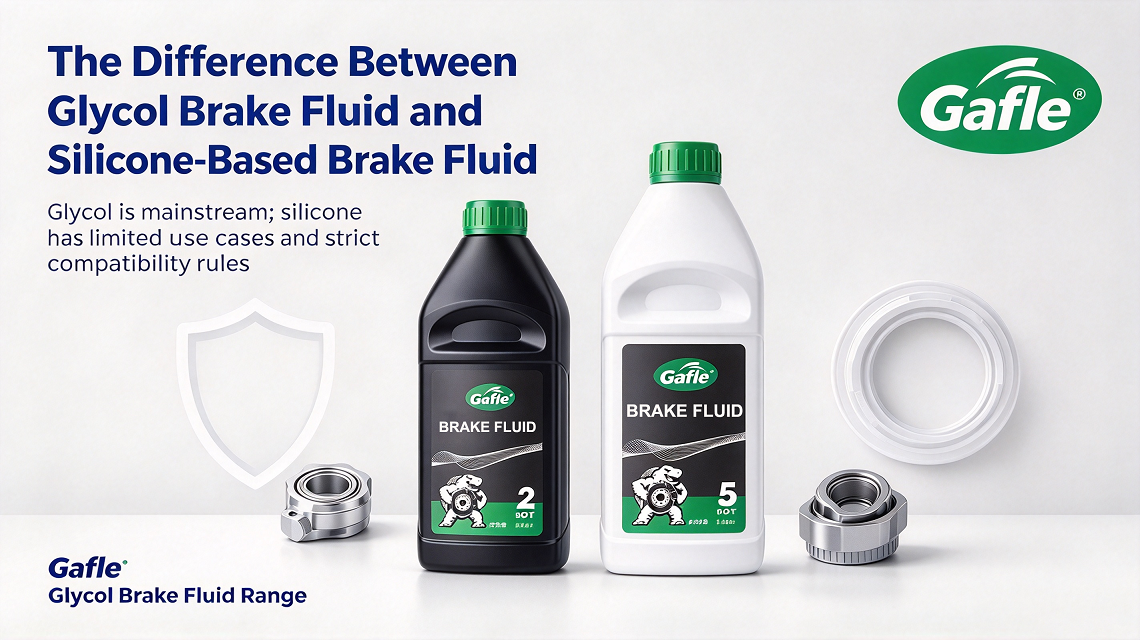
Two major chemical families dominate the global brake fluid market: glycol-based brake fluid and silicone-based brake fluid. Many buyers confuse DOT 5 silicone fluid with DOT 5.1 glycol fluid, which is one of the most dangerous misjudgments in brake service.
Gafle’s standard DOT3, DOT4, DOT4 LV and Racing325 brake fluid all belong to glycol formulations. Silicone brake fluid is a separate category, rarely used in daily road vehicles, with unique characteristics and strict usage limitations.
Glycol brake fluid: the mainstream choice for nearly all modern passenger cars, motorcycles and light commercial vehicles.
Glycol fluid (DOT3 / DOT4 / DOT4 LV / DOT5.1) is hygroscopic, meaning it absorbs water over time. While moisture absorption reduces boiling point, it has a major advantage: it is fully compatible with standard EPDM rubber seals and hoses used in most factory brake systems. It mixes safely with other glycol brake fluids of different DOT grades when needed for top-up, and it is widely available and cost-effective for mass aftermarket maintenance.
Silicone brake fluid (DOT5) is non-hygroscopic and does not absorb water.
Water will not dissolve into silicone fluid; any water entering the brake system stays as separate liquid droplets. This sounds attractive at first glance, but separated water can pool at low points inside brake lines. Under heavy braking, water boils into steam and creates vapor lock. Silicone fluid also has poor lubricity compared to glycol variants, and it is incompatible with many older rubber brake components. Once you fill a system with silicone fluid, you cannot switch back to glycol without fully stripping and cleaning the entire hydraulic circuit.
Typical application scenarios for silicone brake fluid.
Silicone DOT5 brake fluid is mostly selected for classic car storage, antique vehicles that sit idle for months or years, and some special military equipment. It is not recommended for daily driven modern passenger cars or racing applications. It also tends to trap tiny air bubbles during bleeding, making brake bleeding more difficult for technicians.
Key takeaways for importers, distributors and repair shops.
Never mix silicone brake fluid with glycol brake fluid. The two formulations cannot blend, and cross-contamination will damage brake seals and cause brake failure. Most OEM vehicle specifications require glycol brake fluid. When customers ask for DOT5, confirm whether they mean DOT5 silicone or DOT5.1 glycol. Gafle supplies full-range glycol brake fluid for standard automotive and racing applications, matching most road vehicle OEM requirements globally.
Welcome to contact GAFLE for more information & cooperation!
peter
ZHEJIANG GAFLE AUTO CHEMICL CO.,LTD
Tel:86-579-8222 1665
Fax:86-579-8246 4690
Cel/Wechart:86-13335993986
E-mail:peter@gafle.net
Web:www.gafle.net
Featured Blogs
Windshield Washer Fluid Guide: Choosing the Right Formula

Windshield Washer Fluid Guide: Choosing the Right Formula

1. Why windshield washer fluid deserves more attention than it gets 2. What buyers are really comparing 3. Common formulation types and how they differ 4. Selection criteria that matter in the real world 5. Buying mistakes that lead to complaints 6. Practical advice for sourcing managers and product teams 7. Quick FAQ 8. What to do next

EV Brake Fluid: What Buyers and Service Teams Should Know

EV Brake Fluid: What Buyers and Service Teams Should Know

1. EV brake fluid: why it deserves more attention than it usually gets 2. What changes in an EV braking system 3. Why viscosity and cold-flow behavior matter 4. Choosing brake fluid for EV regenerative braking system applications 5. What wholesale buyers and service centers should watch 6. Common mistakes in EV brake fluid selection 7. A practical buyer’s checklist 8. FAQs about EV brake fluid

Coolant Tap Water: What You Need to Know Before Mixing

Coolant Tap Water: What You Need to Know Before Mixing

1. Can You Use Coolant Tap Water? What Engineers and Maintenance Buyers Need to Know 2. Why tap water is not a neutral choice 3. Antifreeze dilution: the chemistry behind the warning 4. Where deionized water fits 5. Quick buyer guidance: when tap water is a bad bet 6. Common mistakes maintenance teams make 7. Practical decision rule 8. FAQ

Brake Fluid OEM Sourcing: What Buyers Should Check First

Brake Fluid OEM Sourcing: What Buyers Should Check First

1. Why brake fluid OEM sourcing deserves more attention than it usually gets 2. What buyers should look for first 3. How brake fluid OEM compares with other private-label chemical programs 4. Quality inspection: what can go wrong and where to catch it 5. Selection criteria that actually affect long-term performance 6. Common mistakes buyers still make 7. FAQ for sourcing teams 8. A practical next step

Coolant Selection Guide: Corrosion, Electrolysis, and System Life

Coolant Selection Guide: Corrosion, Electrolysis, and System Life

1. What coolant really has to do in an engine or industrial system 2. Coolant versus antifreeze: useful distinction, but not the whole story 3. Why corrosion control is the part buyers should not skim past 4. Coolant electrolysis risks in mixed-metal systems 5. What good coolant selection looks like in practice 6. Where heavy-duty formulations fit 7. Common buyer mistakes that cost more later 8. Buyer checklist before you source coolant 9. Final practical note for engineering and procurement teams

Brake Fluid Packaging for Ocean Shipping: How to Prevent Moisture Damage

Brake Fluid Packaging for Ocean Shipping: How to Prevent Moisture Damage

1. Why brake fluid packaging becomes a shipping issue, not just a storage issue 2. What makes brake fluid vulnerable in transit 3. Key packaging features buyers should look for 4. How to prevent brake fluid moisture during sea transport 5. What to ask before placing a bulk export order 6. Common mistakes that cause avoidable loss 7. FAQ: quick answers for sourcing teams 8. Choosing packaging that protects both product and reputation