
Why annual production capacity matters in manufacturing decisions
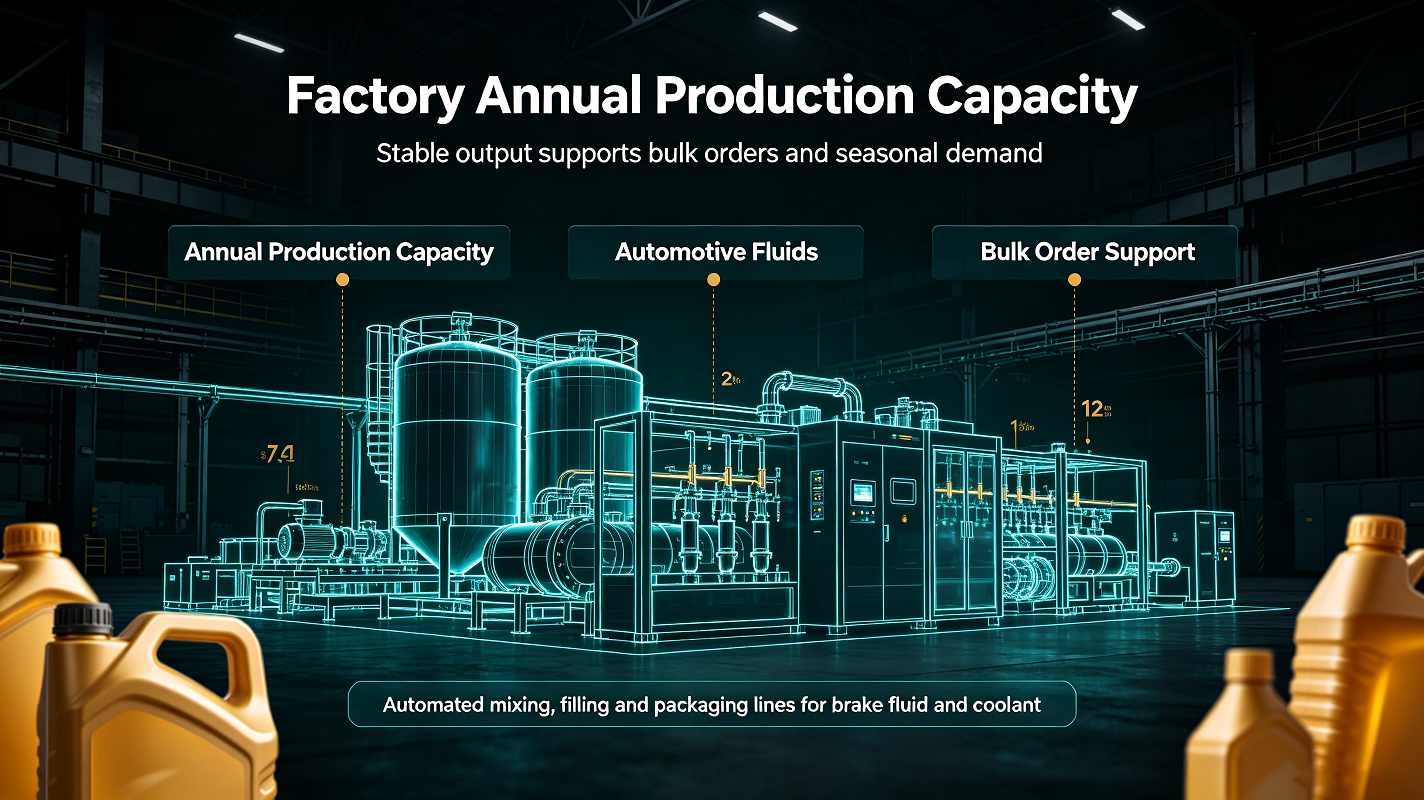
When buyers compare suppliers, annual production capacity is often the number that reveals whether a factory can truly support a program or just quote for it. In manufacturing, capacity is not a vanity metric. It is the difference between a supplier that can sustain volume through the year and one that can only handle a short burst of orders. For sourcing managers, engineers, and product teams, this matters because delivery stability affects launch timing, inventory planning, and even customer trust downstream.
A supplier may look attractive on paper: good pricing, tidy samples, responsive emails. But if the plant cannot maintain factory output at the level your business needs, the relationship can become fragile quickly. That is especially true for products that move in recurring volume, such as fluids, components, packaged goods, and other repetitive SKUs where bulk production capability is part of the buying decision rather than a background detail.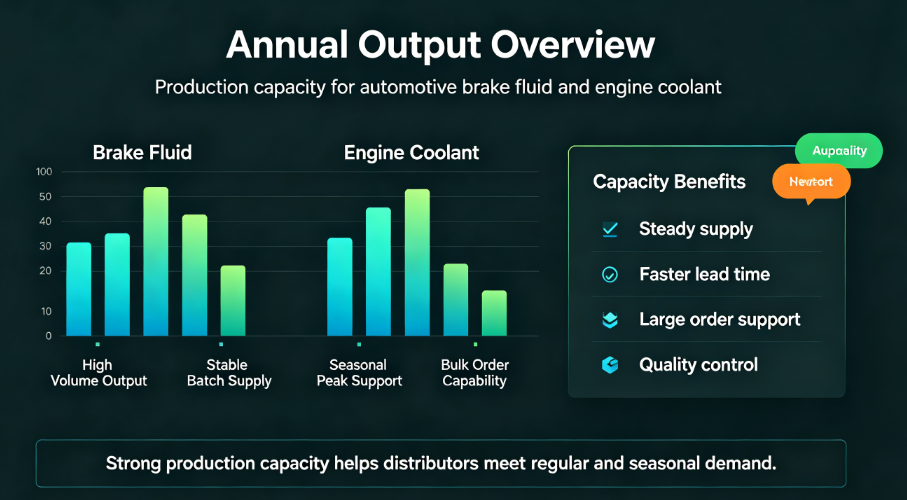
What capacity tells you that a brochure often does not
Annual production capacity is usually the clearest shorthand for how much a site can produce over a full year under normal operating conditions. It helps answer a practical question: can this supplier meet my demand without frequent delays or quality drift?
That said, the number alone can be misleading if it is not read carefully. Some factories quote theoretical maximum output. Others refer to actual operating output after maintenance, line changeovers, shift patterns, and internal scrap rates are considered. Those are not the same thing, and buyers should not assume they are interchangeable. A plant that advertises a high figure but runs a narrow product mix may still struggle when your order needs changeovers or special packaging.
For global programs, the issue is even more sensitive. Brake fluid/antifreeze manufacturing capacity for global distributors, for example, is not only about how many liters a facility can produce. It also depends on blending consistency, packaging lines, storage discipline, and the ability to coordinate shipments across markets. In practice, the useful question is less “How big is the factory?” and more “How reliably can it serve my channel over time?”
A quick way to think about capacity levels
There is no universal threshold that fits every industry, but buyers often evaluate capacity in layers:
1. Routine replenishment volume
This is the level needed to keep standard orders moving without strain. If your demand is predictable, a modest factory output may be enough, provided the supplier has disciplined scheduling.
2. Growth headroom
This is the extra room above current demand. It matters when a product starts scaling faster than expected or when a customer program expands into new regions. Without headroom, any surge becomes a rush job.
3. Resilience under disruption
Maintenance, labor shortages, raw material delays, and packaging interruptions can all reduce output. A supplier’s bulk production capability is only valuable if it has enough operational resilience to absorb ordinary setbacks.
Questions buyers should ask before trusting the number
Capacity discussions become more useful when they move beyond a single headline figure. A practical buyer will ask:
What product mix does that capacity assume?
How many shifts run regularly?
Are changeovers frequent or rare?
Is the number based on one line or the whole site?
How much of the annual production capacity is already committed to other customers?
These questions may sound basic, but they often expose the real constraint. A factory can have impressive nameplate capability and still be fully booked during your peak season. That is why sourcing teams should treat capacity as a planning tool, not a promise by itself.
Common mistakes when evaluating manufacturing partners
One common mistake is focusing only on price and assuming capacity will sort itself out later. It rarely does. Another is comparing suppliers by output without asking whether they produce the same formulation, packaging format, or quality controls. For engineered goods and chemical products alike, not all manufacturing lines are interchangeable.
A second mistake is ignoring logistics. Even a plant with strong annual production capacity can become a bottleneck if warehousing, labeling, or export coordination is weak. Buyers sometimes discover this only after the first large order is placed, which is not the ideal moment to learn it.
How to use capacity data in supplier selection
The best approach is to match supplier capability to your actual demand pattern. If your volumes are steady, look for consistency and scheduling discipline. If demand is seasonal, ask how the plant handles surges. If you are building a global brand, make sure the supplier’s output can support both domestic and export requirements without forcing rushed compromises.
In short, annual production capacity helps you separate a capable manufacturer from a merely available one. It does not replace quality review, cost analysis, or compliance checks, but it is one of the fastest ways to judge whether a supplier can grow with you.
Buyer takeaway
Before you approve a supplier, ask for the capacity figure, then ask what that figure really includes. That small follow-up often tells you more about the factory than the number itself.
If you are comparing manufacturers for ongoing supply, request a written explanation of production assumptions, operating shifts, and current utilization. It is a practical step, and in many cases, it saves time later.
Welcome to contact GAFLE for more information & cooperation!
peter
ZHEJIANG GAFLE AUTO CHEMICL CO.,LTD
Tel:86-579-8222 1665
Fax:86-579-8246 4690
Cel/Wechart:86-13335993986
E-mail:peter@gafle.net
Web:www.gafle.net