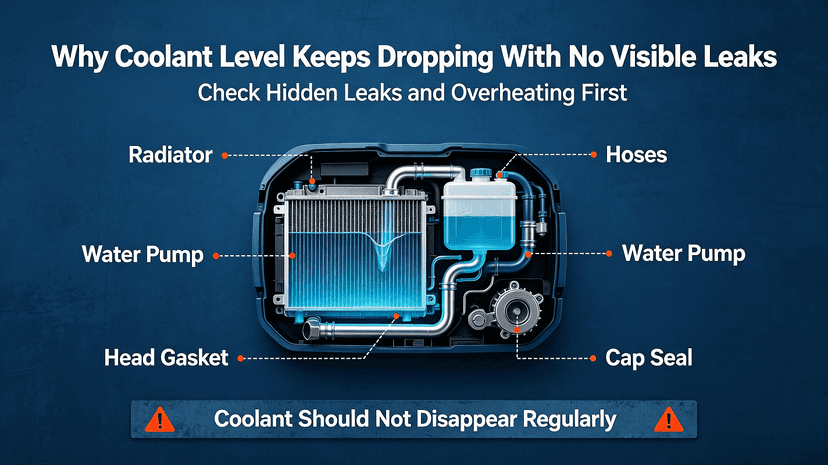
Many vehicle owners notice the coolant reservoir level slowly dropping over time, even when there are no obvious puddles under the car. At first glance, this may seem like a minor issue, but unexplained coolant loss can signal hidden problems inside the cooling system, engine or seals. Ignoring the symptom may lead to overheating, engine damage and expensive repairs.
1. Small external leaks may be evaporating before you see them
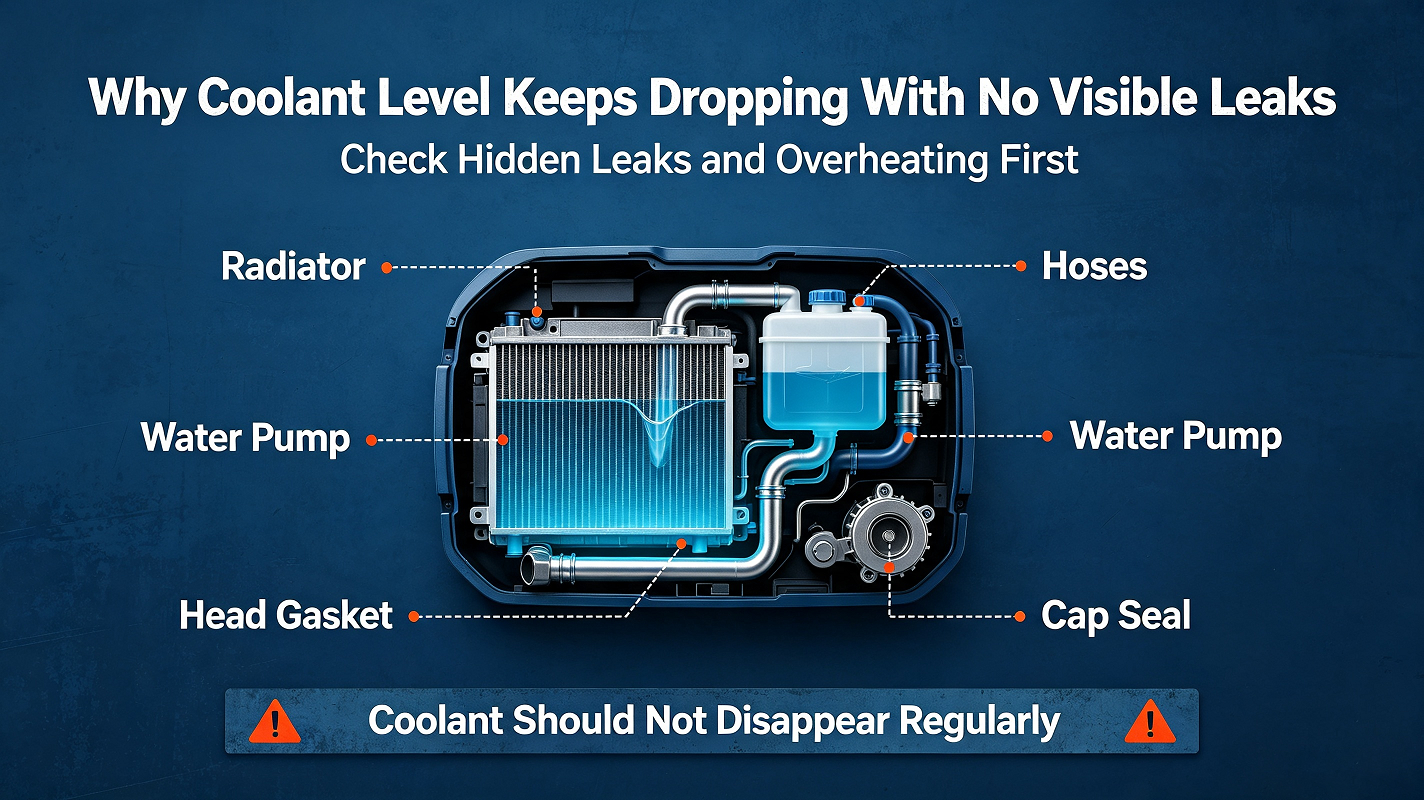
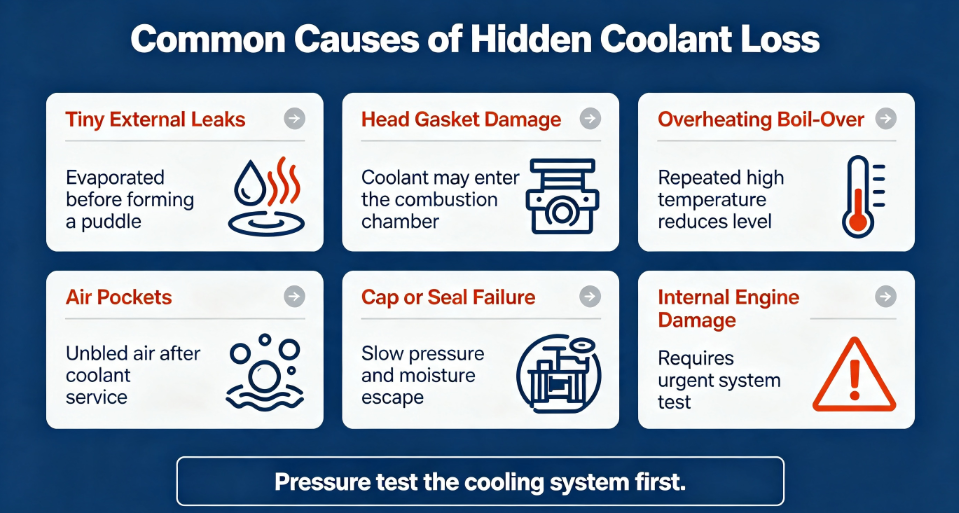
The most common cause of disappearing coolant is a tiny external leak. When coolant leaks slowly onto hot engine parts, it evaporates quickly and leaves no obvious puddle. You may only find faint dried coolant stains around hoses, gaskets, the water pump, radiator or heater core.
2. A blown head gasket can cause coolant to enter the combustion chamber
A head gasket failure is one of the more serious causes. When the gasket between the cylinder head and engine block is damaged, coolant can leak into cylinders, burn together with fuel and exit through the exhaust system. In this case, the coolant level drops without leaving a visible external leak.
3. Overheating and boil-over can reduce coolant level
If the engine often runs hot, coolant may expand and flow into the overflow tank. When it cools down, some liquid does not fully return to the system. Repeated overheating can gradually reduce the coolant level and create the impression that coolant is disappearing for no reason.
4. Improper bleeding after coolant service causes air pockets
After a coolant change or flush, air must be fully removed from the cooling system. If air remains trapped inside, the coolant level in the reservoir may appear lower than normal. The vehicle may also experience fluctuating temperature, heater output problems or repeated low-level warnings.
5. Evaporation through the reservoir cap is possible
A slightly faulty or incorrectly fitted coolant cap can allow pressure and moisture to escape over time. This is usually a slower form of coolant loss, but it can still cause the reservoir level to drop gradually.
6. Internal engine damage requires urgent inspection
Coolant loss can also be caused by cracks in the cylinder head, engine block or water jacket. These issues are more serious and should be diagnosed quickly. Coolant may enter the oil system, combustion chamber or exhaust system without forming an obvious puddle.
How to diagnose coolant loss correctly
First, check the radiator, hoses, water pump, thermostat housing, heater core and reservoir cap for dried coolant stains. Second, pressure test the cooling system to find small leaks that are not visible under normal conditions. Third, test for combustion gas in the cooling system, which may indicate head gasket or engine damage.
B2B maintenance tip
For repair shops and fleet operators, unexplained coolant loss should never be dismissed as “normal consumption”. Coolant is not like engine oil; it should not disappear regularly. A systematic inspection helps avoid come-back repairs and builds customer trust.
GAFLE supplies high-quality coolant for passenger cars, trucks, heavy-duty machinery and EV thermal systems. Stable formula, clear specification and professional support help wholesalers and garages reduce after-sales risk. Contact us for bulk supply and product recommendations.
Welcome to contact GAFLE for more information & cooperation!
peter
ZHEJIANG GAFLE AUTO CHEMICL CO.,LTD
Tel:86-579-8222 1665
Fax:86-579-8246 4690
Cel/Wechart:86-13335993986
E-mail:peter@gafle.net
Web:www.gafle.net