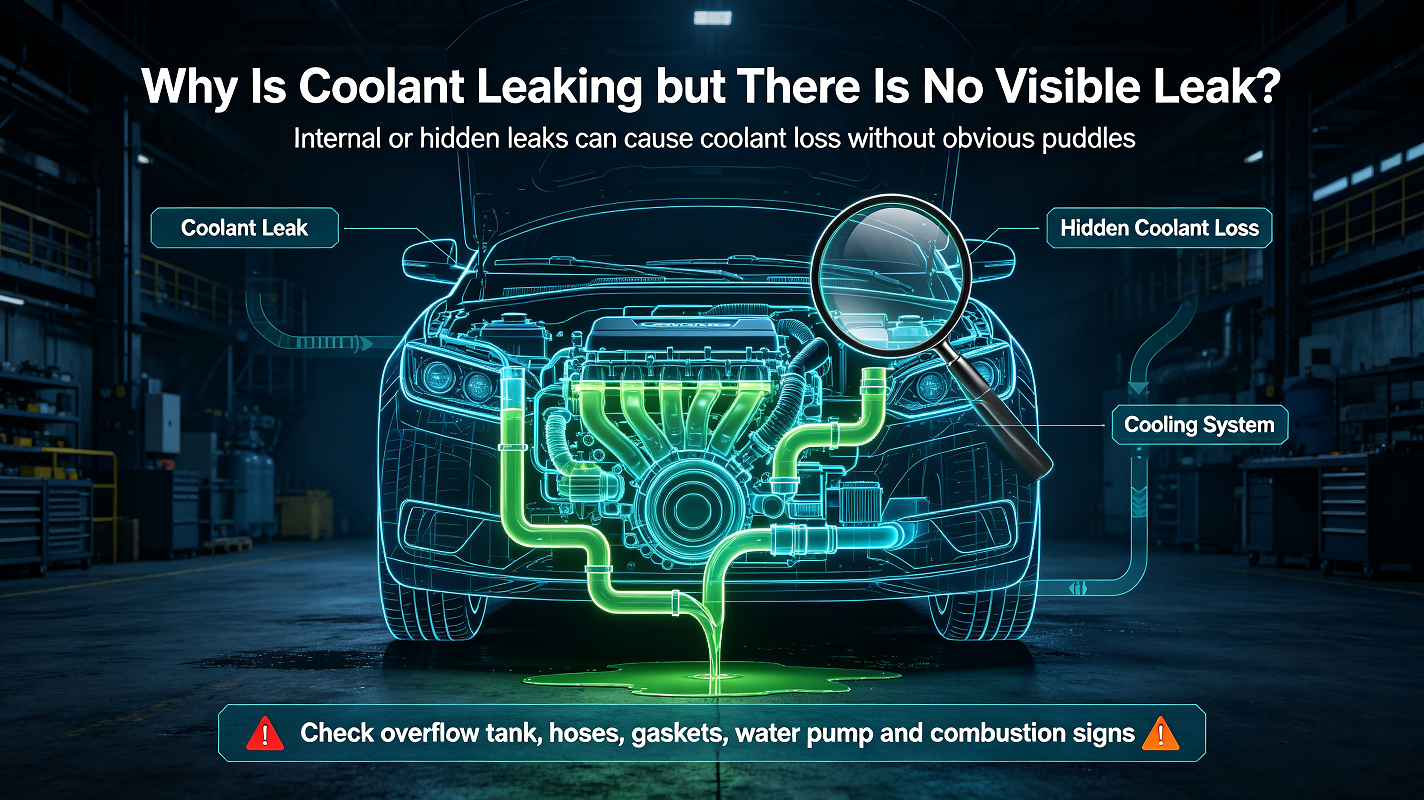
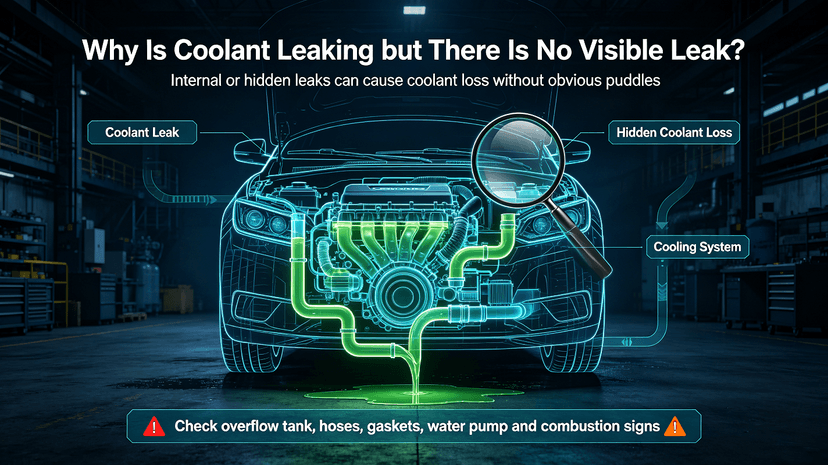
Why is coolant leaking but no visible leak?
When a vehicle keeps losing coolant and you cannot see a puddle, the question is usually not whether there is a problem, but where the coolant is going. For drivers, fleet managers, and repair shops alike, why is coolant leaking but no visible leak is a practical diagnostic issue because the missing coolant may point to a slow external seep, an internal engine problem, or a leak that only shows up under heat and pressure. That distinction matters. A small weep at a hose clamp is annoying; an internal leak into the combustion chamber can become expensive quickly.
What makes these cases frustrating is that coolant often escapes only when the system is hot, pressurized, and vibrating down the road. By the time the engine cools, the evidence may be gone. That is why a careful inspection has to go beyond looking for drips on the ground.
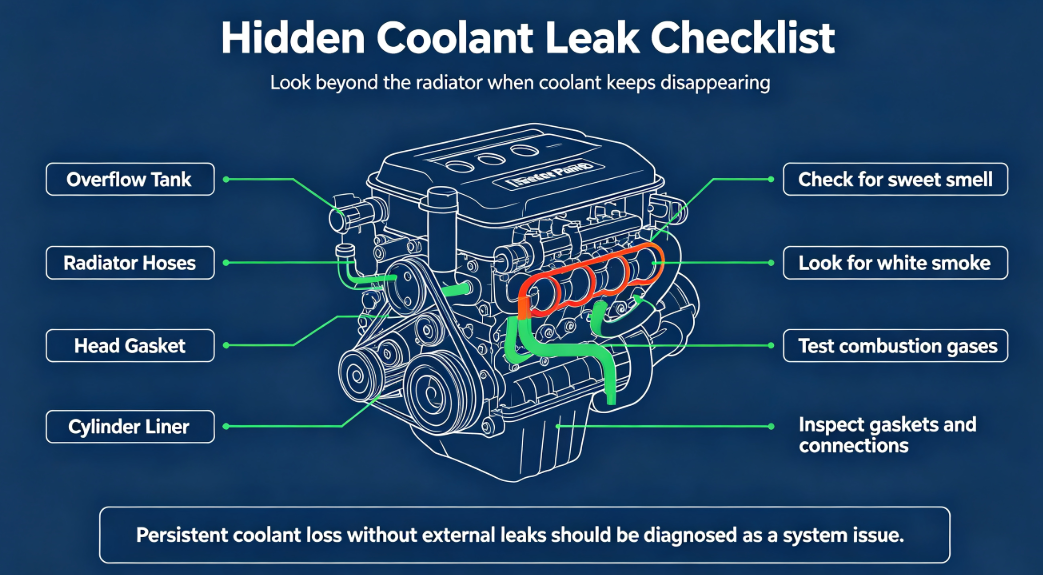
The main places coolant disappears without leaving a puddle
In many cases, the problem is a hidden coolant leak that never reaches the driveway. Coolant can leak onto a hot engine surface and evaporate before it becomes visible. It can also drain onto a splash shield or subframe, then spread out so thinly that the source is hard to trace.
External leaks that hide themselves
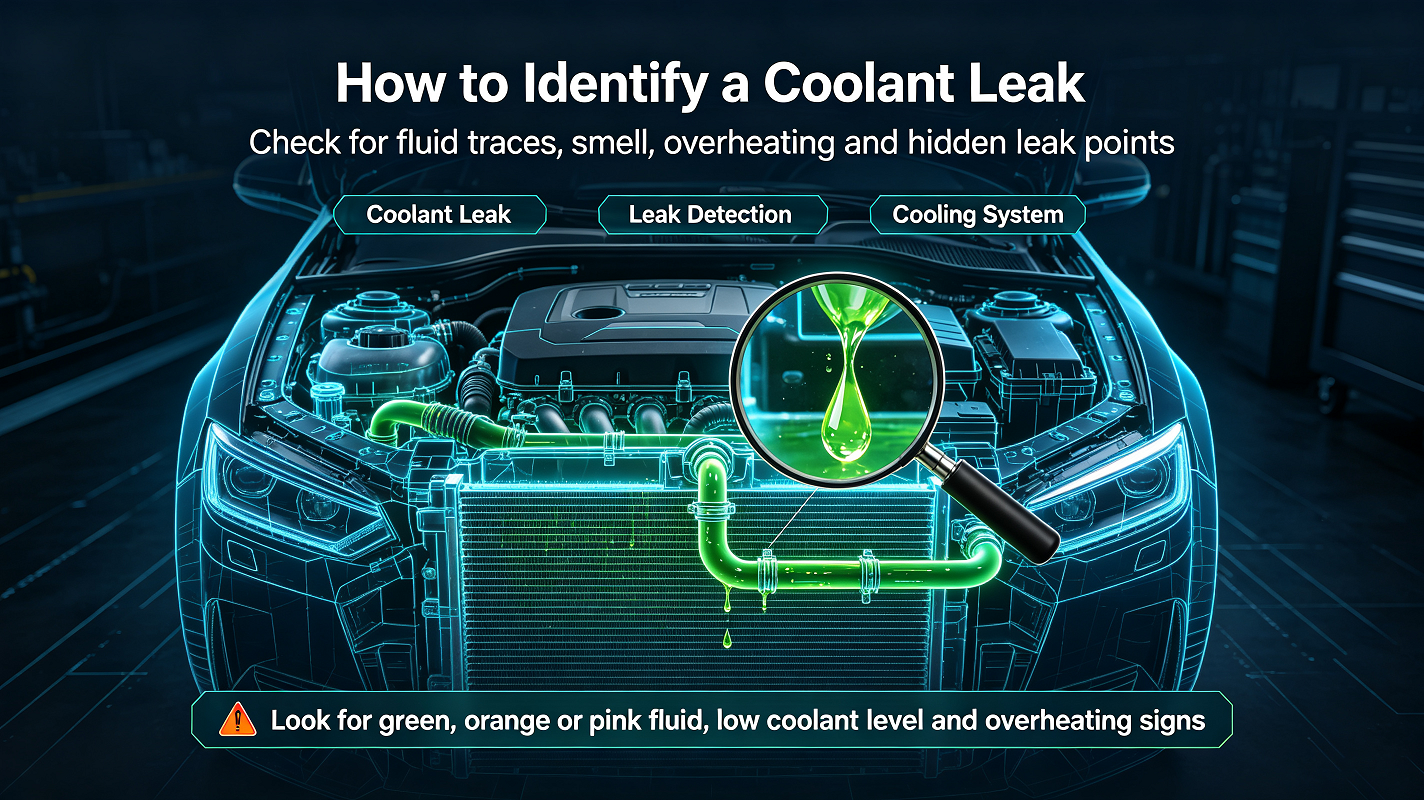
Some of the most common hidden coolant leaks come from parts that only leak under load or temperature. Typical examples include radiator end tanks, hose connections, thermostat housings, water pumps, and plastic coolant fittings. A crack may open when the engine is hot and close again as the part cools. That cycle can make the loss look random.
Heater hoses and the heater core deserve attention too. A heater core leak may not drip outside the vehicle at all. Instead, it can create a sweet smell in the cabin, fogged windows, or damp carpet. Those clues are easy to miss if you are only looking under the hood.
Internal leaks that do not show on the floor
One of the more serious causes of losing coolant is internal leakage into the engine. A head gasket problem, cracked cylinder head, or damaged intake gasket can allow coolant into the combustion chamber or into the oil. In those cases, there may be no exterior leak to find. White exhaust smoke, rough cold starts, milkiness in the oil, or unexplained overheating are warning signs, although none of them is perfectly conclusive by itself.
It is worth being cautious here. Not every white puff of exhaust means a head gasket, and not every low coolant complaint is catastrophic. But repeated coolant loss without visible evidence should push the diagnosis in that direction sooner rather than later.
Why the leak may only appear under certain conditions
Cooling systems are pressure systems. When pressure builds, weak points open up. A hose that looks fine in the bay may split only while driving. A radiator cap that no longer holds pressure can let coolant boil at a lower temperature, which may cause loss through the overflow path. That can look like evaporation, but it is really a pressure-control issue.
Another common pattern is trace leakage that dries almost immediately. Over time, crusty residue around a joint or cap can tell the story, but it may take a flashlight and a clean surface to spot it. This is one reason technicians often start by wiping suspect areas clean before retesting.
A practical diagnostic sequence
If you are trying to identify a hidden coolant leak, a random parts swap is usually the wrong approach. A better sequence is to confirm the coolant level when cold, inspect obvious connections, and then pressure-test the system. Pressure testing often reveals leaks that only appear when the system is stressed. Dye tracing can help as well, especially when the source is small or tucked behind other components.
Checking the underside of the vehicle, the water pump area, the thermostat housing, radiator seams, and the firewall area around the heater core gives a faster read than simply topping off the reservoir and waiting. If the vehicle loses coolant but the pressure test holds, internal leakage becomes more likely. If pressure drops and the source is external, the leak is there somewhere, even if it is stubborn.
Signs that narrow the diagnosis
Some clues are useful because they point in different directions. A dry engine bay with repeated coolant loss can suggest an internal problem. Damp carpet, a sweet odor, or a greasy film on the inside of windows can suggest heater core trouble. Coolant crust near a hose or tank joint points back to an external seep. Overheating at idle may hint at circulation issues, while overheating under load may point to a more severe loss of system integrity.
Common mistakes that slow the repair
One mistake is assuming that because there is no puddle, there is no leak. That delay can turn a manageable repair into a larger one. Another is mixing symptoms without checking the cooling system as a whole. A low reservoir, an old radiator cap, and a worn hose can exist together, and fixing only one piece may not solve the issue.
It also helps not to overtrust the coolant level sensor, if the vehicle has one. Sensors can warn late, and they do not explain where the coolant went. The mechanic still has to do the real detective work.
What buyers and service teams should ask before approving repairs
For sourcing managers, fleet supervisors, and service advisors, the real decision is not just whether the vehicle needs coolant added. It is whether the cause is external, internal, or intermittent. That determines labor time, parts planning, and downtime risk. Ask whether the leak reproduces hot or cold, whether a pressure test was performed, whether any residue was found, and whether the oil and exhaust were checked for signs of contamination.
If the answer to those questions is vague, the diagnosis probably is too. A careful cooling-system inspection is slower than a top-off, but it is usually cheaper than repeating the same repair twice.
FAQ: quick answers for the workshop or the driver
Can coolant disappear without leaving a stain? Yes. It can evaporate on hot engine parts or leak internally.
Is it safe to keep driving? Not for long if the level keeps dropping. Overheating can damage the engine fast.
Does every hidden coolant leak mean head gasket failure? No. Many are external and relatively minor. But internal leaks should be ruled out early.
What is the first test worth doing? A pressure test is often the most useful starting point, followed by a close inspection of likely leak points.
What to do next
If the vehicle keeps losing coolant and there is no visible leak, treat it as a diagnosis problem, not a topping-off routine. Start with the cooling system under pressure, inspect both external and internal leak paths, and do not ignore small clues like residue, odors, or repeated overheating. That approach is usually the fastest way to separate a minor seep from a serious engine issue.
Welcome to contact GAFLE for more information & cooperation!
peter
ZHEJIANG GAFLE AUTO CHEMICL CO.,LTD
Tel:86-579-8222 1665
Fax:86-579-8246 4690
Cel/Wechart:86-13335993986
E-mail:peter@gafle.net
Web:www.gafle.net