Winter washer fluid is one of those products that looks simple until it fails. A driver in a northern market does not care about formulation elegance; they care that the nozzle sprays on a January morning at minus twenty five and that the reservoir has not cracked by March. Behind that expectation sits a formulation and testing discipline that most buyers never see. GAFLE factory produces low temperature washer fluid for cold markets, and the points below are what separate a reliable winter product from a label with a number on it.
Why -30°C fluid is a different product, not a stronger mix
A genuine -30°C washer fluid is a re-engineered system, not a standard formula with extra alcohol poured in. Adding alcohol lowers the freeze point, but it also changes evaporation rate, viscosity, effect on plastics, smell, flammability classification and cost. Push the concentration high enough and the product may protect against freezing while damaging the very components it is meant to serve.
A properly designed winter fluid balances four requirements at once: freeze protection at the claimed temperature, cleaning performance on winter road film and salt spray, material compatibility across the washer circuit, and a hazard profile that can legally be sold and transported in the target market. Optimising only the first requirement is the most common failure mode in low-cost winter products.
The chemistry behind freeze protection
Freeze protection comes from the alcohol system, and the type of alcohol matters as much as the percentage. Methanol offers strong freeze point depression per unit cost but carries toxicity and exposure concerns that several markets regulate tightly. Ethanol performs well and supports methanol-free positioning, though it is more expensive and its flash point affects transport classification. Isopropanol and glycol-containing blends sit between the two on cost and performance.
The relationship between concentration and freeze point is not linear, and it differs by alcohol type. A formulator therefore cannot copy a competitor's percentage and expect the same protection. The starting point is a target freeze point, then a measured freezing curve for the chosen system, then a decision on the safety margin above the claimed figure.
A margin matters because real-world conditions are not laboratory conditions. Wind, an open reservoir, a partially emptied bottle stored in a cold garage and evaporation during use all shift the effective concentration. A product labelled at -30°C is normally formulated to protect somewhat below that figure so the claim still holds at the end of the bottle.
Testing the claim
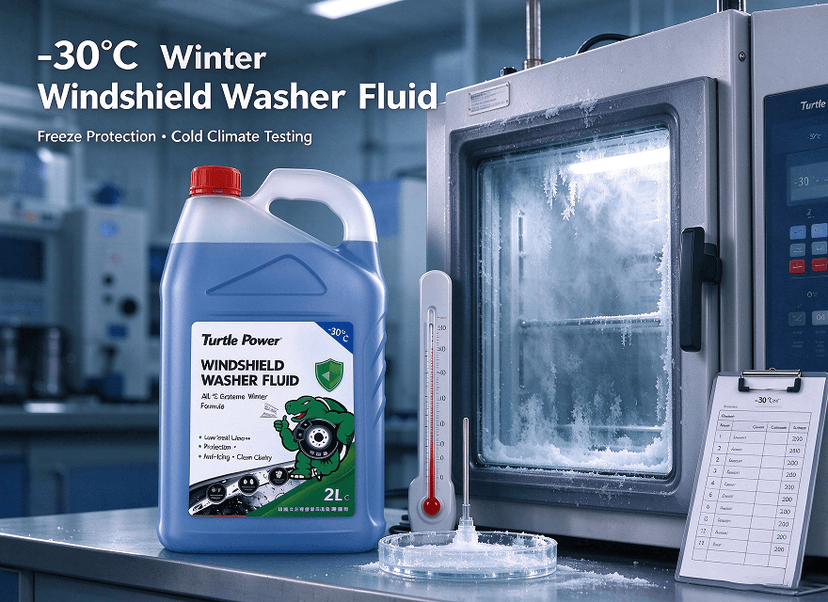
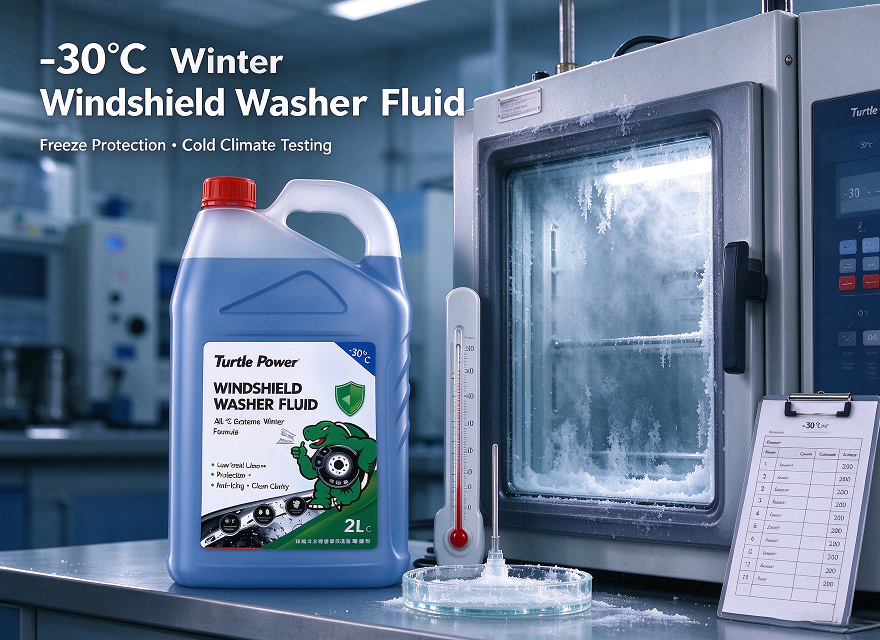
Freeze point claims should be verified by test rather than by calculation, and every production batch should carry the evidence. The standard approach is instrumental measurement of the crystallisation point, run on the finished product rather than on the concentrate or an intermediate blend.
A factory producing winter fluid should retain a sample from each batch and record the measured freeze point against the specification. When a customer in a cold market reports that the fluid froze, the retained sample answers the question immediately: the batch either met specification or it did not, and if it did, the cause lies in storage, dilution or contamination at the customer's end.
Batch records should also cover alcohol content, pH, density and appearance. Alcohol content is the indicator most likely to drift if raw material quality varies, and it is the number a customs laboratory will check if a shipment is sampled.
Material compatibility at low temperature
Low temperature exposes material weaknesses that mild conditions hide, so compatibility testing must cover the whole washer circuit. Washer pumps are usually small diaphragm or centrifugal units with plastic housings and elastomer seals. At low temperature, seals stiffen, plastics become brittle and any swelling caused by aggressive solvents becomes a crack rather than a nuisance.
The circuit also includes the reservoir, the level sensor, the hoses, the filter screen and the nozzles. Polycarbonate headlamp washer covers and acrylic components are particularly sensitive to some solvent systems, which is why a compatibility programme should test actual component materials rather than a single generic plastic coupon.
A manufacturer serious about winter products will run immersion tests at low temperature, check for crazing, swelling, hardness change and extractable matter, and document the results. Buyers should ask for those results specifically for the winter grade, not for the all-season product.
Label claims and regulatory scrutiny
Winter fluid labels carry performance claims that regulators and retail buyers both scrutinise, so the wording must match the test data. A -30°C claim printed on a bottle is a performance promise, and in several markets it is treated as a claim that must be substantiated if challenged by a consumer authority or a retail buyer's quality team.
The safe approach is to state the measured freeze point for the product as supplied, and to explain dilution if the product is a concentrate. If the fluid is sold as ready-to-use, the label should not imply protection beyond what the test shows. Hazard statements must reflect the actual alcohol content, and transport classification must be declared correctly on export documents.
Bulk storage and shelf life in cold climates
Bulk winter fluid rewards careful storage planning, because cold climates are exactly where warehouse conditions are hardest to control. Unopened containers stored above freezing and out of direct sunlight normally remain stable for the standard shelf life, typically two to three years depending on the formula. The risk appears after opening, when headspace air exchange allows alcohol to evaporate and the freeze point to rise.
For distributors holding drum or IBC stock through the winter, the practical rules are straightforward: keep containers sealed, store above freezing where possible, rotate stock by batch date and avoid leaving partially used drums open for weeks. A distributor who tops up a drum from a half-empty container without recording the date is creating a future complaint.
Bulk buyers should also confirm the packaging specification for cold transport. Certain plastic drums become brittle at very low temperature and should not be dropped or stacked heavily during loading in winter conditions.
FAQ
Q1: What is the difference between -20°C and -30°C washer fluid? A1: The alcohol system and its concentration differ, and so does the safety margin built into the formula. A -30°C product protects further below zero, costs more per litre and usually carries a stricter hazard classification.
Q2: Can I make -30°C fluid by adding alcohol to a standard washer fluid? A2: Not reliably. Adding alcohol changes stability, cleaning performance and material compatibility, and the resulting mixture has no tested freeze point. A formulated winter grade is the safer route.
Q3: How is the freeze point actually measured? A3: Instrumental crystallisation point measurement on the finished product is the usual method. Results should be recorded per batch and retained with a sample.
Q4: Does winter washer fluid damage washer pumps? A4: A correctly formulated product does not. Poorly balanced high-alcohol products can harden seals and stress plastics, which is why compatibility test reports should be requested.
Q5: What is the shelf life of -30°C washer fluid? A5: Typically two to three years in unopened, properly stored packaging. Once opened, alcohol evaporation raises the freeze point, so partial containers should be used within one season.
Q6: Can winter fluid be shipped in the same container as all-season fluid? A6: Usually yes, provided the transport classification is declared correctly for each SKU and the mixed loading does not breach segregation rules for the higher hazard class.
Welcome to contact GAFLE for more information & cooperation!
peter
ZHEJIANG GAFLE AUTO CHEMICL CO.,LTD
Tel:86-579-8222 1665
Fax:86-579-8246 4690
Cel/Wechart:86-13335993986
E-mail:peter@gafle.net
Web:www.gafle.net