logo

Can you support market-specific compliance requirements?

logo

Published

Nov 03 2026

  • News
  • Buying Guide

Follow us

can-you-support-market-specific-compliance-requirements

global import regulation support for automotive chemical fluid

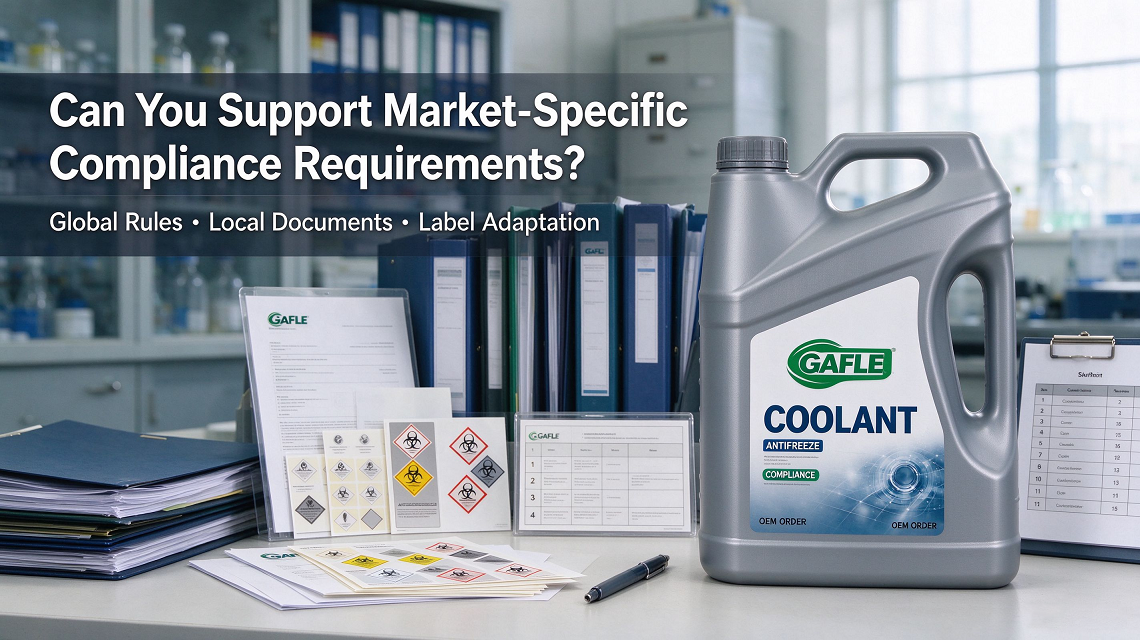
When you run OEM orders of brake fluid and coolant for overseas markets, product quality alone is never enough. Every territory has its own set of chemical control laws, import filing rules, labeling rules and test requirements. Non-compliance issues can lead to cargo detention at the port, customs fines, shipment return or even sales ban of your whole product line. Many OEM buyers ask the same question: Can you support market-specific compliance requirements? At Gafle, we build our OEM service workflow around global regulatory differences to help our customers avoid these costly compliance risks.

Regional automotive chemical regulations vary widely across the world. There is no universal rulebook for automotive fluids. The EU follows REACH regulation for substance restriction and hazard communication. North America has OSHA hazard communication standards together with specific antifreeze labeling laws. Many Southeast Asian, Middle Eastern and Latin American countries require local chemical notification or simplified registration before import. Some markets set extra limits on additives, phosphate content, heavy metals and biodegradability for coolant. Brake fluid also faces separate rules, with many customs checking whether products meet recognized DOT specifications. We map these requirements before production starts, instead of adjusting documents after goods are manufactured.

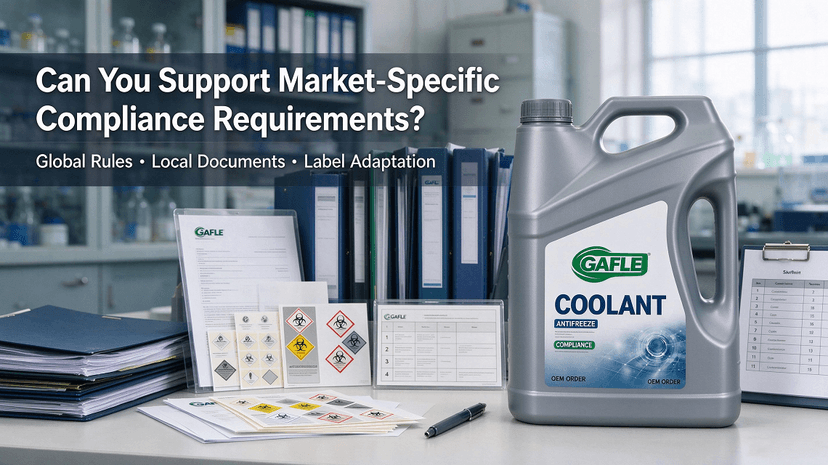
Localized label adaptation is one of the most frequent compliance requirements. Labels are often the first item checked by customs officers. Some countries mandate that warning statements, hazard symbols, precautionary phrases and ingredient information must be printed in the official local language, not only English. The layout, size of warning icons and content order also follow fixed templates in certain regions. For OEM private label projects, we help you design labels that satisfy both your brand style and local mandatory rules. We will review label drafts against target-market regulation before printing, to reject any non-compliant wording or symbol layout in advance.

We prepare market-tailored safety and technical documentation packages. A standard English SDS cannot always pass import review. Some regulators demand region-specific SDS versions formatted to their local GHS implementation. We issue SDS, TDS and COA that match the GHS revision adopted in your destination country. If the market needs extra certificates, chemical registration numbers, or third-party audit statements, we coordinate with authorized testing institutions to get these supporting materials ready. All documents are traceable and can be submitted directly to customs, distributors or local environmental agencies.

Product testing and formulation are adjusted to fit local mandatory standards. Compliance is not limited to papers and labels. The fluid formula and performance test items must also match local standards. For brake fluid, that means meeting correct DOT3 / DOT4 / DOT 5.1 specifications accepted by that market. For coolant, we run tests following required ASTM standards and check restricted additive limits set by local environmental rules. If your target market bans certain corrosion inhibitors or chemical components, our R&D team can reformulate the product to remove restricted substances while keeping core cooling and anti-corrosion performance.

We provide continuous support during customs inspection and third-party audits. Even with fully prepared documents, shipments may face random customs verification or distributor audit. Our technical and compliance team can supply supplementary explanation letters, batch test records and standard interpretation materials. We communicate with you promptly if the customs or regulator raises questions about your Gafle OEM brake fluid or coolant. This support helps you respond quickly and reduce the chance of cargo hold-up.

FAQ

Q1: Can you revise SDS to fit EU REACH and local GHS rules?

A1: Yes. We can provide REACH-aligned SDS and update hazard classification and statements following the latest GHS version used in the EU and other target markets.

Q2: Do you support multi-language labels for brake fluid and coolant OEM packaging?

A2: Yes. We can produce labels with local official languages, required hazard pictograms and warning texts as per your country’s labeling laws.

Q3: What if my target market requires chemical registration before import?

A3: We supply all required raw material and product test data you need to finish local chemical registration. For some regions, we can also guide you through the filing process.

Q4: Can you modify coolant formulas to meet local restriction on phosphate or silicate?

A4: Absolutely. We have low-phosphate, OAT, HOAT and Si-OAT coolant formulas available to satisfy different regional additive restrictions.

Q5: Will you check compliance requirements for a new market before we place bulk OEM order?

A5: Yes. Our compliance team will carry out a pre-order regulation check for your target country and share a checklist of required documents and limits before production.

Q6: Are your brake fluid products compliant with DOT requirements accepted in US and other markets?

A6: Our DOT3, DOT4 and DOT 5.1 brake fluids are tested against relevant DOT standards and we can provide the corresponding test reports for import audit.

Welcome to contact GAFLE for more information & cooperation!
peter
ZHEJIANG GAFLE AUTO CHEMICL CO.,LTD
Tel:86-579-8222 1665
Fax:86-579-8246 4690
Cel/Wechart:86-13335993986
E-mail:peter@gafle.net
Web:www.gafle.net
Featured Blogs
Can you support market-specific compliance requirements?

Can you support market-specific compliance requirements?

1. Different countries and regions enforce distinct chemical safety, environmental and labeling regulations for automotive brake fluid and coolant, which creates major customs clearance risks for international OEM buyers. 2. Localized label compliance means adjusting label text, warning symbols, ingredient disclosures and hazard statements strictly according to the mandatory rules of your target sales territory. 3. Standard and region-adapted technical documents including SDS, TDS and COA are prepared to match local authority requirements for import filing and inspection. 4. We adjust product testing schemes to align with mandatory industry standards in target markets, covering brake fluid DOT specifications, coolant ASTM standards and local heavy metal or volatile substance limits. 5. Our team provides auxiliary support when your shipment faces customs inspection, third-party audit or official regulatory inquiries in the destination country.

-30°C Windshield Washer Fluid: Formulation, Testing and Bulk Sourcing

-30°C Windshield Washer Fluid: Formulation, Testing and Bulk Sourcing

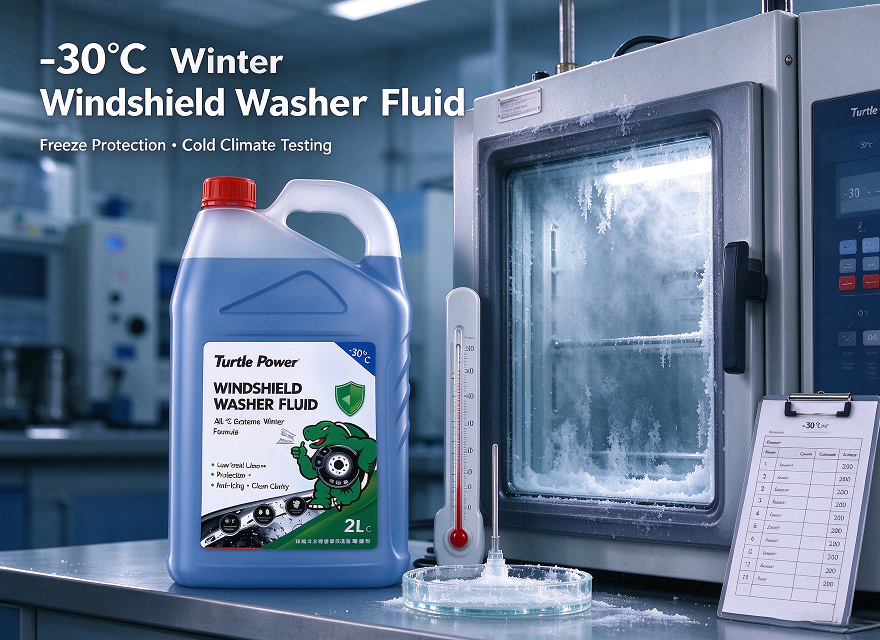
1. A genuine -30°C washer fluid is a re-engineered system, not a standard formula with extra alcohol poured in. 2. The difference between a winter fluid and a mild-climate fluid lies in the whole formulation balance, not in a single concentration number. 3. Freeze protection comes from the alcohol system, and the type of alcohol matters as much as the percentage. 4. Freeze point claims should be verified by test rather than by calculation, and every production batch should carry the evidence. 5. Low temperature exposes material weaknesses that mild conditions hide, so compatibility testing must cover the whole washer circuit. 6. Winter fluid labels carry performance claims that regulators and retail buyers both scrutinise, so the wording must match the test data. 7. Bulk winter fluid rewards careful storage planning, because cold climates are exactly where warehouse conditions are hardest to control.

Concentrate or Ready-to-Use Windshield Washer Fluid

Concentrate or Ready-to-Use Windshield Washer Fluid

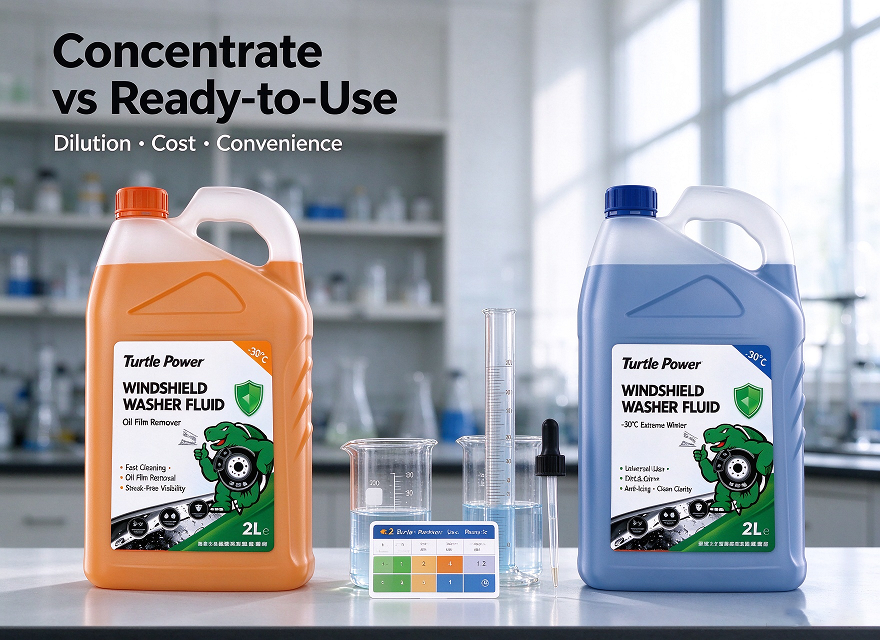
1. Concentrate and ready-to-use fluid are two different business models rather than two versions of the same product, and the choice changes your freight bill, your shelf space and your customer complaints. 2. The core difference is what travels in the container: concentrate ships the active chemistry, while ready-to-use fluid ships water alongside it. 3. A concentrate is a carefully balanced system of solvents, surfactants and inhibitors designed to be diluted at a defined ratio without losing stability. 4. Dilution ratio is the point where concentrate economics meet real-world execution, because the correct ratio depends on climate, water quality and who is doing the mixing. 5. Ready-to-use fluid wins on consistency and convenience, and that is exactly what retail buyers pay a premium for. 6. The only fair comparison between the two formats is landed cost per litre of usable fluid, calculated after freight, packaging and dilution losses. 7. Packaging and label requirements differ enough between the formats that launching both at once usually doubles the artwork and approval workload.

Can you provide multilingual SDS and technical documents?

Can you provide multilingual SDS and technical documents?

1. SDS, or Safety Data Sheet, is a mandatory compliance document for cross-border trade of coolant and brake fluid, and many countries require SDS in local official language. 2. A standard SDS covers 16 sections of safety information for chemical products, used for customs clearance, warehouse storage and logistics transportation. 3. Our manufacturer can provide multilingual SDS versions for different target markets, with language adaptation and region-specific hazard statements. 4. Besides SDS, there is a full set of supporting technical documents for global automotive fluid import, including TDS, COA and certificate of origin. 5. Buyers need to understand the rules of document revision, batch update and proper usage to avoid compliance risks.

Can you provide performance test reports?

Can you provide performance test reports?

1. Performance test reports and COA documents are essential for importing, customs clearance and sales of coolant and brake fluid, but many buyers struggle to understand the technical indicators. 2. There are two main types of test reports from our manufacturer: internal Certificate of Analysis (COA) and independent third-party lab reports. 3. Coolant test reports focus on freezing point, boiling point, reserve alkalinity and corrosion protection performance. 4. Brake fluid test reports mainly track dry boiling point, wet boiling point, kinematic viscosity and rubber seal compatibility. 5. OEM buyers need to know how to get test reports, update batch data and use these documents correctly for import and sales.

Can you provide technical support for product development?

Can you provide technical support for product development?

1. Many brand owners do not have in-house chemical technical teams and need professional technical support from their automotive fluid manufacturer during OEM development. 2. Our factory provides pre-production technical consultation to help buyers select suitable coolant or brake fluid specifications for their target market and vehicle types. 3. We offer lab testing support including seal compatibility test, stability test and performance verification for OEM projects. 4. Technical support continues after products launch, helping buyers handle end-user questions and product-related troubleshooting. 5. GAFLE manufacturer has fixed communication channels and response rules for technical support requests from OEM buyers.