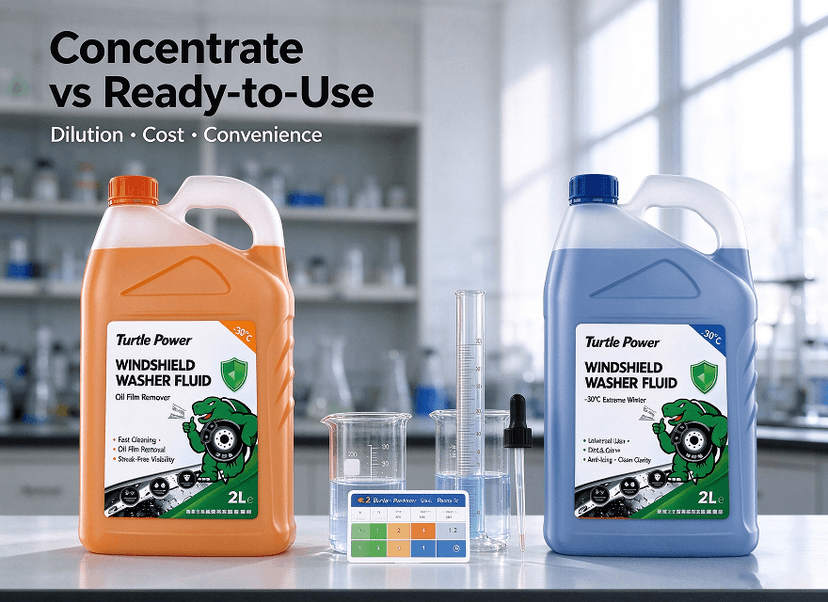
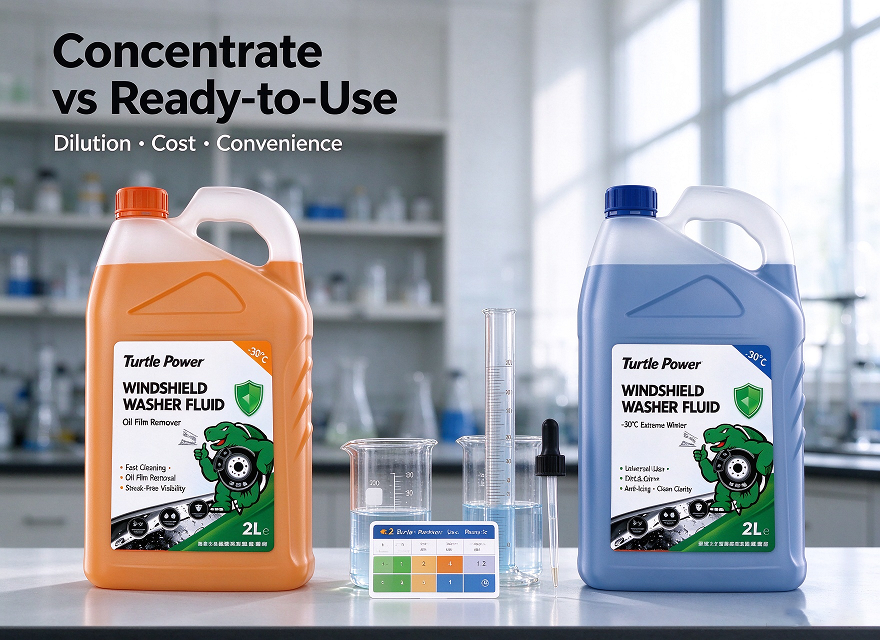
Every washer fluid buyer eventually faces the same question: should the product ship as a concentrate or as a ready-to-use liquid? On paper the answer looks like simple arithmetic, since concentrate obviously carries less water. In practice the decision touches freight, packaging, retail placement, dilution discipline and after-sales risk at the same time. GAFLE factory produces both formats for overseas buyers, and the differences below are the ones that actually change the outcome of a project.
Two formats, two different business models
Concentrate and ready-to-use fluid are two different business models rather than two versions of the same product, and the choice changes your freight bill, your shelf space and your customer complaints. A ready-to-use product is sold as a finished consumer good: open the cap, pour it into the reservoir, done. A concentrate is sold as an input that still needs a decision and an action from the user, or from the workshop technician who mixes it.
That single difference reshapes the whole supply chain. Ready-to-use fluid means larger pack volumes, higher freight per usable litre and more warehouse space, but also simpler retail listings and fewer support calls. Concentrate means smaller packs, cheaper freight per usable litre and higher margin potential, but it transfers part of the dilution responsibility to your customer.
What actually travels in the container
The core difference is what travels in the container: concentrate ships the active chemistry, while ready-to-use fluid ships water alongside it. Water is heavy, and in ocean freight weight and volume both cost money. Shipping a diluted product means paying to move water across an ocean, then paying again to store and distribute it.
This is why concentrate is the default choice for importers with strong technical support and for industrial or workshop channels where dilution happens routinely. Ready-to-use fluid is the default for retail shelves in markets where consumers expect a finished product and will not read a dilution table.
The cost gap is not marginal. Once packaging weight, pallet count and container utilization are accounted for, the freight component of a diluted product can be several times higher per usable litre than the same chemistry shipped as a concentrate.
What a concentrate actually contains
A concentrate is a carefully balanced system of solvents, surfactants and inhibitors designed to be diluted at a defined ratio without losing stability. It is not simply a stronger version of the finished fluid. The solvent package provides freeze protection and dissolves the cleaning agents; the surfactant package removes road film without attacking the windscreen; corrosion inhibitors protect the washer pump, level sensor and nozzles; dyes and bittering agents complete the formulation.
Because the concentrate is diluted before use, the chemistry must remain stable both before and after mixing. A formula that separates, clouds or loses detergency after dilution with hard local water will generate complaints that look like a quality failure but are actually a compatibility failure. This is why a manufacturer should test the concentrate against several water hardness levels before approving the formula for export.
Dilution ratio in practice
Dilution ratio is the point where concentrate economics meet real-world execution, because the correct ratio depends on climate, water quality and who is doing the mixing. A concentrate sold for a cold market may specify a richer mix in winter and a leaner mix in summer; the same bottle can therefore produce two different freeze points depending on the season.
Water quality matters more than most buyers expect. Very hard water can reduce surfactant efficiency and leave mineral residue on the glass; water with high chloride content can accelerate corrosion of the pump. For workshop use, distilled or demineralised water is often specified, while consumer packs usually accept tap water with a clear instruction.
Measurement discipline is the practical risk. Consumers rarely measure accurately, so a retail concentrate should include a calibrated dosing cap and a simple ratio table on the label. Industrial buyers mixing in drums or IBC totes need a documented mixing procedure instead, because a technician who guesses the ratio can under-protect an entire fleet.
The case for ready-to-use fluid
Ready-to-use fluid wins on consistency and convenience, and that is exactly what retail buyers pay a premium for. Every bottle performs identically, there is no dilution error, no argument about water quality and no instruction that can be misread. For a brand selling through supermarkets, convenience chains or e-commerce, that consistency is worth real money.
It also simplifies liability. If a customer damages a pump or complains about streaking, the investigation starts and ends with the product as supplied. With a concentrate, the first questions are always how it was mixed and with what water, and answering those questions consumes time and goodwill.
Shelf life and storage favour ready-to-use fluid as well, since a finished product has a single, clearly stated expiration date and needs no mixing equipment in the warehouse.
Comparing cost properly
The only fair comparison between the two formats is landed cost per litre of usable fluid, calculated after freight, packaging and dilution losses. Comparing the price of a one litre concentrate bottle against a one gallon ready-to-use jug tells you nothing, because the usable volumes are different.
Build the comparison in four steps. Calculate freight per container, then divide by the usable litres the container yields after dilution. Add packaging cost per usable litre, then add the cost of the dilution step itself, including labour and water treatment where relevant. Finally, subtract the expected loss from over-dilution or spoiled mixed batches, which is usually small in industrial channels and larger in consumer channels.
Once the arithmetic is complete, most importers discover that concentrate wins clearly in industrial and workshop channels, while ready-to-use fluid wins in premium retail where the customer is paying for certainty rather than for chemistry.
Packaging and launch sequence
Packaging and label requirements differ enough between the formats that launching both at once usually doubles the artwork and approval workload. A concentrate label must carry the dilution table, the seasonal mixing guidance and often a warning about not using it undiluted. A ready-to-use label carries the freeze point, the volume and the application instructions, and nothing about mixing.
Bottle sizes diverge as well. Ready-to-use fluid sells in one litre, four litre, five litre and one gallon formats, while concentrate sells in smaller bottles and in twenty litre drums or IBC totes for industrial users. Each size needs its own label approval and its own carton specification.
The practical sequence is to launch one format first, prove the channel, then add the second format with a separate artwork set. A brand that tries to launch four ready-to-use sizes and two concentrate sizes at the same time usually loses a month to label revisions alone.
FAQ
Q1: What dilution ratio should a washer fluid concentrate use? A1: Ratios depend on the target freeze point and the climate. A common starting point is one part concentrate to three to five parts water for moderate conditions, with a richer mix for winter protection; the exact figure must come from the manufacturer's technical data sheet for that specific formula.
Q2: Can I dilute concentrate with tap water? A2: In most consumer applications yes, though hard water reduces performance and leaves mineral residue. Workshop and fleet users are better served with demineralised water.
Q3: Which format is cheaper to ship internationally? A3: Concentrate is cheaper per usable litre, because you are not paying ocean freight for water. The advantage grows with distance and with packaging weight.
Q4: Does ready-to-use fluid have a longer shelf life than concentrate? A4: Both are usually stable for two to three years in unopened packaging under proper storage, but ready-to-use fluid has a simpler expiration statement and no mixing step that could go wrong.
Q5: Can a factory supply both formats under one private label? A5: Yes, and many brands do, but each format needs its own label, carton specification and approval cycle.
Q6: Is concentrate suitable for retail consumers? A6: It can work well if the pack includes a dosing cap and a clear ratio table. Without those, dilution errors will generate complaints that damage the brand.
Welcome to contact GAFLE for more information & cooperation!
peter
ZHEJIANG GAFLE AUTO CHEMICL CO.,LTD
Tel:86-579-8222 1665
Fax:86-579-8246 4690
Cel/Wechart:86-13335993986
E-mail:peter@gafle.net
Web:www.gafle.net