Most car owners think engine cooling antifreeze and air conditioning systems work completely separately. They only check refrigerant level and AC compressor when the air conditioner blows warm air or cuts out randomly. However, faulty antifreeze can trigger AC shutdown indirectly. This tricky intermittent fault is frequently discussed by our manufacturer’s technical team and repair shop suppliers. Without knowing this connection, technicians may replace expensive AC parts and still fail to solve the root problem.
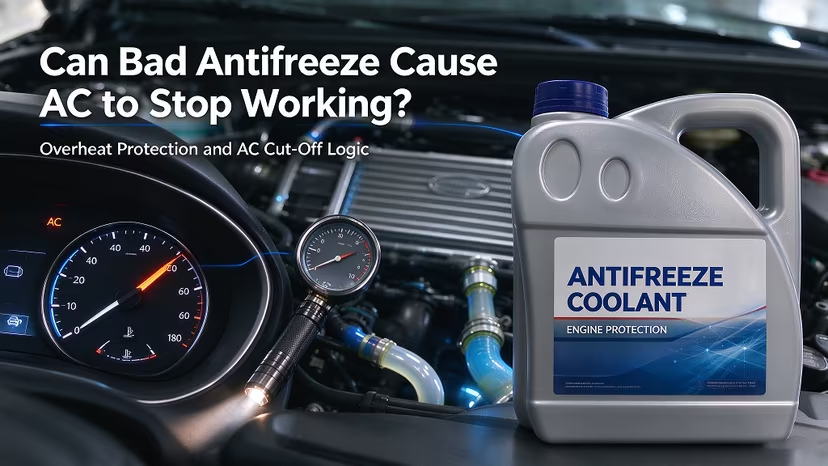
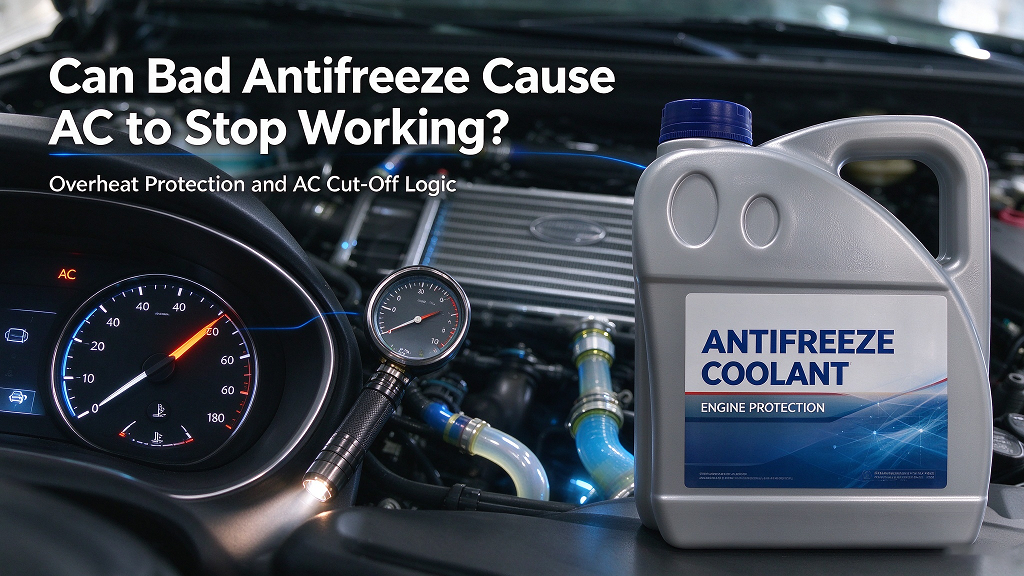
Vehicle ECU programs are designed to shut down the AC compressor when engine temperature rises too high. The AC compressor runs off the engine belt and adds extra mechanical load. When coolant temperature climbs above the preset safety threshold, the ECU cuts power to the compressor immediately. This is a factory-built safety strategy to prevent permanent overheating damage to pistons, cylinder heads and gaskets. The AC system is sacrificed temporarily to protect the main engine.
Degraded or contaminated antifreeze reduces heat dissipation and leads to engine overheating. Sludged, exhausted or improperly mixed coolant cannot carry heat away efficiently. Sediment buildup inside the radiator blocks airflow heat exchange. Even if the coolant level is full, poor fluid quality slows heat transfer. The engine temperature climbs steadily under load, especially when driving uphill or in hot weather with the AC turned on.
AC failure caused by bad coolant is an indirect protective reaction instead of direct damage to AC parts. The compressor, condenser, expansion valve and refrigerant circuit may still be in perfect working condition. Once the cooling system is flushed, refilled with qualified antifreeze and the engine temperature returns to normal range, the air conditioning system will usually work again without extra AC repairs.
You can tell the difference between coolant-related AC shutdown and refrigerant leaks by checking the temperature gauge. If the temperature gauge rises high at the same moment the AC cuts off, you should focus diagnosis on the cooling system, antifreeze condition, radiator and water pump. If air turns warm while the temperature gauge stays normal, the fault is likely low refrigerant, a faulty compressor clutch or AC sensor failure.
Our factory reminds repair shop suppliers to check coolant status first when customers report intermittent AC cuts. This simple diagnostic habit saves lots of unnecessary AC part replacements and improves customer satisfaction. We also provide ready-to-use technical handouts that suppliers can share with their affiliated repair shops to train technicians on this common hidden fault.
FAQ
Q1: Can a bad antifreeze cause the air conditioner to stop working?
A1: Yes, indirectly. Poor antifreeze leads to engine overheating. The ECU turns off the AC compressor to protect the engine.
Q2: If AC stops working, does that mean antifreeze is bad?
A2: Not always. Low refrigerant, faulty compressor or broken AC sensor also cause AC failure.
Q3: What sign shows overheating causes AC shutdown?
A3: The dashboard temperature gauge rises sharply when AC cuts off.
Q4: Can I keep driving if AC shuts down because of overheating?
A4: Stop driving immediately. Continuous driving under high temperature will crack the engine block.
Q5: Will flushing cooling system fix this AC issue?
A5: If overheating comes from bad coolant, a full flush and new antifreeze will solve the problem.
Q6: Is this protection logic the same for gasoline and diesel cars?
A6: Most modern gasoline and diesel passenger vehicles use this overheating AC cut-off logic.
Welcome to contact GAFLE for more information & cooperation!
peter
ZHEJIANG GAFLE AUTO CHEMICL CO.,LTD
Tel:86-579-8222 1665
Fax:86-579-8246 4690
Cel/Wechart:86-13335993986
E-mail:peter@gafle.net
Web:www.gafle.net