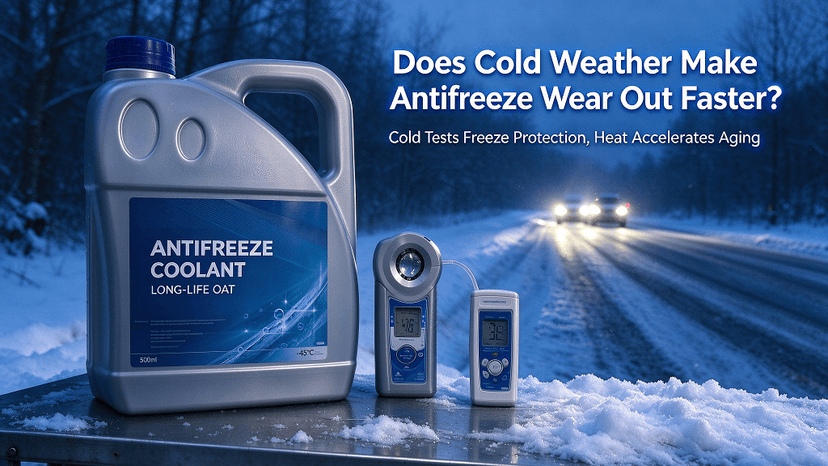
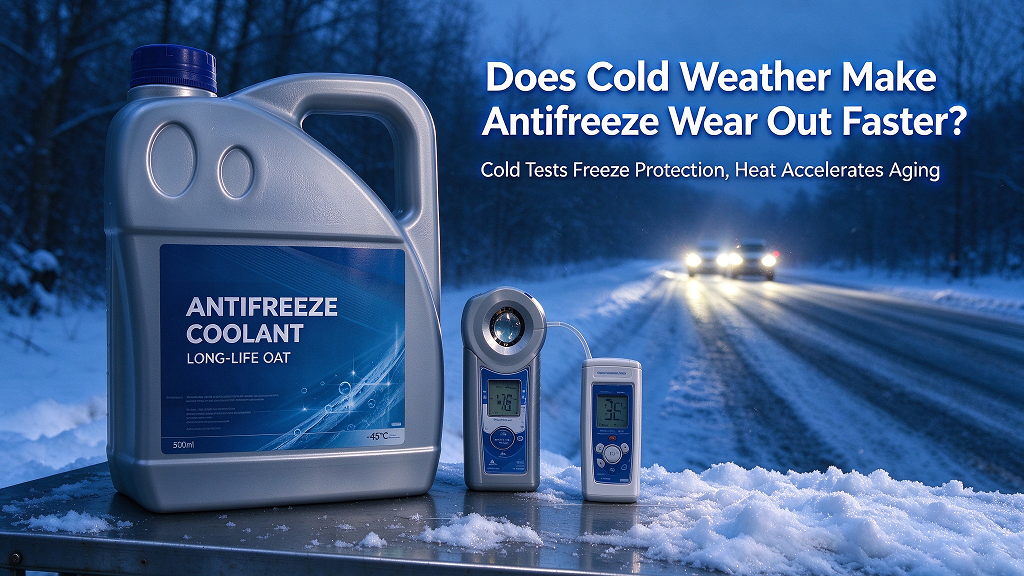
Many drivers believe freezing winter temperatures will make antifreeze degrade faster and lose its function. This is a widespread misunderstanding across northern cold regions. Cold weather tests whether the freeze protection of coolant is sufficient, but it is not the main driver of additive aging. Our manufacturer provides year-round technical support for customers from northern cold regions, and we often clarify this point for suppliers and their end users.
The main factors that consume antifreeze inhibitors are high engine operating temperature and continuous oxidation. Every time the engine heats up after startup, inhibitors react slowly with metal surfaces to form thin protective passivation films. This chemical reaction consumes inhibitor molecules gradually. Oxidation also accelerates at higher temperatures. The longer coolant stays at high operating temperature, the faster the protective additives are used up.
Cold weather itself does not break down the corrosion inhibitors inside qualified antifreeze. Stable OAT or HOAT coolant formulas are designed to keep their inhibitor performance steady at low temperatures, as long as the mixing ratio is correct and no contamination enters the cooling system. The glycol base fluid and inhibitor packages do not decompose just because the ambient temperature drops below zero. The coolant only needs to stay liquid to perform its heat transfer work.
Cold regions create indirect risks such as improper dilution and frequent temperature cycling. If the mixing ratio is wrong and there is not enough antifreeze concentrate, cold weather reveals the weakness quickly and leads to ice formation. Big temperature swings between freezing outdoor air and hot engine fluid put repeated mechanical stress on rubber seals, gaskets and hoses. Over time, thermal cycling can create tiny leaks at connection points, even if the coolant chemistry itself is still good.
Hot climate areas usually shorten antifreeze service life more obviously than cold winter zones. Sustained high engine temperature in tropical or desert markets speeds up oxidation and inhibitor depletion. Many of our supplier partners serving hot zones recommend shorter replacement cycles for their customers, while users in cold temperate zones can follow the standard long-life service interval.
Our factory supplies special high-performance antifreeze for clients operating in extreme cold markets. We recommend refractometer testing before winter arrives to confirm freeze protection matches the local lowest expected temperature. This simple pre-winter check is a value-added service that suppliers can offer to repair shops and fleet customers.
FAQ
Q1: Does cold weather make antifreeze wear out faster?
A1: No. Low temperature does not consume antifreeze inhibitors. High engine heat and oxidation are the main causes of coolant degradation. Cold weather only tests freeze protection.
Q2: What shortens antifreeze service life most?
A2: High operating temperature, oil contamination, air entering the cooling system and poor dilution water quality.
Q3: Should I test antifreeze before winter?
A3: Yes, test freeze point to confirm the mixture can handle local lowest temperature.
Q4: Can the same antifreeze last equally long in cold areas and tropical countries?
A4: The same formula degrades faster under continuous high temperature in tropical markets.
Q5: Will freezing damage the antifreeze chemical formula?
A5: If mixed correctly, it will not freeze. If freezing happens, the engine block gets damaged instead of the coolant formula.
Q6: Is there special antifreeze for extremely cold markets?
A6: Yes, our factory produces low-freeze-point concentrate for wholesale buyers in cold climate regions.
Welcome to contact GAFLE for more information & cooperation!
peter
ZHEJIANG GAFLE AUTO CHEMICL CO.,LTD
Tel:86-579-8222 1665
Fax:86-579-8246 4690
Cel/Wechart:86-13335993986
E-mail:peter@gafle.net
Web:www.gafle.net