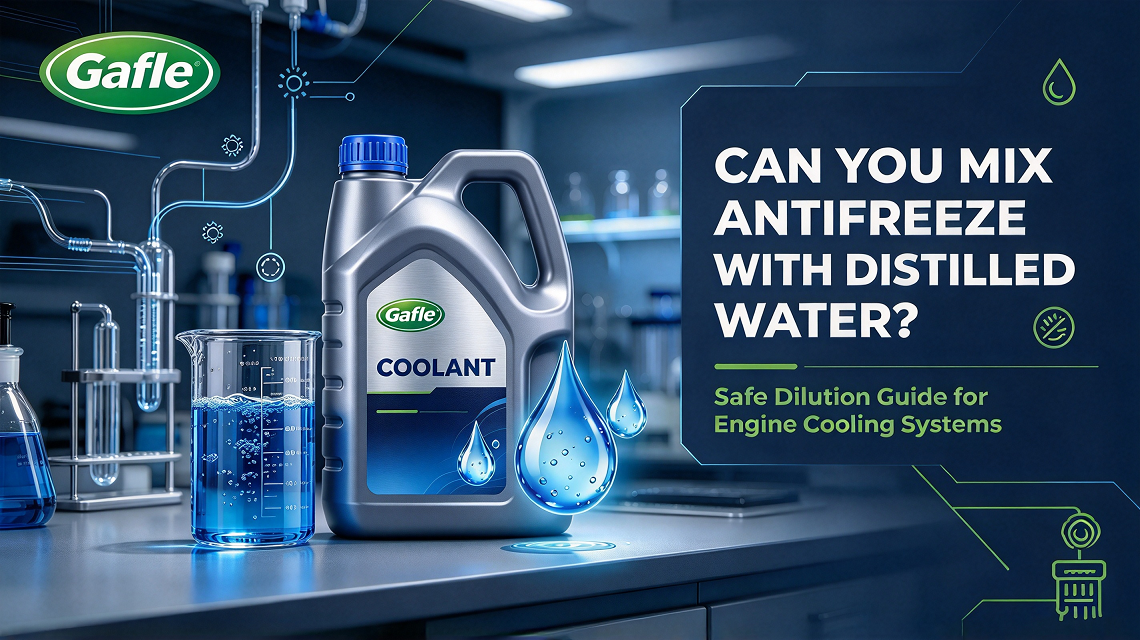
Distilled water is the only widely recommended water source for diluting concentrated antifreeze, but many users misunderstand the exact rules. Countless cooling system failures trace back to poor water selection. This article clarifies what water works safely, what water is forbidden, and how to use distilled water correctly without ruining coolant performance. This is essential knowledge for wholesale customers, repair technicians and DIY vehicle owners.
Distilled water is created by boiling water and condensing the steam. This process removes nearly all dissolved mineral salts, calcium, magnesium and heavy metal ions. Minerals are the enemy inside cooling systems. When coolant heats and cycles repeatedly, mineral ions precipitate out and form hard, insoluble limescale. Scale sticks tightly to radiator fins, water jackets and narrow heater core passages, blocking heat transfer permanently. Distilled water eliminates this scale risk, so it is the industry standard dilution medium for automotive coolant.
Tap water, well water, spring water and mineral bottled water must never be mixed into antifreeze. Even water that tastes clean and clear contains dissolved minerals. In hard-water regions, tap water mineral content is very high. After just months of thermal cycling, scale builds rapidly. Minerals also react with coolant additives, neutralizing corrosion inhibitors and shortening coolant service life. Some technicians see no immediate problem after using tap water, but hidden scale damage slowly accumulates and leads to radiator replacement years later.
Distilled water and deionized water are both acceptable for coolant mixing, with minor technical differences. Deionized water removes charged mineral ions through resin filtration, while distillation removes nearly all dissolved solids including non-ionic contaminants. For automotive coolant dilution, both perform adequately. Most large professional coolant mixing workshops prefer deionized water for continuous high-volume production, while small shops and DIY users usually buy off-the-shelf distilled water jugs. Neither of these water types introduces scale-forming minerals.
A critical rule: distilled water is only for diluting full-strength concentrated antifreeze. You should not add straight distilled water into a cooling system already filled with correctly mixed 50/50 coolant. Adding pure water to an existing balanced blend lowers glycol concentration, raises freezing point and dilutes inhibitor levels. If your customer’s vehicle has a small coolant loss and the existing fluid is already properly mixed, they should top up with matching ready-mixed coolant, not plain distilled water.
Emergency road top-up with distilled water is allowed, but it is only a temporary fix. If a vehicle overheats far from a shop and no mixed coolant is available, distilled water can be added to get the vehicle to a repair location. After reaching the workshop, the diluted coolant must be drained, tested, re-blended or fully flushed. Driving long-term after adding only water will leave the system vulnerable to freezing and corrosion. This emergency workaround does not count as a permanent solution.
Many people assume grocery-store purified drinking water is a suitable substitute for distilled water. This is risky. Most drinking purified water only reduces mineral content, it does not reach the zero-mineral standard of distilled water. Trace mineral residues remain. For occasional emergency use it is better than tap water, but it is not approved for formal coolant mixing for long-term vehicle protection.
Pre-mixed coolant you buy from Gafle already uses factory-grade deionized or distilled water. You never need to add extra water to factory pre-mixed jugs. Opening and adding outside water contaminates the controlled formula, breaks the designed ratio and voids consistent performance. Store any coolant you mix on-site in sealed, clean containers, to prevent dust, dirt and mineral contamination from entering the fluid before use.
FAQ
Q1: Why is distilled water the best choice to mix antifreeze?
A1: It contains almost zero dissolved mineral ions, so it will not form limescale inside the cooling system after repeated heating cycles.
Q2: Can I use deionized water instead of distilled water?
A2: Yes, deionized water is also fully acceptable for coolant dilution and widely used in commercial coolant production.
Q3: Is bottled purified drinking water safe for mixing coolant permanently?
A3: Not ideal. It still contains trace dissolved minerals, and long-term use can create scale buildup. Only use it in a last-resort emergency.
Q4: Can I add distilled water directly into my radiator to top up?
A4: Only in an emergency. If your coolant is already correctly mixed 50/50, topping with plain water ruins the ratio and inhibitor concentration.
Q5: What will happen if I mix antifreeze with hard tap water?
A5: Minerals create hard scale, clog radiators, reduce cooling efficiency, and consume corrosion inhibitors, shortening coolant life.
Q6: Does distilled water expire after I open the jug?
A6: Distilled water itself does not expire, but it can absorb dust and contaminants from open air. Keep it sealed in clean containers.
Q7: Can I mix different brands of antifreeze together before adding distilled water?
A7: Only when their coolant chemistry (OAT/HOAT/IAT) is confirmed compatible. Incompatible blends create sludge.
Q8: How much distilled water should I use for one gallon of concentrated antifreeze for 50/50 mix?
A8: Add one gallon of distilled water to one gallon of concentrated antifreeze to reach the standard 50/50 ratio.
Welcome to contact GAFLE for more information & cooperation!
peter
ZHEJIANG GAFLE AUTO CHEMICL CO.,LTD
Tel:86-579-8222 1665
Fax:86-579-8246 4690
Cel/Wechart:86-13335993986
E-mail:peter@gafle.net
Web:www.gafle.net