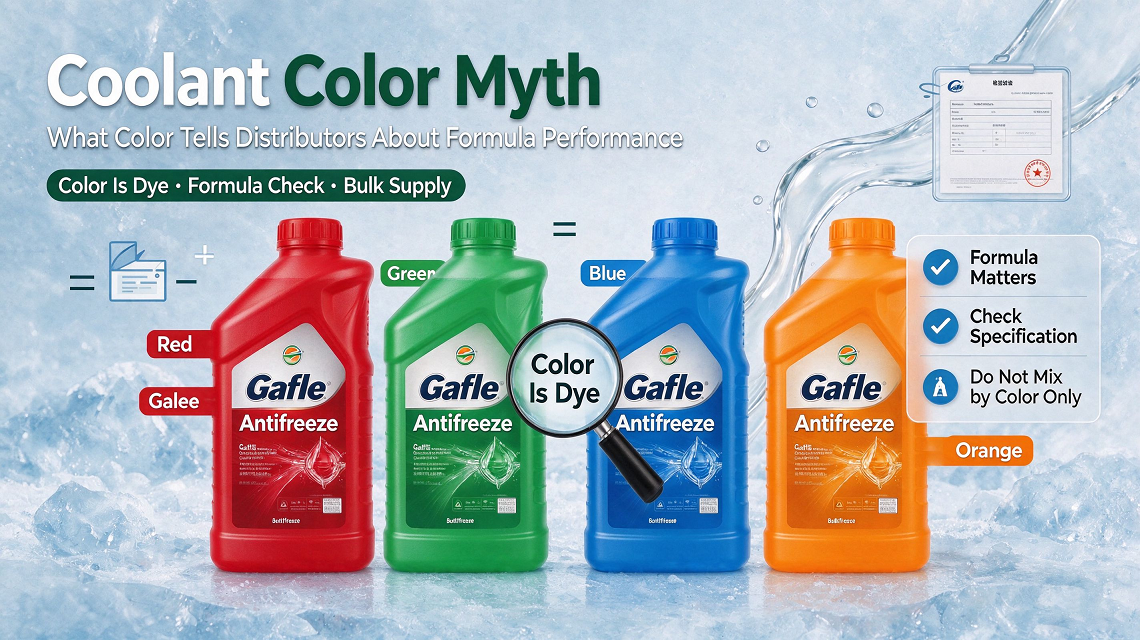
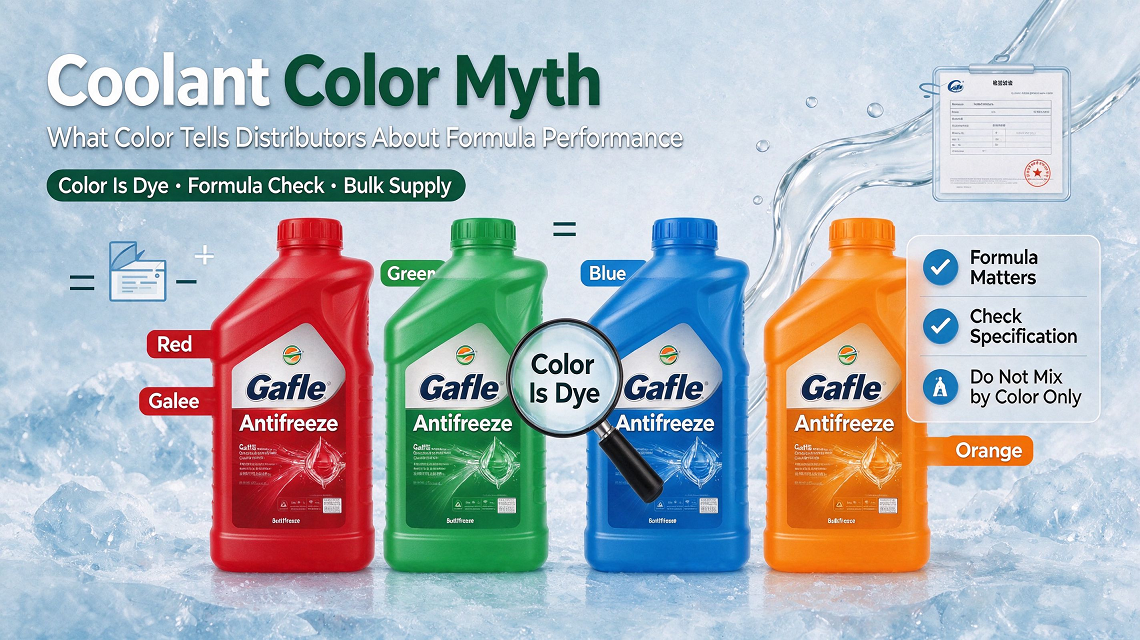
Walk into almost any fleet bay or maintenance workshop, and you will likely see a technician grab an open jug of fluid based purely on whether it looks neon green, amber, or deep pink. This common practice raises an urgent question for fleet operators and plant engineers: does coolant color indicate formula type? The short, definitive answer is no. Assuming that pigment dictates chemical compatibility is an expensive color myth that continues to cause avoidable component failures, plugged heat exchangers, and voided engine warranties across industrial and automotive applications.
The Origin of the Color Myth
Decades ago, visual identification was reasonably straightforward. For a long time, the North American market ran almost exclusively on conventional Inorganic Additive Technology (IAT). This formulation used silicates and phosphates to provide fast-acting, sacrificial protection for cast iron and copper-brass radiators, and manufacturers universally dyed it bright fluorescent green. When long-life Organic Acid Technology (OAT) entered the market in the mid-1990s, brands like GM differentiated their carboxylate-based Dex-Cool by dyeing it bright orange.
That visual shorthand quickly collapsed as global equipment manufacturers developed proprietary inhibitor chemistries. European designs eliminated phosphates to avoid hard-water scaling, opting for low-silicate Hybrid OAT (HOAT) blends dyed turquoise, pink, or purple. Asian heavy-duty and automotive builders eliminated silicates to protect water pump seals from abrasive particulates, creating Phosphated OAT (P-OAT) formulations dyed blue, pink, or green. Today, dye is simply a chemical-grade colorant added near the end of blending. It carries zero international regulatory standardization.
Deconstructing Antifreeze Color Meaning by Chemistry
Understanding true chemical composition matters far more than deciphering supposed antifreeze color meaning. While certain pigments correlate with specific OEM conventions, color overlap between incompatible formulations is widespread.
- Inorganic Additive Technology (IAT): Typically green. Relies on fast-depleting inorganic salts (silicates, phosphates). Service life is short, typically 2 years or 30,000 to 50,000 miles.
- Organic Acid Technology (OAT): Orange, red, pink, or yellow. Uses neutralized organic carboxylates (such as sebacate and 2-EHA) with no silicates or phosphates. Designed for extended drain intervals of 5 years or 150,000+ miles.
- Hybrid Organic Acid Technology (HOAT): Often yellow, orange, or blue. Combines organic acids with a small dose of silicates to provide rapid aluminum passivation along with extended service intervals.
- Silicated OAT (Si-OAT) and Phosphated OAT (P-OAT): Often magenta, violet, pink, or blue. Engineered to satisfy specific metallurgies without triggering either abrasive seal wear or drop-out when using tap water.
Because there is no governing body enforcing what dye a chemical compounder must use, one brand's universal extended-life OAT might be yellow, while another manufacturer's HOAT uses the exact same shade. Relying on color as a substitute for chemical classification is functionally a gamble.
Can You Mix Coolant of Same Color?
One of the costliest assumptions in preventive maintenance involves top-offs: can you mix coolant of same color without issue? Absolutely not. Pouring a green aftermarket OAT into a heavy-duty cooling loop filled with legacy green IAT creates an uncontrolled chemical cocktail inside the engine block.
When distinct corrosion inhibitor chemistries clash, several mechanical issues occur:
- Precipitation and Gelling: Mixing silicates with incompatible organic acids or hard-water contaminants can destabilize the solution, throwing silicates out of suspension. This produces a thick, silica-based sludge that settles in the narrow passages of heater cores and radiator tubes.
- Depleted Corrosion Protection: Inhibitor packages rely on precise chemical balances to establish passivation layers across mixed metallurgy (aluminum, copper, cast iron, solder). Chemical cross-contamination can cancel out these inhibitors, leaving cylinder liners vulnerable to cavitation corrosion.
- Premature Water Pump Seal Failure: Chemical dropout creates abrasive micro-solids that grind against mechanical ceramic and carbon water pump face seals, producing chronic weeping and eventual seal blowouts.
Reliable Coolant Formula Identification in Modern Operations
Because visual inspection is fundamentally unreliable, operations require an intentional protocol for coolant formula identification. You can eliminate guesswork across your maintenance department by standardizing on a few operational controls:
1. Verify Industry and OEM Specifications
Ignore the dye and read the fluid data sheet. Commercial vehicle and heavy equipment coolants must meet rigorous engineering benchmarks, such as ASTM D6210 for fully formulated heavy-duty diesel engines, or ASTM D3306 for light-to-medium-duty applications. Look for specific OEM material standards (such as Cummins CES 14603, Detroit Diesel 93K217, or Cat EC-1) rather than generic marketing terms like "heavy-duty" or "universal."
2. Restrict Site Stocking
Where feasible, transition the entire yard or production facility to a single, high-quality, nitrite-free extended life coolant (NF-ELC) compatible with your primary engine assets. Limiting inventory reduces human error at the service cart.
3. Enforce Dedicated Transfer Equipment
Dyes stain transfer pumps, sight glasses, and funnels. Dedicated, labeled containers for specific fluid types prevent cross-contamination during routine top-offs.
4. Deploy Routine Chemical Testing
Use optical refractometers—not floating-ball hydrometers—to measure glycol freeze-point accurately. For complex diesel fleets running hybrid or wet-sleeve systems, use chemical test strips or laboratory ICP spectroscopy to measure nitrite, molybdate, and reserve alkalinity levels rather than judging fluid health by its color clarity.
Frequently Asked Questions
Does a clear or pale yellow coolant mean the fluid is universal?
Not necessarily. While some blenders produce pale amber or "global" formulations intended to be chemically tolerant of modest dilution with other chemistries, "universal" is largely an industry convenience term. Adding universal fluids still dilutes the engineered additive concentration of the base fill, which shortens overall protection life.
What should you do if an incompatible coolant was added by mistake?
If an unverified fluid is introduced during a top-off, do not run the equipment long enough to let heat cycles polymerize the mixture. Perform a complete cooling system drain, flush the circuit thoroughly with demineralized or deionized water, and refill with the designated OEM-specified formulation.
Why do manufacturers dye coolant at all if it does not indicate the chemistry?
Pigments primarily serve safety and maintenance diagnostics. Glycol is naturally clear and sweet-tasting, making it an extreme poisoning hazard if left undyed. High-visibility fluorescent dyes also make leaks immediately visible under normal shop lighting or UV inspection lamps.
Next Steps for Facility and Fleet Managers
If your shop currently inventories multiple unlabelled jugs or relies on technicians matching fluid by eye, review your operational fluid schedules this week. Audit your engine manuals, record the exact ASTM and OEM engineering numbers required across your machinery, and discard the assumption that color equals chemistry.
Welcome to contact GAFLE for more information & cooperation!
peter
ZHEJIANG GAFLE AUTO CHEMICL CO.,LTD
Tel:86-579-8222 1665
Fax:86-579-8246 4690
Cel/Wechart:86-13335993986
E-mail:peter@gafle.net
Web:www.gafle.net