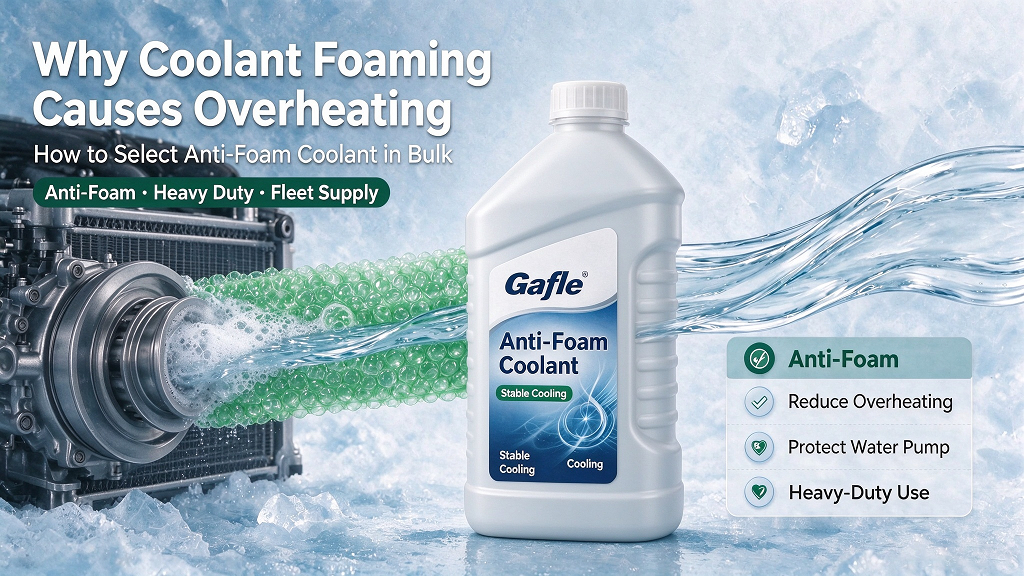
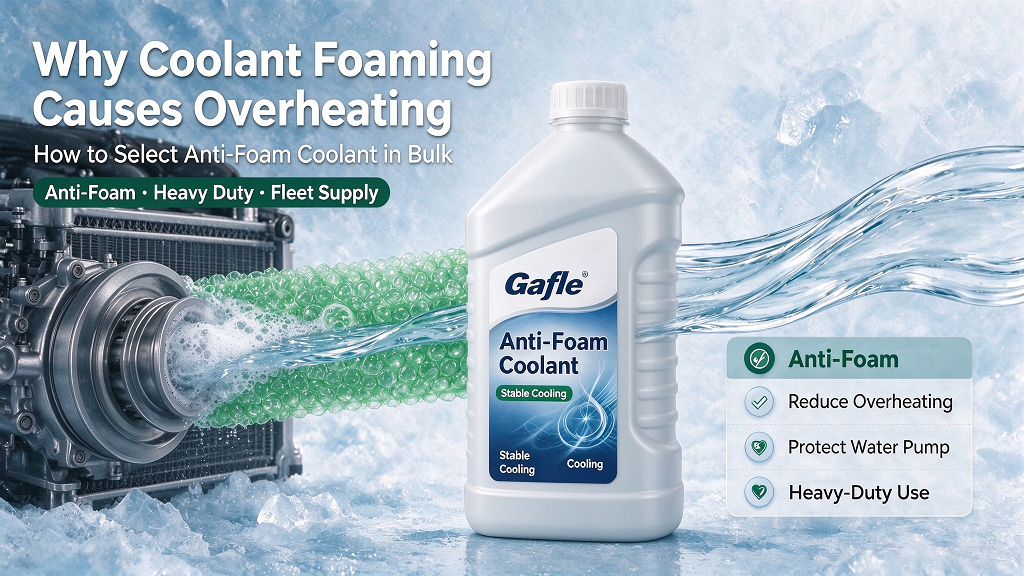
Thermal Dynamics: Why Coolant Foaming Causes Overheating
In high-output combustion engines and industrial chillers, thermal stability depends entirely on an unbroken boundary layer of liquid. When bubbles invade the jacket, technicians quickly discover why coolant foaming causes overheating even when sight glasses indicate a full system. Liquid solutions conduct heat efficiently; trapped gas does not. When aeration turns a dense water-glycol mixture into an emulsion of microbubbles, the circulating medium loses the physical capacity to pull thermal energy away from critical metal surfaces.
Two Destructive Mechanisms: Thermal Blanketing and Impeller Cavitation
The failure to manage heat during a foaming event stems from two compounding thermodynamic and hydraulic failures: interface insulation and loss of pumping pressure.
1. Thermal Blanketing at the Metal Boundary
A standard 50/50 water and ethylene glycol mixture exhibits a thermal conductivity of roughly 0.40 W/m·K. Air, by contrast, sits around 0.026 W/m·K—roughly fifteen times less conductive. When micro-bubbles collect on hot cylinder liners or valve bridges, they create a microscopic insulating jacket. This disrupts nucleate boiling, the micro-phase shift that absorbs extreme heat flux, and forces the system into localized film boiling. The bulk fluid flows past without ever wetting the metal. This severe localized overheating can warp heads, crack exhaust ports, and scorch oil films on piston ring lands in a matter of hours.
2. Impeller Cavitation and Loss of Hydraulic Head
Centrifugal water pumps are non-positive displacement devices designed exclusively for incompressible liquids. Entrained gas alters the fluid density:
- Loss of Hydraulic Head: Compressible froth absorbs the mechanical energy of the rotating vanes instead of converting it into kinetic flow. Discharge pressure collapses, causing flow rates across the radiator core to fall sharply.
- Vane Erosion: As entrained bubbles migrate from low-pressure intake zones to high-pressure discharge points, they implode violently. The resulting micro-jets pit the impeller vanes, progressively eroding the pump until circulation drops to a fraction of design intent.
Chemical Breakdown: The Role of Defoamers
Liquid formulations rarely foam without mechanical agitation combined with surfactant degradation. Modern heavy-duty formulations use organic acid inhibitors and glycols to balance freeze and boil thresholds, but these chemistries require foam depressants to operate reliably.
This is where specifying a heavy-duty anti-foam antifreeze becomes vital. Formulated defoamers—typically silicone emulsions or insoluble polyglycols—lower surface tension at gas-liquid interfaces, forcing micro-bubbles to coalesce and pop inside expansion tanks rather than circulating through the block. Over extended drain intervals, however, shear stress and oxidation destroy these compounds. Contamination with hard municipal tap water introduces calcium and magnesium, which strip out defoaming chemistry and turn degraded antifreeze into a frothing emulsion under sustained pump speed.
How to Avoid Coolant Foaming: Practical Shop Protocols
Understanding how to avoid coolant foaming comes down to denying air entry points and maintaining additive integrity. Experienced maintenance teams follow several core practices:
- Use Vacuum-Assisted Refill Tools: Manual gravity pouring routinely traps air in high passages. A venturi-style vacuum bleeder collapses system hoses, evacuates the internal volume, and draws fresh charge into every passage without entraining air.
- Inspect the Low-Pressure Suction Side: A weeping lower radiator hose clamp or worn water pump seal might not leak fluid when static. Under high engine RPM, however, the negative pressure draws ambient air straight into the fluid flow.
- Check for Combustion Gas Infiltration: A failed cylinder head gasket or cracked EGR cooler can blast high-pressure exhaust gas into the jacket, overpowering chemical defoamers. Run a chemical combustion-leak check if fluid expansion seems violent upon acceleration.
- Maintain Water Quality: Never mix concentrates with unconditioned well water. High mineral content accelerates the precipitation of silicone anti-foam additives. Always use deionized or reverse-osmosis water.
Diagnostic Quick Reference: Aeration Symptoms
| Observed Symptom | Likely Root Cause | Immediate Action |
|---|---|---|
| Fine, stable foam layer in reservoir | Depleted defoamer package or chemical contamination | Drain, flush, and refill with anti-foam antifreeze |
| Rapid reservoir pressurization when cold | Combustion gas leaking through gasket or cracked head | Perform block chemical test for carbon dioxide |
| Temperature spikes under load only | Impeller cavitation from suction-side air ingestion | Inspect intake hoses, fittings, and water pump shaft seals |
Frequently Asked Questions
Can aftermarket defoamer additives be poured directly into the reservoir?
Adding aftermarket bottles to an aged charge is risky. Universal additives frequently clash with existing corrosion inhibitor chemistries, precipitating silicates out of suspension and creating abrasive sludge that destroys mechanical pump faces. Replacing the exhausted batch is far safer.
How can a shop distinguish true boiling from mechanical foaming?
Steam bubbles collapse instantly when the liquid temperature drops slightly or when sampled into a room-temperature beaker. In contrast, mechanical foam retains its cellular, spongy structure long after fluid has cooled, indicating surface-active foaming rather than phase-change boiling.
Next Steps for Fleet and Plant Technicians
If recurring thermal warnings point toward jacket aeration, pull a 100 mL sample directly from the header tank while the engine idles at operating temperature. If the fluid looks like dense espresso crema rather than translucent liquid, skip the thermostat replacement. Check the suction circuit for vacuum leaks, verify water quality, and transition the equipment to an OEM-approved fluid package designed for high-cavitation service.
Welcome to contact GAFLE for more information & cooperation!
peter
ZHEJIANG GAFLE AUTO CHEMICL CO.,LTD
Tel:86-579-8222 1665
Fax:86-579-8246 4690
Cel/Wechart:86-13335993986
E-mail:peter@gafle.net
Web:www.gafle.net