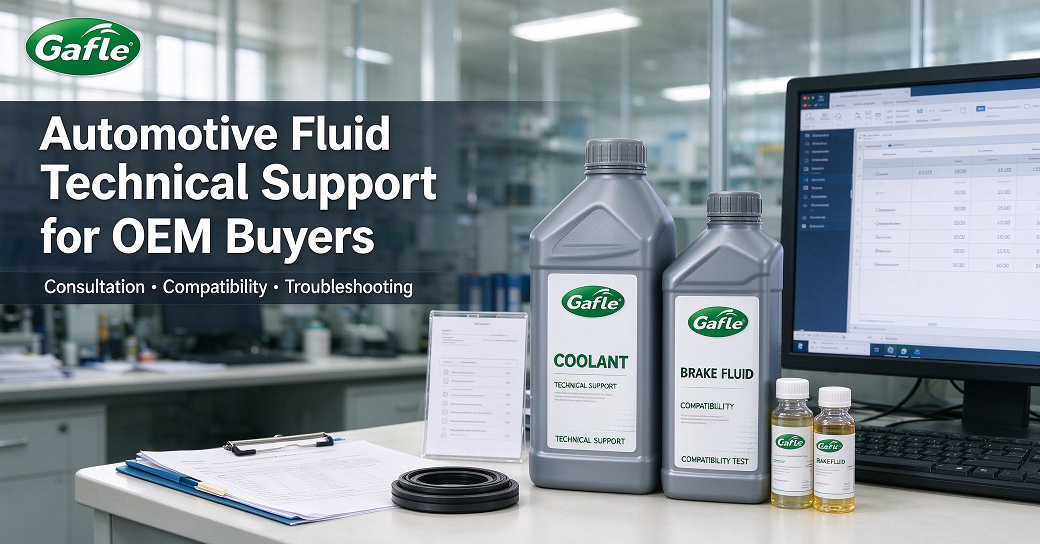
Quick Answer: An ISO 9001 automotive chemical supplier should be qualified at both the management-system and product levels. Verify the current certificate, issuing body, manufacturing address and scope; then connect the actual brake fluid, coolant, washer fluid or refrigerant you intend to buy to its specification, tests, sealed packaging and traceable batch records. ISO 9001:2026 is now the current standard, while existing ISO 9001:2015 certificates may remain valid during the official transition. Certification alone never proves individual vehicle compatibility.
For overseas importers, automotive aftermarket distributors and private-label brand owners, an ISO 9001 certificate can help reduce uncertainty in the first stage of supplier selection. It shows that a company claims to operate under an externally assessed quality management system, but it cannot tell a buyer whether one particular drum, bottle or cylinder meets the specification in the purchase order. That requires a second layer of evidence.
The distinction becomes even more important when one supplier offers several automotive chemical families. Brake fluid has safety-critical hydraulic performance requirements; engine coolant has different corrosion and freeze-protection requirements; washer fluid must match its declared temperature and cleaning performance; and refrigerant requires chemical identity, purity and compliant containment. A certificate cannot replace those separate product assessments.
This guide gives procurement and quality teams a practical eight-evidence review, explains the recently released ISO 9001:2026 edition, and shows how to translate the results into a sample-to-reorder supply program. It also identifies GAFLE product and OEM service pages that buyers can use to start a documented technical inquiry.
GAFLE | QUALITY-LED SOURCING
Start with the right product and evidence
1. What Does ISO 9001 Actually Tell an Automotive Chemical Buyer?
ISO 9001 is a quality management system (QMS) standard for organizations of many kinds. Its purpose is to establish a disciplined way to understand customer requirements, control processes, manage risks, handle nonconforming outputs, evaluate performance and improve operations. It is not an automotive chemical formulation standard, a vehicle fitment certificate or a guarantee that every future batch will be identical.
For a brake fluid or coolant project, a functioning QMS should make it easier to answer real operational questions: Who approves the formulation? How are incoming materials identified? What happens if a filling-line check fails? Can a customer link a packaged lot to its production and inspection records? How are changes communicated before the next order?

A supplier may be certified yet lack the product-specific documentation your market needs. Another supplier may offer an impressive laboratory sample without having an adequately controlled repeat-order process. Professional buyers need to assess both conditions rather than treating a certificate or sample as a complete substitute for supplier qualification.
FORK's company profile and product catalogue describe automotive fluid manufacturing and OEM/private-label capabilities. Its published corporate information lists ISO 9001 among its management-system credentials. Those statements are useful starting points, but they should be supported by a current certificate and order-specific records before contractual approval.
2. ISO 9001:2026 Is Now Published: What Happens to 2015 Certificates?
A buyer checking ISO 9001 claims in late 2026 should know that the standard has changed. ISO 9001:2026 was published on September 16, 2026, replacing ISO 9001:2015 as the current edition. The revision retains the established quality-management framework while clarifying leadership responsibility, quality culture and ethical behavior, the distinction between risks and opportunities, and the intent of requirements through a new Annex A.
That publication does not mean every organization certified to ISO 9001:2015 suddenly became uncertified. The official transition arrangements allow already-certified organizations until September 30, 2029 to move to the 2026 edition. Separately, new and initial accredited certificates are to be issued only against the 2026 edition from March 31, 2028. Any individual certificate must still be current and valid in its own right.
| Date or situation | Practical meaning for the buyer | What to request |
|---|---|---|
| September 16, 2026 | ISO 9001:2026 became the current published edition | Certificate edition and supplier transition plan |
| Existing ISO 9001:2015 certificate | May remain valid during the recognized transition if its own status remains active | Full certificate, issuer, site, expiry and current status |
| From March 31, 2028 | New/initial accredited certifications are to use ISO 9001:2026 | Confirm the appropriate certificate edition |
| By September 30, 2029 | Existing certified organizations are expected to complete their transition | Transition audit status and updated certificate |
These dates come from the ISO technical committee's published transition guidance. They are not GAFLE-specific certification dates. Ask GAFLE—or any potential supplier—which edition its certificate presently covers and which certification body will oversee the transition. Do not invent a 2026 certificate number or assume a transition audit has been completed when no evidence is available.
For a buyer managing a multi-year contract, add the planned certificate transition to the supplier review calendar. It is a relatively simple step that prevents an out-of-date document from remaining unchallenged in the purchasing file.
3. Eight Pieces of Evidence to Request From an ISO 9001 Automotive Chemical Supplier
The following evidence checks are arranged in the order a buyer can use them, from identity through repeat supply. They are an illustrative qualification process, not a claim that GAFLE has completed an independent audit under this article.
Check 1 — Confirm the certificate, legal entity and actual factory
Obtain the complete certificate, not a small logo on a product page. Record the company name, certified location, scope wording, certificate number, certification body, edition, issue/expiry dates and current status. Verify accredited certification information through the issuing certification body, relevant accreditation body or a suitable certification database such as IAF CertSearch where a record is available.
A missing database result alone does not prove a certificate is fraudulent; some records may not be publicly searchable. If the evidence cannot be reconciled, request clarification directly from the issuing body. Most importantly, confirm that the manufacturing activity relevant to your product is actually within the claimed certificate scope.
Check 2 — Identify who controls each product and production step
The seller, formulator, blender, filler, testing laboratory and exporter may not always be the same organization or site. Ask for a simple process map identifying who owns product specifications, sampling, release and change approval. If subcontractors are used, define the quality responsibilities and records expected from them.
This matters when a supplier offers brake fluid, antifreeze, washer fluid and refrigerant in one catalogue. Do not assume every listed category is manufactured on the same certified site or through identical procedures. The purchasing contract should name the accountable supplier and the approved production route.
Check 3 — Review raw-material identity and formulation control
Request an explanation of incoming material qualification, storage, identity checks, formulation revision control and prevention of inadvertent substitutions. A buyer does not need confidential recipe percentages to evaluate whether the factory can manage a formula; a redacted control-flow description or representative record may be sufficient.
For glycol-based brake fluid, moisture and incompatible contamination are important considerations. For a coolant, concentration, water quality and inhibitor-system consistency may be more relevant. Each family needs its own process risk analysis rather than one generic “automotive fluids quality” statement.
Check 4 — Match the manufacturing process to critical characteristics
Ask which variables are monitored during blending, transfer, filling and packaging, who authorizes process deviations and how equipment cleaning is documented. Examples include material identity, batch quantity, mixing conditions, cleanliness, filling accuracy and package-seal acceptance.
The exact parameters depend on the formulation and equipment. A factory tour is valuable, but a controlled process description and sample records tell you more about consistency across multiple orders. Ask to see how an out-of-limit observation is detected and handled before product release.
Check 5 — Build a product-specific test and document file
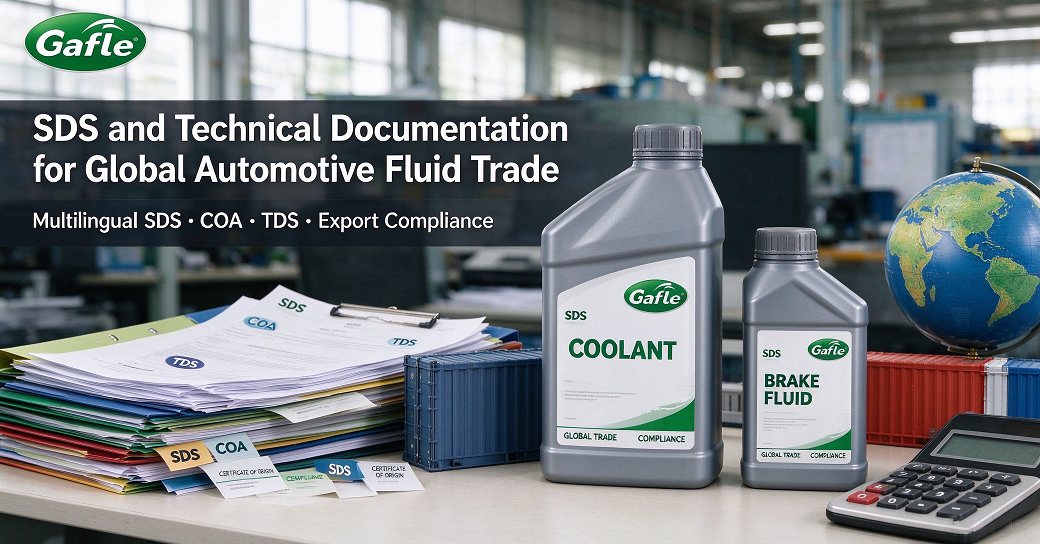
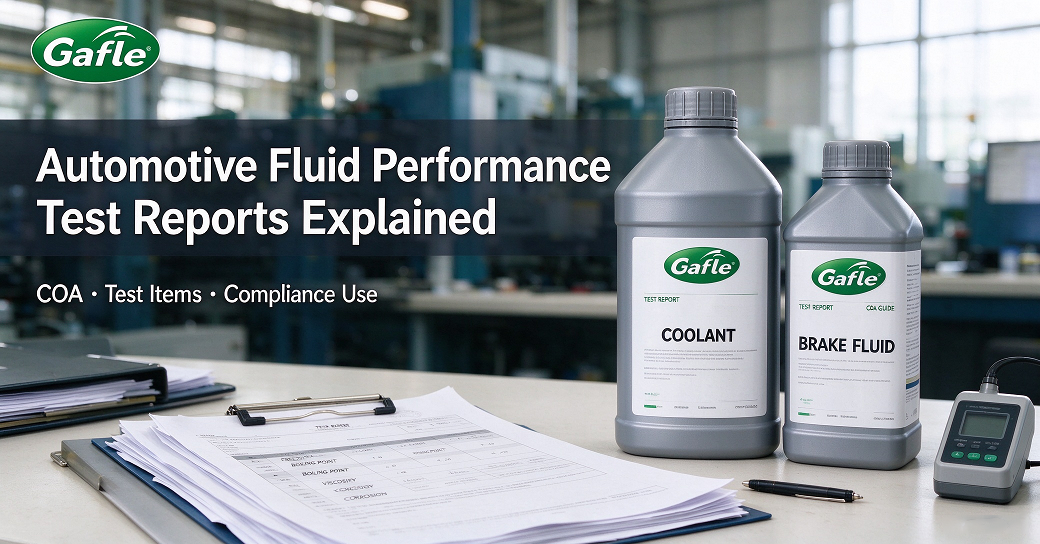
Request the correct TDS, SDS and applicable qualification test evidence for the exact formula under quotation. A TDS describes technical characteristics, an SDS addresses safety and handling, a test report records work on an identified sample, and a COA or agreed release record connects selected results to an actual production lot.
Do not confuse a standard's minimum performance requirement with a tested value for the offered product. Likewise, do not describe ISO 9001 certification as proof of FMVSS No. 116 or an OEM-specific fluid approval. The next section provides a product-family evidence map to guide this request.
Check 6 — Verify closures, labels and export packaging
Finished-package quality can be as important as blending accuracy. Specify the container, fill quantity, cap, seal, tamper-evident feature, label language, carton, pallet arrangement and batch identification. For certain U.S.-market brake-fluid containers, FMVSS No. 116 establishes sealing and labeling provisions; other markets have different applicable requirements.
Agree who signs off artwork and what happens when a mandatory statement or formulation changes. A supplier's offer of private-label packaging does not mean every package design or language variant is available at every order volume.
Check 7 — Demonstrate batch-to-batch traceability and corrective action
Select a representative finished lot and ask for a controlled, possibly redacted, traceability example: incoming materials, batch record, in-process checks, finished-product tests, packaging lot and shipment reference. Also ask how complaints and nonconformities are contained, investigated and corrected.
A supplier's ability to show the evidence chain matters more than a claim of zero defects. It helps determine whether a problem can be confined to an affected lot or whether every unit in distribution would be difficult to identify.
Check 8 — Lock repeat-order specification and change notification
The first approved sample is only the beginning. Before placing an order, agree on a master specification, the current formula/TDS revision, the packaging and artwork versions, routine batch-release tests, approved manufacturing site, records supplied with shipment, and the circumstances that trigger buyer reapproval.
If an additive source, bottle closure, production line, claimed standard or label changes, the buyer should know whether technical review is required. Repeat-order discipline is a concrete way to turn ISO 9001 process principles into lower procurement risk.
GAFLE | QUALITY-LED SOURCING
Talk to GAFLE about your technical requirements
4. Different Automotive Chemicals Need Different Qualification Evidence
The main reason to choose a specialized automotive chemical supplier is not that all automotive fluids behave alike. It is that the supplier can explain what must be controlled for each product family and deliver evidence appropriate to the intended market.
| Product family | Product-level evidence buyers should examine | Common confusion to avoid | GAFLE product entry |
|---|---|---|---|
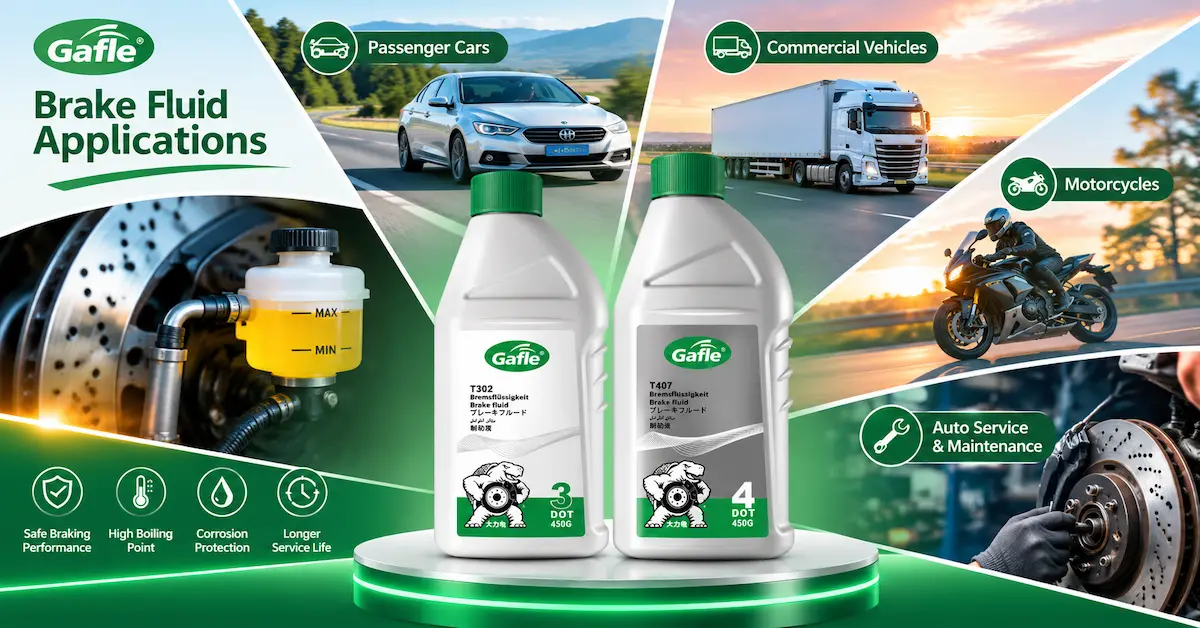
| DOT brake fluid | Exact grade, dry/wet ERBP, viscosity, compatibility/corrosion test evidence, applicable label and seal rules | ISO 9001 does not prove every bottle meets a DOT grade or vehicle requirement | Brake Fluid |
| Antifreeze / coolant | Approved chemistry, concentration, freeze protection, corrosion-inhibitor performance, materials and OEM requirements | Color alone does not prove formulation or vehicle compatibility | Antifreeze / Coolant |
| Windshield washer fluid | Declared temperature grade, cleaning characteristics, ingredient and packaging safety, market labeling | A temperature grade must be supported by the particular formula, not assumed from packaging | Washer Fluid |
| Refrigerant gas | Refrigerant identity, purity/contaminants, pressure container, safety and destination import rules | R134a and R1234yf are not automatically interchangeable | Refrigerant Gas |
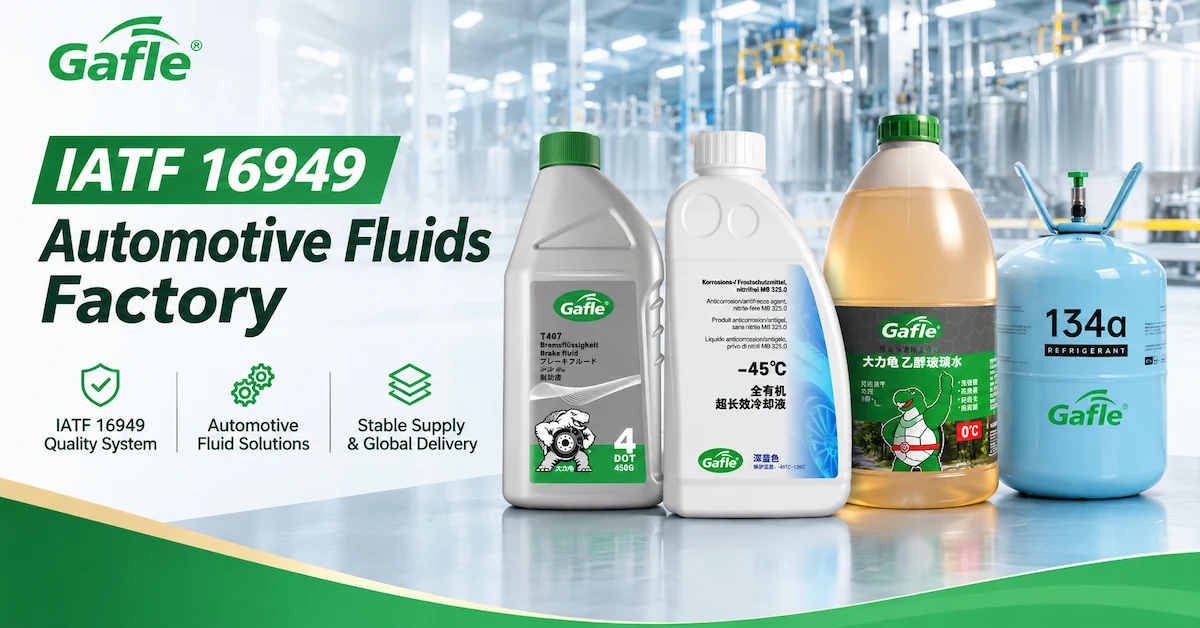
For example, GAFLE publishes DOT407 as a DOT 4 brake-fluid product and lists several cooling, washer-fluid and refrigerant categories. The publicly available product description is an appropriate way to find a candidate. It is not a substitute for the current TDS, applicable standards evidence or model-specific approval.
An importer purchasing more than one category should create a technical file per SKU instead of treating the supplier certificate as the universal supporting document. This approach also makes inquiries more effective: the supplier receives a concrete product and test request, not a vague demand for “all certifications.”
5. ISO 9001 vs IATF 16949 vs Product Standards: Avoid the Certification Trap
ISO 9001 and IATF 16949 are management-system frameworks, while brake-fluid and coolant requirements address product properties or particular vehicle applications. Buyers may need several types of evidence, but they should not combine them into a single unqualified claim such as “ISO-approved brake fluid.”
| Evidence type | Primary purpose | What the buyer still needs |
|---|---|---|
| ISO 9001:2026 / transitional ISO 9001:2015 certificate | Establishes a defined quality management system at stated scope/site | Product specification, actual test results, batch quality records |
| IATF 16949 certification | Automotive-sector QMS requirements within an eligible, defined scope | Current scope verification and product-specific approval evidence |
| FMVSS No. 116 for applicable brake fluids | Technical and packaging requirements for regulated grades | Evidence that the exact product meets the required grade |
| ISO 4925 and appropriate SAE references | Technical classes and criteria for relevant non-petroleum brake fluids | Edition/class matching and formulation-specific test evidence |
| Coolant or refrigerant specifications | Product- and application-specific technical requirements | Correct formula, materials compatibility, destination requirements |
| Vehicle-manufacturer documentation | Model/system-specific selection or approval requirements | Proof of any approval claim made about the supplied SKU |
The company should also distinguish certification scope, product conformance, third-party approval and routine lot release. These are different assertions. Purchasing teams can record them in different fields rather than relying on a single green check mark in a supplier scorecard.
This is particularly important for companies entering the aftermarket with their own branding. A credible label should use the exact grade and specification supported by the test file, not claims that every product is “internationally certified” without context.
6. Applying This Framework to GAFLE's Published Capabilities
Zhejiang Gafle Auto Chemical Co., Ltd. identifies itself as a China-based automotive chemical manufacturer and describes in-house production, laboratory activity and private-label packaging. Its corporate pages list ISO 9001, IATF 16949, ISO 14001 and ISO 45001 management-system certifications. Those are company-published claims; this article does not independently verify the current ISO 9001 certificate number, version, accreditation, site-specific scope or any completed transition to ISO 9001:2026.
For supplier qualification, the right next step is to ask for documentary confirmation of the claim alongside the product file. This should be a routine professional request, not an accusation or a presumption of nonconformity.
| What GAFLE publicly identifies | What an overseas buyer should request next |
|---|---|
| Automotive chemical manufacturing | Name and site of the manufacturer for each proposed SKU |
| ISO 9001 and other QMS credentials | Current certificate, issuer, accreditation, scope, status and 2026 transition plan |
| DOT 3 / DOT 4 and other brake-fluid lines | Product-specific TDS, applicable test evidence, and sample COA or release format |
| Antifreeze, washer fluid and refrigerant product ranges | Separate technical files and permitted market/application claims |
| OEM and private-label services | Available bottle/can formats, design approval steps, MOQ quotation, lead-time assumptions and change control |
You can begin by reviewing the complete GAFLE product catalogue, the DOT407 brake-fluid product, and the company profile. Then submit a structured inquiry specifying which grades and markets you intend to serve. No exact MOQ, production lead time, test value or model approval should be assumed without a current product quotation and document review.
7. From First Sample to Repeat Shipment: A Five-Stage Acceptance Plan
A good supplier qualification process should produce records that survive staff changes, product revisions and the first successful shipment. The following is a proposed buyer workflow rather than a claim that GAFLE follows these exact five stages for every customer.
Stage 1 — Scope and feasibility. Send the target market, buyer type, intended fluid, technical standard, pack size, labeling language, trial quantity and annual forecast. Obtain the exact offered SKU and the manufacturing route.
Stage 2 — Technical file review. Check the ISO certificate and its relevance, then review the correct TDS/SDS, qualification reports, application restrictions and proposed batch-release criteria. Record open questions instead of assuming equivalence between grades.
Stage 3 — Sample and pack approval. Request representative technical samples and a finished-pack sample or approved design proof. Confirm seal, fill quantity, label, carton, barcode and batch-code format. Document any customer-specific tests.
Stage 4 — First production release. The purchase order should refer to the approved specification, formula revision, packaging version, acceptance limits and Incoterm with named place. Review the agreed finished-lot documentation and resolve deviations before shipment.
Stage 5 — Reorder and improvement. Compare new and previous lot records, confirm there have been no unapproved changes, review complaints or returns, and update forecasts and quality requirements. Ask for an updated certificate when the ISO 9001 transition or ordinary recertification occurs.
A simple internal supplier acceptance sheet can use statuses such as pending documents, technical review, sample approved, conditionally approved and released for repeat purchase. Define who has authority to approve each status. A lower price should not override a failed critical safety or compliance requirement.
8. OEM and Private Label: Where an ISO 9001 Supplier Can Reduce Commercial Risk
Private-label projects create additional points where quality can drift. Two orders may use the same fluid but different bottles, closures, languages and distributor addresses; another may use a different formula under visually similar artwork. A capable partner should manage those distinctions through explicit identifiers and approved revisions.
Before signing off packaging, determine which elements are standard and which require special production or testing. Ask who owns artwork approval, how label claims are checked against the technical file, what market-specific safety statements are needed, and whether a package change triggers a new trial.
Separate formula MOQ, packaging MOQ and artwork MOQ in the quotation. A single minimum order for an entire mixed-SKU program may conceal different setup costs for each variant. Likewise, obtain lead-time estimates for a standard pack and a custom design separately; do not assume they are identical.
For repeat orders, keep a master record of accepted bottle material, closure, label files, carton dimensions and batch identification. This is a concrete way to apply the spirit of documented quality management to an OEM commercial relationship. GAFLE lists private-label packaging services, so buyers can discuss these requirements through its contact page.
GAFLE | QUALITY-LED SOURCING
Talk to GAFLE about your technical requirements
9. Build a Supplier Comparison Around Total Risk, Not Certificate Logos
When two suppliers both claim ISO 9001, use an evidence-based comparison. Start with non-negotiable gates: valid scope where certification is contractually required, correct product chemistry and standard, appropriate safety information and a controlled route for producing the specified SKU. After those pass, compare commercial factors such as packaging options, communication and landed cost.
A sample weighting for internal purchasing discussions is 25% product conformity, 20% batch and process controls, 15% packaging/label integrity, 15% certificate and document quality, 15% supply reliability and 10% commercial responsiveness. These are illustrative buying-team weights, not an official ISO evaluation or a score assigned to GAFLE.
The cheapest bottle can become expensive when the wrong grade reaches a workshop, labels have to be reprinted, a shipment is delayed by missing documentation or the supplier cannot trace the affected batch. A useful comparison includes quoted product and pack costs, testing arrangements, freight, import charges, inventory needs, corrective-action handling and the stability of repeat-order terms.
It is also worth looking at the buyer's own readiness. An unclear RFQ creates unclear quotations. Send the same approved technical requirements to each candidate and compare what is actually included in the price before drawing a conclusion.
10. Copy-Ready RFQ: Ask GAFLE for an ISO 9001 Supplier Review
Subject: ISO 9001 Automotive Chemical Supplier Review — [Product / Market / Annual Volume]
Dear GAFLE Team,
We are an automotive chemical [importer/distributor/private-label brand] serving [country/region]. We are evaluating [brake fluid, coolant, washer fluid or refrigerant; exact product grade and application] for an initial order of [quantity by SKU], with an estimated annual demand of [forecast].
Please confirm the proposed manufacturer and production site, and provide the current ISO 9001 certificate showing the issuing body, certificate number, edition, validity, location and scope. Since ISO 9001:2026 has been published, please also clarify your current transition status if the certificate refers to ISO 9001:2015.
For the offered product, please provide the latest TDS, relevant SDS, applicable test or conformity evidence, an example batch COA/release record, available packaging and closure specifications, sample conditions, OEM/private-label options, MOQ per SKU and artwork version, quotation basis, lead-time assumptions and process for notifying customers of formulation or package changes.
Our quality team will review the evidence before sample and purchase-order approval. Please identify anything that requires separate technical or commercial confirmation.
Kind regards,
[Name / Company / Email / Phone]
GAFLE | QUALITY-LED SOURCING
Talk to GAFLE about your technical requirements
11. Frequently Asked Questions About ISO 9001 Automotive Chemical Suppliers
1. Is ISO 9001:2026 the current version of ISO 9001?
Yes. ISO 9001:2026 was published on September 16, 2026, replacing the 2015 edition as the current published standard. Existing certified organizations have a defined transition period rather than losing certification automatically on publication day.
2. Can an ISO 9001:2015 certificate still be valid in 2026?
Yes. An individual ISO 9001:2015 certificate may remain valid during the official transition if it is active and the certification arrangement remains in good standing. Check the issuer, scope and current status; do not rely only on the edition or printed expiry date.
3. Does ISO 9001 certification prove that brake fluid meets DOT 4 requirements?
No. ISO 9001 addresses a quality management system, while DOT 4 requirements concern the product's actual technical performance and applicable packaging/labeling. Buyers need current product-specific evidence and application checks.
4. How can I verify an ISO 9001 supplier certificate?
Request the complete certificate and compare the legal entity, site, scope, issuing body and status. An accredited certificate may be checked through appropriate certification or accreditation channels such as IAF CertSearch. If the result is unclear, contact the issuer directly.
5. Is IATF 16949 the same as ISO 9001?
No. ISO 9001 is a general quality-management framework; IATF 16949 adds automotive-sector QMS requirements within its own certification scheme. Neither one is a blanket product approval for every automotive chemical.
6. Which documents should I request for a DOT 4 brake-fluid order?
Request the exact product TDS, SDS, relevant qualification evidence, an agreed lot-release or COA format, packaging/label specification and applicable certificate details. The product's claimed standards and intended vehicle systems must be checked separately.
7. Does the same ISO 9001 certificate cover a supplier's coolant and refrigerant products?
Not automatically. Check the certification scope and actual manufacturing sites and activities. Even when both products are within a relevant quality system, each still needs its own test, safety and market documentation.
8. Can GAFLE supply OEM and private-label automotive fluids?
GAFLE publicly describes automotive chemical manufacturing and OEM/private-label packaging services. A particular product, bottle or can format, order volume, technical dossier and lead time must be confirmed through a project-specific inquiry.
9. What is the best way to compare two ISO 9001 automotive chemical suppliers?
Use pass/fail technical and compliance gates first. Then compare verified process records, batch traceability, quality responsiveness, packaging consistency, shipment capability and normalized landed cost. An ISO logo should not override missing evidence.
10. What should be rechecked before each bulk reorder?
Confirm the approved formula and TDS revision, packaging/artwork version, production site, quality-release criteria, certificate status where relevant, agreed commercial terms and any changes or corrective actions since the previous order.
Conclusion
Selecting an ISO 9001 automotive chemical supplier is not a paperwork exercise. The best sourcing decision connects a verifiable quality management system to the exact automotive fluid, documented manufacturing controls, formula-specific test results, sealed packaging and traceable batches. With ISO 9001:2026 now published and the transition from 2015 underway, buyers should also check certificate edition and transition status without assuming that older certificates are automatically invalid.
For brake fluid, coolant, windshield washer fluid and refrigerant procurement, begin with the applicable product standard and intended market, then review the factory and order records that support repeat supply. GAFLE's company information and automotive fluid portfolio provide starting points for technical evaluation. To assess the exact proposed SKU, certificate scope, OEM packaging and commercial feasibility, contact GAFLE for a documented supplier qualification and quotation. Verify the system, approve the product, and preserve the evidence for every reorder.