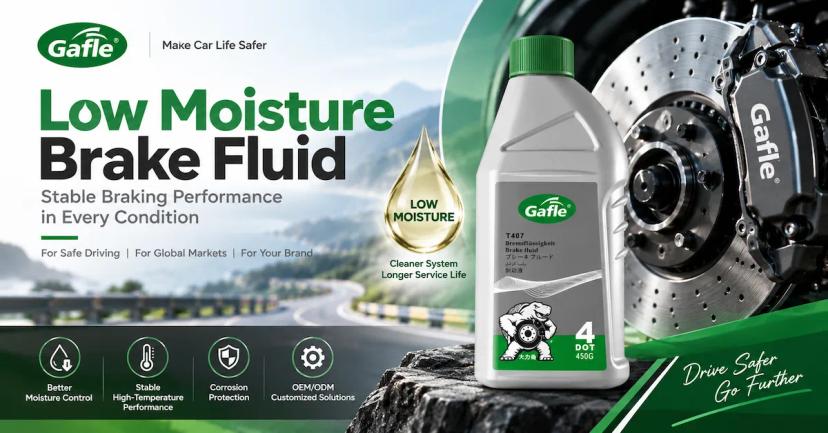
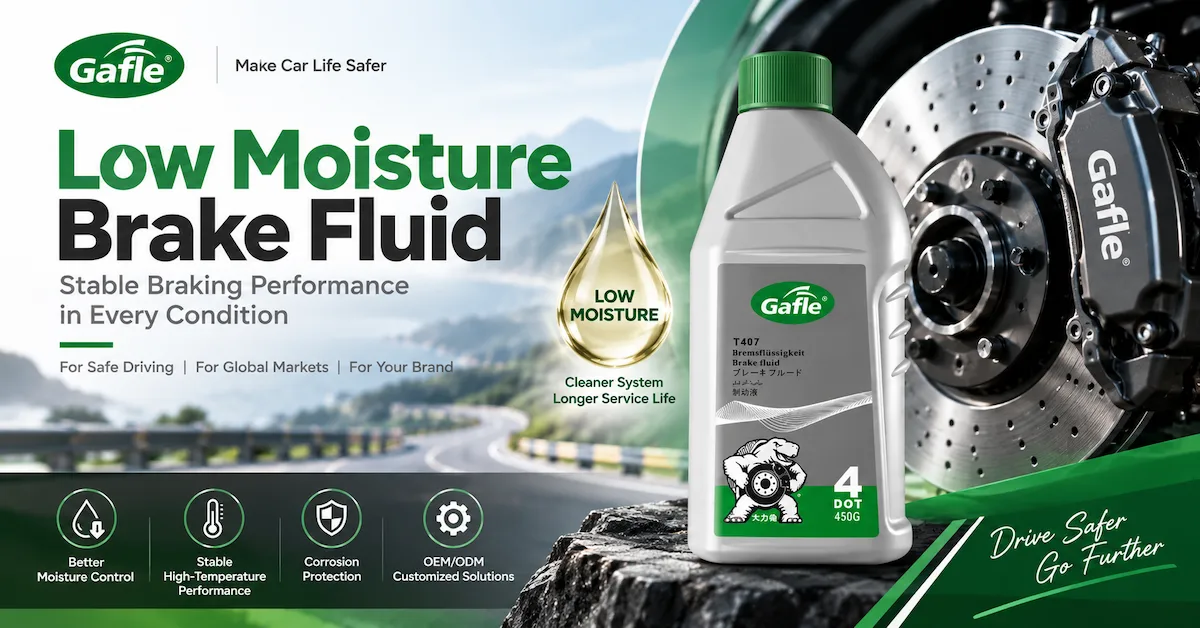
Low Moisture Brake Fluid is best understood as a moisture-control purchasing requirement, not a separate DOT performance grade. For an importer or private-label brand, the practical goal is to purchase a compatible brake fluid with documented low initial water contamination, dependable performance after standardized humidification, effective moisture-control measures during production, and packaging that protects the fluid until use. A supplier should demonstrate these qualities through a clearly identified formula, applicable standard, approved test methods, lot-specific records, and a suitable container—not a vague “low moisture” claim on the label.
That distinction can determine whether a bulk shipment creates repeat business or a difficult quality dispute. Brake fluid may leave the blending process in good condition, but moisture exposure during transfer, filling, repacking, storage, and maintenance can change its condition. A strong procurement specification therefore covers both the chemistry and the journey from factory to workshop. This guide explains the science, the testing, the packaging risks, and a practical supplier-approval framework for automotive chemical buyers. It also explains how to discuss a moisture-controlled OEM or private-label program with FORK without assuming that an unverified product claim is already certified.
1. What Does “Low Moisture Brake Fluid” Actually Mean?
The phrase sounds self-explanatory, yet different suppliers and buyers sometimes use it for three separate properties. The first is low water content in a newly manufactured or freshly packaged fluid. This is a measurable condition of a specific batch. The second is controlled moisture pickup during processing and distribution, which is a feature of the manufacturing and packaging system. The third is retained functional performance after moisture exposure, which is evaluated using specified wet-boiling, water-tolerance, corrosion, and related tests.
Those properties should not be confused. A fluid may have a low initial water-content reading but an inadequate wet boiling point for its claimed grade. Another formulation may display excellent wet-boiling performance while its production batches vary excessively in initial contamination. A premium closure can protect good fluid during freight, but it cannot correct an unsuitable formulation or a contaminated filling operation. Purchasing decisions become clearer when each claim has its own measurement and acceptance criterion.
Importantly, “Low Moisture” is not an independent FMVSS No. 116 DOT classification. A supplier cannot substitute that phrase for the actual DOT 3, DOT 4, or DOT 5.1 non-silicone identification required in applicable markets. When the target customer asks for a low-moisture product, the buyer should translate that wording into testable requirements before discussing cost, formula options, or packaging artwork.
2. Why Glycol-Based Brake Fluid Absorbs Water—and Why That Matters
Conventional DOT 3, DOT 4, and DOT 5.1 non-silicone brake fluids are generally based on glycol ethers and related constituents. These fluids are hygroscopic: they can take up water from their surroundings. Some formulations contain borate esters and other ingredients that influence both performance and the way the fluid behaves when exposed to moisture. Hygroscopic behavior is a normal property of this chemistry, not by itself evidence of a faulty product.
In service, water can gradually enter through the reservoir interface, hoses, seals, or maintenance activity. During manufacturing, it can enter from wet raw materials, humid air, inadequately dried equipment, transfer connections, or open containers. Conditions differ substantially between these situations. For example, opening a large drum repeatedly in a humid repacking room creates a very different exposure profile from storing a correctly sealed retail bottle.
Moisture is important because brake systems rely on the fluid maintaining appropriate physical and chemical properties. Repeated braking transfers heat to the caliper and nearby fluid. If part of the fluid system reaches conditions under which vapor develops, the resulting gas is compressible and can interfere with the hydraulic response. Water exposure can also affect corrosion behavior, chemical stability, and interactions with system materials. The magnitude of each risk depends on the actual formulation, operating conditions, maintenance history, and applicable specification.
The aim of moisture control is not to promise that a glycol fluid will never absorb water. The aim is to start with an appropriately dry, qualified product, protect it from unnecessary contamination, and ensure that its performance remains suitable for the vehicle manufacturer’s prescribed service conditions.
3. Low Initial Moisture Is Not the Same as Moisture Resistance
This is the most useful distinction for technical buyers. Initial moisture content describes the water measured in a sample at a defined point, such as after blending or after filling. Moisture resistance may refer to how quickly a material or package takes up water under stated conditions, although the phrase must be defined carefully. Wet-boiling performance indicates how the fluid performs in a standardized laboratory test after controlled humidification.
| Question | Relevant evidence | What it does not prove |
|---|---|---|
| Is the packaged fluid initially dry? | Water content, lot, sampling point and method | Long-term wet performance by itself |
| How does it perform after moisture conditioning? | Wet ERBP and relevant supporting tests | A fixed maintenance interval for every vehicle |
| Does the package protect the fluid? | Seal, leakage, storage and transport validation | Correct chemistry for all hydraulic systems |
| Is the result repeatable? | Multiple production-lot results and control records | That every future batch is automatically compliant |
A useful private-label product claim might therefore concern a documented low initial water content under an agreed method and limit. The claim should not imply that the fluid is permanently moisture-proof. A claim about slower moisture pickup needs a separate comparative procedure, justified conditions, and reliable results. Without those data, buyers should favor restrained wording that is accurate and supportable.
4. How Moisture Affects Boiling Performance, Corrosion and Brake-System Reliability
Dry and wet boiling points answer different questions
The equilibrium reflux boiling point, often described as the dry boiling point, is measured on the fluid under the prescribed fresh-fluid procedure. It is helpful when comparing initial thermal performance. The wet equilibrium reflux boiling point is measured after a prescribed laboratory humidification procedure. It helps buyers understand the formulation’s behavior after water exposure and is not simply a second measurement on the same unopened bottle.
Buyers should not assume the fluid’s wet test sample contains a universal fixed water percentage. Under FMVSS No. 116, a reference material is used to establish the humidification endpoint, and the candidate fluid’s water content is measured after conditioning. This is different from telling a supplier to mix an arbitrary amount of water into every sample. A result is meaningful only when the standard, method, sample identity, and test conditions are specified.
Internal corrosion is a system-level concern
Water-related deterioration may affect steel, cast iron, aluminum, copper alloys, and other materials present in hydraulic components. Brake fluids include additive systems intended to help manage corrosion and stability, but an additive claim should be supported by testing. One measured water-content number cannot show whether the formulation also passes water tolerance, oxidation, corrosion, and rubber-component requirements. This is why a moisture-focused inquiry should include the broader performance file.
Complex hydraulic control systems require a full specification
Modern ABS and electronic stability-control circuits operate through precisely controlled hydraulic components. Cold viscosity and material compatibility may be important alongside boiling behavior. A buyer seeking low moisture for a modern ABS/ESC application should not ignore low-temperature viscosity or the vehicle’s named fluid specification. “Low moisture,” “low viscosity,” and “high boiling point” are three different statements that need separate evidence.
5. DOT 3, DOT 4 and DOT 5.1: What the Standards Actually Establish
For U.S.-market automotive brake fluids, FMVSS No. 116 establishes requirements for grade-related properties, testing, containers, and labeling. The following figures are regulatory minimum boiling-point requirements, not GAFLE product-test results or promises about a particular stock-keeping unit. Other properties and legal requirements also apply.
| Common category | Minimum dry ERBP | ERBP Minimum Act | Buyer reminder |
|---|---|---|---|
| DOT 3 | 205°C | 140°C | Use only where specified or otherwise permitted |
| DOT 4 | 230°C | 155°C | Verify vehicle and system requirements |
| DOT 5.1 non-silicone* | 260°C | 180°C | Not the same as silicone DOT 5 |
*FMVSS No. 116 presents these higher minimum boiling values in its DOT 5 grade provisions and separately identifies DOT 5.1 NON-SILICONE BASE through its labeling requirements. Do not confuse DOT 5.1 with silicone-based DOT 5.
International buyers may also evaluate the current edition of ISO 4925:2026, which covers non-petroleum-based hydraulic brake and clutch fluids. Supplier documentation should name the specific edition, class, and applicable requirements; the designation alone is not evidence of compliance. SAE documents, regional regulatory requirements, and OEM specifications may also be relevant depending on the destination market and vehicle population.
Never use a grade comparison to override the reservoir marking or vehicle service manual. A nominally higher grade does not automatically establish fit for every hydraulic design, and mineral-oil-based systems are a separate compatibility issue. For a deeper comparison of available categories, buyers can review the GAFLE brake fluid product range.
6. How to Specify Low Moisture Brake Fluid in an OEM Purchase Order
Buyers often ask suppliers for “low moisture brake fluid” and receive a generic quotation for DOT 4. That creates a communication gap. The safer approach is to write a short acceptance schedule alongside the commercial order. It should state what must be proven, who provides the evidence, and how the parties will handle a result outside the agreed limits.
| Specification field | What the buyer should request | Acceptance decision |
|---|---|---|
| Formula identity | SKU, formulation version, DOT/ISO grade | Must match approved sample and label |
| Initial water content | Result, units (% mass or mg/kg), method, sampling point | Buyer/supplier-agreed maximum; not invented |
| Dry / wet ERBP | Results and governing standard/method | Applicable grade and contract requirements |
| Other performance | Cold viscosity, corrosion, compatibility, stability | Relevant vehicle and standards criteria |
| Packaging | Container material, closure, seal, lot code, tests | Approved design and performance |
| Release documents | TDS, SDS, relevant reports, COA, traceability | Defined document version and sign-off |
Do not take an example specification from another brand and paste its moisture threshold into the purchase order without validating whether it applies to the proposed chemistry and measurement method. A meaningful limit should follow product qualification, laboratory capability, agreed tolerances, and the commercial risk level. The initial-water-content criterion can be stricter than a buyer’s general grade requirement, but that added requirement needs a defensible technical basis and a supplier capable of reproducing it.
7. Testing Water Content: Karl Fischer, Sampling and Interpretation
Water measurement is central to a low-moisture sourcing program, but it is easy to lose accuracy before the sample reaches the instrument. Karl Fischer analysis is a widely used family of laboratory methods for quantifying water. In an automotive-brake-fluid program, the laboratory must use a method appropriate to the formulation and show that the procedure provides results suitable for the intended concentration range. FMVSS No. 116 also provides its own method requirements and allows other analytical methods meeting stated comparability criteria.
Buyers should request the method identification and validation basis, rather than assuming the words “Karl Fischer tested” settle the matter. The report should identify the lot number, sample point, collection date, measurement units, analyst or laboratory, and any quality-control checks relevant to the result. Where the method can be affected by matrix components or handling, the laboratory should demonstrate that those effects are controlled.
A useful three-location sampling plan
- After controlled blending: establish the condition of the finished bulk fluid before filling.
- After final filling and sealing: identify whether the packaging operation introduced an avoidable change.
- After transport or defined warehouse exposure: compare the actual packaged product against the approved arrival criterion.
This sequence can pinpoint the stage of contamination more effectively than testing one anonymous sample. However, the results are comparable only when the sampling method, container, timing, analytical method, and interpretation are controlled. Sampling from an open vessel in humid air can introduce moisture and create an apparent product failure that did not originate in the manufacturing lot.
Electrical-conductivity-style workshop testers can be convenient screening tools, but their readings may depend on formulation and instrument calibration. They are not automatically substitutes for validated laboratory water analysis, nor can every field tester prove conformance with a regulated DOT grade. A professional importer should use field screening to trigger further evaluation, not as the sole basis for rejecting or approving a shipment.
8. Wet Boiling Point Testing: A More Meaningful Long-Term Comparison
If a supplier offers an exceptionally low fresh-fluid water measurement, ask for the wet ERBP result as well. Wet-boiling behavior measures how the overall formulation performs after the standard’s moisture-conditioning procedure. It reflects chemistry and test conditions, not merely the number of water molecules found in the original container.
Two products can have similar initial water contents but different wet boiling points. Conversely, a single fresh moisture result cannot predict every service-life outcome. That is why moisture-sensitive buying specifications should use complementary tests rather than choosing one headline number. Compare results only when test methods, grading frameworks, and definitions are aligned.
A responsible supplier should explain whether a quoted figure is a minimum guaranteed specification, a typical result, or a single laboratory observation. These are not interchangeable. If a brochure states “dry boiling point above 250°C,” for example, the buyer must still identify the product, the applicable grade, the wet boiling point, the method used, and whether the number is warranted for commercial production. The goal is an auditable acceptance decision, not the highest-looking advertisement.
For a related explanation of field and laboratory evaluation, see GAFLE’s article on how brake fluid moisture content can be tested.
9. Manufacturing Controls That Help Preserve a Low-Moisture Condition
A low-moisture product is the outcome of a process, not merely a recipe. In a well-designed sourcing assessment, the buyer should follow the material through receiving, storage, blending, transfer, filtration where applicable, filling, sealing, and finished-goods handling. GAFLE describes an airtight manufacturing environment, automated production lines, and controlled manufacturing practices on its company information page. These are useful starting points for a supplier discussion, but the acceptance standard for any specific OEM project should be supported by its own evidence.
Raw-material storage and introduction
Hygroscopic ingredients require storage conditions appropriate to their sensitivity. A plant should be able to explain how incoming materials are identified, evaluated, sealed, and moved into production. Ask how long a vessel remains open, whether transfer connections expose the contents to ambient air, and how partially used material is managed. The question is not simply whether the warehouse looks tidy; it is whether the process limits unnecessary water exposure.
Blending, cleaning and changeover
Water remaining in a mixing tank or transfer line after cleaning can undermine moisture-control efforts. Ask for cleaning and dryness verification appropriate to the equipment and formulation. Where more than one grade or formula is manufactured, request an explanation of changeover segregation, identification, and prevention of cross-contamination. A closed transfer system can reduce unnecessary exposure, but it still needs good procedures, inspection, and maintenance.
Filling, sealing and release
The final filling stage deserves special attention. Open containers, poorly prepared closures, or interruptions on the line can introduce risk after a batch has passed its bulk-liquid tests. Discuss container preparation, filling-line exposure, closure integrity checks, and the precise point at which the lot is accepted for release. A clean facility supports good practice; it is not a substitute for water-content and performance measurements on the product that customers actually receive.
Importers can make supplier meetings more productive by requesting a flow diagram, a sample batch record with sensitive details removed, an anonymized certificate of analysis, and an explanation of how deviations are handled. Each document should answer a specific risk question rather than merely adding pages to the audit folder.
10. Why Packaging Is Part of the Brake Fluid Specification
For a moisture-sensitive automotive liquid, a bottle is a functional protection system. An attractive label does not compensate for a weak inner seal or a closure that cannot withstand routine distribution. The U.S. FMVSS No. 116 packaging and labeling provisions explicitly address keeping fluid clean and dry and storing it in the original, tightly closed container. Requirements for resealable closures, inner seals, and tamper evidence apply under the standard’s specified conditions and package categories.
For OEM buying, evaluate the entire packaging combination: container resin or metal, bottle neck geometry, closure, liner or induction seal, fill volume, batch coding, label compatibility, secondary carton, and the environmental conditions anticipated in storage and transport. A closure that performs acceptably on a short domestic route should not automatically be approved for a prolonged sea shipment without adequate testing.
Packaging qualification checklist
- Seal integrity: check the approved closure and inner-seal design with representative filled samples.
- Container compatibility: confirm that the fluid does not adversely affect the selected bottle and closure materials.
- Handling resistance: verify leakage and damage risk under the expected carton, pallet and transport conditions.
- Label integrity: confirm grade identification, safety warnings, traceable lot codes and required local language.
- Storage expectations: establish supported conditions and a documented shelf-life basis where claimed.
- Post-shipment quality: define what to inspect or sample when goods arrive at the importing warehouse.
A useful packaging study may compare newly filled units against units exposed to agreed temperature, humidity, and handling conditions. Test duration, sample size, methods, and acceptance limits should be written into the program. Do not claim that a particular bottle is “moisture-proof” without data proving exactly what that wording means. Read GAFLE’s related ocean-shipping packaging guide when preparing a freight-focused risk review.
Share your destination market, vehicle specification, proposed grade, moisture-testing requirements, pack size and annual demand with GAFLE. Ask the team to identify a suitable candidate product and the documents available for technical qualification.
Contact GAFLE for Technical Review & Quotation11. Moisture Control During Ocean Freight, Warehousing and Repacking
Export shipments pass through different climatic conditions. Hot loading areas, humid ports, extended container voyages, and uncontrolled local warehouses can expose packaging to moisture and mechanical stress. These events do not automatically mean that fluid in intact, correctly sealed containers has absorbed water; the actual barrier and closure performance determine the risk. But they provide good reasons to qualify packaging before a large shipment.
Repacking may be a larger exposure risk than the voyage itself. Some distributors import large drums and fill retail containers locally to reduce unit costs or accommodate local label requirements. That business model can work, but it creates a second manufacturing step. The importer then becomes responsible for controlling its own transfer hoses, vessel dryness, filling environment, closures, batch identification, and quality-release criteria.
For warehouse teams, practical controls include keeping original containers closed, segregating damaged units, following the agreed storage conditions, rotating stock by controlled inventory rules, and recording discrepancies when cartons or caps are compromised. Avoid creating an arbitrary universal shelf-life promise; use product-specific evidence, package design, manufacturing date, and the supplier’s approved instructions.
Receiving inspections should combine visible packaging checks with document verification. If a lot is suspicious, hold the affected stock and follow an agreed sampling and laboratory escalation plan. A visual check alone cannot establish the true water content, but routine laboratory testing of every bottle is also impractical. A risk-based plan bridges those extremes.
12. Three Common Procurement Scenarios and Their Different Priorities
Scenario A: A tropical-market brake fluid importer
The buyer distributes automotive fluids through multiple warehouses and repair shops in a high-humidity region. Its main concern is avoiding uncontrolled moisture pickup before the fluid reaches service technicians. The practical purchasing solution is to emphasize initially qualified batches, robust retail sealing, clear storage instructions, and documented controls for any local repacking. The buyer should not replace normal maintenance advice with an unsupported claim that the formula eliminates moisture absorption.
Scenario B: A high-volume workshop chain
The chain requires consistent fluid for many vehicle types, with fast stock turnover and technicians who must select the correct grade. The most valuable controls are grade-specific inventory, readable labels, approved service procedures, lot traceability, and packaging that reduces cross-contamination during routine handling. Moisture testing can support its quality program, but a fleet or workshop should also follow each vehicle manufacturer’s replacement and service requirements.
Scenario C: An own-brand importer with a premium product line
The buyer wants to position its product above entry-level brake fluids. Instead of writing “never absorbs water” on the bottle, it can request an evidence-based quality package: specified fresh-fluid water content, wet ERBP, appropriate additional performance tests, packaging validation, and an agreed release document for every commercial lot. This creates a more defensible premium story and gives the sales team measurable benefits to explain.
Each scenario starts with the same principle: the vehicle application and regulatory grade come first. A moisture-control feature can strengthen a properly selected product, but it cannot fix a grade mismatch or eliminate required maintenance.
13. Comparing Low Moisture Brake Fluid with Other Marketing Terms
Distributors often encounter terms that sound technical but describe different aspects of a formula. Misunderstanding them can lead to overlapping SKUs or inaccurate private-label descriptions. The safest assortment is based on the intended vehicle applications and supported product specifications.
| Term on a quotation | What it may describe | Essential buyer check |
|---|---|---|
| Low moisture | Low initial water level or enhanced moisture control | Which metric, limit and test method? |
| High wet boiling point | Thermal performance after standardized humidification | What wet ERBP and grade? |
| Low viscosity / LV | Flow characteristics at specified temperatures | What cold-viscosity result and required class? |
| Racing / high temperature | Performance for severe thermal conditions | Road-use suitability and complete test evidence? |
| Synthetic | Broad formulation or marketing description | What chemistry and applicable grade? |
None of these expressions should be used as a universal substitute for the underlying performance requirements. In particular, DOT 4 LV or DOT 4 Plus are commercial descriptions, not new DOT grades established by FMVSS No. 116. A low-water-content specification and a low-viscosity specification can coexist in one project, but both need independent verification.
14. How to Evaluate GAFLE as a Moisture-Controlled Brake Fluid Supplier
GAFLE’s public product range provides starting points for buyer discussions rather than proof that one item is separately certified as “Low Moisture Brake Fluid.” Its brake fluid catalog includes DOT 3, DOT 4, DOT 5.1, OEM, racing/performance, and application-specific product directions. The publicly described DOT407 brake fluid is positioned as a DOT 4 product for hydraulic brake and clutch systems. However, the available public page does not provide a verified initial-moisture guarantee for DOT407, so no such result should be inferred.
The company also describes OEM and private-label manufacturing, custom specifications, in-house packaging design, and controlled automated production. These publicly stated capabilities are relevant to moisture-sensitive buying because they create a practical framework for discussing product formulation, filling controls, closure selection, and a technical approval package. They do not replace independent review of the exact proposed SKU, current TDS, qualification reports, and commercial batch records.
For a productive inquiry, give GAFLE enough context to make a technical recommendation. A request such as “send your best low moisture brake fluid price” is missing the information needed to select a product. A stronger request states the required DOT or ISO specification, intended vehicles, destination, package, target water-content measure, wet ERBP criterion, expected quantity, and desired documentation.
If a proposed product does not have a published moisture number, ask whether a current, lot-specific result can be supplied. If a proposed private-label claim goes beyond the available evidence, the appropriate next step is a documented qualification plan—not publishing the claim immediately. GAFLE's contact team can be approached for the applicable range, custom packaging discussion, and technical-file availability.
15. A Six-Step OEM / Private-Label Qualification Workflow
Step 1: Define the real vehicle market
List the vehicle population, OEM service specifications, hydraulic-system families, expected climates, and any applicable market regulation. A single global label should not be approved solely because one grade is popular in one region. This step prevents the team from designing a moisture-control project around an incompatible base product.
Step 2: Convert marketing language into technical criteria
Specify initial water content, test method, measurement units, dry and wet ERBP, any low-temperature viscosity limit, and supporting performance requirements. Make the distinction between mandatory acceptance limits and optional development targets. If the new claim requires comparative testing, agree on the reference sample and environmental conditions.
Step 3: Request product documents and a representative sample
Obtain a TDS, SDS, appropriate test reports, and a clearly identified development or production sample. Confirm that the product identity on every document matches the proposed commercial item. A laboratory report without a traceable link to the formula and lot is difficult to use for supplier approval.
Step 4: Qualify bottle, closure, carton and artwork together
Review the exact pack size and sealing design, rather than approving only the appearance of a container. Ensure that legally required wording, grade designation, warnings, and traceability information fit the intended market. Test packaging according to the agreed transport and storage profile.
Step 5: Agree on the commercial batch release plan
Record sample approval, production-lot identity, required COA fields, retention samples, acceptance authority, treatment of deviations, and rules governing formulation or packaging changes. The agreement should also identify responsibilities for freight, inspection at destination, and investigation of a potential quality complaint.
Step 6: Monitor repeat orders, not just the first shipment
Review lot-to-lot results, packaging complaints, laboratory trends, on-time delivery, and customer feedback. One satisfactory qualification sample demonstrates potential; a consistent sequence of appropriately controlled deliveries builds supplier confidence. If results drift toward a contractual limit, agree on a review before customers experience the problem.
16. Total Cost: Why the Lowest Quotation May Not Be the Best Buy
Low moisture brake fluid is sometimes positioned as a premium product, yet the useful procurement comparison is not simply the price per bottle. Importers bear costs related to qualification, laboratory testing, packaging, freight, rework, leakage, stock holding, potential returns, and damage to an own-label brand. A low unit price can become expensive if the supplier cannot explain how initial water content and packaging integrity are controlled.
A practical total-cost model adds the quoted product and packaging price to inbound freight, market labeling, sampling and laboratory work, warehouse handling, and a realistic allowance for defects or returns. Avoid inserting fictional failure-rate savings into a business case. Instead, compare alternative proposals using actual shipping quotes, measured rejection experience where available, and the documented costs of each quality-control option.
For example, a distributor might compare a cheaper closure against a more robust approved pack. The decision should be based on compatibility, test results, expected freight conditions, and real cost differences. The premium option might be justified if it demonstrably lowers a measured risk. If testing shows no meaningful benefit for the selected route and customer, there is no need to over-engineer the pack for marketing purposes alone.
It is also worth examining SKU complexity. Stocking separate products labeled “low moisture,” “premium,” and “high wet boiling” without clearly different specifications can increase inventory risk and confuse workshop buyers. A simpler, technically defensible range may give distributors better training, clearer sales messages, and easier replenishment.
17. RFQ Checklist: What to Send a Low Moisture Brake Fluid Manufacturer
To obtain a meaningful technical proposal and commercial quotation, include the following information in your first inquiry. This reduces the time spent clarifying terminology after the sales team has already prepared an unsuitable offer.
- Target market and destination country, including relevant regional labeling requirements.
- Vehicle manufacturer requirements, intended brake or clutch systems, and required DOT/ISO grade.
- Any desired initial water-content limit, units, sampling plan, and analytical method.
- Required dry and wet ERBP, low-temperature viscosity, and other relevant performance criteria.
- Whether you need standard GAFLE branding, OEM manufacturing, or private-label packaging.
- Proposed bottle or container size, closure type, artwork language, and carton presentation.
- Estimated first order and forecast order profile, stated as planning inputs rather than assumed supplier MOQ.
- Requested documents: TDS, SDS, current testing evidence, example COA, and traceability details.
- Shipping destination, preferred commercial terms, and any special transport or storage exposures.
- Preferred qualification timeline, sample-testing responsibilities, and technical contact.
Ask the supplier to distinguish between a presently available product, an optional packaging variation, and a genuinely new development program. Each category can involve a different schedule and level of testing. No responsible sourcing guide should invent a universal MOQ, lead time, or test turnaround for a supplier without a verified quotation.
18. Common Mistakes When Buying Moisture-Sensitive Brake Fluid
Mistake 1: Treating “low moisture” as a certification. It is a descriptive phrase until supported by a named criterion, method, product identity, and evidence.
Mistake 2: Looking only at initial water content. Fresh moisture analysis does not replace grade qualification, wet ERBP, water tolerance, corrosion, cold viscosity, and materials testing.
Mistake 3: Assuming DOT 5.1 and silicone DOT 5 are the same. The applicable fluid family and labeling distinction must be maintained; do not mix or substitute fluids merely because their numbers look similar.
Mistake 4: Accepting an unqualified package change. A new bottle, liner, closure, or repacking site may introduce a different moisture-exposure risk even when the bulk formula has not changed.
Mistake 5: Equating a single excellent sample with dependable production. A supplier-approval program should address multiple lots, test traceability, deviations, and ongoing review.
Mistake 6: Promising a fixed extended service life. A good packaging or fresh-moisture result does not override the vehicle manufacturer’s brake-fluid maintenance requirements.
Mistake 7: Using an undefined “better than the standard” statement. Buyers should ask which edition, which requirement, which measured value, and whether a result is guaranteed or typical.
Mistake 8: Approving labels before technical sign-off. The product, grade, market language, moisture claim, and compliance wording should all be aligned before packaging production.
19. Frequently Asked Questions About Low Moisture Brake Fluid
Is low moisture brake fluid a separate DOT grade?
No. “Low moisture brake fluid” is a descriptive or purchasing expression, not a separate DOT grade in FMVSS No. 116. A supplier must still identify the actual applicable fluid grade and support any moisture-specific claim with an agreed test method and results.
What is the difference between low moisture content and a high wet boiling point?
Low initial moisture content means that relatively little water was measured in a particular fresh-fluid sample. A high wet boiling point describes performance after standardized humidification. The two measures are related to water exposure but evaluate different product attributes, so both may be important to a purchaser.
Can glycol-based DOT 4 brake fluid be completely non-hygroscopic?
Conventional glycol-based DOT 4 formulations are hygroscopic. Buyers should be cautious of absolute promises that a standard glycol fluid will never absorb moisture. Packaging and processing can reduce avoidable exposure, while formulation and testing establish how the product behaves under specified conditions.
Does low moisture automatically mean better braking performance?
No. Braking-system suitability also depends on grade, boiling points, viscosity, chemical stability, corrosion protection, material compatibility, and vehicle requirements. A low water reading does not compensate for a mismatch with the system or a failure of another mandatory test.
How should importers verify the water content of a shipment?
Use an agreed laboratory method with controlled sampling, traceable lot identity, consistent units, and specified acceptance criteria. The supplier’s batch certificate can be reviewed against independent or buyer-side tests where appropriate. Simple workshop screening devices are not a complete replacement for validated lab analysis.
Does a higher wet boiling point allow longer brake-fluid replacement intervals?
Not automatically. Service intervals depend on vehicle manufacturer instructions, operating conditions, contamination, and maintenance procedures. Do not advertise an extended replacement interval based only on one laboratory value unless the claim is appropriately validated and compatible with the vehicle requirements.
Can packaging prevent moisture contamination during export?
Properly selected, compatible and correctly sealed packaging can help limit moisture ingress and physical contamination. Its performance must be evaluated under relevant storage, transport, and handling conditions. Repacking or opening the container creates new exposure and should be controlled separately.
Does GAFLE publish a certified low-moisture threshold for DOT407?
The currently accessible DOT407 product description identifies the product as DOT 4 and discusses thermal and protection benefits, but it does not present a verified numerical low-moisture specification. Ask GAFLE for the current technical documentation and the applicable lot-specific evidence rather than treating “low moisture” as an existing certified DOT407 feature.
What should private-label buyers include in a low moisture brake fluid RFQ?
Include the intended vehicles, actual grade, destination market, target moisture and performance criteria, packaging plan, quantity forecast, document requirements, and sampling or approval procedures. State whether you want an existing product, an OEM packaging variation, or new formulation development.
Conclusion
Low Moisture Brake Fluid should be purchased as a verified combination of appropriate fluid chemistry, controlled initial water content, strong wet-boiling performance, reliable manufacturing practice, and qualified packaging. The phrase itself is not an additional DOT grade and cannot replace a vehicle specification, a laboratory test report, or a clear commercial acceptance agreement.
For importers, distributors, workshop networks, and private-label brands, the strongest sourcing decision starts with the intended vehicles and ends with repeatable lot-level evidence. Compare initial water-content measurements, dry and wet ERBP, viscosity, corrosion and compatibility, container sealing, and release documentation together. Treat claims such as “moisture-proof,” “lifetime fluid,” or “suitable for every vehicle” with caution unless they are specifically substantiated.
GAFLE offers a brake fluid portfolio and publicly describes OEM and private-label manufacturing capabilities. If you are developing a moisture-controlled DOT 3, DOT 4, or DOT 5.1 procurement program, the next useful step is to share your target specification, market, packaging needs, and test-document requirements and request technical qualification for the exact proposed product.
Ready to qualify a brake fluid supplier for your market?
Contact GAFLE to discuss available grades, OEM/private-label packaging and the technical evidence needed for your moisture-control purchasing specification.
Request Product Information & OEM Quotation