Many B2B buyers judge antifreeze quality only by its clear appearance. This inspection method is unreliable. Degraded coolant can still look transparent, but its anti-corrosion inhibitors have run out. Once protection fails, hidden corrosion develops inside the cooling system, and damage appears as leaks or blockages months later. Learning degradation signs helps distributors inspect incoming goods, handle customer complaints and select reliable manufacturers. GAFLE factory carries out strict QC stability testing for every antifreeze batch before export.
Antifreeze can look clear and transparent while protective inhibitors have already been depleted, so visual check alone cannot confirm coolant quality. The glycol base fluid itself does not break down quickly. The weak point is the inhibitor package. These anti-corrosion additives are consumed gradually when reacting with metal surfaces, oxygen and heat. When inhibitor levels drop below the effective threshold, the fluid may still look clean, but metal corrosion protection disappears.
The root cause of coolant degradation is continuous consumption of corrosion inhibitors during repeated heat cycles and contact with metal surfaces. Every heating and cooling cycle of the engine triggers minor chemical reactions inside the coolant. Each cycle consumes a small amount of inhibitor. High working temperature, aeration and galvanic contact between different metal materials accelerate this consumption speed. Once inhibitors are insufficient, corrosion starts on radiators, engine liners and water pump components.
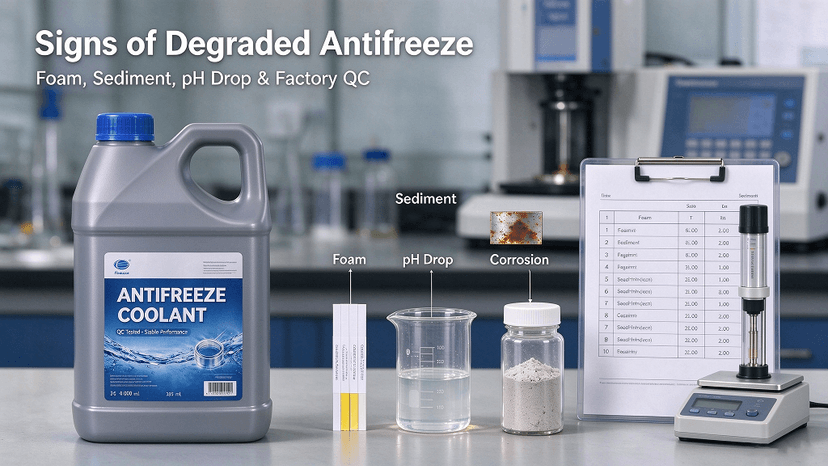
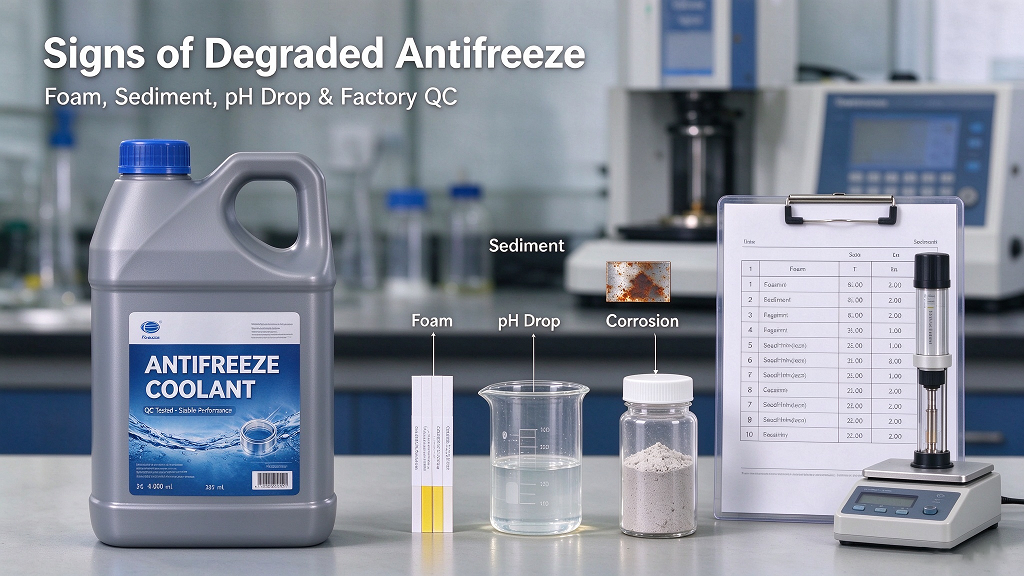
Visible warning signs of degraded antifreeze include persistent foam, cloudiness, solid sediment and unexpected abnormal color shift. Foam is a common warning signal. Qualified stable coolant will not leave lasting foam after shaking. Persistent foam means surfactant breakdown or fluid contamination. Sediment forms from inhibitor precipitation, rust particles or chemical reactions between incompatible coolant types. Cloudiness and abnormal color change also signal contamination or additive breakdown.
Core laboratory QC parameters include pH value, reserve alkalinity and metal corrosion weight loss testing. pH value tells whether the fluid turns acidic, which accelerates metal corrosion. Reserve alkalinity reflects the remaining buffer capacity of inhibitors, namely the remaining service life. Corrosion weight loss tests soak standard metal coupons in hot coolant for fixed hours, then measure metal weight loss to judge anti-corrosion performance. These three tests form the core of professional coolant quality inspection.
Our factory uses accelerated thermal cycling stability tests to simulate long-term service and verify batch quality before release. Instead of waiting for years of real vehicle road tests, GAFLE factory uses thermal cycling chambers. Coolant samples cycle repeatedly between high temperature and low temperature. After the test, technicians check pH variation, sediment formation and corrosion performance. If the sample fails stability testing, the whole batch will not be approved for export.
Improper storage, mixing incompatible coolant and dilution with hard water will greatly speed up antifreeze degradation. Storing coolant in hot warehouses or direct sunlight accelerates chemical aging. Mixing different coolant technologies triggers inhibitor reactions and sediment. Hard tap water brings mineral ions that form scale and deplete additives. These three factors are the top sources of customer complaints for overseas coolant suppliers.
Choose a trusted antifreeze manufacturer that provides batch COA and full QC reports for every shipment. Every batch from our factory comes with a COA recording pH, reserve alkalinity, freeze point and corrosion test results. We can supply stability test reports for buyers requiring third-party verification. As your supplier, we also share simple field test guidance for distributors to inspect goods after arrival.
FAQ
Q1: Is clear antifreeze always good antifreeze?
A1: No. Coolant can look clean while inhibitors are depleted. Lab testing is required to confirm corrosion protection performance.
Q2: What does persistent foam in antifreeze indicate?
A2: Persistent foam usually means contamination, additive breakdown or mixing incompatible coolant. Short-lived foam after shaking is normal.
Q3: What is reserve alkalinity in coolant testing?
A3: It measures the remaining buffer capacity of inhibitors, showing how much corrosion protection life is left.
Q4: Will high-temperature storage damage antifreeze?
A4: Yes. Long exposure to high heat speeds up inhibitor degradation and shortens service life.
Q5: Can filtered sedimentary antifreeze be reused?
A5: Not recommended. Sediment means the inhibitor system has reacted, and corrosion protection cannot be restored by simple filtration.
Q6: Does this factory provide COA for every antifreeze batch?
A6: Yes. Each shipment has batch-specific COA with complete QC test data.
Welcome to contact GAFLE for more information & cooperation!
peter
ZHEJIANG GAFLE AUTO CHEMICL CO.,LTD
Tel:86-579-8222 1665
Fax:86-579-8246 4690
Cel/Wechart:86-13335993986
E-mail:peter@gafle.net
Web:www.gafle.net