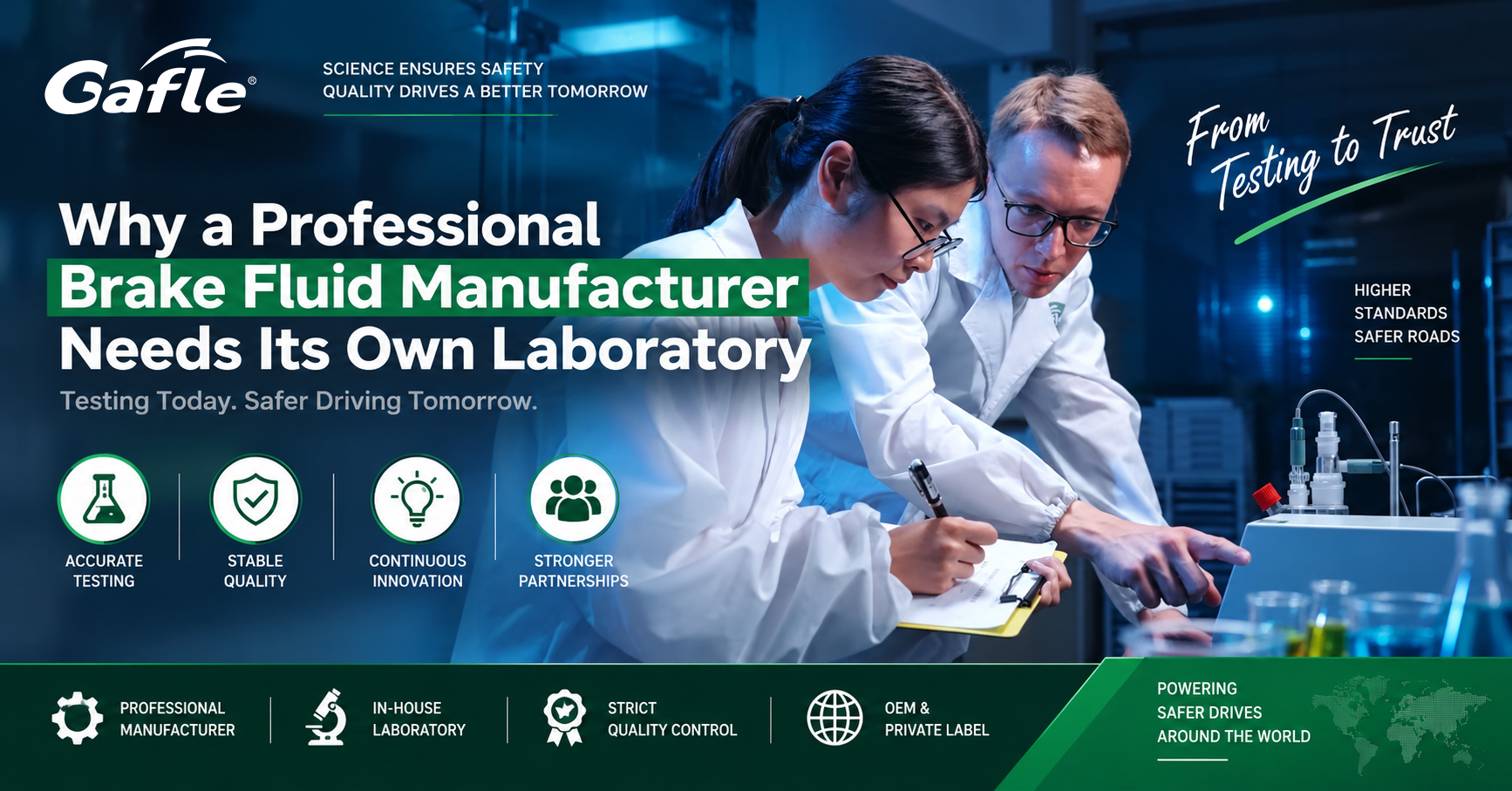
 Why a Professional Brake Fluid Manufacturer Needs Its Own Laboratory
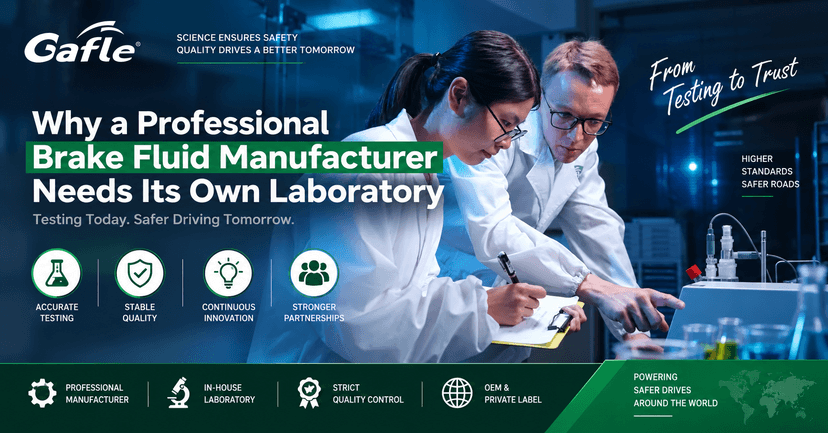
In the automotive industry, quality is built on science, precision, and continuous verification. While advanced production equipment is essential, a professional in-house laboratory is what truly ensures that every bottle of brake fluid meets strict performance and safety requirements.
For distributors, OEM customers, and automotive brands, choosing a manufacturer with its own laboratory means greater confidence in product consistency, technical support, and long-term reliability.
As a professional Brake Fluid Manufacturer, Gafle has more than 20 years of dedicated manufacturing experience. Our in-house laboratory plays a vital role in product development, quality control, and continuous innovation, helping us deliver premium brake fluid solutions to customers around the world.
Why an In-House Laboratory Matters
Brake fluid is a safety-critical product. It must perform reliably under extreme temperatures, hydraulic pressure, and long-term operation.
Without an in-house laboratory, manufacturers often have limited ability to verify product performance quickly or improve formulations efficiently.
A professional Brake Fluid Laboratory helps manufacturers:
- Verify product performance
- Maintain consistent quality
- Support product development
- Improve manufacturing efficiency
- Reduce quality risks
- Meet customer specifications
For OEM customers, this means greater confidence that every production batch meets the same high standards.
Key Brake Fluid Tests Every Professional Laboratory Performs
Comprehensive Brake Fluid Testing is one of the most important responsibilities of an in-house laboratory.
At Gafle, every production batch undergoes multiple laboratory evaluations before shipment.
Dry Boiling Point Testing
This test measures the boiling point of fresh brake fluid.
A high dry boiling point helps maintain braking performance during demanding driving conditions.
Wet Boiling Point Testing
Because brake fluid naturally absorbs moisture during use, wet boiling point testing evaluates product performance after controlled moisture absorption.
This provides a more realistic assessment of long-term braking performance.
Low-Temperature Viscosity Testing
Brake fluid must flow efficiently even in cold weather.
Viscosity testing verifies stable hydraulic response under low-temperature conditions.
Corrosion Resistance Testing
Brake fluid should help protect master cylinders, brake lines, calipers, and other internal components from corrosion.
Laboratory testing verifies this protective capability.
Material Compatibility Testing
Brake fluid must remain compatible with rubber seals, hoses, and metal components throughout its service life.
Compatibility testing helps ensure long-term braking system reliability.
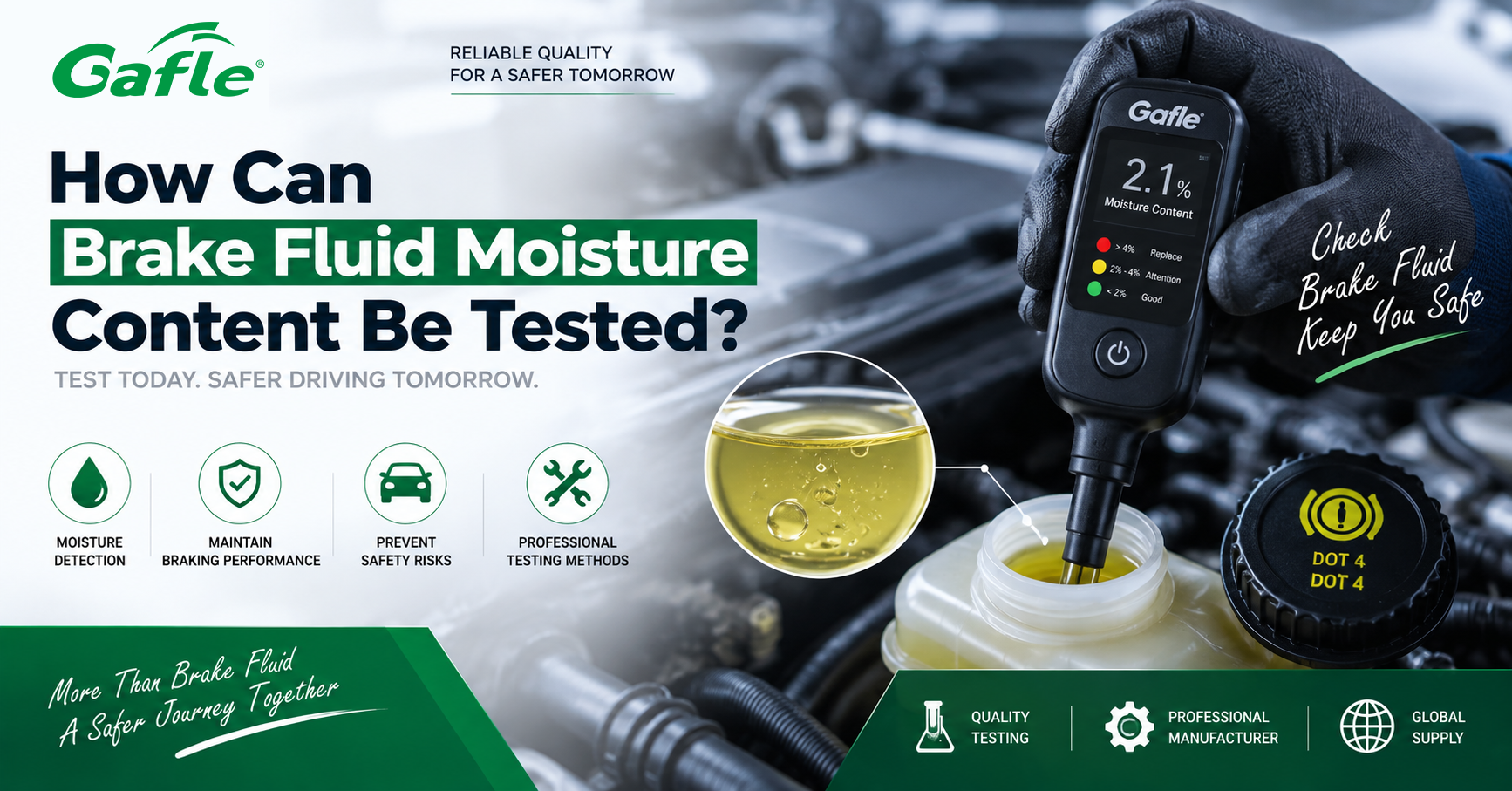
Moisture Content Analysis
Because brake fluid is hygroscopic, monitoring moisture levels is essential for evaluating product quality and service performance.
How an In-House Laboratory Improves Brake Fluid Quality Control
An in-house laboratory supports Brake Fluid Quality Control throughout the entire manufacturing process—not just during final inspection.
Raw Material Verification
Every incoming raw material is inspected before entering production.
This helps ensure consistent product quality from the very beginning.
Production Monitoring
Laboratory technicians regularly monitor production samples to verify that manufacturing remains within established quality parameters.
Finished Product Inspection
Before shipment, every production batch undergoes comprehensive laboratory testing to verify performance, appearance, and compliance with customer specifications.
Batch Traceability
Testing data is linked to production batches, making it possible to review manufacturing records whenever needed and supporting continuous process improvement.
Supporting Brake Fluid Research and Development
A professional laboratory is not only responsible for quality inspection—it also drives Brake Fluid Research and Development.
At Gafle, our laboratory supports continuous innovation by focusing on:
- Higher boiling point formulations
- Improved oxidation resistance
- Enhanced corrosion protection
- Better low-temperature performance
- Longer service life
- Compatibility with modern braking systems
Continuous research allows us to improve product performance while responding to changing customer needs and vehicle technologies.
Why an In-House Laboratory Benefits OEM Customers
OEM customers require more than stable production—they need technical support throughout the product development process.
An experienced OEM Brake Fluid Manufacturer with its own laboratory can provide:
Product Validation
Laboratory testing verifies that products meet customer requirements before production begins.
Formula Optimization
Technical teams can refine formulations to support different market requirements and vehicle applications.
Faster Technical Support
Because testing is conducted internally, product evaluation and problem-solving can often be completed more efficiently.
Consistent Product Performance
Routine laboratory verification helps maintain stable quality across every production batch, supporting stronger customer confidence and brand reputation.
How to Choose the Best Brake Fluid Manufacturer in China
Many international buyers searching for the Best Brake Fluid Manufacturer in China understand that production equipment alone is not enough.
A reliable manufacturer should also offer:
- Professional Brake Fluid Laboratory
- Comprehensive Brake Fluid Testing
- Strict Brake Fluid Quality Control
- Experienced research and development team
- Modern manufacturing facilities
- IATF 16949 quality management
- OEM and private label capabilities
- Stable production capacity
- Global export experience
- Long-term technical support
These capabilities help ensure consistent product quality and reduce sourcing risks for distributors and automotive brands.
Why Global Customers Choose Gafle
At Gafle, our laboratory is one of the core foundations of our manufacturing system.
Our strengths include:
- 20+ Years of Dedicated Brake Fluid Manufacturing Experience
- Professional Brake Fluid Laboratory
- Advanced Brake Fluid Testing Equipment
- Comprehensive Brake Fluid Quality Control
- Continuous Brake Fluid Research and Development
- Modern Manufacturing Facilities
- IATF 16949 Quality Management System
- OEM & Private Label Manufacturing
- Stable Large-Scale Production
- Global Export Experience
- Participant in Drafting China's National Brake Fluid Standards
These advantages allow us to provide reliable brake fluid products and long-term manufacturing partnerships for customers around the world.
Frequently Asked Questions
Why does a brake fluid manufacturer need its own laboratory?
An in-house laboratory enables manufacturers to verify product performance, maintain consistent quality, improve formulations, support OEM projects, and respond quickly to technical requirements.
What tests are performed in a brake fluid laboratory?
Typical tests include dry boiling point, wet boiling point, low-temperature viscosity, corrosion resistance, material compatibility, moisture content analysis, and product stability verification.
How does laboratory testing improve brake fluid quality?
Laboratory testing verifies that every production batch meets technical specifications before shipment, helping maintain consistent performance and reliability.
Why is an in-house laboratory important for OEM customers?
It supports product validation, customized formulation development, performance verification, and continuous quality monitoring, giving OEM customers greater confidence in product consistency.
How should buyers choose the Best Brake Fluid Manufacturer in China?
Buyers should evaluate manufacturing experience, laboratory capability, testing equipment, quality management systems, OEM expertise, production consistency, and technical support—not simply compare prices.
Conclusion
A professional laboratory is much more than a testing facility—it is the center of quality assurance, product development, and continuous improvement. From raw material inspection and production monitoring to finished product verification and research, every stage contributes to delivering brake fluid that performs consistently under demanding conditions.
For distributors, importers, and automotive brands searching for the Best Brake Fluid Manufacturer in China, partnering with a manufacturer that operates its own advanced laboratory provides greater confidence in product quality, technical expertise, and long-term cooperation.
With more than 20 years of dedicated manufacturing experience, Gafle continues to invest in professional laboratory facilities, advanced testing equipment, and rigorous quality management to deliver premium brake fluid products to customers worldwide.
At Gafle, every bottle is backed by science, every batch is verified through rigorous testing, and every innovation begins in our laboratory—because reliable braking starts with reliable