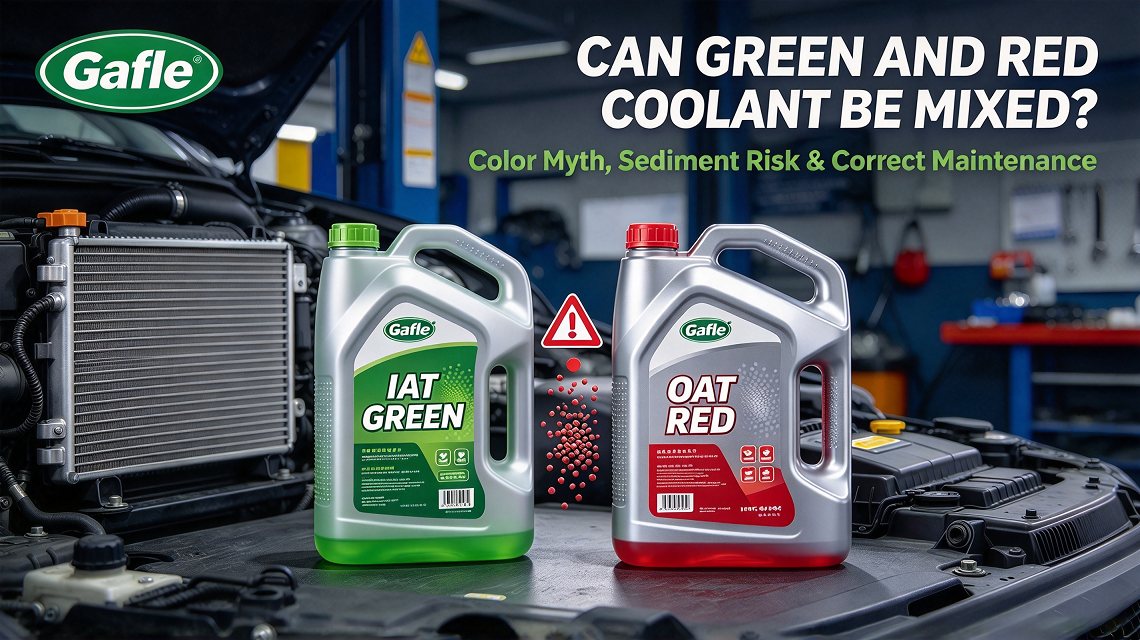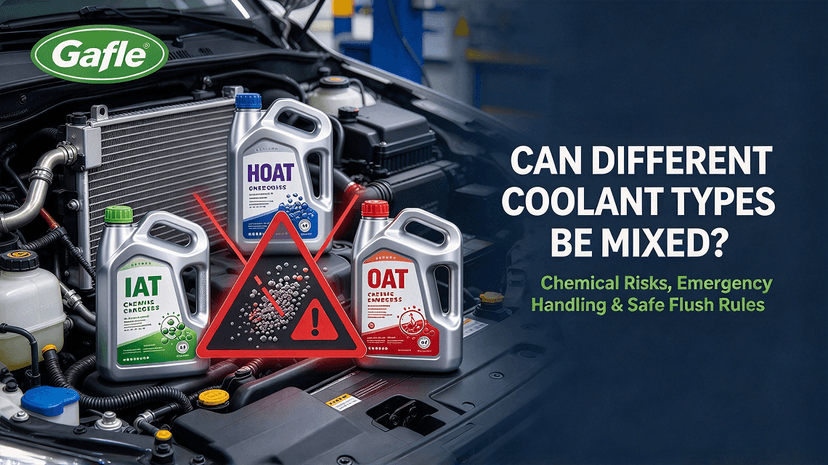
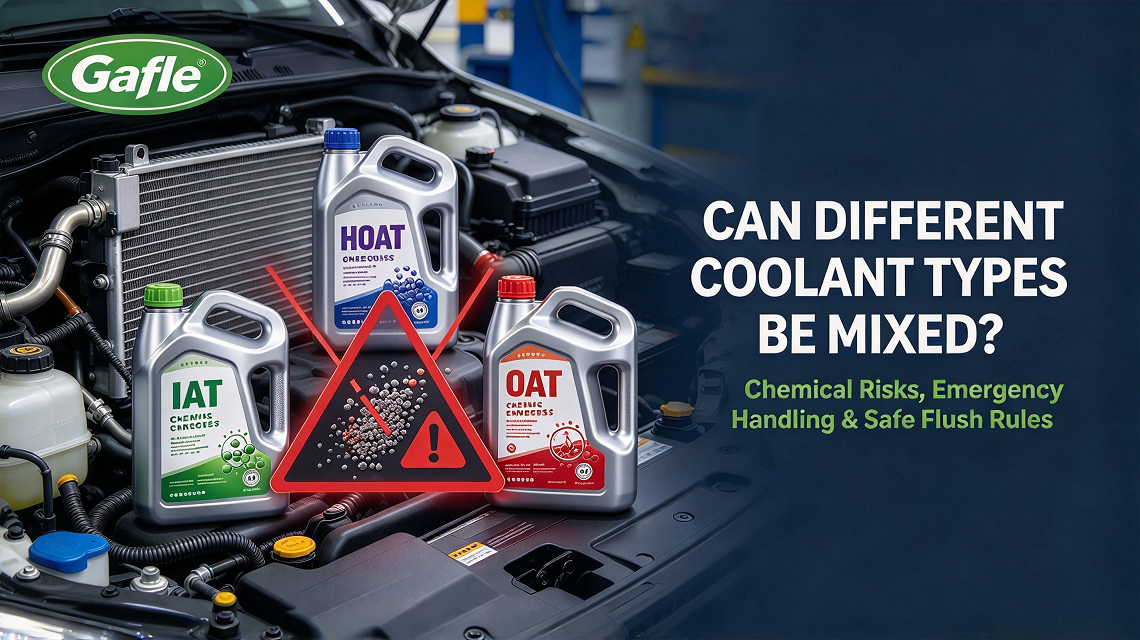
When a low-level warning trips on a heavy-duty engine or an industrial heat loop, maintenance operators face an immediate temptation: grab whatever drum or jug is sitting on the shop floor. In that moment, the central question is whether can different types of coolant be mixed without causing permanent damage. The short answer from any tribologist or fluid chemist is simple: do not do it. While base fluids like ethylene glycol or propylene glycol will blend without separating, the proprietary additive packages suspended in them will frequently react, neutralize each other, and destroy your equipment from the inside out.
The Color Fallacy on the Shop Floor
One of the most persistent myths in preventative maintenance is that coolant color designates chemistry. It does not. Dye is added purely for visual identification and leak tracking, and there is no universal regulatory standard binding green to conventional silicates, orange to organic acids, or yellow to hybrid chemistries.
Two coolants of identical translucent orange can rely on completely incompatible chemical platforms. One might be an extended-life Organic Acid Technology (OAT) formulated for heavy diesel wet-sleeve liners, while another is a light-duty carboxylate mix that lacks the nitrite protection required to stop cavitation erosion. If you mix different coolant types based strictly on visual cues, you are gambling with expensive heat exchangers.
Chemical Families: Why Additive Packages Clash
Coolant is essentially water, glycol, and an inhibitor package. It is the inhibitor package—roughly 3% to 5% of the formulation—that protects cast iron, aluminum, brass, and solder joints. Coolants fall broadly into three distinct chemistries:
- Inorganic Additive Technology (IAT): Relies on fast-acting mineral salts like silicates and phosphates. They form a thick, protective barrier over metal surfaces quickly, but they deplete rapidly (typically within two years) and are sensitive to chemical shock.
- Organic Acid Technology (OAT): Employs carboxylates (such as sebacate and 2-ethylhexanoic acid) that form a chemical bond only at microscopic corrosion sites. They last significantly longer but take hours of operating temperature to form a passivation layer.
- Hybrid OAT (HOAT / Si-OAT / P-OAT): Blends organic acids with small doses of silicates or phosphates to give both immediate coverage and extended lifespan.
When coolant mixing occurs across these boundaries, the chemical balance collapses. Inorganic silicates can strip the protective organic films off internal surfaces, or the presence of organic acids can destabilize mineral salts held in suspension.
What Happens If Incompatible Coolants Are Mixed?
Understanding what happens if mixed helps clarify why fluid engineers treat cross-contamination as a critical maintenance failure. The consequences generally unfold in three stages:
1. Silicate Dropout and Gelation
When an incompatible coolant introduces foreign salts or drops the fluid’s pH below its stability window, dissolved silicates fall out of solution. This process, often called "silicate dropout," creates a viscous green or brown sludge. This gel coats heat exchanger channels, blinds radiator cores, and clogs cabin heating units. Flow drops, localized hot spots develop, and cylinder heads risk thermal warping.
2. Cavitation and Liner Pitting
In diesel equipment, cylinder liners oscillate violently during combustion. Nitrites and molybdates in heavy-duty formulations create a sacrificial microscopic barrier against cavitation bubbles. If an operator dilutes a heavy-duty fluid with a standard automotive OAT, that protective film fails. Micro-implosions pit through cast iron liners, eventually allowing coolant to migrate into the crankcase.
3. Water Pump Seal Destruction
Precipitated solids do not simply disappear; they turn into an abrasive slurry circulating at high velocity. Mechanical water pump seals—typically silicon carbide or carbon-ceramic—wear out quickly under abrasive particulate load. A leaking water pump weep hole is frequently the first visible symptom of an unintended chemical clash.
Quick Compatibility Reference
As a baseline rule for maintenance planning:
- IAT + OAT: Severely Incompatible. Results in rapid additive precipitation and loss of corrosion inhibitors.
- OAT + HOAT: Incompatible. May compromise passivation layers and cut service intervals by more than half.
- Ethylene Glycol + Propylene Glycol: Mechanically miscible, but skews freeze point refractometer readings, rendering standard optical testing inaccurate.
How to Safely Switch Coolant Type
Upgrading a plant's chiller system or standardizing a mixed fleet onto a modern Si-OAT formulation makes economic sense, but the changeover must be deliberate. If you need to know how to safely switch coolant type, follow this sequential procedure rather than a basic drain-and-fill:
- Hot Drain: Run the equipment to operating temperature to suspend existing debris, then drain the cooling system fully. Be sure to open block petcocks, lower radiator hoses, and auxiliary heat loops to clear uncirculated fluid pockets.
- Chemical Flush (if contaminated): If the system displays scale, oil contamination, or prior sludge, circulate an approved neutral pH chemical cleaner with demineralized water for the manufacturer-recommended duration, then drain.
- Cascade Rinse: Fill the system with distilled or reverse-osmosis (RO) water. Tap water introduces chlorides and calcium that permanently degrade new fluid packages. Run the engine until the thermostat opens, circulate for 15 minutes, and drain. Repeat this process until the effluent drains clear and shows a neutral pH.
- Refill and Purge: Refill using a 50/50 premix of your target coolant. Premixed fluids eliminate dilution errors caused by hard plant water. Bleed the air thoroughly to avoid localized steam pockets, which can chemically bake new organic acids during initial startup.
Practical Advice for Fleet and Maintenance Sourcing
If an operator finds themselves in a remote location facing a critically low reservoir and no matched chemistry available, what should they do? Use pure distilled water. Diluting an existing package with water lowers your freeze protection and boil-over threshold, but it will not destabilize the chemical package into an abrasive gel. The operator can top off with matched concentrate later or perform a controlled drain when the equipment returns to the bay.
From a procurement perspective, the easiest way to prevent maintenance errors is SKU consolidation. Standardize operations around a single, robust hybrid or organic acid formulation that satisfies the strictest OEM specs in your equipment profile. Lock the coolant cabinet, label equipment fill necks clearly with the exact chemistry required, and discard leftover mystery jugs that accumulate behind the maintenance benches.
Frequently Asked Questions
Can I top off a low system with universal coolant?
Proceed with caution. While universal coolants claim compatibility across all platforms, they are typically dilute OAT chemistries. Adding them to an older IAT system cuts inhibitor protection roughly in half and can trigger slow drop-out over hundreds of operating hours. Use them only for genuine emergencies.
Can different brands of the same coolant type be mixed?
If both fluids meet the exact same manufacturer specification (e.g., two distinct brands meeting Cummins CES 14603 or CAT EC-1), they are chemically compatible. However, minor variations in proprietary stabilization buffers can slightly reduce overall service lifespan.
How do I verify what coolant is currently in my equipment?
Do not trust the color alone. Use test strips tailored to nitrite, molybdate, and pH levels, or draw a 4-ounce fluid sample and send it to an authorized fluids lab for an elemental ICP (Inductively Coupled Plasma) spectroscopy scan before adding new chemicals.
Welcome to contact GAFLE for more information & cooperation!
peter
ZHEJIANG GAFLE AUTO CHEMICL CO.,LTD
Tel:86-579-8222 1665
Fax:86-579-8246 4690
Cel/Wechart:86-13335993986
E-mail:peter@gafle.net
Web:www.gafle.net