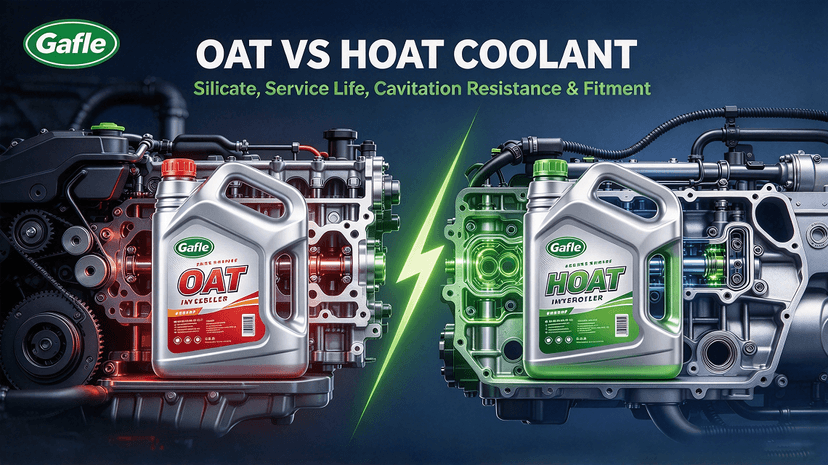
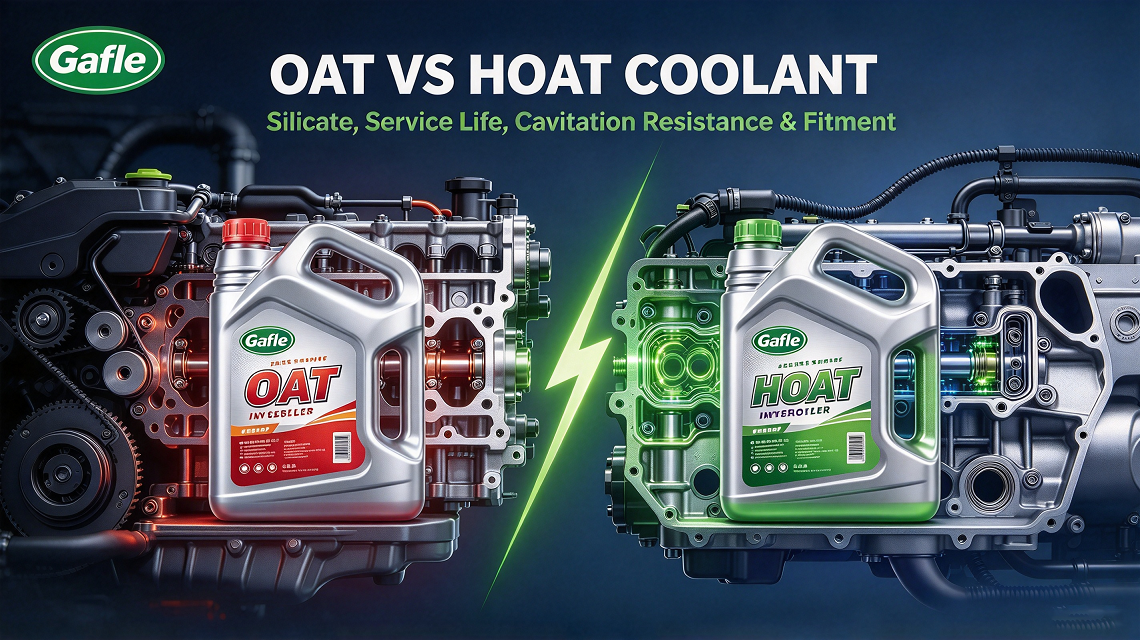
Engine cooling systems have evolved far beyond the era of pouring generic green fluid into a brass radiator and calling it a day. With modern aluminum engine blocks, tighter cooling jackets, composite water pump impellers, and elevated operating temperatures, selecting the wrong chemical package can chew through gaskets and pit cylinder liners within months. For fleet managers, mechanical engineers, and maintenance directors, understanding the actual difference between OAT and HOAT coolant is not an academic exercise—it is essential preventative maintenance against catastrophic thermal failure.
While both chemistries fall under the extended-life umbrella, their additive packages use distinct mechanisms to passivate metal surfaces and fight cavitation. Color was once a reliable shorthand, but today dye is arbitrary; fluid chemistry is what dictates whether your heat exchanger survives its design cycle.
The Underlying Chemistry: Organic Acid vs. Hybrid Formulations
Traditional coolants (Inorganic Additive Technology, or IAT) protected cooling circuits by laying down a thick, protective inorganic layer across all surfaces via silicates or phosphates. This layer wore off quickly, necessitating frequent flushes every two years or 30,000 miles.
Organic Acid Technology (OAT) replaced inorganic salts entirely with carboxylates (such as sebacic acid, adipic acid, and 2-ethylhexanoic acid, or 2-EHA). These organic acids do not plate out indiscriminately. Instead, they react chemically only at active corrosion sites on metal surfaces. Because the additives are consumed only where oxidation starts, OAT coolants achieve an extended service life—often 5 years or 150,000 miles in passenger vehicles, and significantly longer in stationary industrial engines.
Hybrid Organic Acid Technology (HOAT) is precisely what its name implies: a hybrid coolant. Formulators take an organic acid backbone and spike it with a controlled dose of an inorganic inhibitor—typically low-dose silicates (common in European formulations) or phosphates (common in Asian automotive specs). The inorganic component provides rapid surface passivation for vulnerable aluminum cylinder heads and heater cores, while the organic carboxylates sustain long-term corrosion resistance.
Direct Comparison: OAT vs HOAT Coolant
Evaluating OAT vs HOAT coolant comes down to heat transfer efficiency, elastomer interactions, and sacrificial replenishment rates.
Pure OAT solutions offer exceptional longevity and maintain high thermal conductivity because they form microscopic monolayers rather than thick deposits. However, OAT has distinct vulnerabilities. Certain organic acids, notably 2-EHA, are plasticizers that can soften and degrade specific silicone seal materials, nylon radiator end tanks, and older neoprene gaskets over prolonged exposure. Furthermore, pure OAT is relatively slow to passivate fresh metal surfaces compared to inorganic chemistries.
HOAT formulations address that lag time. By introducing a modest amount of inorganic silicates or phosphates, a hybrid coolant provides instantaneous, robust protection to aluminum water pump housings and prevents cavitation erosion around wet cylinder liners. The trade-off is life expectancy: the inorganic portion depletes faster than the organic base, typically giving HOAT an operational lifespan around 5 years or 100,000 to 150,000 miles. Silicate-based HOAT coolants also require careful pH management; if the fluid becomes overly alkaline or acidic, dissolved silicates can drop out of suspension, forming an abrasive gel that clogs narrow radiator passages and abrades dynamic pump seals.
Can You Mix Them? The Reality of Coolant Compatibility
In field operations, maintenance techs frequently ask about coolant compatibility when topping off reservoirs. The short answer: do not mix them.
Mixing an OAT with a HOAT might not cause instant engine seizure, but it drastically destabilizes the corrosion inhibitor matrix. When foreign organic acids interact with the silicates or phosphates in a hybrid coolant, the pH equilibrium often shifts. This chemical destabilization causes silicates to precipitate into abrasive silica grit or a gelatinous sludge, particularly in low-flow pockets like heater cores and oil coolers.
Furthermore, cross-contamination dilutes the carboxylate concentration below the critical threshold required to protect cast iron and aluminum. The resulting mixture no longer protects against wet-sleeve liner cavitation and drops the overall protection timeline down to that of an uninhibited base fluid. If a system containing OAT is accidentally topped off with HOAT, plan for a thorough chemical flush and system refill rather than waiting for scheduled maintenance.
Decision Matrix: Should I Use OAT or HOAT Coolant?
When specifying fluids for a fleet or an industrial power unit, the question of "should I use OAT or HOAT coolant" comes down to three operational variables:
1. OEM Metallurgy and Seal Specs: If the engine relies on silicone-based gaskets or contains older brass/copper solder, avoid 2-EHA-heavy OAT fluids. European OEMs (such as BMW, Mercedes-Benz, and Volkswagen) historically favor silicate-based HOAT because the silicates immediately coat aluminum under high-stress Autobahn conditions. Asian OEMs (Toyota, Honda, Hyundai) strictly prohibit silicates due to concerns about water pump seal wear, preferring Phosphate-HOAT (P-HOAT) or dedicated non-2-EHA OAT coolants.
2. Liner Cavitation Risk: Heavy-duty diesel engines with wet cylinder liners produce intense micro-vibrations that cause vapor bubbles to collapse against the cylinder wall. If you run commercial diesel powerplants without supplemental coolant additives (SCAs), a heavy-duty HOAT or a nitrite-bearing OAT (NOAT) is mandatory to prevent pitting through the liner wall.
3. Maintenance Intervals: For remote stationary generators or utility fleets where downtime must be kept to an absolute minimum, an OAT fluid provides the longest run time between drains, provided the entire cooling circuit is verified compatible with carboxylate chemistry.
Common Pitfalls in Fluid Procurement
The most pervasive error in procurement is purchasing by color. A decade ago, OAT was almost exclusively orange and HOAT was gold or yellow. Today, fluid blenders dye coolants blue, purple, magenta, green, or yellow to satisfy specific contract requests. Relying on color rather than the underlying chemical standard (such as ASTM D3306 for light-duty or ASTM D6210 for heavy-duty applications) guarantees cross-contamination over time.
Another frequent misstep is ignoring water quality during dilution. Even the best hybrid coolant will precipitate its silicate package if mixed with hard tap water rich in calcium and magnesium. Always source pre-diluted 50/50 mixtures or insist on deionized water for on-site blending.
Frequently Asked Questions
What is the most visible sign of an incompatible coolant mixture?
Cloudiness in the overflow reservoir, followed by a rusty or brown discoloration, is the most common early indicator. In advanced cases, you will find a thick, jelly-like residue coating the underside of the radiator cap or clogging the heater core return lines.
Is HOAT better than OAT for older engines?
Generally, yes. Older engines manufactured prior to the late 1990s often feature copper-brass radiators, lead solder, and silicone or cork gaskets that do not tolerate the organic acids (specifically 2-EHA) found in many pure OAT coolants. A silicate-based HOAT or a conventional IAT provides better immediate protection for these softer metals.
Does a hybrid coolant require Supplemental Coolant Additives (SCAs)?
Most modern heavy-duty HOAT formulations are fully formulated and do not require SCAs at initial fill. However, over extended service in high-load diesel engines, the inorganic silicate and nitrite levels should be monitored using test strips and replenished as directed by the manufacturer.
Auditing Your Fluid Strategy
Clarifying the coolant difference across your equipment inventory pays dividends in reduced downtime and fewer component replacements. If your maintenance shop currently stocks multiple unidentified coolant drums, conduct an audit of your equipment manufacturer manuals. Consolidate your inventory around certified OEM specifications, train technicians never to top off systems based on fluid color, and implement strict water-quality protocols for dilution.
Welcome to contact GAFLE for more information & cooperation!
peter
ZHEJIANG GAFLE AUTO CHEMICL CO.,LTD
Tel:86-579-8222 1665
Fax:86-579-8246 4690
Cel/Wechart:86-13335993986
E-mail:peter@gafle.net
Web:www.gafle.net