Why Coolant Chemistry Outweighs Color in Industrial and Fleet Cooling Systems
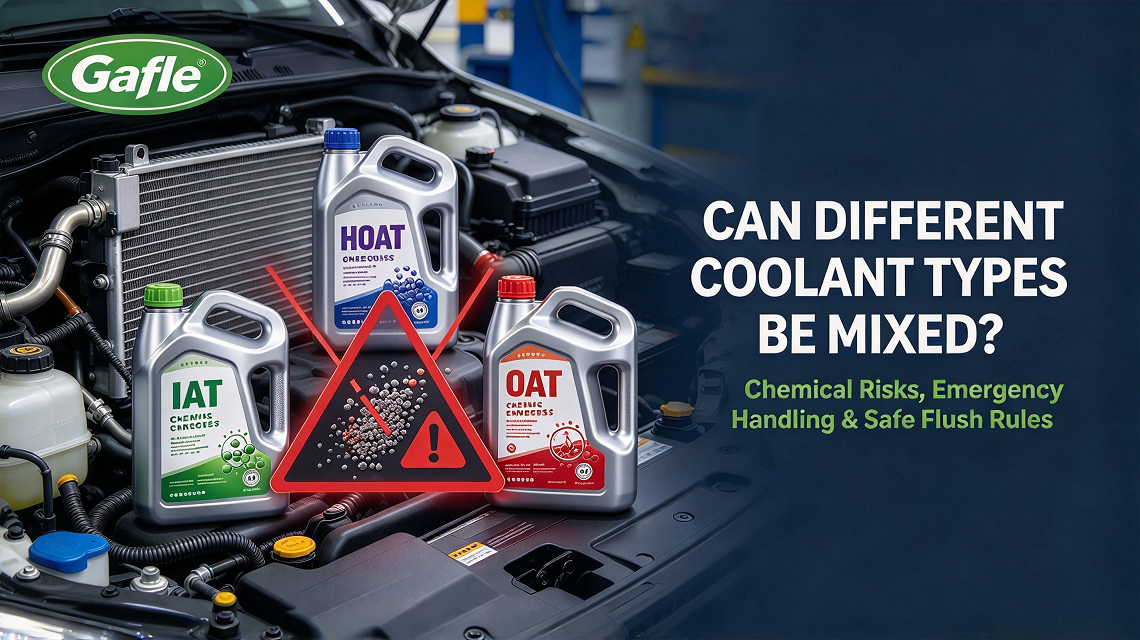
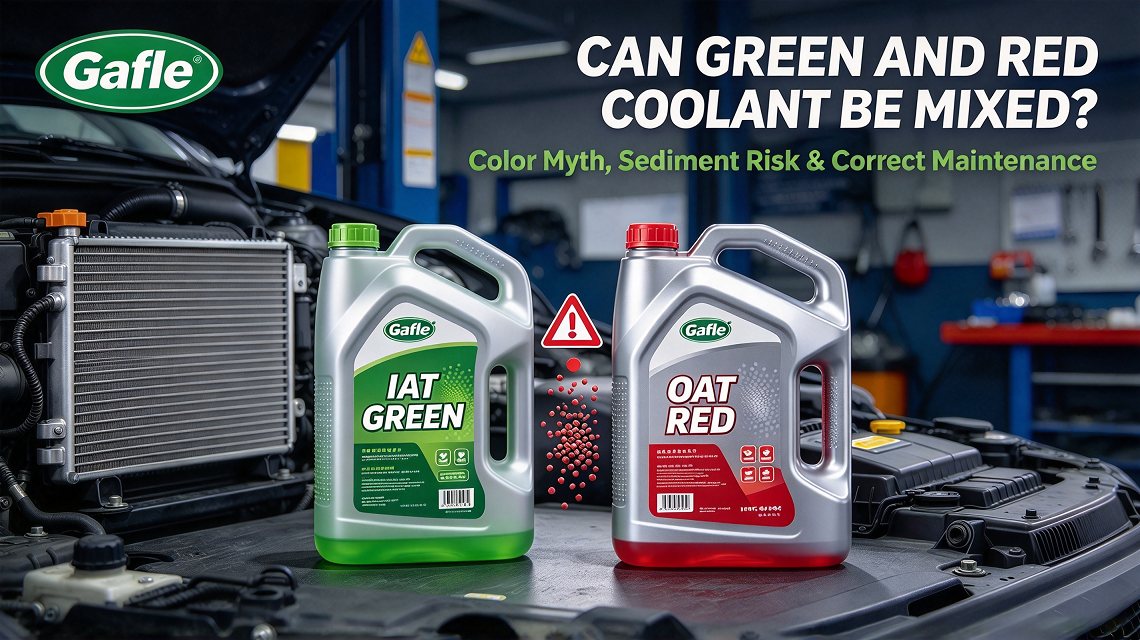
It remains one of the most common maintenance errors in shop environments and field equipment servicing: a technician grabs an unlabelled jug to top off an expansion tank and proceeds to mix green and red coolant without checking the chemical formulation. While the immediate result is an unsightly brown fluid, the operational consequences run far deeper than visual aesthetics. Coolant is not a simple dyed thermal conductor; it is a precisely engineered chemical package designed to prevent cavitation, eliminate galvanic corrosion, and maintain heat transfer efficiency across multi-metal assemblies.
For fleet managers, plant maintenance leads, and mechanical engineers, understanding what happens if green and red coolant mix is essential to avoiding premature water pump failures, clogged heater cores, and localized cylinder head overheating. The dye itself is chemically arbitrary, but the underlying additive packages are often fiercely antagonistic.
The Chemistry Beneath the Dye: IAT vs. OAT
To evaluate the coolant color mixing risk, technicians must look past the dye and examine the corrosion inhibitor chemistry. Historically, bright fluorescent green coolant indicated Inorganic Additive Technology (IAT). These formulations utilize fast-acting inorganic salts—predominantly silicates, phosphates, and borates—that rapidly form a thick protective barrier across cast iron, brass, and copper surfaces. However, silicates deplete relatively quickly, which is why legacy IAT fluids typically carried a service life of just two years or 30,000 to 50,000 miles.
Red, orange, and magenta fluids typically belong to the Organic Acid Technology (OAT) or Hybrid Organic Acid Technology (HOAT) families. Instead of building a sacrificial physical layer over all internal surfaces, OAT formulas use carboxylate salts (such as sebacate and 2-ethylhexanoic acid, or 2-EHA) that passivate metal surfaces at the microscopic level, reacting chemically only at active corrosion sites. When evaluating green coolant IAT red coolant OAT combinations, you are attempting to blend an inorganic salt-based system with an organic carboxylate system. They are neither chemically neutral toward each other nor universally miscible.
What Happens When Incompatible Chemistries Collide?
When personnel mix these conflicting packages, the reaction compromises the thermodynamic properties of the fluid and initiates mechanical problems across the entire cooling circuit:
- Silicate Dropout and Gelation: The introduction of organic carboxylates can destabilize dissolved silicates in the IAT base. The silicates precipitate out of solution, forming a thick, pasty silicate gel. This sludge settles in low-flow areas, most notably the bottom tank of the radiator, oil cooler bundles, and narrow heater core passages.
- Accelerated Corrosion and Cavitation: Mixing dilutes the active concentration of both additive systems below their effective threshold. The organic acids cannot effectively passivate metal already filmed with residual silicates, while the depleted silicates leave cylinder liners exposed. In heavy-duty diesel engines, this absence of sacrificial protection leads rapidly to cavitation pitting on wet sleeve cylinder liners.
- Mechanical Seal Abrasion: Water pump rotary shaft seals depend on clean fluid film lubrication. Precipitated silicates act as an abrasive lapping compound, cutting into the silicon carbide or carbon seal faces and causing rapid seal weeping or catastrophic shaft bearing failure.
The Fallacy of Color-Coding in Modern Maintenance
One major pitfall in modern facility maintenance is relying entirely on fluid hue. While green traditionally meant conventional IAT and red meant extended-life OAT, coolant manufacturers today use dyes largely at their own discretion. Japanese OEMs, for instance, have long utilized phosphate-enhanced hybrid OAT (P-HOAT) that can be tinted red, pink, or blue, while some universal extended-life coolants are dyed a pale yellow-green.
Assuming that two fluids are compatible simply because both appear red—or assuming all green fluids are obsolete IAT formulas—is a recipe for component degradation. Always reference the technical data sheet (TDS), looking specifically for ASTM standards such as ASTM D3306 for light-duty applications or ASTM D6210 for heavy-duty commercial applications where supplemental coolant additives (SCAs) and liner pitting protection are mandatory.
Remediation Protocols: What to Do After Accidental Cross-Mixing
If an operator realizes they have introduced an incompatible chemistry into a cooling loop, action must be taken before the engine runs through repeated thermal cycles. If the fluid was merely added to an unpressurized overflow bottle while the engine was cold and off, the contamination can often be isolated by siphoning and cleaning the reservoir before it is drawn into the primary radiator circuit.
If the engine has run and brought the fluid up to operating temperature, a standard drain-and-refill will not suffice. A significant volume of coolant remains trapped inside the engine block, heater matrix, and bypass plumbing. The system requires a thorough flush using demineralized or deionized water, often paired with a mild cooling system cleaner to break down early-stage silicate dropouts. Once the flush water runs completely clear and neutral on a pH test strip, the system should be recharged with the single OEM-specified coolant diluted to the proper glycol-to-water ratio.
Frequently Asked Questions
Can I top off an OAT system with green coolant in an emergency?
If you face a severe leak in the field and the alternative is catastrophic overheating, you can use whatever coolant or clean water is accessible to limp the machine back to a maintenance depot. However, this must be logged as a temporary measure. The cooling system must be drained, flushed, and recharged according to OEM specifications before the equipment returns to regular service.
How quickly does gelation occur after mixing?
It is rarely instantaneous at ambient temperature. Chemical dropouts typically accelerate once the engine reaches thermal equilibrium (around 85°C to 105°C), where heat and continuous shear stress speed up additive degradation. Noticeable sludge and tube restriction can manifest within a few hundred operating hours or several weeks of routine operation.
Will a standard refractometer indicate if coolants were mixed?
No. A refractometer measures the refractive index to determine freeze point based on the concentration of ethylene or propylene glycol. It does not measure the health, type, or degradation state of the corrosion inhibitor package. Evaluating chemical incompatibility requires pH testing, test strips for carboxylate/silicate content, or laboratory inductively coupled plasma (ICP) spectroscopy.
Welcome to contact GAFLE for more information & cooperation!
peter
ZHEJIANG GAFLE AUTO CHEMICL CO.,LTD
Tel:86-579-8222 1665
Fax:86-579-8246 4690
Cel/Wechart:86-13335993986
E-mail:peter@gafle.net
Web:www.gafle.net