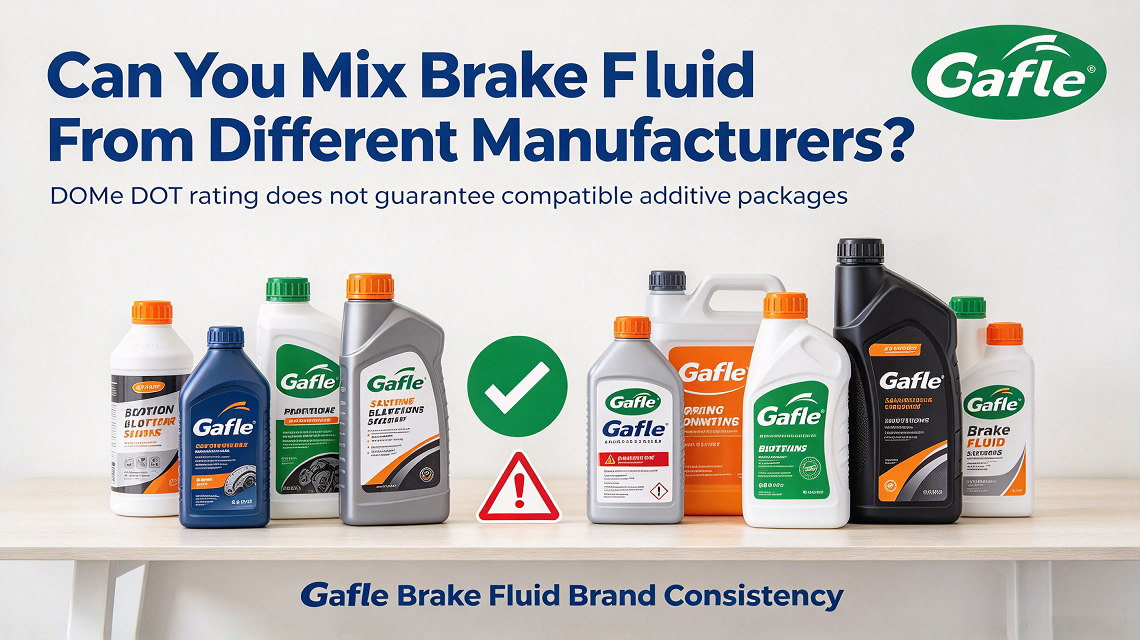
Even if two brake fluids carry the same DOT rating, mixing products from different manufacturers carries potential risks.
DOT standards set the minimum performance thresholds for boiling point, corrosion resistance and physical properties, but they do not control the proprietary additive packages each manufacturer uses. Brake fluid additives serve multiple critical functions: preventing metal corrosion, lubricating internal moving parts, resisting oxidation and stabilizing fluid viscosity under wide temperature ranges. Each brand develops unique additive formulas. When two different additive systems blend together, unwanted chemical reactions may take place inside the closed brake circuit.
Chemical incompatibility between additives may create sediment or sludge inside brake lines.
Fine solid sediments can accumulate in narrow brake passages, ABS valve modules and caliper ports. ABS units contain tiny solenoid valves; even small particles can block these channels. Once blocked, hydraulic pressure transfer will be disrupted, leading to uneven braking response, stuck brake pistons or failed anti-lock functions. This problem often does not appear immediately after mixing. Sediment builds up gradually over weeks or months of driving, making it hard for technicians to trace the fault back to mixed brake fluid brands.
Top automotive safety recommendations advise against mixing brake fluid brands.
If you only need to top up the brake reservoir for emergency use, always use the same brand and same DOT grade fluid already in the system. Emergency topping up should be followed by a full brake flush at the earliest opportunity. When performing routine brake maintenance, a complete brake fluid flush is the best practice. The technician must fully drain all old fluid from the master cylinder, brake lines and four calipers before refilling with Gafle brake fluid. Full flushing eliminates residual old fluid and avoids cross-contamination of different additive formulas.
For fleet operators and auto repair businesses, standardizing one brake fluid brand simplifies maintenance.
When your workshop or fleet uses Gafle brake fluid series, you benefit from consistent additive formulas across every production batch. Bulk purchasers can obtain stable product quality and unified technical support. Standardization also reduces inventory complexity, as you only need to stock a limited range of brake fluid grades. Avoid mixing brake fluid brands to reduce brake system maintenance cost, minimize unexpected breakdowns and cut the risk of safety accidents for your end customers.
Welcome to contact GAFLE for more information & cooperation!
peter
ZHEJIANG GAFLE AUTO CHEMICL CO.,LTD
Tel:86-579-8222 1665
Fax:86-579-8246 4690
Cel/Wechart:86-13335993986
E-mail:peter@gafle.net
Web:www.gafle.net
peter
ZHEJIANG GAFLE AUTO CHEMICL CO.,LTD
Tel:86-579-8222 1665
Fax:86-579-8246 4690
Cel/Wechart:86-13335993986
E-mail:peter@gafle.net
Web:www.gafle.net