Thermal management engineers routinely face a stubborn thermodynamic trade-off: liquid water carries heat better than nearly any accessible fluid, yet its phase limits are notoriously rigid. Understanding how coolant additives raise boiling point is critical when sizing radiators, specifying fleet operating parameters, or designing closed-loop thermal circuits that must withstand sustained thermal peaks without vapor pocketing.
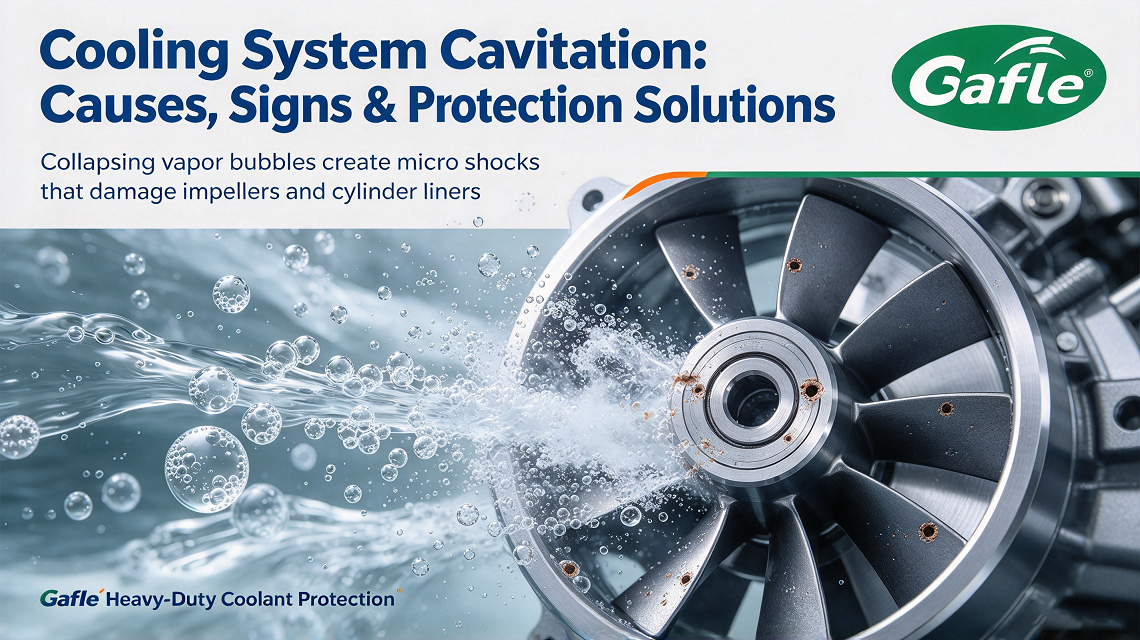
While technicians often think of an additive package strictly as protection against winter freezing, the high-temperature chemistry matters just as much. Liquid phase stability under thermal load prevents catastrophic cylinder head distortion, micro-boiling against exhaust port jackets, and cavitation erosion around water pump impellers.
The Thermodynamics: Colligative Properties and Vapor Pressure
At the molecular level, boiling occurs when the vapor pressure of a liquid equals the external atmospheric or system pressure. For liquid molecules to escape into the vapor phase, they require enough thermal energy to overcome intermolecular attractions and break free at the liquid-gas boundary.
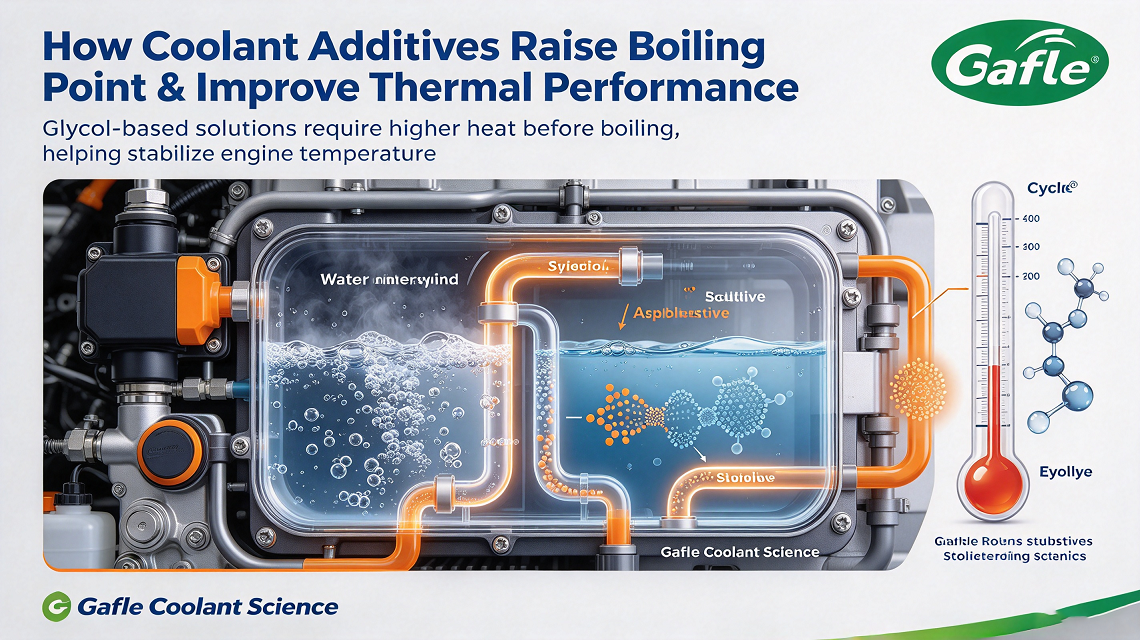
When a non-volatile solute—predominantly ethylene glycol or propylene glycol—is mixed into deionized water, it physically interrupts the hydrogen bonding network of the water molecules. According to Raoult's Law, the vapor pressure of a solvent drops in direct proportion to the mole fraction of the added solute.
Because the glycol molecules occupy surface area and exhibit strong dipole attractions to water, water molecules require significantly more thermal energy to achieve the vapor pressure necessary to boil. The resulting elevation in boiling point is a colligative property: it depends primarily on the concentration of solute particles in the solution rather than their specific reactive chemistry. A standard 50/50 mixture of water and ethylene glycol base fluid immediately shifts the atmospheric boiling point from 100°C (212°F) to roughly 106°C to 108°C (223°F to 226°F) before any mechanical pressurization is introduced.
Why Pure Water Cannot Be Engine Coolant
It is common to ask why pure water cannot be engine coolant if its specific heat capacity (approximately 4.18 J/g·°C) is roughly 15% higher than a glycol-water blend. On paper, pure water absorbs and carries more thermal energy per unit volume than any glycol solution.
In real operations, however, bulk temperature readings do not tell the whole story. Cylinder heads and turbocharger housings present localized hot spots where wall temperatures easily exceed 115°C under heavy torque loads. When pure water contacts these extreme surfaces, it initiates film boiling—a dangerous phenomenon where an insulating vapor blanket forms between the metal and the fluid. Vapor conducts heat poorly compared to liquid, causing instantaneous localized overheating, metal fatigue, and eventual head gasket failure.
Beyond phase stability, water lacks the boundary lubricants necessary for dynamic pump seals and provides no passivation against electrolytic corrosion. Without modern carboxylate or silicate additives, raw water rapidly attacks cast iron, aluminum alloys, and copper-brass brazing.
The Multiplier Effect: Chemical Elevation Meets Pressure Caps
Chemical boiling point elevation rarely acts in isolation. In automotive and industrial powertrains, chemical formulation works in tandem with a spring-loaded pressure cap.
Every pound per square inch (psi) of mechanical pressure exerted on the fluid raises the boiling threshold by roughly 1.5°C to 1.8°C (2.7°F to 3.2°F). When a modern 15 psi (1.03 bar) pressure cap is installed over a 50/50 ethylene glycol and water engine coolant, the combined threshold moves past 128°C (262°F).
This delta is not merely a safety buffer; it enables contemporary internal combustion engines to operate at higher bulk temperatures (often 95°C to 105°C), which significantly improves combustion efficiency, lowers oil viscosity losses, and allows smaller, lighter heat exchangers.
Formulation Balances and Field Realities
More is not always better when dosing glycol-based antifreeze into an industrial cooling circuit. There is an operational ceiling that maintenance supervisors sometimes overlook:
The 70/30 Upper Limit
While increasing glycol content up to about 68% continuously raises the boiling point and depresses the freeze point, concentrations above 70% degrade thermal performance rapidly. Glycol has lower thermal conductivity and higher kinematic viscosity than water. Pushing mixtures past 60% increases pump parasitic load, reduces laminar heat dissipation, and can ironically cause engine components to run hotter despite the higher boiling ceiling.
Corrosion Inhibitor Depletion
Boiling point elevation remains relatively constant over time because glycol molecules do not evaporate out of a sealed circuit. However, the organic acid technology (OAT) or hybrid organic acid (HOAT) corrosion inhibitors suspended within the fluid do deplete. As pH drifts acidic over thousands of operating hours, localized cavitation can initiate at lower temperatures than chemical charts predict, purely due to surface roughness changes inside coolant passages.
Frequently Asked Questions
Does propylene glycol raise the boiling threshold as effectively as ethylene glycol?
Propylene glycol elevates the boiling point to a similar extent—roughly 106°C at atmospheric pressure for a 50/50 mix. However, propylene glycol exhibits higher dynamic viscosity at sub-zero temperatures and transfers heat slightly less efficiently, meaning flow rates must sometimes be adjusted in industrial chillers.
Can I run pure water with a wetting agent instead of glycol to maximize heat transfer?
In controlled track racing environments where glycol is banned due to slip hazards, teams use deionized water alongside corrosion inhibitors and surfactant wetting agents. Surfactants reduce surface tension to minimize nucleate bubble formation, but they do not measurably raise the chemical boiling threshold. This approach requires tightly regulated operating pressures and continuous monitoring.
Specifying for Long-Term System Reliability
When calculating thermal headroom for stationary generators, marine propulsion, or heavy equipment fleets, do not rely on baseline water metrics. Evaluate your worst-case localized heat flux against the combined margin provided by additive concentration and cooling circuit pressurization. Regular refractometer testing remains the most reliable field method to verify that your fluid maintains the precise glycol-to-water ratio required to prevent localized phase change under load.