Can Brake Fluid Damage Car Paint? The Chemistry and Immediate Response
The short answer is unequivocal: yes, conventional brake fluid can cause severe paint damage in a matter of minutes. For anyone working in a service bay, fleet garage, or body shop, an accidental drip during a master cylinder bleed or hydraulic line service is an immediate emergency. Modern automotive finishes are durable against UV rays, acid rain, and road salt, but the polyglycol ether chemistry found in common hydraulic fluids behaves remarkably like an industrial solvent.
Understanding why this interaction happens—and recognizing that not all fluids share the exact same chemical formulation—determines whether an accident results in a quick rinse or an expensive trip to the spray booth.
The Chemistry Behind the Destruction: Glycol vs. Automotive Finishes
Most vehicles on the road rely on DOT 3, DOT 4, or DOT 5.1 hydraulic formulations. These are non-petroleum, glycol-ether-based liquids engineered to handle high operating temperatures and absorb ambient moisture over time. Unfortunately, the molecular structure of polyethylene glycol ethers closely mirrors the solvents historically formulated to strip commercial coatings.
When glycol-based fluid contacts an automotive finish—typically a cross-linked polyurethane clearcoat over a base color coat—it begins an aggressive solvent-extraction process:
- Penetration: The fluid permeates the microscopic pores of the clearcoat within 30 to 60 seconds.
- Softening and Swelling: The chemical breaks down cross-linked polymer bonds, causing the clear resin layer to swell, lose tensile strength, and soften into a rubbery gel.
- Delamination: If left unaddressed for longer than a few minutes, the fluid migrates downward through the basecoat, separating it from the electrocoat (e-coat) primer or bare sheet metal.
An important distinction must be made regarding DOT 5 fluid. Unlike glycol formulations, DOT 5 is silicone-based and hydrophobic. It will not strip automotive coatings, though it presents severe contamination risks if it ever migrates into a paint booth before refinishing.
How to Remove Brake Fluid Before Permanent Etching Occurs
When an accidental spill happens on a painted surface, your first instinct is often your worst enemy: grabbing a dry rag and wiping. Because the chemical immediately softens the top layer of resin, rubbing the affected area with dry cloth can sheer the softened clearcoat right off the substrate or embed abrasive grit into the melting finish.
Here is the standard protocol for how to remove brake fluid safely:
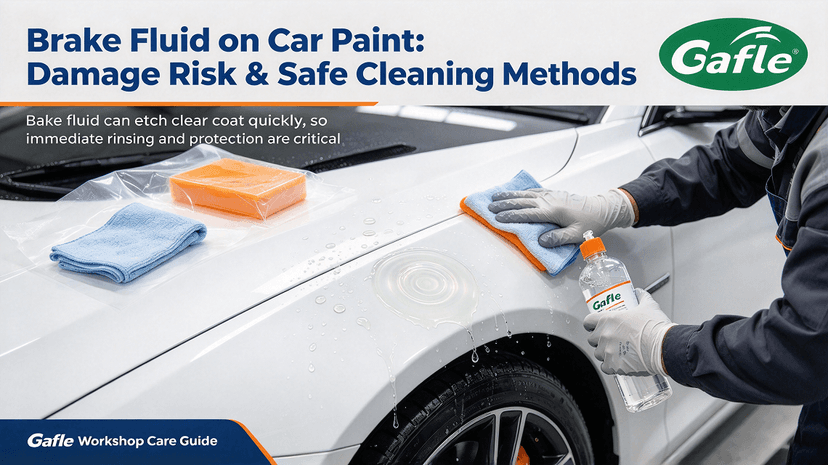
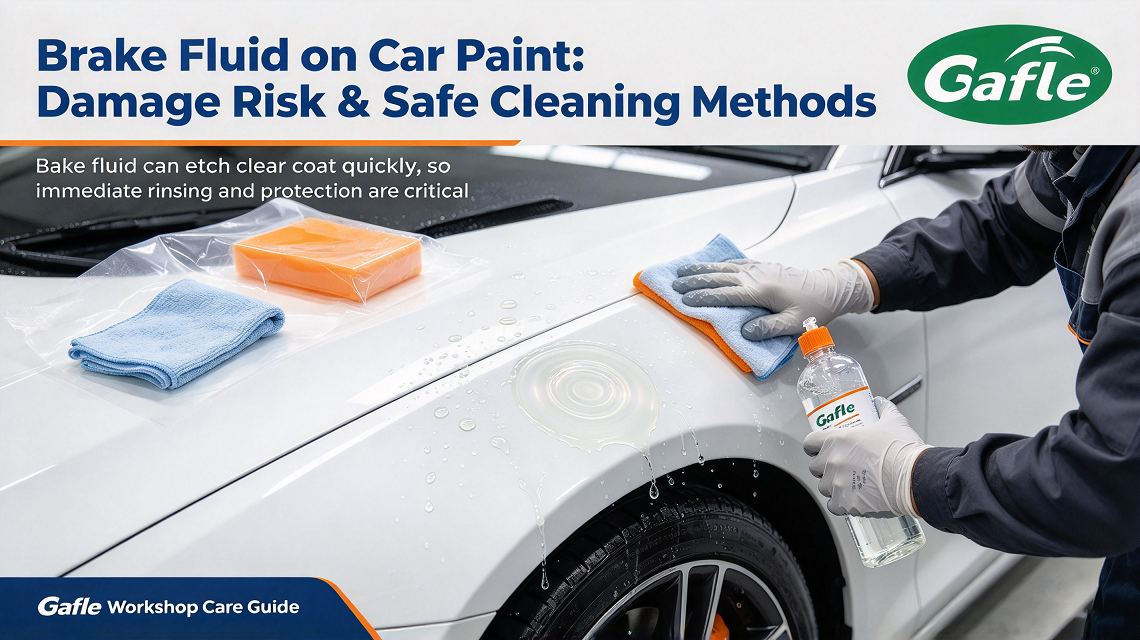
1. Flood with Water Immediately: Glycol ether is entirely water-soluble. Do not look for mineral spirits or degreasers; plain, ambient-temperature water is the fastest neutralizing agent. Pour copious amounts of water directly over the spill to dilute the concentration and wash the chemicals off the surface.
2. Apply a Neutral Detergent: Wash the area using standard automotive car wash soap and a clean, sopping-wet microfiber sponge. Lift the sponge away rather than scrubbing vigorously across the spill margin.
3. Flush Thoroughly: Rinse the entire section—including panel seams, cowl drains, and door jambs where liquid may have pooled out of plain sight.
4. Blot Dry and Inspect: Gently blot the area dry. If the exposure was under a couple of minutes, the clearcoat may remain structurally intact, although it might feel marginally tacky until residual moisture and solvents fully flash off.
Assessing Severity: When Is Repainting Required?
The extent of automotive paint damage depends almost entirely on dwell time and panel temperature. A warm engine bay panel or a car baked in midday sun will react exponentially faster than cold metal in an unheated bay.
Minor Hazing and Surface Softening
If neutralized within roughly two to three minutes, you may notice slight dulling or a hazy halo. In instances where the coat has not wrinkled or lifted, the recommended procedure is simply leaving the panel undisturbed for 24 to 48 hours. Modern two-component clearcoats can sometimes re-harden as volatile components dissipate. Once fully cured, light compounding and machine polishing may restore optical clarity.
Wrinkling, Blistering, and Complete Delamination
If fluid resides on the surface for ten minutes or longer, brake fluid spill on paint repair typically shifts from cosmetic correction to structural refinishing. Signs that the coating has failed completely include:
- Wrinkling or an orange-peel texture that pulls away with a fingernail.
- Discoloration that penetrates directly to the primer.
- Flaking clearcoat leaving dry base pigment exposed.
At this stage, compounding is useless. The compromised paint must be block-sanded down to a stable foundation—often bare metal or original substrate—feather-edged, re-primed, and resprayed to factory specifications.
Preventative Measures in Professional and Production Environments
Managing hydraulic fluids demands disciplined shop practices. Technicians should always drape critical painted edges with chemical-resistant fender covers rather than porous cotton shop towels, which merely wick fluid against the clearcoat. When pressure-bleeding systems, maintain dedicated catch bottles with tight-fitting bleeder hose nipples, and ensure a pressurized water spray bottle is on hand beside the lift before loosening any hydraulic fitting.
Frequently Asked Questions
Does ceramic coating protect against glycol-based fluids?
Ceramic coatings (silicon dioxide or silicon carbide) offer a marginal sacrificial barrier, buying maybe two to three extra minutes before the solvent compromises the underlying clearcoat. However, they are not completely impervious to aggressive glycol solvents and cannot prevent long-term etching.
Can rubbing alcohol clean up a hydraulic fluid spill?
Avoid it. Isopropyl alcohol can soften already-stressed clearcoats. Plain clean water remains the most effective and safest vehicle to dilute and flush away water-miscible glycol fluids.
Welcome to contact GAFLE for more information & cooperation!
peter
ZHEJIANG GAFLE AUTO CHEMICL CO.,LTD
Tel:86-579-8222 1665
Fax:86-579-8246 4690
Cel/Wechart:86-13335993986
E-mail:peter@gafle.net
Web:www.gafle.net