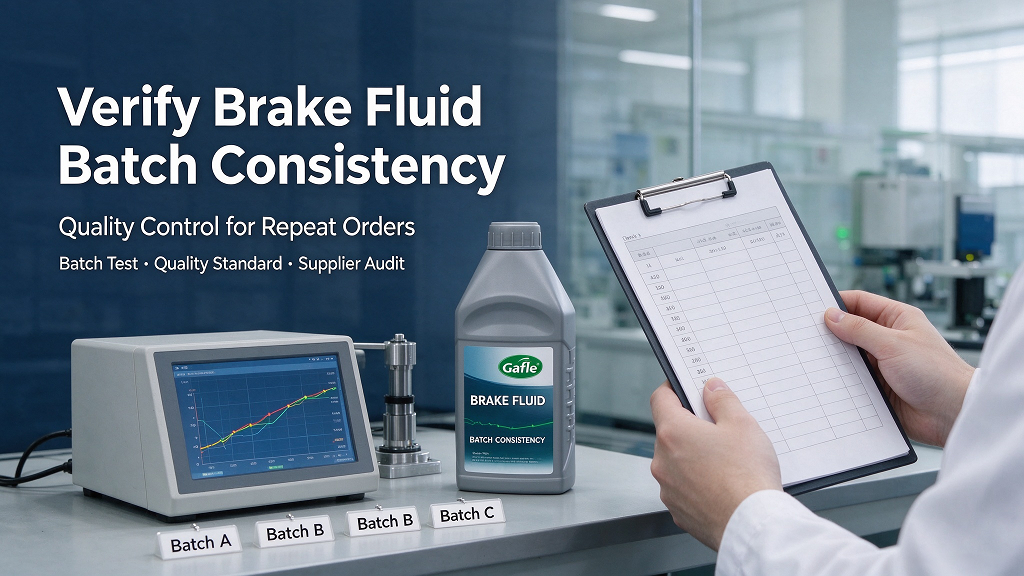
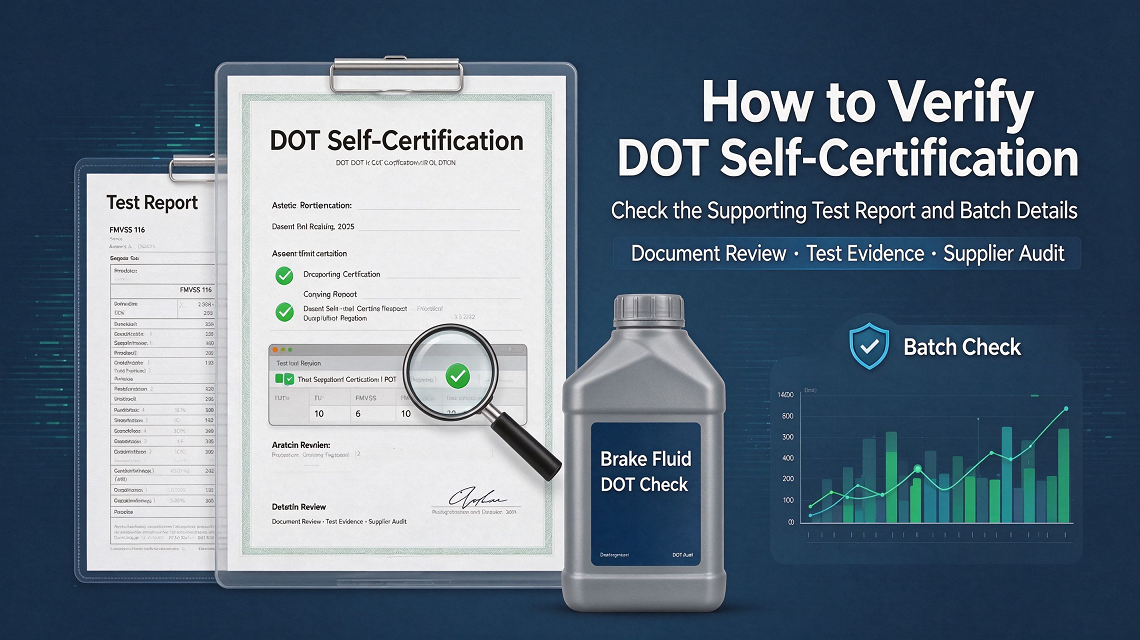
For procurement managers and automotive systems engineers, knowing how to check brake fluid DOT declaration validity is often the difference between a compliant supply chain and a catastrophic recall. Commercial friction points frequently emerge when importing or distributing hydraulic braking fluids, particularly when sourcing teams encounter glossy certificates bearing official-looking government seals. In the United States, however, federal compliance for FMVSS No. 116 does not operate on government-issued permits. Misunderstanding how compliance is formally declared leaves Tier-1 distributors and private-label packagers legally exposed under National Highway Traffic Safety Administration (NHTSA) enforcement.
The Core Reality: DOT Self-Certification vs. Government Approval
Before diving into validation steps, sourcing teams must confront an industry open secret: the U.S. Department of Transportation does not inspect, test, or award gold-embossed certificates of approval for hydraulic fluid. Instead, federal law dictates a system of DOT self-certification under 49 U.S.C. Chapter 301 and 49 CFR § 571.116.
Under this statutory framework, the manufacturer or packager independently certifies that its formulations meet all performance requirements of FMVSS No. 116 (such as equilibrium reflux boiling point, rubber swelling, kinematic viscosity, and corrosion resistance). If an overseas vendor presents a document labeled as an "Official DOT Endorsement Certificate," treat it with immediate skepticism. Legitimate compliance documentation looks distinctly different from third-party ISO registrations.
Step-by-Step: How to Verify DOT Brake Fluid Certificate Claims
To separate genuine manufacturing declarations from paper-mill fabrications, procurement teams should apply a disciplined four-step audit trail when evaluating documentation.
1. Cross-Reference NHTSA Manufacturer Identification (Part 566)
Under 49 CFR Part 566, any entity manufacturing or packaging motor vehicle equipment for the U.S. market must file basic identifying information with NHTSA no later than 30 days after manufacturing begins. Sourcing specialists can access NHTSA's publicly searchable manufacturer database (via the vPIC portal). If a supplier claims domestic distribution status but does not appear in Part 566 filings under their registered corporate entity or manufacturing plant, their declaration is deficient from a regulatory standpoint.
2. Audit the FMVSS No. 116 Test Report Structure
A valid supplier declaration must be anchored by comprehensive laboratory test results, not merely an executive statement. To verify DOT brake fluid certificate submissions and declarations effectively, inspect the test report for:
Accreditation of the testing facility: Look for ISO/IEC 17025 accredited independent laboratories specializing in chemical and automotive fluids.
- Data completeness: A complete FMVSS No. 116 protocol evaluates over a dozen discrete physical and chemical properties. If a vendor supplies a two-page document showing only dry boiling point and pH, the validation is incomplete.
- Report currency: Formulations age, additives evolve, and packaging lines change. A laboratory test report older than two to three years without change-control documentation poses significant audit risk.
3. Scrutinize Critical Performance Metrics
When reviewing raw laboratory data attached to the declaration of conformity, focus on the triad of parameters that most frequently fail post-market compliance spot-checks:
- Dry Equilibrium Reflux Boiling Point (ERBP): Minimum 401°F (205°C) for DOT 3, 446°F (230°C) for DOT 4, and 500°F (260°C) for DOT 5.1.
- Wet ERBP: The fluid must maintain thermal stability after moisture absorption—minimum 284°F (140°C) for DOT 3, 311°F (155°C) for DOT 4, and 356°F (180°C) for DOT 5.1.
- Kinematic Viscosity at -40°C: Viscosity limits ensure cold-weather anti-lock brake system (ABS) modulation works without valve lag. Marginal test figures often indicate substandard base polyglycol cuts.
4. Verify Container Labeling Mandates (Section S5.2.2)
Federal compliance does not stop at fluid chemistry; it extends directly to primary packaging. Sourcing managers should request uncurated photographs of finished production packaging. FMVSS No. 116 Section S5.2.2 explicitly mandates precise warning text, batch codes, packager identification, and safety notices on every retail container. A failure in container typography or missing lot traceability renders the entire batch technically non-compliant, regardless of how stable the chemical formulation is.
Red Flags During Supplier Audits
During vendor onboarding, watch for these recurring discrepancies:
- Unmatched Batch Numbers: The Certificate of Analysis (COA) provided with a shipping lot references formulation numbers disconnected from the foundational laboratory qualification report.
- Ambiguous Corporate Entities: The entity registered in NHTSA databases is a shell trading company rather than the toll blender actually compounding the glycol ether formulations.
- Refusal of Blind Testing: An unwilling vendor who balks at contractual clauses permitting random third-party sample pulls for verification at an accredited domestic lab.
Selecting a Reliable Brake Fluid Supplier DOT Certificate and Partner
Securing a truly reliable brake fluid supplier DOT certificate and partnership requires aligning with blenders who treat regulatory transparency as a baseline operating cost rather than an obstacle. Reputable fluid compounders maintain complete lot-retention programs, active automated filling environments, and transparent batch-specific documentation that bridges baseline FMVSS qualification with routine production runs.
Before signing supply agreements, establish an unambiguous compliance protocol: demand full initial qualification data under FMVSS No. 116, confirm active Part 566 submissions, and establish clear warranty structures covering recall liability if federal compliance testing detects product deviation.
Frequently Asked Questions
Does NHTSA issue an official registration number for fluid compliance?
No. NHTSA assigns manufacturer identification IDs for administrative tracking under Part 566, but it does not issue registration numbers that signify fluid performance approval or certification.
Can an overseas laboratory qualify FMVSS No. 116 compliance?
Yes, provided the facility holds valid ISO/IEC 17025 accreditation and strictly executes the standardized ASTM/FMVSS testing methodology. However, the legal responsibility for non-compliance within the U.S. market falls on the registered domestic importer or packager.
What is the difference between a Certificate of Analysis (COA) and a DOT Declaration?
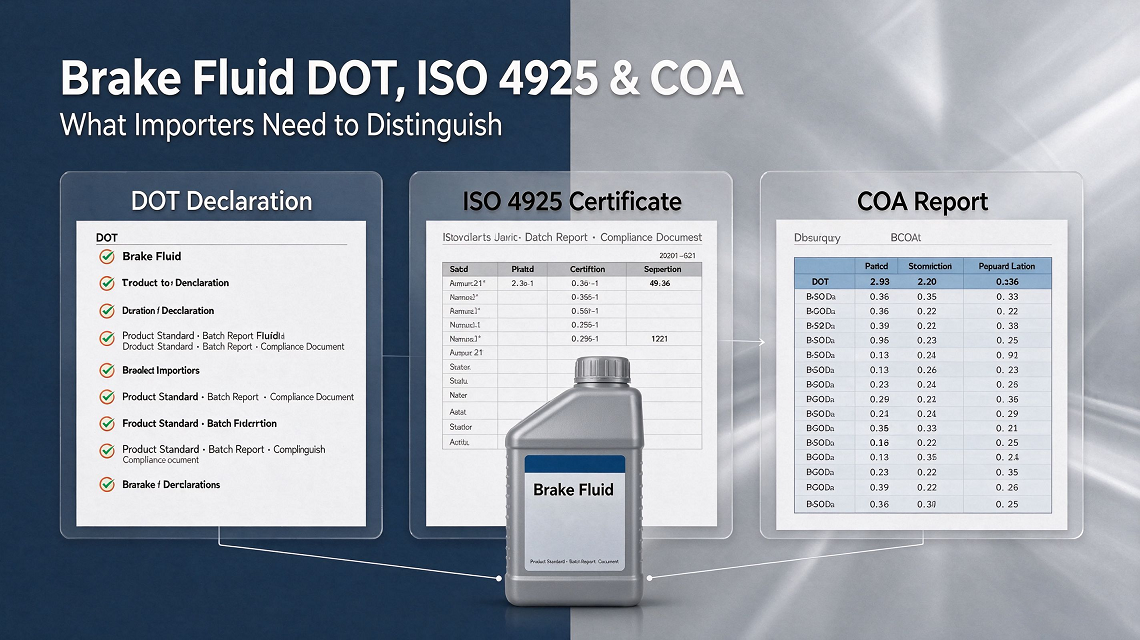
A COA confirms specific batch properties (such as moisture content, color, and density) at the time of packaging. A DOT declaration represents a comprehensive legal assertion that the base formulation satisfies the full spectrum of FMVSS No. 116 mechanical, chemical, and packaging mandates.
Welcome to contact GAFLE for more information & cooperation!
peter
ZHEJIANG GAFLE AUTO CHEMICL CO.,LTD
Tel:86-579-8222 1665
Fax:86-579-8246 4690
Cel/Wechart:86-13335993986
E-mail:peter@gafle.net
Web:www.gafle.net