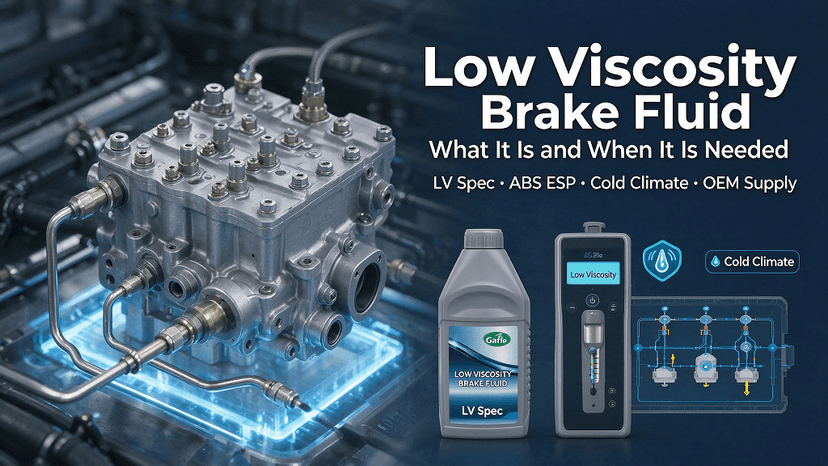
Understanding Hydraulic Response: What Is Low Viscosity Brake Fluid?
For chassis engineers, fleet managers, and automotive parts buyers, asking what is low viscosity brake fluid usually stems from a practical engineering headache: why are modern anti-lock braking (ABS) and electronic stability programs (ESP) flagging performance warnings or sluggish valve return in colder weather? Simply put, low viscosity brake fluid—most often standardized under ISO 4925 Class 6 or specific OEM formulations—is a glycol-ether-based hydraulic fluid formulated to maintain rapid flow through micro-valves at severe sub-zero temperatures. Where conventional DOT 4 fluid thickens dramatically as ambient temperatures drop, low viscosity alternatives hold their fluid characteristics, allowing modern active safety electronics to build, hold, and release hydraulic pressure in fractions of a second.
The Kinematic Difference: Standard vs. Low Viscosity Formulations
To understand the practical difference, you have to look at kinematic viscosity at -40°C. High-temperature dry and wet boiling points matter for preventing vapor lock under continuous descending friction, but cold-temperature fluid movement determines how fast hydraulic control units (HCUs) respond.
Under conventional standards like SAE J1703 and standard DOT 4 specifications, maximum allowable kinematic viscosity at -40°C is typically set between 1,500 and 1,800 mm²/s (cSt). While that range is adequate for vacuum-boosted master cylinders and large brake caliper pistons, it presents an engineering bottleneck for electronic actuators. By contrast, a dedicated low viscosity fluid (such as DOT 4 LV or ISO 4925 Class 6) caps viscosity at roughly 700 to 750 mm²/s at -40°C—a reduction of more than 50 percent in internal hydraulic resistance during freezing conditions.
Why Modern Safety Systems Demand Faster Flow
The widespread adoption of low viscosity brake fluid for ABS ESP systems is directly tied to changes in valve body architecture. Early three-channel ABS units used relatively coarse solenoid valves cycling a few times per second. Modern stability control, dynamic traction control, and ADAS-driven autonomous emergency braking (AEB) are fundamentally different. They feature high-frequency, pulse-width modulated (PWM) proportional valves with internal orifices sometimes narrower than a millimeter.
During an active skid or an emergency lane-change intervention, the ESP system may need to modulate line pressure up to 15 to 20 times per second across independent wheels. If the brake fluid turns viscous in a cold climate, fluid transit through these micro-valves lags. That delay translates directly into increased stopping distance or a stability controller that over-corrects because hydraulic pressure does not decay rapidly enough when the solenoid de-energizes.
Application Realities: When Do You Need Low Viscosity Brake Fluid?
A common specification mistake in maintenance and aftermarket sourcing is assuming all DOT 4 fluids are interchangeable across platforms. Knowing when do you need low viscosity brake fluid comes down to the following platform design factors:
- Integrated Vehicle Dynamics: Any vehicle running modern ESP/ESC, hill-start assist, electronic brakeforce distribution (EBD), or active torque vectoring relies on calibrated valve response tables built around ISO Class 6 flow rates.
- ADAS and Autonomous Braking: Radar- and camera-initiated braking cannot wait for pedal stroke pressure from a human driver; hydraulic pressure must be self-generated by the ABS motor and distributed instantly.
- Cold-Weather Fleet Deployments: For commercial transport, service fleets, and passenger cars operating in regions subject to extended low temp periods, thicker fluids produce noticeable pedal stiffness and delayed stability intervention.
- Electric and Hybrid Vehicles: EV braking systems blend regenerative drag with friction braking via complex electro-hydraulic decoupling. These systems continuously modulate caliper pressure at small increments, where fluid internal friction can cause uneven regenerative blending.
Sourcing and Specifying for OEM Supply Chains
For tier-one platforms and commercial buyers handling OEM supply, selecting brake fluids involves balancing more than cold kinematic numbers. Glycol-ether chemistry must remain chemically inert against standard elastomer seals (typically EPDM) and copper-lined steel or aluminum brake lines across the vehicle's design lifecycle.
A frequent operational caution: low viscosity fluids, due to their tailored polymer structure and smaller molecular chains, can sometimes show higher initial hygroscopic rates if exposed to atmosphere during bulk dispensing. Manufacturing plants and automated assembly cells must verify that bulk totes, dispensing nozzles, and vacuum-fill lines are hermetically dry. Introducing even minor ambient moisture before factory fill will degrade both the wet boiling point and the fluid's low-temperature shear stability.
Frequently Asked Questions
Can you mix low viscosity DOT 4 with regular DOT 4?
Chemically, yes. Both rely on polyethylene glycol ether bases and borate esters, meaning they will not separate or gel if mixed. Functionally, however, diluting low viscosity fluid with standard DOT 4 raises the overall viscosity curve. In freezing weather, this dilution compromises the response speed of electronic stability systems.
Does a low viscosity formulation sacrifice high-temperature boiling points?
Generally, no. Formulations meeting ISO 4925 Class 6 maintain dry boiling points of at least 250°C and wet boiling points above 165°C, comparable to or exceeding standard DOT 4 requirements.
Next Steps for Procurement and Engineering Teams
When drafting material callouts or ordering hydraulic fluids for assembly or fleet maintenance, review the chassis platform's hydraulic control unit (HCU) manual. If the system specifies ISO 4925 Class 6 or an OEM-equivalent low-viscosity baseline, avoid standard DOT 4 substitutes. Request full technical data sheets (TDS) showing both dry/wet boiling figures and kinematic viscosity at -40°C to ensure compliance with modern active safety standards.
Welcome to contact GAFLE for more information & cooperation!
peter
ZHEJIANG GAFLE AUTO CHEMICL CO.,LTD
Tel:86-579-8222 1665
Fax:86-579-8246 4690
Cel/Wechart:86-13335993986
E-mail:peter@gafle.net
Web:www.gafle.net