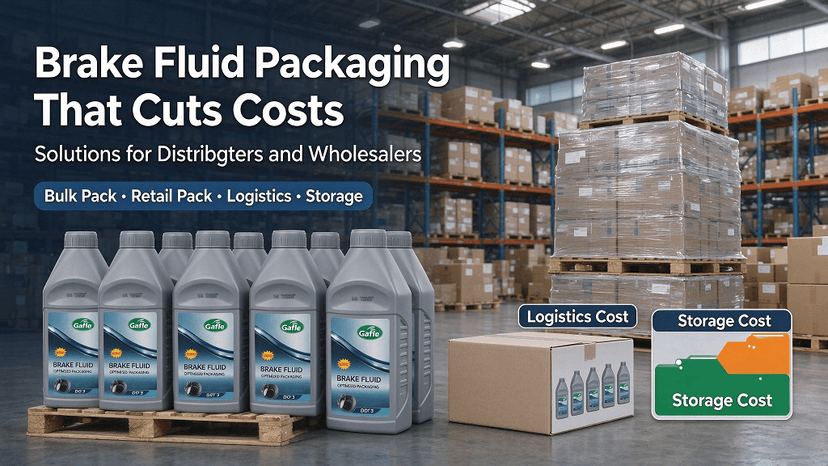
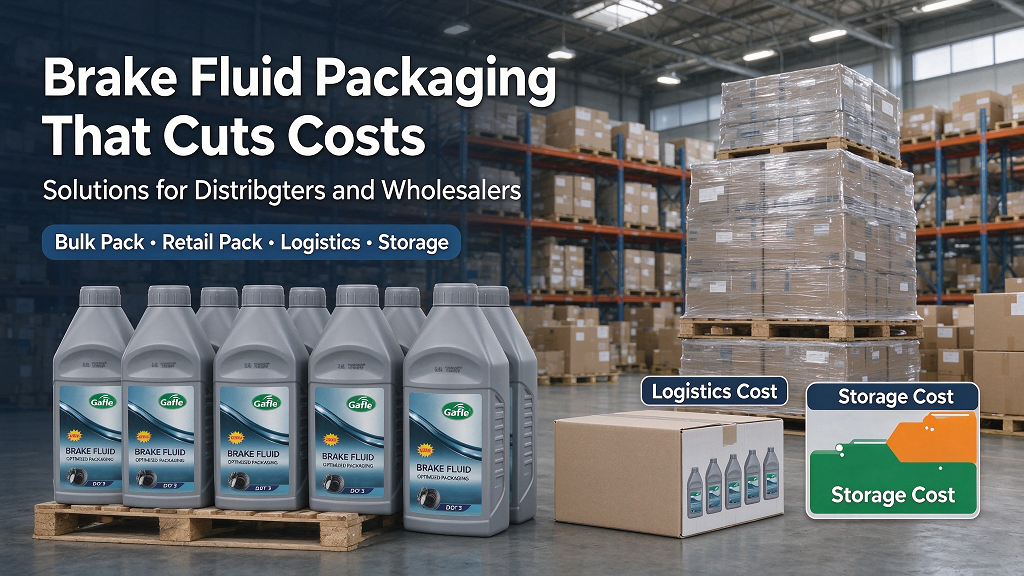
The Margin Reality of Brake Fluid Distribution
For chemical and automotive parts distributors, sourcing brake fluid rarely fails on formulation alone. Most glycol-ether and borate-ester blends meet basic FMVSS 116 or ISO 4925 standards out of the blending plant. Where margins quietly erode is in transit and storage: micro-leakage through inadequate cap liners, humidity ingress turning fresh DOT 4 into out-of-spec stock on warehouse racks, and poor carton palletization that wastes trailer volume. Selecting cost-effective brake fluid packaging for distributors is less about buying the cheapest container and more about managing the total landed cost per liter delivered to repair shops and retail shelves.
Material Realities: Tinplate vs. Treated Polyethylene
Brake fluid is aggressively hygroscopic. Even modest exposure to ambient humidity depresses its wet boiling point, causing premature degradation before the consumer ever cracks the seal. That moisture sensitivity dictates your packaging substrate.
Historically, tinplate metal cans were the default standard. Steel provides an absolute moisture and oxygen barrier, and tinplate holds up well under continuous vertical stacking without sidewall creep. However, metal has distinct drawbacks for modern high-volume supply chains: it dents easily during rough intermodal freight, adds tare weight that drives up long-distance shipping rates, and suffers from price volatility driven by raw sheet-metal indices.
High-Density Polyethylene (HDPE) bottles, specifically those co-extruded with an ethylene vinyl alcohol (EVOH) barrier layer or fluorinated surfaces, have taken over broad market segments. Standard unlined HDPE is generally insufficient for multi-year shelf-life targets because moisture vapor transmission rates (MVTR) allow water molecules to migrate through thin plastic walls over time. Sourcing managers must balance these physical trade-offs when qualifying any new bottle format:
Tinplate Cans: Zero vapor transmission; superior top-load crush strength; vulnerable to exterior rust in tropical ports; higher baseline shipping weight.
- Fluorinated HDPE: Lower container cost; reduced dent claims; lightweight; requires tightly controlled fluorination levels to prevent chemical interaction with glycol ethers.
- Multi-Layer Co-Ex (HDPE/EVOH): Reliable vapor barrier; excellent drop impact resistance; slightly higher unit tooling and bottle cost compared to monolayer plastics.
Comparing Packaging Formats Across the Supply Chain
| Packaging Format | Primary Use Case | Moisture Risk Profile | Pallet Cube Efficiency |
|---|---|---|---|
| 250ml / 500ml Plastic Bottle | Retail, DIY, quick-lube top-offs | Moderate (depends on induction seal) | Moderate; corrugated divider losses |
| 1L Tinplate Rectangular Can | Commercial workshops, export fleets | Extremely low (hermetic barrier) | High; zero-gap carton stacking |
| 20L / 5-Gallon Pail | High-turnover fleet service centers | Low until opened; requires desiccant vent | Moderate; round footprint leaves voids |
| 200L Drum / 1000L IBC Tote | Decanting hubs, industrial blenders | Low in bulk; high during transfer | High liquid volume per pallet footprint |
Evaluating Bulk vs Small Pack Brake Fluid Logistics Cost
A persistent operational debate for regional suppliers is calculating the bulk vs small pack brake fluid logistics cost. Shipping pre-packaged 250ml or 500ml bottles in master cartons from an offshore contract packager delivers turnkey inventory, but you pay ocean and road freight on corrugated dividers, empty headspace inside cartons, and pallet voids.
Conversely, importing bulk brake fluid in 1,000-liter intermediate bulk containers (IBCs) or flexitanks maximizes fluid density per TEU (twenty-foot equivalent unit). The trade-off is capital and procedural: your operation requires localized filling lines, nitrogen blanket purging to prevent moisture uptake during bottling, and certified secondary containment. For distributors moving under 50,000 liters annually, the compliance overhead, bottle mold amortization, and clean-fill labor usually wipe out the bulk freight savings. Once your distribution run exceeds that volume, localized packing into a standard private-label bottle design quickly outpaces finished-pack imports on a pure margin basis.
Sealing Integrity: The Overlooked Failure Point
A robust bottle or can is useless if the closure fails. The single largest source of distributor inventory write-offs in automotive fluids is neck leakage and seal oxidation. Brake fluid cuts through standard non-compatible adhesive residues and softens low-grade elastomer gaskets.
For plastic containers, a heavy-duty, pulp-backed foil induction seal is mandatory. The induction heat-sealing process must achieve an airtight bond across the entire 360-degree perimeter of the bottle lip. If your filler runs line speeds too fast or operates with inconsistent induction coil heights, microscopic pinholes form. Ambient air enters, the brake fluid draws moisture, and bottles in the bottom tiers of a pallet show weeping caps after six weeks in a warm transit container.
When auditing potential suppliers, inspect their neck finish tooling. Uneven parting lines across the bottle mouth prevent induction foils from seating flat, regardless of how much torque the capping machine applies.
What to Demand from a Brake Fluid Packaging Supplier
A reliable brake fluid packaging supplier should understand that these chemical mixtures require tighter QC tolerances than conventional motor oils or windshield wash. When reviewing factory specifications and container samples, check for these non-negotiable details:
- Resin Consistency: Virgin HDPE resin with traceable melt flow indices to prevent environmental stress cracking (ESC) caused by exposure to glycol derivatives.
- Closure Compatibility: Child-resistant or standard closures equipped with liner backing materials specifically formulated to resist swelling when exposed to borate esters.
- Structural Ribbing: Side-wall reinforcement that counteracts panelling—the natural inward buckling that occurs when packed bottles cool down or experience elevation and barometric pressure drops during intermodal transit.
- Outer Box Edge Crush Test (ECT): Sufficiently rated corrugated master cartons (minimum 32 to 44 ECT depending on tier height) to prevent corner crushing during sustained warehouse humidity.
Practical Recommendations for Sourcing Teams
Start by auditing your damage logs from the past four quarters. If your primary loss driver is corner-dent claims on metal tins, test fluorinated HDPE bottles with robust vertical ribbing to lower freight weights and scrap rates. If your challenge is customer returns due to low boiling-point tests, examine your induction foil suppliers and check whether nitrogen-dosing stations are operational on your packager's fill line.
Avoid designing complex, custom-molded bottle geometries unless your distribution volume justifies dedicated molds across several seasons. Standardized, off-the-shelf industrial neck finishes allow you to source alternative caps quickly during raw-material allocations, keeping your filling lines active and your distribution contracts fulfilled.
Frequently Asked Questions
Can standard motor oil bottles be used for brake fluid?
Generally, no. Standard motor oil relies on monolayer HDPE designed for petroleum lubricants that do not have high moisture-scavenging properties. Brake fluid stored in monolayer HDPE without an EVOH barrier or specialized fluorination will absorb atmospheric moisture over time, failing boiling-point specifications.
How does warehouse temperature affect packaged brake fluid?
Wide temperature swings cause pressure fluctuations within sealed bottles. Without proper side-panel ribbing, the container can expand and collapse, stressing the induction foil seal and risking micro-fissures around the neck threads.
Is metal packaging still necessary for DOT 5 silicone-based fluids?
Not strictly necessary, but metal or barrier-treated plastic remains common. While DOT 5 does not absorb moisture like DOT 3 or DOT 4, it is highly sensitive to air entrapment and chemical permeation, making airtight packaging critical.
Welcome to contact GAFLE for more information & cooperation!
peter
ZHEJIANG GAFLE AUTO CHEMICL CO.,LTD
Tel:86-579-8222 1665
Fax:86-579-8246 4690
Cel/Wechart:86-13335993986
E-mail:peter@gafle.net
Web:www.gafle.net