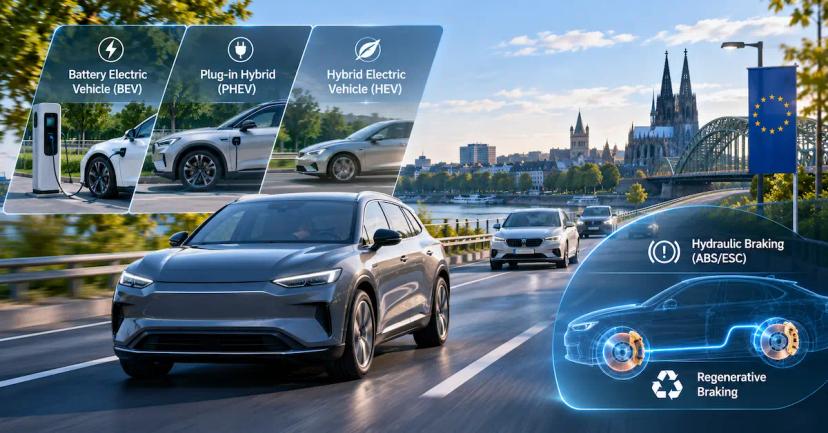
Quick Answer: European electric and hybrid cars still need the correct hydraulic brake fluid, even when regenerative braking handles part of the vehicle's deceleration. For importers and workshop distributors, the priority is to identify the vehicle-specific fluid requirement, verify relevant DOT/ISO performance evidence, and maintain appropriate service and supply controls. An EV label does not automatically mean a special brake fluid is required, and a conventional DOT 4 claim does not establish approval for every electric vehicle.
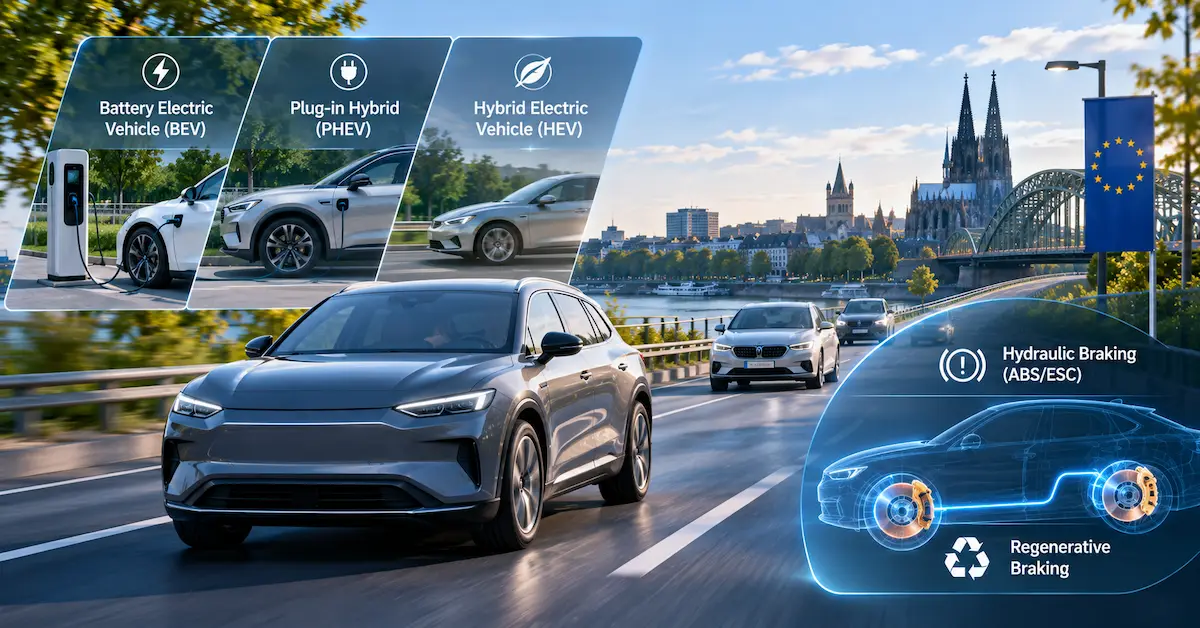
The European automotive aftermarket is changing as battery electric vehicles (BEVs), plug-in hybrids (PHEVs), and conventional hybrids (HEVs) become part of everyday workshop demand.
However, one important maintenance requirement remains: the hydraulic braking system must use the correct fluid and remain serviceable throughout the vehicle's operating life.
Regenerative braking changes how frequently friction brakes are used, but it does not eliminate the need for hydraulic braking, electronic stability control, or manufacturer-specified service procedures.
For automotive chemical importers, aftermarket distributors, and private-label brands, this creates a purchasing challenge. They must supply European car brake fluid that matches increasingly diverse braking systems without assuming that every electric vehicle requires the same specification.
This guide explains how to evaluate fluid requirements, understand regenerative braking, assess low-viscosity performance, manage workshop service risks, and qualify a dependable brake fluid supplier.
For available product categories and technical sourcing discussions, explore the GAFLE brake fluid range.
1. Why Do Electric and Hybrid Cars Still Need Brake Fluid?
Electric vehicles still need brake fluid because regenerative braking does not replace every function of the hydraulic braking system.
During normal driving, an electric motor can help slow a vehicle while recovering kinetic energy. Depending on the vehicle and operating conditions, conventional friction brakes continue to provide braking force when needed.
Hydraulic braking remains important for situations involving emergency deceleration, stability control, low-speed stopping, or conditions in which available regenerative braking is limited.
A European EV or hybrid vehicle may therefore contain familiar hydraulic components, including:
-
Brake fluid reservoirs and hydraulic circuits
-
Brake master-cylinder or integrated braking components
-
Hydraulic control units
-
Brake calipers and pistons
-
Seals, hoses and associated fittings
-
ABS and electronic stability control functions
The exact arrangement varies between vehicle platforms. Some vehicles use electronically controlled or integrated braking architectures, so hydraulic service requirements cannot be generalized from older conventional vehicles.
For purchasing teams, the main implication is straightforward: the propulsion system does not determine the brake fluid specification by itself.
A battery electric vehicle, plug-in hybrid and conventional passenger car may have different braking architectures even when they belong to the same manufacturer's lineup.
Before specifying a product, the distributor must know which hydraulic fluid the vehicle manufacturer permits.
2. How Does Regenerative Braking Change Hydraulic Brake Requirements?
Regenerative braking introduces an additional way to decelerate a vehicle. Instead of relying entirely on friction between brake pads and discs, the vehicle can use its electric drive system to convert some motion into electrical energy.
That process changes brake usage patterns but does not automatically remove hydraulic-system requirements.
Regenerative braking and friction braking work together
The official Volvo EX30 braking-system explanation describes regenerative braking, conventional friction brakes, stability control and automatic braking functions as parts of the vehicle's braking system.
For an aftermarket buyer, this is useful evidence that a modern electric vehicle combines electrical energy recovery with conventional braking functions.
The actual brake fluid still needs to satisfy the vehicle's documented hydraulic requirements.
Why braking-system integration matters
Some EV and hybrid architectures coordinate regenerative and friction braking to manage vehicle deceleration.
In systems using electronically controlled hydraulic pressure, the properties and service condition of the prescribed brake fluid remain relevant to the operation of hydraulic components.
Depending on the design, engineers may need to consider fluid viscosity, temperature performance, compatibility with seals, pressure-control operation and the manufacturer's bleeding or diagnostic procedures.
An aftermarket supplier should not claim that one particular viscosity grade improves regenerative braking efficiency without supporting vehicle-specific evidence.
Reduced pad usage does not mean maintenance-free brakes
When regenerative braking handles a larger share of routine deceleration, the friction brakes may experience different usage patterns from those of a conventional combustion-engine vehicle.
Brake discs and calipers can still require inspection, especially in wet, salted or corrosive road environments.
Importantly, brake fluid condition and friction brake surface condition are different maintenance issues. A high-quality brake fluid does not prevent every form of external brake-disc corrosion.
The practical purchasing lesson is that electric vehicle brake service still requires qualified technicians, correct service information and suitable replacement materials.
3. European EV and Hybrid Applications: What Must Buyers Verify?
European workshops service several electrified drivetrain categories. Each presents potential fluid requirements that must be confirmed against the particular model and braking architecture.
| Vehicle category | Braking-system characteristics | Key brake fluid sourcing question |
|---|---|---|
| Battery electric vehicle (BEV) | Regenerative and friction braking may operate together | What exact hydraulic fluid and class does the manufacturer specify? |
| Plug-in hybrid (PHEV) | Electric and combustion operating modes, often with coordinated braking | Does the fluid requirement differ by model generation or brake-control system? |
| Hybrid electric vehicle (HEV) | Regenerative braking integrated with conventional braking functions | What is the permitted fluid and required maintenance procedure? |
| Performance-oriented electrified car | Potentially higher braking loads and specialized controls | Are additional thermal or manufacturer approval requirements specified? |
| Electrified commercial or fleet vehicle | Fleet duty cycles and possibly more demanding hydraulic systems | What service interval, fluid specification and maintenance evidence apply? |
This table is an application-planning framework, not an approval chart.
Buyers serving vehicles from Volvo, Volkswagen Group, BMW, Mercedes-Benz, Renault, Peugeot, or other manufacturers should not assign a single fluid specification to an entire brand.
Even models within one vehicle family can differ by year, market, braking-system version or service-document revision.
Which buyers benefit most from a specialized EV service range?
The strongest commercial opportunity is usually among buyers who already serve identifiable electrified vehicle populations.
These include European independent workshop networks, EV repair specialists, automotive parts importers, fleet maintenance organizations and private-label fluid brands.
For these customers, accurate application information is more valuable than generic marketing phrases such as "universal electric car brake fluid."
A distributor should build its assortment around verified customer demand and supported vehicle applications.
4. A Real OEM Example: Volvo EX40 Brake Fluid Specifications
One useful example is the Volvo EX40, because Volvo publishes specific brake fluid information in its vehicle documentation.
The official Volvo EX40 brake fluid specification describes Volvo Original or an equivalent fluid fulfilling a combination of DOT 4, DOT 5.1 and ISO 4925 Class 6 classifications.
The documentation also recommends that brake fluid service be performed by an authorized Volvo workshop.
What does this example mean for procurement?
It demonstrates why buyers should not select an EV brake fluid by the DOT 4 name alone.
An OEM may describe a combination of requirements that must be evaluated together. A candidate fluid needs supporting evidence for the actual specification—not merely a label containing one familiar grade.
A fluid marketed as DOT 4 cannot automatically be advertised as suitable for the EX40. The purchaser must examine the complete relevant requirements and the candidate product's technical evidence.
How to apply this lesson to other European cars
Use the same verification method for other EVs and hybrids:
-
Identify the exact model, model year and market.
-
Obtain the relevant current manufacturer service information.
-
Record the full prescribed fluid specification.
-
Compare available product test documentation.
-
Approve only the applications supported by that documentation.
The Volvo example is not an endorsement or approval of any GAFLE product.
It illustrates how an importer should interpret genuine manufacturer requirements when developing an aftermarket brake fluid range.
5. DOT 4, Low-Viscosity Brake Fluid and ISO Class 6: What Is the Difference?
European car brake fluid buyers often encounter several overlapping product descriptions.
These include standard DOT 4, DOT 4 LV, DOT 5.1 and ISO 4925 Class 6.
Although these descriptions can appear together in marketing materials, they should not be treated as interchangeable.
| Fluid classification or description | What it indicates | What buyers must verify |
|---|---|---|
| DOT 4 | A defined brake fluid performance grade | Actual performance results and vehicle requirements |
| DOT 4 LV | Commercial description associated with lower-viscosity performance | Specified viscosity target and supporting test report |
| ISO 4925 Class 6 | A defined classification within ISO 4925 | Evidence against the required edition and full class requirements |
| DOT 5.1 | A non-silicone brake fluid performance grade | Full performance specification and approved application |
| EV-specific or hybrid brake fluid | Marketing or application positioning | Actual technical differences and vehicle suitability |
| OEM-approved brake fluid | Suggests formal vehicle-manufacturer approval | Valid approval evidence for the exact product |
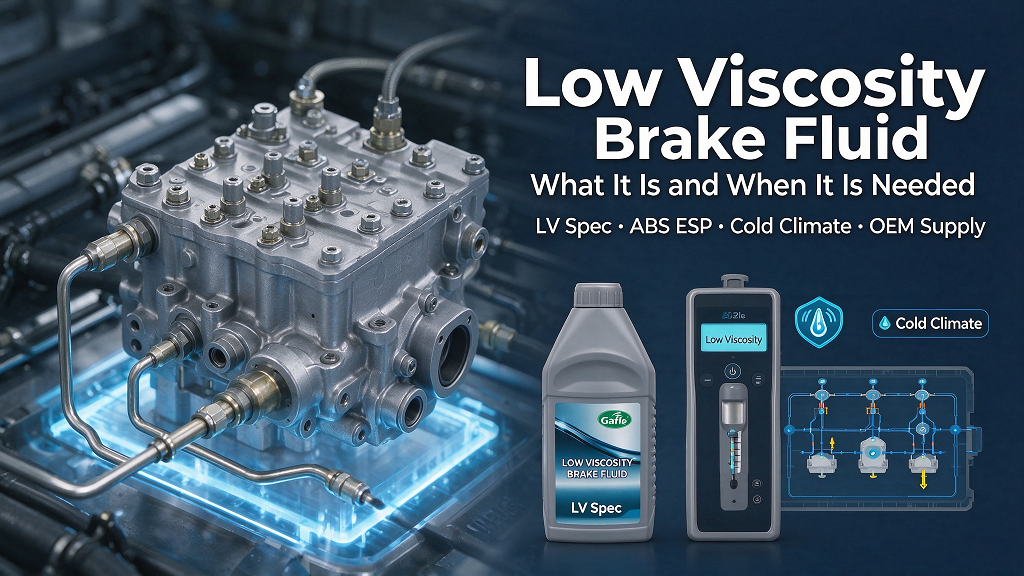
Why low-temperature viscosity matters
Brake fluid viscosity describes resistance to flow.
In electronically controlled hydraulic brake systems, cold-temperature fluid behavior may be an important part of the vehicle's technical specification.
However, an importer should not assume that all EVs require ISO Class 6 or that every product described as low viscosity meets that classification.
The relevant parameters and limits must be obtained from the applicable vehicle and fluid standards.
The current ISO standard matters
The official ISO 4925:2026 standard overview identifies the current fourth edition of the non-petroleum-based hydraulic brake fluid specification, published in June 2026.
The scope includes fluids intended for suitable hydraulic braking and clutch systems equipped with SBR and EPDM sealing components.
Buyers reviewing supplier documentation should note the edition cited. A report based on an older edition does not automatically prove conformity with a newer one.
The purchasing file should identify the applicable standard, edition, claimed class, test methods and actual results.
What about boiling-point performance?
Dry and wet equilibrium reflux boiling points remain important fluid characteristics.
The purchasing team should examine them alongside viscosity, chemical stability, corrosion protection and elastomer compatibility.
Selecting a fluid with an impressive advertised dry boiling point is not sufficient if the vehicle requires additional low-temperature or manufacturer-specific performance.
The correct specification is the complete approved requirement, not one headline measurement.
6. Are Brake Fluid Materials and Seals Different in Electric Vehicles?
Not necessarily.
Electrification does not automatically require a new elastomer chemistry in every hydraulic brake system.
Many hydraulic braking systems designed for suitable non-petroleum, glycol-based fluids use compatible elastomer components, including appropriately formulated EPDM seals.
However, EPDM refers to a material family. Actual seal performance depends on the compound, fluid formulation, dimensions, temperatures and operating conditions.
An importer should distinguish three levels of evidence.
Fluid-level evidence demonstrates that the offered fluid meets the applicable requirements of its claimed grade or class.
Material-level evidence examines its interaction with specified reference elastomers or production seal compounds.
Component-level evidence establishes that the intended assembled braking component performs according to the relevant engineering criteria.
For EV or hybrid development programs, these distinctions are important when a supplier claims compatibility with a particular brake-control system.
General rubber compatibility statements cannot replace vehicle-specific approval or component validation.
7. Does Regenerative Braking Extend Brake Fluid Service Intervals?
Not automatically.
A regenerative braking system may reduce the frequency of friction brake application during certain driving conditions. That does not establish that the hydraulic brake fluid can remain in service indefinitely.
Brake fluid aging depends on the specified fluid chemistry, operating conditions, moisture exposure, maintenance history and the vehicle manufacturer's service requirements.
A car that travels relatively few kilometres can still require inspections or fluid service according to its manufacturer.
Service planning for European workshop networks
For importers and distributors supplying multiple workshops, a practical service program should account for three separate questions:
1. When should the fluid be checked or replaced?
Use the model-specific manufacturer maintenance schedule and professional service information. Do not impose one universal interval on every EV and hybrid vehicle.
2. How should fluid condition be evaluated?
Where a service procedure calls for testing, use the manufacturer's prescribed method and acceptance criteria. Different test methods measure different properties and may not be interchangeable.
3. Who should perform the service?
Electrified vehicles may have high-voltage systems and electronically controlled braking functions. Servicing must follow applicable vehicle safety and workshop procedures.
A generic brake-fluid flushing instruction is not a substitute for the required OEM diagnostic or hydraulic service process.
Brake fluid replacement and brake hardware inspection are separate jobs
A vehicle may require a brake fluid inspection and a separate assessment of pads, discs, calipers or hoses.
These tasks should not be combined into an unsupported claim that one fluid prevents all brake-system deterioration.
For aftermarket brands, accurate service guidance builds more trust than exaggerated maintenance promises.
8. Why Do Moisture Control and Sealed Packaging Matter?
Many non-silicone glycol-based brake fluids are hygroscopic, meaning they can absorb moisture.
Moisture exposure can influence fluid properties and contribute to service concerns over time.
This makes packaging and warehouse handling important parts of brake fluid quality management.
Before the product reaches the workshop
Importers should check the integrity of bottles, closures and cartons during incoming inspection.
The supplied package should be appropriate for the fluid, provide reliable sealing and preserve traceability.
A distributor should also establish storage instructions and inspection criteria for damaged or leaking containers.
Inside the workshop
Technicians should follow product instructions and vehicle service requirements, use appropriate handling equipment and avoid contaminating the hydraulic system.
Previously opened, contaminated or unidentified fluid should not be treated as equivalent to properly stored, new fluid.
Professional workshop customers may value clearly marked small service packs, particularly when the fluid is intended for a narrowly defined application.
Packaging considerations for private-label brands
A purchasing specification should address:
| Packaging item | Recommended procurement check | Commercial value |
|---|---|---|
| Bottle and closure | Material suitability and sealing integrity | Reduces product handling and storage risk |
| Tamper evidence | Appropriate packaging design | Supports confidence in unopened stock |
| Product identification | Exact grade, class and product code | Helps avoid workshop selection errors |
| Lot traceability | Readable production or batch identification | Supports complaints and targeted investigations |
| Carton construction | Transport and handling suitability | Helps protect goods during distribution |
| Label artwork | Accurate claims and market-specific content | Reduces approval and compliance risk |
These are proposed purchasing checkpoints, not claims about a specific GAFLE package or production test result.
9. What Technical Evidence Should an EV Brake Fluid Supplier Provide?
A professional buyer should evaluate technical evidence before comparing commercial quotations.
A supplier's general product brochure can identify a candidate fluid, but an application-specific purchase requires more information.
| Technical evidence | Why it matters for European EVs and hybrids | Buyer acceptance question |
|---|---|---|
| Product TDS | Identifies formulation claims and reported technical characteristics | Does it cover the exact proposed SKU? |
| Applicable standard test report | Supports the claimed DOT or ISO classification | Are the results traceable and relevant? |
| Low-temperature viscosity result | Addresses specified cold-flow requirements | Does it meet the actual vehicle requirement? |
| Dry and wet boiling-point results | Evaluates relevant thermal performance | Are the method and acceptance limits defined? |
| Corrosion and material compatibility data | Addresses interactions within compatible hydraulic systems | Does the evidence cover the intended fluid and materials? |
| SDS | Supports safe handling and regulatory evaluation | Is it current and appropriate to the destination market? |
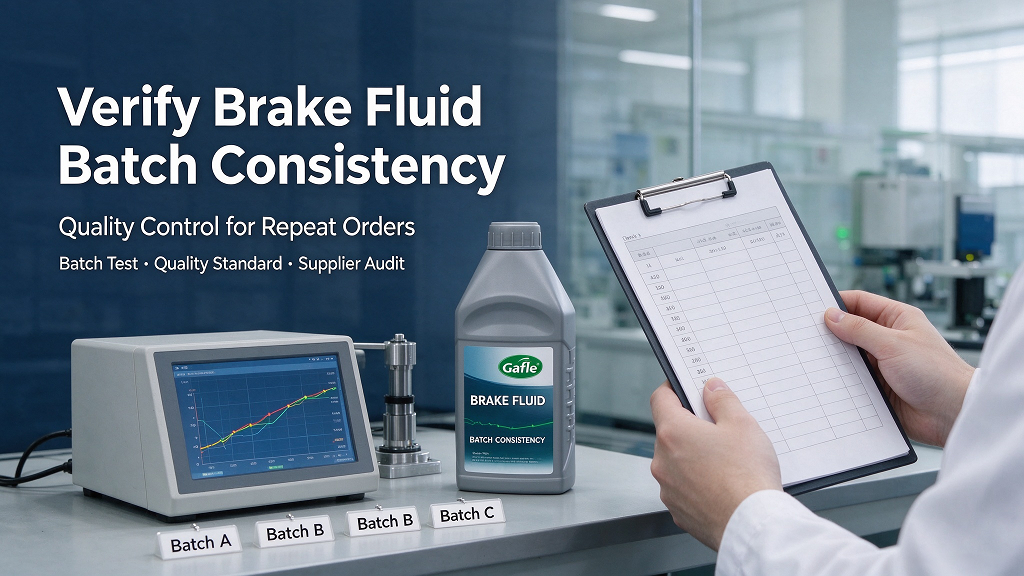
| Batch-release documentation | Supports consistency across commercial shipments | Which measurable properties are checked per lot? |
| OEM approval documentation, where claimed | Establishes the status of manufacturer-specific approval | Is the approval authentic, current and product-specific? |
Qualification testing versus routine batch control
Not every test needs to be repeated on every production lot.
Some tests establish the suitability of a formulation during product qualification. Others form part of routine production-release procedures.
Purchasers should ask suppliers to explain the distinction and agree on inspection frequency, critical specifications and record retention.
A Certificate of Analysis does not automatically replace a full qualification report.
Formula change control
A technically approved fluid must remain connected to the formulation supplied in commercial orders.
If a supplier changes relevant raw materials, additive systems or formulation parameters, the buyer should be informed according to an agreed change-control procedure.
Depending on the change, requalification may be needed.
This is especially relevant for buyers supplying specialized automotive repair channels with documented performance or OEM requirements.
10. How Can GAFLE Support European EV and Hybrid Brake Fluid Sourcing?
Zhejiang Gafle Auto Chemical Co., Ltd. markets automotive chemical products, including brake fluid categories intended for hydraulic braking applications.
The company's published brake fluid portfolio includes DOT 3, DOT 4, DOT 5.1, OEM-related and other specialized product categories. Its product listing also identifies an energy-vehicle-related category.
This provides an initial sourcing route for importers developing an aftermarket range.
However, the actual suitability of an offered product must be evaluated against the buyer's target vehicle requirements.
GAFLE DOT407 DOT 4 brake fluid
The GAFLE DOT407 product page describes a DOT 4 hydraulic brake fluid with stated thermal, corrosion-protection and material-compatibility features.
These are manufacturer-published product descriptions.
They should not be interpreted as independent verification that DOT407 satisfies ISO 4925 Class 6, a particular European vehicle specification or a specific electric-car OEM approval.
A buyer evaluating DOT407 should request the current TDS and relevant technical documents.
How to shortlist GAFLE products for an EV workshop network
The most useful inquiry is not simply "Do you have brake fluid for electric cars?"
A better request identifies the required standards and the vehicle applications the fluid must support.
For example, the importer can ask GAFLE to propose a product for a defined European workshop population requiring a specified fluid classification and provide the relevant evidence.
The result may be an existing catalogue product, a different product from the range, or a project that requires further technical discussion.
Explore GAFLE Brake Fluid Products
Request an EV and Hybrid Brake Fluid Sourcing Review
11. OEM and Private-Label Brake Fluid: What Should Buyers Specify?
Private-label development creates an opportunity to build a clearly positioned brake-fluid range for electrified vehicles.
But the product's value must come from documented suitability, supply consistency and reliable technical communication—not simply adding "EV" to the label.
Start with the intended application
The buyer should identify the target destination markets, customer channels, vehicle populations and technical specifications.
A private-label product intended for general workshops may need different positioning from one proposed for a specialized electric-vehicle service network.
The supplier should confirm whether an existing formulation can meet the requirements or whether further development and validation are necessary.
Separate performance claims from brand design
Marketing teams may want phrases such as "advanced EV brake fluid," "low viscosity," or "OEM grade."
Each statement should be reviewed for technical meaning and documentary support.
An OEM approval may be claimed only when the exact product holds the relevant valid approval. Similarly, an ISO class claim should be supported by applicable test evidence.
Establish the commercial approval process
Before issuing a bulk purchase order, agree on the approved fluid, packaging configuration, label content, production-quality expectations and change-notification procedure.
Buyers should request the actual minimum order quantity, sample arrangements, lead time and quotation terms from GAFLE rather than assuming that one published product category guarantees a specific commercial capability.
12. How Should Distributors Plan Packaging, Inventory and Procurement Cost?
For workshop distributors, brake-fluid inventory should follow real demand rather than the largest number of possible product descriptions.
An excessively complicated range can increase warehouse costs and lead to incorrect workshop selection.
A more effective approach is to segment inventory by documented specification requirement and customer usage.
| Sourcing scenario | Recommended commercial approach | Main risk to control |
|---|---|---|
| Mixed European passenger-car workshop | Stock products supported by a verified application database | Incorrect grade substitution |
| Dedicated EV workshop | Prioritize specific documented OEM requirements | Unsupported "EV compatible" claim |
| Fleet maintenance customer | Agree service demand, pack size and supply frequency | Unnecessary stock and open-pack waste |
| Low-viscosity application group | Establish a separately identifiable qualified SKU where needed | Assuming ordinary DOT 4 meets a tighter requirement |
| Private-label distributor | Lock technical specifications and approved artwork | Mismatch between label claims and tested formula |
Compare total procurement value
The lowest unit price does not always provide the lowest total supply risk.
Cost evaluation should include the product price, shipping and landed costs, packaging configuration, technical documentation, samples, potential testing requirements and inventory turnover.
Buyers should also consider the cost of maintaining multiple similar SKUs that customers cannot distinguish.
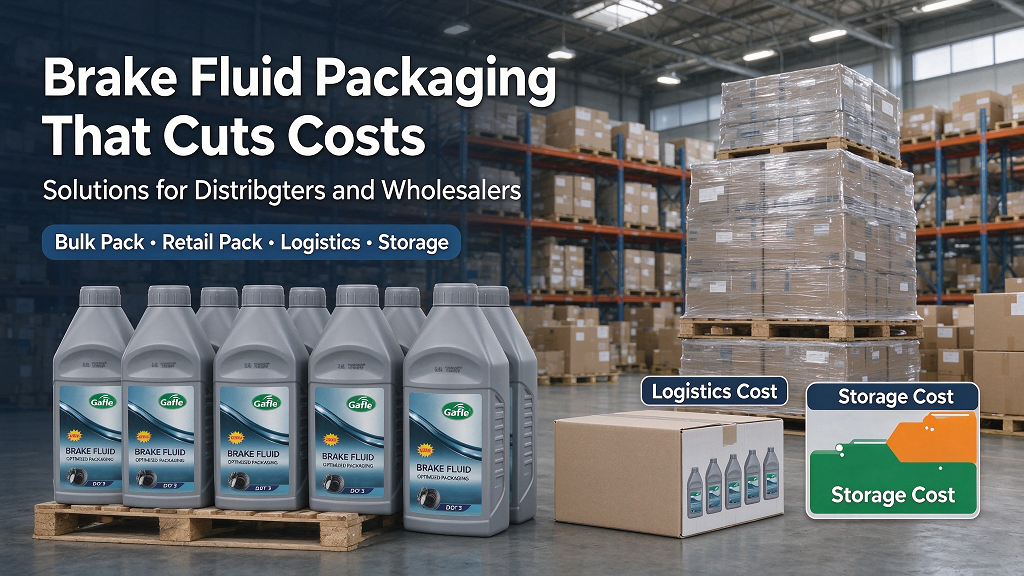
Packaging size should match service demand
A small professional workshop may prefer different packaging from a high-throughput fleet service operation.
Smaller sealed packs can be useful for narrowly defined service applications, while larger packaging may suit workshops with established fluid-handling procedures and predictable consumption.
Actual available bottle sizes and packaging options should be confirmed with the supplier.
13. Common Mistakes When Sourcing European Car Brake Fluid for EVs
Mistake 1: Assuming regenerative braking eliminates hydraulic brake fluid
Electric vehicles can still use hydraulic friction braking and electronically controlled brake functions. Fluid specifications remain important.
Mistake 2: Treating DOT 4 as a universal European EV specification
A DOT 4 claim does not establish all additional manufacturer or low-viscosity requirements.
Mistake 3: Assuming every electric vehicle requires ISO Class 6
Different manufacturers and braking platforms may specify different requirements. The vehicle's actual documentation must govern selection.
Mistake 4: Using "OEM approved" without proof
A supplier's declared conformity and a formal manufacturer approval are not interchangeable.
Mistake 5: Treating longer friction-pad life as longer brake-fluid life
Brake-pad wear and hydraulic-fluid condition follow different mechanisms and service requirements.
Mistake 6: Ignoring contamination and opened-container risks
Proper packaging, storage and professional handling remain important regardless of drivetrain type.
Mistake 7: Comparing quotations without the same specification
Two quotations are not technically equivalent unless they address the same formulation, tests, packaging and documentation requirements.
Mistake 8: Publishing broad fitment claims before technical approval
Application statements should identify the vehicle and requirement actually supported by evidence.
For a broader discussion of passenger-car fitment across traditional European brands, see GAFLE's European Car Brake Fluid OEM Fitment Guide.
14. Copy-Ready RFQ for European EV and Hybrid Brake Fluid
Subject: European EV and Hybrid Brake Fluid — Technical Review and Bulk Supply Inquiry
Dear GAFLE Sales and Technical Team,
We are an automotive fluid [importer/distributor/private-label brand] serving [destination country or region].
Our customers include [EV workshops, hybrid-vehicle repair centers, automotive aftermarket distributors or fleet maintenance businesses].
We are evaluating European car brake fluid for the following applications:
Target vehicles: [Manufacturer, model, model year or specified vehicle population]
Required hydraulic fluid: [Exact OEM specification or applicable DOT/ISO classification]
Technical requirements: [Required low-temperature viscosity, boiling-point performance, relevant test requirements and any application-specific conditions]
Documentation: [TDS, SDS, applicable test reports, batch-release documentation and approval evidence where relevant]
Packaging: [Preferred bottle sizes, label languages, packaging design and carton requirements]
First-order volume: [Quantity per product SKU]
Annual forecast: [Estimated annual volume]
Destination: [Country and delivery location]
Commercial requirements: [MOQ, sample availability, quoted pricing, lead time and shipping terms]
Please recommend the relevant current GAFLE products and identify the available technical evidence for the requested applications.
If any requested manufacturer specification or approval has not been demonstrated, please distinguish that requirement from confirmed product claims.
We would also appreciate information about OEM/private-label packaging options, formula change control and available batch-quality documentation.
We intend to complete our technical review before approving the first bulk order.
Kind regards,
[Name]
[Company]
[Contact Information]
Send Your Brake Fluid RFQ to GAFLE
15. Frequently Asked Questions About European Car Brake Fluid for EVs and Hybrids
FAQ 1. Do electric cars need brake fluid?
Yes. Many electric vehicles use hydraulic friction braking systems alongside regenerative braking. The required fluid depends on the vehicle's braking architecture and manufacturer specification. Electric propulsion does not automatically eliminate hydraulic brake-fluid maintenance.
FAQ 2. Is European car brake fluid different from regular DOT 4 brake fluid?
"European car brake fluid" is a market description rather than one universal technical grade. Some European vehicles require specific performance characteristics or manufacturer requirements beyond a generic DOT 4 designation. Buyers should compare the exact specifications, not marketing terminology.
FAQ 3. What brake fluid is suitable for European electric vehicles?
There is no single fluid suitable for every European EV. The correct product depends on the vehicle's manufacturer, model, year, braking system and stated fluid requirement. A supplier should demonstrate how the offered product meets those requirements.
FAQ 4. Does regenerative braking reduce the need for brake fluid replacement?
Not necessarily. Regenerative braking may reduce friction brake usage, but it does not establish that hydraulic brake fluid can remain in service indefinitely. Fluid inspection and replacement should follow the applicable manufacturer maintenance requirements.
FAQ 5. Do electric cars require low-viscosity brake fluid?
Some vehicles specify fluid properties associated with low-viscosity classifications, while others have different requirements. Buyers must check the exact vehicle documentation before deciding that an ISO Class 6 or other low-viscosity product is required.
FAQ 6. What is ISO 4925 Class 6 brake fluid?
ISO 4925 Class 6 is a defined classification within the ISO brake-fluid specification. For procurement, the supplier should provide evidence that its exact product meets the relevant requirements of the specified standard edition. The class alone does not establish every OEM approval.
FAQ 7. Can DOT 5.1 replace DOT 4 in a hybrid or electric car?
It should not be assumed. DOT 5.1 is a non-silicone brake-fluid category, but substitution depends on the manufacturer's instructions and the required performance and compatibility conditions. Confirm the intended vehicle specification before approving a change.
FAQ 8. What documents should an EV brake fluid importer request?
Request the exact product TDS, suitable SDS, relevant standard-test evidence, available batch-release documentation, packaging specification and any authentic OEM approval records associated with the proposed product. The importer should also assess destination-market obligations.
FAQ 9. Does GAFLE offer brake fluid products for electric vehicle sourcing projects?
GAFLE publicly lists multiple brake-fluid categories, including an energy-vehicle-related category. Buyers can contact the company to identify suitable candidate products and request available technical documentation. No particular EV application or manufacturer approval should be assumed without product-specific evidence.
FAQ 10. How can distributors get a European EV brake fluid quotation?
Provide the target vehicle population, exact fluid specifications, destination market, packaging requirements and estimated order volume. Ask the supplier to identify which product claims are supported, what documents are available and which requirements need further validation before ordering.
16. Conclusion
European car brake fluid remains an essential aftermarket product as electric and hybrid vehicles become more common in professional workshops.
Regenerative braking changes the way vehicles slow down, but hydraulic brake systems still depend on correct fluid selection, appropriate maintenance and reliable technical documentation.
For B2B buyers, the most important purchasing principle is to match the actual vehicle requirements rather than relying on broad EV-oriented marketing claims.
A credible sourcing program connects manufacturer specifications, applicable DOT and ISO requirements, laboratory test evidence, approved packaging and ongoing batch control.
This approach helps importers and workshop distributors build technically defensible product ranges while reducing the risk of unsuitable substitutions and unsupported OEM claims.
GAFLE's published brake-fluid portfolio provides a starting point for reviewing potential products for European aftermarket distribution.
To discuss your target vehicle applications, required specifications, product documentation and OEM/private-label packaging needs, contact GAFLE for a project-specific technical review and quotation.
Choose the right specification, verify the supporting evidence and establish a dependable supply program before placing a bulk order.