European Car Brake Fluid sounds like a straightforward product category until an importer has to approve it for a mixed European vehicle fleet. A bottle marked “DOT 4” may meet a recognized performance grade yet still lack evidence for the viscosity, vehicle-manufacturer requirement, or specific service application a workshop expects. The commercial problem is not finding another bottle of brake fluid. It is building a defensible product assortment that technicians can select correctly, distributors can sell confidently, and brand owners can document.
For automotive-fluid importers, parts distributors, private-label brands, and multi-site repair groups, the safest sourcing process begins with vehicle-specific requirements, then translates those requirements into a fluid specification, independent evidence, packaging instructions, and a repeatable quality-control agreement. This guide explains how to do that for the Volkswagen Group, BMW/MINI, Mercedes-Benz, Porsche, and other European passenger-car segments without assuming that one generic fluid is approved for every model.
1. Why “European Car Brake Fluid” Is Not One Universal Specification
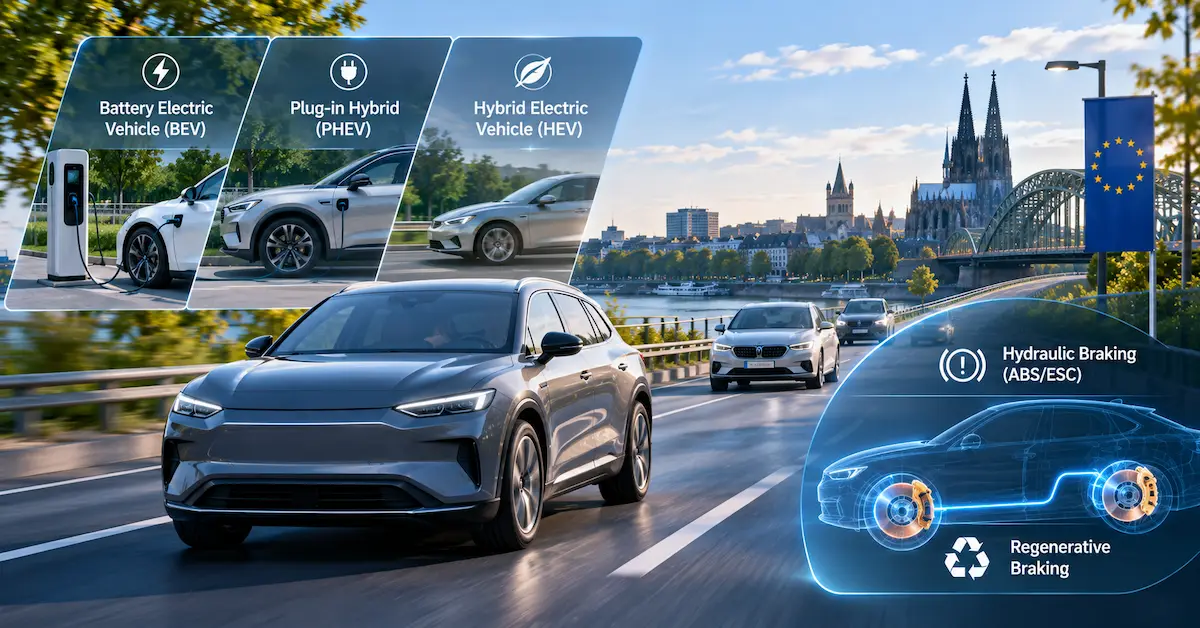
European passenger cars share sophisticated braking technologies, but they do not share a single universal brake-fluid approval. A late-model Volkswagen, an earlier BMW, a Mercedes-Benz van, a performance-oriented Porsche, and a Scandinavian-market Volvo can differ in hydraulic hardware, ABS/ESC control strategies, maintenance instructions, and manufacturer fluid specifications. Differences can also exist between model years and within one manufacturer's range.
The European aftermarket often uses expressions such as “European formula,” “DOT 4 Plus,” “DOT 4 LV,” “synthetic brake fluid,” or “high-performance DOT 4.” These may describe useful commercial categories, but they do not, on their own, establish vehicle fitment or an original-equipment approval. A supplier must convert each expression into something testable: an exact standard, a grade or class, a viscosity limit, and evidence that the fluid is suitable for the intended application.
This is why a European car brake fluid distributor should separate three decisions. Technical suitability asks whether a product has the correct performance characteristics and material compatibility. Documented fitment asks which vehicle platforms and model years are supported by the evidence. Commercial readiness asks whether the manufacturer can deliver the same product, documentation, and label claims repeatedly. Passing only the first test is not enough to launch a credible private-label range.
2. Who Should Use This Guide—and Who Should Not Make Blanket Fitment Claims?
The primary readers are automotive-fluid sourcing managers building a European-vehicle range; European and international importers supplying independent garages; private-label brands preparing a premium brake-fluid line; distributors serving VW/Audi, BMW, and Mercedes workshops; and quality engineers assessing supplier quotations. Fleet buyers and workshop chains can also use the purchasing checklist to standardize approved fluids.
| Buyer profile | Core purchasing question | Most valuable output |
|---|---|---|
| Importer / distributor | Which SKUs cover my real vehicle population? | Vehicle-fitment matrix and documentation pack |
| Private-label brand | Which statements can legally and technically appear on the bottle? | Approved claims, TDS, packaging and artwork |
| Workshop chain | Can technicians select and use the fluid without ambiguity? | Clear service instructions and packaging sizes |
| Quality / technical manager | What evidence validates a supplied batch? | Test methods, limits, COA and traceability |
| Purchasing manager | What changes the true landed cost? | Equivalent quotations with measurable risks |
This guide does not authorize a technician to ignore an owner's manual, workshop-information system, vehicle identification number (VIN), or manufacturer service bulletin. It is also not a universal fluid-substitution chart. Some vehicles or hydraulic systems require different fluid chemistry, so products must not be cross-applied merely because their packaging looks similar.
3. European Vehicle Brand Matrix: Where OEM Specification Checking Begins
A useful brand matrix records the question to verify, not an unsupported declaration that the same fluid fits every car from the brand. The examples below are intended for procurement research; they are not approvals or GAFLE fitment claims.
| Vehicle family | Specification or issue to investigate | What a buyer must verify | Frequent sourcing error |
|---|---|---|---|
| Volkswagen / Audi / Skoda / SEAT / CUPRA | VW Group service requirements; VW 501 14 appears in certain VW manuals | Exact model, year, VIN, service document, permitted fluid and stated alternatives | Labeling every DOT 4 LV bottle “VW approved” |
| BMW / MINI | Certain BMW service literature discusses low-viscosity DOT 4 ESL | Platform-specific fluid instruction, DSC/ABS requirements and service bulletin | Assuming every BMW accepts standard DOT 4 |
| Mercedes-Benz | MB 331.0 is an identifiable Mercedes-Benz brake-fluid specification | Vehicle application, current MB operating-fluids information and product approval evidence | Confusing “meets DOT 4” with MB approval |
| Porsche | Vehicle-specific fluid instructions and high thermal-duty applications | Owner/service information, year, braking system and use case | Treating racing fluid as a default road-service substitute |
| Volvo / Polestar | System-specific brake-fluid and maintenance requirements | Vehicle-specific manufacturer instructions and current service documentation | Generalizing one model's requirement across all vehicles |
| Renault / Peugeot / Citroen / Opel | A diverse European passenger-car installed base | Model/year, brake-control system, stated grade and any OEM conditions | Selecting only by European brand name |
VW Group example. Some Volkswagen manuals reference VW 501 14 and describe conditional alternatives when the specified product is unavailable. The wording and conditions are vehicle-specific. A distributor should not extrapolate that instruction to every VW, Audi, Škoda, or SEAT vehicle, nor assume that an ISO Class 6 claim constitutes a VW 501 14 approval.
BMW/MINI example. BMW technical training has described the use of a low-viscosity DOT 4 ESL fluid in particular brake-system generations. That establishes why cold-flow characteristics matter in some applications; it does not create a model-wide permission to substitute one fluid for another. The VIN-based service specification remains authoritative.
Mercedes-Benz example. Mercedes-Benz maintains its own operating-fluids specifications, including MB 331.0. For procurement, the relevant questions are whether the exact offered product appears on an appropriate approval list, whether a current approval document exists, and whether the specified vehicle requires that approval. Marketing language should distinguish “approved to MB 331.0” from “formulated toward similar performance targets.”
Porsche and other performance vehicles. A road-going sports car can experience high thermal loads, yet performance alone does not justify overriding the manufacturer's fluid instruction. Confirm the distinction between ordinary service, spirited-road use, and race-only operating conditions. A track-oriented product may demand different maintenance practices and may not carry the approvals needed for road vehicles.
The practical goal is a VIN- and specification-led European brake-fluid fitment database that a technician can defend, rather than a promotional chart promising universal suitability.
4. Decode the Standards: DOT Grades, ISO Classes and OEM Approvals
Three layers are commonly confused. FMVSS No. 116 describes performance and labeling requirements for DOT brake-fluid grades under the US regulatory framework. ISO 4925 provides specifications and test methods for certain non-petroleum-based hydraulic brake and clutch fluids; its 2026 edition is the current published revision as of this article. Automaker specifications may add or prioritize requirements for particular vehicle platforms, materials, and service arrangements.
A DOT grade is a useful baseline, but it is not an all-purpose European vehicle approval. The minimum values below come from the DOT grade requirements in FMVSS No. 116, not from a particular GAFLE product test report.
| DOT grade | Minimum dry boiling point (ERBP) | Minimum wet boiling point | Maximum viscosity at −40°C | Procurement implication |
|---|---|---|---|---|
| DOT 3 | 205°C | 140°C | 1,500 mm²/s | Use only where the vehicle specification permits |
| DOT 4 | 230°C | 155°C | 1,800 mm²/s | Common baseline; additional low-viscosity demands may apply |
| DOT 5.1, non-silicone | 260°C | 180°C | 900 mm²/s | Different grade; verify required application and compatibility |
Reference values: FMVSS No. 116 minimum/maximum requirements. These values are not measured GAFLE SKU performance or a European-brand fitment approval. Silicone-based DOT 5 is chemically different from non-silicone DOT 5.1 and must not be treated as interchangeable.
There is another subtlety: the standard DOT 4 maximum viscosity at −40°C is not itself a guarantee that a product meets a tighter low-viscosity requirement. Procurement teams asking for DOT 4 LV need a separately specified viscosity performance and supporting test evidence. Likewise, labeling a product Class 6 or Class 7 requires proof against the specified ISO edition and class, not just a convincing product name.
Relevant manufacturer documentation may also reference SAE standards such as J1703 or J1704. Record the precise edition and acceptance conditions when those standards appear in the purchasing specification. For a detailed explanation of modern ISO classifications, see GAFLE's ISO 4925 brake-fluid buyer guide.
5. Standard DOT 4 vs DOT 4 LV vs DOT 5.1: Which Belongs in a European Assortment?
For many European passenger-car distributors, DOT 4 is a commercially important category. However, a single standard DOT 4 SKU is not necessarily enough for a workshop network handling different generations of ABS, ESC, DSC, and other electronically controlled hydraulic systems.
Standard DOT 4 can serve vehicles whose service specifications call for a compatible DOT 4 fluid without tighter additional requirements. Buyers should still review actual dry and wet boiling results, low-temperature viscosity, corrosion testing, and the vehicle's permitted fluid statement.
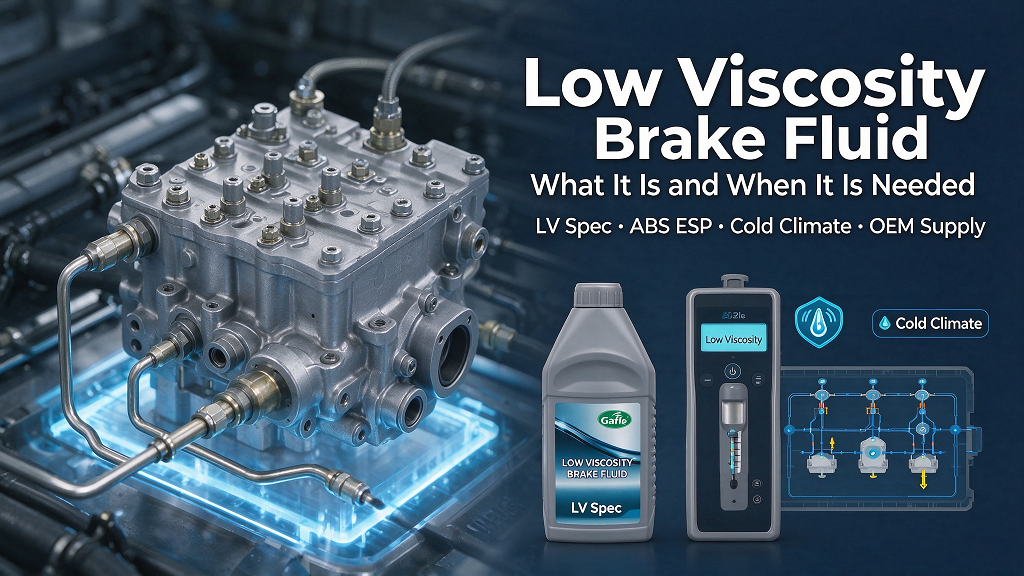
DOT 4 LV / low-viscosity is a market descriptor for products engineered around improved low-temperature fluidity. Some such products also target ISO 4925 Class 6 and relevant manufacturer specifications, but the designations should never be treated as automatically identical. Ask for the promised −40°C viscosity, test method, applicable class, and batch acceptance limit. GAFLE discusses the subject in its low-viscosity ABS/ESC sourcing guide.
DOT 5.1 is a non-silicone grade with higher DOT minimum boiling-point requirements than DOT 4. It may be appropriate for specific high-performance or hydraulic-system requirements, but “higher number” does not mean automatic approval as a replacement for a vehicle's original specification. Product-specific viscosity and OEM evidence still govern selection.
| Commercial range | Main selection rationale | Do not infer from the label |
|---|---|---|
| Standard DOT 4 | Documented fit for specified conventional service | Fitment for all European vehicles |
| DOT 4 LV | A defined lower-viscosity target and qualifying tests | Any particular automaker approval |
| DOT 5.1 | Required DOT 5.1 performance and compatible system | Universal superiority or fitment |
| High-boiling racing formula | Validated extreme thermal-duty requirement | Routine street-vehicle approval |
6. Eight Technical Tests That Matter More Than “Premium” on a Label
Brake fluid is a safety-critical hydraulic medium. Two bottles can have similar promotional claims and different verified results. Engineers should therefore compare the actual test parameters behind the claims.
| Qualification point | Why it matters | Evidence to request |
|---|---|---|
| Dry ERBP | Resistance to vapor formation in fresh fluid | Measured result, method, specification limit |
| ERBP Act | Thermal margin after standardized moisture conditioning | Measured wet result and test conditions |
| Viscosity at −40°C | Cold hydraulic response, relevant to some ABS/ESC systems | Limit, result, unit and test method |
| Viscosity at 100°C | Required fluid behavior at higher temperatures | Grade-related result and tolerance |
| Corrosion resistance | Protection of compatible metallic brake components | Test report covering required metal specimens |
| Elastomer compatibility | Effects on approved brake-system seals and cups | Swelling, hardness and applicable test results |
| Water tolerance and stability | Behavior when moisture and temperature stresses occur | Relevant stability and water-tolerance tests |
| Packaging and contamination control | Preservation of tested product during storage and transport | Seal validation, leak testing, batch traceability |
Dry boiling point is not the whole story
A headline figure such as “high boiling point” is incomplete without distinguishing dry equilibrium reflux boiling point from wet equilibrium reflux boiling point. Common glycol-based fluids absorb moisture over time; the wet test is intended to examine performance after controlled humidification. Real field moisture uptake depends on the system, environment, and maintenance conditions, so a wet test should not be translated into a guaranteed number of months of safe operation.
Cold viscosity is an engineering issue, not a premium-sounding adjective
In electronically controlled hydraulic brakes, pumps and valves must operate as intended across a temperature range. A numerical viscosity result at the required temperature provides more useful evidence than a product name containing “LV.” This is particularly relevant to distributors supplying vehicles exposed to sub-zero winter temperatures.
Corrosion and seal compatibility support long-term reliability
A brake fluid must behave acceptably with the metals and elastomer materials specified for its service category. Do not confuse a generic “rubber-friendly” marketing claim with a formal compatibility test. A strong quotation records the intended vehicle fluid family and the method used to verify the required materials.
7. Match European Driving Conditions to Measurable Fluid Requirements
Geography helps a distributor forecast demand, but climate cannot replace vehicle specifications. Use it to refine a technically valid shortlist, not to justify a substitute fluid.
Cold northern-European service. Low-temperature flow deserves attention in Scandinavian, Baltic, Alpine, and other winter markets. Ask whether the relevant fleet and brake-control systems require a tighter viscosity limit than ordinary DOT 4. Confirm it from vehicle documents rather than assuming all cars in cold countries need Class 6.
High-mileage urban workshops. Frequent service, mixed model years, and technician turnover create a packaging and labeling challenge. A clearly differentiated standard DOT 4 and qualifying low-viscosity range can reduce selection ambiguity when supported by a credible fitment system.
Mountain and high-load driving. Repeated braking can produce significant heat. Verify boiling-point performance and the actual vehicle duty cycle, but avoid implying that boiling point alone solves problems caused by worn pads, incorrect maintenance, or brake-system faults.
Premium and performance repair channels. Porsche, BMW M, Mercedes-AMG, and comparable customer segments may require specialized attention. Document the exact model and approved service fluid before recommending a higher-performance SKU. Racing products and road-service products should have distinct instructions and claims.
8. Build a Fitment Matrix Before Ordering European Car Brake Fluid
A vehicle-fitment matrix is a commercial risk-control tool. It connects one approved or documented fluid option to the customer population that actually needs it, while exposing entries where evidence is still missing.
For every vehicle group, include the make, model, model year, vehicle platform or VIN scope, engine or drivetrain where relevant, brake-system designation, OEM fluid instruction, DOT grade, ISO class if stated, required approval, candidate supplier SKU, supporting document, and fitment status. The final field should distinguish “confirmed,” “requires technical review,” and “not suitable.”
| Illustrative workshop request | What to enter in the matrix | Status before document review |
|---|---|---|
| VW Group vehicle, year not supplied | Request VIN or model/year; retrieve exact brake-fluid instruction | Pending—do not approve |
| BMW workshop requests “DOT 4 ESL” | Identify affected platform and required technical reference | Pending—verify low-viscosity and BMW conditions |
| Mercedes workshop requests “MB 331.0” | Confirm current MB fluid requirement and candidate product evidence | Pending—do not claim MB approval |
| Performance-car workshop requests “racing DOT 4” | Separate track use from street-service requirements | Pending—application-specific review |
Do not convert those illustrative requests into a public fitment promise. The matrix should contain document identifiers and revision dates so technicians and sales teams know what supported each decision. When a service bulletin changes, update only the affected vehicle entries and associated product claims.
A simple approval workflow is: receive vehicle data; retrieve OEM source; define fluid requirements; compare candidate TDS/test reports; validate applicable approval; sign off the matrix; and publish only the approved, scoped application statement. This makes customer service and warranty discussions much easier to manage.
9. Use a Three-Tier SKU Strategy Instead of One “Universal Euro” Bottle
For many aftermarket programs, a practical starting point is three carefully differentiated product tiers, provided that the actual vehicle mix justifies all three.
Tier A: documented standard DOT 4 coverage. Position this product for workshops serving vehicles that explicitly permit the specified DOT 4 fluid. Emphasize transparent specifications, dependable supply, familiar packaging, and repeatable batch quality—not a blanket “all European cars” claim.
Tier B: qualified low-viscosity product. Create a separate SKU for vehicle applications whose documented requirements include tighter cold-temperature viscosity or a specified ISO class. Packaging should spell out the exact supported classification and avoid an unsupported “OEM approved” badge.
Tier C: specialist higher-performance fluid. Add a non-silicone DOT 5.1 or other appropriately validated performance product only where your customers need it. Keep specialty road-service and motorsport claims distinct; they may demand different usage and service instructions.
For a smaller importer, starting with two rigorously documented SKUs may be better than launching five overlapping bottles. The correct measure is not shelf width. It is how reliably each SKU maps to real repair jobs and how few ambiguous substitutions it creates. A well-designed portfolio can simplify technician training, wholesale ordering, and inventory forecasting.
10. How GAFLE Products Can Enter a European-Car Sourcing Shortlist
GAFLE is a China-based automotive-fluid manufacturer with a published brake-fluid product portfolio covering DOT grades, OEM options, and application-oriented products. For a European importer or private-label project, those website listings are useful starting points for a technical inquiry, not proof of vehicle-specific OEM approval.
| GAFLE web entry | Public positioning | What the buyer should request before using it in a European range |
|---|---|---|
| DOT407 | DOT 4 brake fluid for hydraulic brake and clutch systems | Current TDS/COA, actual ERBP, viscosity, applicable standards and fitment scope |
| DOT 4 category | DOT 4 product portfolio | Exact model selection, differentiated performance targets and packaging options |
| Brake Fluid portfolio | DOT 3, DOT 4, DOT 5.1 and specialized/OEM categories | Candidate low-viscosity or Class 6/Class 7 SKU and proof for the specified requirement |
| OEM manufacturing overview | Private-label and OEM project capabilities | Formula sign-off process, samples, packaging, quality agreement and commercial quotation |
The strongest use of the GAFLE range is to build an evidence-backed shortlist. Start from the customer vehicle matrix, then ask GAFLE which current SKU is designed around that requirement and which reports support the claim. If a requested VW, BMW, Mercedes-Benz, Porsche, or other original-equipment approval cannot be documented, the product must not be advertised as holding that approval.
GAFLE also discusses controlled manufacturing and cleanliness in its brake-fluid production quality overview. Those manufacturing themes are relevant to repeatable supply, but each order should still be supported by product-level tests and the agreed batch acceptance criteria.
11. “Meets,” “Recommended for,” and “Approved”: Three Claims You Must Keep Separate
Commercial copy for European Car Brake Fluid often fails because different technical statements are presented as synonyms. They are not.
“Meets DOT 4” is a manufacturer's conformity claim against the specified DOT requirements. Request relevant test evidence and confirm the label's legal correctness in the target market.
“Suitable for a vehicle application” is a fitment statement that needs a documented basis for the vehicle and usage conditions. It is more specific than a general grade claim, and the supporting evidence must cover the intended application.
“Approved to VW 501 14” or “MB 331.0 approved” implies an actual approval or authorization under the relevant manufacturer's process. Do not print those words unless a current, authentic approval exists for the exact formulation and its permitted application.
A supplier may design a formulation toward an OEM specification without holding a formal OEM approval. That can still be a legitimate engineering project, but the sales presentation must accurately describe its status. The distinction protects brand credibility, minimizes rejected tenders, and reduces the risk of misleading workshop customers.
12. EU Market Readiness: Product Testing Is Not the Entire Import File
Selling a brake-fluid mixture in the European Economic Area creates responsibilities beyond performance testing. Importers need to assess obligations under applicable REACH and CLP legislation, taking account of the actual mixture, substances, classification, volumes, distribution route, and destination countries. Do not rely on a supplier's generic promise that a product is “EU compliant.”
The EU importer or other responsible economic operator should verify the applicable substance-registration position; the mixture's hazard classification; required CLP label elements and language(s); an accurate, up-to-date safety data sheet when required; and any applicable poison-centre notification and UFI obligations. The exact requirements depend on formulation, classification, role, and market. A brake-fluid performance test report is not a substitute for chemical regulatory assessment.
Likewise, avoid implying that brake fluid must universally carry a CE mark or that a DOT grading statement alone proves EEA market access. Those are different regulatory concepts. If a retailer or large workshop network asks for compliance declarations, clarify exactly which regulation or buyer specification it means.
Country-specific artwork also deserves a controlled approval process. The front label, hazard panels, safety wording, nominal quantity, batch code, importer information, and disposal instructions may need review before printing. If importing to the UK or another non-EEA market, check that market's separate rules rather than copying EU label text unchanged.
13. Packaging Design: Protect the Fluid and Protect the Brand
Packaging is not an afterthought in brake-fluid procurement. Common glycol-based fluids are hygroscopic, so unnecessary moisture exposure and poor sealing can undermine the condition of the product delivered to a workshop. Effective packaging protects both the fluid and the buyer's ability to identify it correctly.
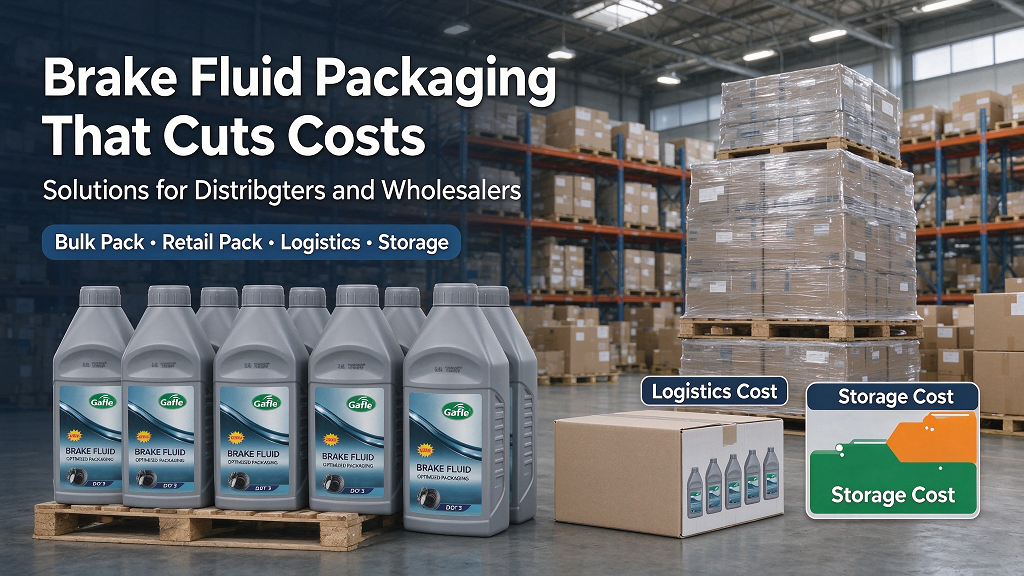
A private-label project should specify the bottle material, closure, inner seal, tamper-evident feature, fill-volume tolerances, batch and production-date coding, label durability, carton strength, and palletization method. Review how the package performs during storage, container transport, handling, and repeated warehouse picking. Ask for agreed tests and evidence rather than accepting a photograph of a neat bottle as packaging qualification.
Typical aftermarket formats can include smaller service bottles and workshop-oriented packs, depending on the verified product and manufacturer offering. The right size depends on expected consumption per job, the workshop's fluid-handling equipment, local labeling rules, and the risk of leaving opened product in service bays. Confirm actual available capacities with the factory rather than assuming every format is stocked.
For a European-car range, make product differentiation obvious. A low-viscosity product and a conventional DOT 4 product should not be visually interchangeable when they serve different documented requirements. Use clear naming, consistent color systems, accurate technical panels, and scannable product codes. Packaging architecture is a safety and conversion tool: it can make correct selection easier at the counter and help the brand earn repeat business.
14. Quality Assurance: What to Request Before a Bulk Order
For a safety-related fluid, supplier evaluation should be performed at SKU and batch level, not only at company brochure level. Quality-system certificates may support confidence in management processes, but they do not replace the performance evidence for a particular brake-fluid formulation.
Ask for a Technical Data Sheet (TDS) describing product characteristics and performance claims; a Safety Data Sheet (SDS) appropriate to the mixture and market; test reports against specified standards; a Certificate of Analysis (COA) or defined batch release document; packaging specification and label artwork; and a written process for managing formulation changes, deviations, and complaints.
| Document or process | Minimum procurement question | Acceptance gate |
|---|---|---|
| TDS | Which grade, class, values and edition does this SKU claim? | Matches signed product specification |
| Standard test reports | Are methods, results, sample identity and dates traceable? | Results cover all critical requirements |
| COA / batch release | Which batch-specific results will ship with the order? | Agreed critical limits satisfied |
| Quality-system evidence | Which facility and activities does the certificate cover? | Relevant, current scope confirmed |
| Change control | Must the buyer approve formula, source or package changes? | Written notification and approval rules |
| Packaging qualification | Are closures, seals and labeling verified? | Approved production pack and inspection plan |
| Traceability | Can a distributed bottle be traced to a production lot? | Demonstrated coding and record retention |
| Nonconformance response | Who handles complaint samples and root-cause analysis? | Timeframes and responsibilities agreed |
When evaluating GAFLE, use its factory and quality-control information as discussion material, then ask the team to confirm which methods, records, and certificates are available for your exact selected product. Do not invent batch test values or assume a displayed certificate applies to every product category.
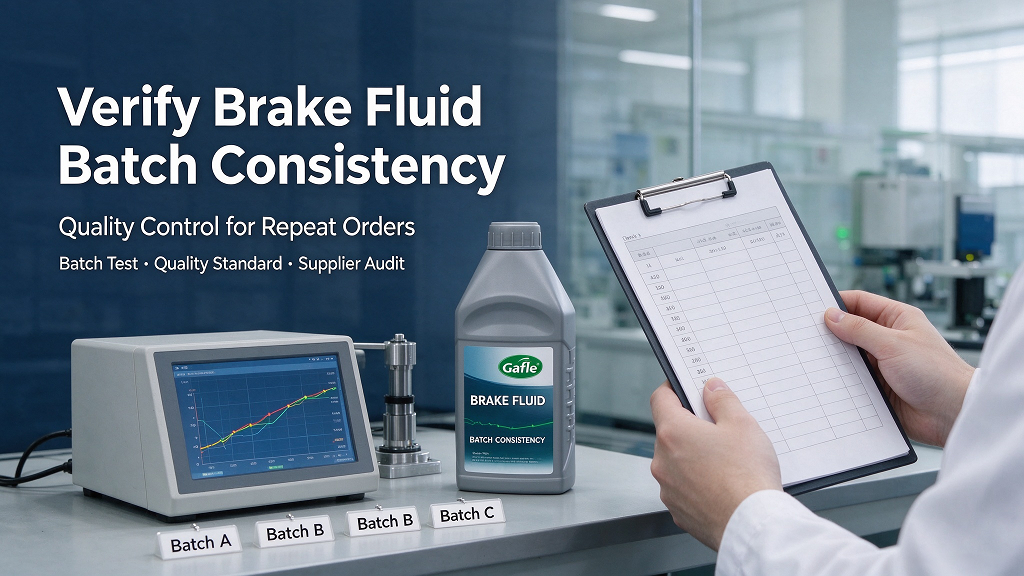
An important commercial safeguard is a golden-sample agreement. Retain an approved sample and its specification reference, then define how routine production will be compared with it. Packaging artwork, fluid performance, seal integrity, and batch identification should remain consistent unless a documented change has been accepted.
15. Compare Total Landed Cost, Not Just the Ex-Factory Bottle Price
A European Car Brake Fluid program can look inexpensive at the quotation stage and become costly after shipping, packaging defects, translation changes, inventory fragmentation, or customer returns. A fair comparison must normalize supplier offers to the same technical and commercial scope.
The meaningful cost equation is: landed product cost + compliance and testing cost + packaging/label cost + inventory carrying cost + expected quality and return exposure. No responsible supplier can estimate all those values without knowing the requested formula, pack size, order quantity, logistics terms, destination, and documentation requirements.
At minimum, compare the following: exact grade and performance specification; whether an OEM approval is included or merely discussed; bottle and cap materials; print and label specifications; test-report scope; MOQ by SKU and artwork; sample-development cost; lead time after approval; shipping terms; and the cost of managing changes or failed batches. A cheaper quote against a weaker specification is not evidence of better value.
Illustrative decision scenario—not a reported customer case: Supplier A offers a low bottle price but no approved low-viscosity evidence for the requested workshop fleet. Supplier B is slightly more expensive but provides the required test data, a controlled label, and signed batch limits. The second offer may represent lower commercial risk, even before a formal landed-cost model is completed. The correct comparison uses the customer's real return rates and operating costs rather than invented savings percentages.
16. OEM / Private-Label Development: From Vehicle Brief to Shelf-Ready Range
A high-conversion private-label program starts with a technical vehicle brief, not a logo file. The brand owner should describe the target countries, intended vehicle population, supported applications, desired product positions, forecast volume, packaging preferences, and documentary requirements.
A practical development sequence is:
- Market and fleet review: compile the vehicle mix and identify service requirements with documentary support.
- Technical target confirmation: approve grade, class, test methods, OEM-specification objectives, and claims that must be substantiated.
- Manufacturer shortlist: request existing product options and determine whether a custom formulation is genuinely needed.
- Sample and laboratory review: compare the candidate fluid with the agreed specification; record discrepancies before commercial approval.
- Packaging and artwork design: validate bottle, closure, label translations, legal panels, claims, and carton requirements.
- Commercial quotation: confirm MOQ, sample costs, production timing, Incoterms, agreed documentation, and any change-control charges.
- Pilot or first-batch release: inspect fluid results, packaging and traceability against the approved master specification.
- Repeat-order management: track complaints, revisions, forecast changes, periodic testing, and customer feedback.
GAFLE describes OEM and private-label production capabilities on its OEM brake-fluid manufacturing page. The precise level of customization, MOQ, validation plan, packaging availability and delivery timing should be confirmed through a project quotation rather than assumed from general marketing material.
17. Supplier Audit: Ten Questions That Expose Weak European-Market Offers
During supplier qualification, detailed questions reveal more than broad statements about being a “leading manufacturer.” Ask for written answers, named documents, and an owner for each action.
- Which exact OEM vehicle requirements are you proposing to cover, and what is the evidence for that scope?
- Which standards, editions, grades, classes and test methods are listed in the signed product specification?
- What are the guaranteed production limits for dry ERBP, wet ERBP, and low-temperature viscosity?
- Can you provide recent, traceable performance evidence for the actual candidate formulation?
- Do any proposed labels claim formal automaker approval, and can you document that status?
- What are your incoming-material, blending, filling, and contamination-control procedures?
- Which batch-specific release results and lot codes will accompany shipments?
- Who reviews REACH/CLP, SDS, language, artwork and importer-information requirements?
- What changes to formulation, materials, suppliers or packaging require buyer notification or approval?
- What are the agreed commercial rules for MOQ, first order, lead time, complaints, returns and corrective action?
A defensible sourcing scorecard can allocate substantial weight to technical conformity and documentary evidence, followed by batch consistency, compliance readiness, packaging, commercial delivery and support. The allocation should match the buyer's risk profile. Avoid using a single arbitrary “supplier quality score” if the underlying evidence is missing.
18. Tailor the Range to European Aftermarket Channels
“Europe” is a large, diverse procurement destination. The best assortment for a specialist German-car workshop chain may not match a mixed-brand distributor in Central Europe, a Nordic retailer, or a performance-focused service business.
Independent repair networks benefit from clear vehicle selection rules, practical pack sizes and dependable repeat supply. Premium marque specialists need current OEM-specification references and are less tolerant of unsupported compatibility language. Parts wholesalers focus on predictable SKU mapping, stock turnover and trade documentation. Private-label brands need an approved artwork system and a long-term manufacturer relationship. Cold-weather channels may place extra emphasis on a qualified low-viscosity line where the fleet requires it.
Segment content and catalogs by verified use case rather than using the same generic “European formula” copy in every market. When expanding into a new country, update regulatory language and vehicle-mix assumptions before reusing a label or landing page.
19. Workshop Service and Storage Rules Buyers Should Communicate
A fluid that meets a specification can still be misused. Distributors and brand owners should provide instructions consistent with the relevant vehicle manufacturer and product SDS. Technicians should consult the vehicle service procedure before flushing, topping up, or replacing the fluid, especially in electronically controlled braking systems that may require specialist bleeding equipment.
Keep brake fluid clean, dry, and in properly closed original packaging. Do not reuse contaminated product or mix unknown fluids. Do not substitute silicone DOT 5 for a system intended for conventional glycol-based brake fluid, and do not confuse DOT 5.1 with DOT 5. Where an OEM sets service intervals, follow those intervals; neither an exceptional dry boiling point nor a “long life” product name automatically extends them.
These instructions support quality and reduce complaints, but the blog should not substitute for technician training or vehicle-specific repair documentation.
20. Copy-Ready European Brake Fluid RFQ Template
A detailed first inquiry saves time because the manufacturer can respond against a clear performance and commercial brief. Buyers can adapt the following structure for a real project.
Project: European passenger-car aftermarket brake-fluid range; proposed private-label or GAFLE-brand supply.
Destination markets: [Countries and distribution channels].
Vehicle population: [Makes, models, platform codes, model years or VIN scope, monthly service volumes].
Proposed product tiers: [Standard DOT 4 / qualified low-viscosity product / specialty fluid, subject to validation].
Required technical claims: [Exact OEM fluid instruction, standard and edition, class/grade, target viscosity at −40°C, dry and wet ERBP, compatibility conditions].
Required evidence: [TDS, SDS, recent standard tests, approval evidence where claimed, COA sample, traceability plan].
Packaging: [Pack sizes, bottle/closure requirements, tamper evidence, labels, languages, artwork files, carton quantities].
Compliance: [REACH/CLP responsibilities, importer details, SDS language, any required notifications, product-claim review].
Commercial requirements: [Forecast, MOQ by SKU, target first-order quantity, quotation currency, Incoterm, destination, lead-time target].
Quality agreement: [Batch limits, change control, pre-shipment sampling, claim investigation process, approval responsibilities].
Requested supplier response: Please identify proposed product codes; distinguish verified conformity from pending tests or OEM approvals; provide document availability; and quote available packaging options. If any requested fitment or approval cannot be substantiated, mark it “pending” rather than approximating the claim.
The result is a better buying conversation. Instead of receiving a generic DOT 4 price, the importer can compare technically equivalent offers and see the work remaining before a product is ready for the European aftermarket.
21. Common Mistakes That Cause Returns, Rework and Lost Workshop Trust
The most damaging mistake is assuming DOT 4 equals universal European-car compatibility. The next is copying a competitor's OEM approval list without reviewing the actual manufacturer's document. Closely related errors include treating a marketing term such as “Plus” or “LV” as a recognized independent grade; ignoring measured cold viscosity; quoting only dry boiling point; and omitting material compatibility testing.
Commercial mistakes are just as expensive. Approving labels before the technical scope is final can force artwork changes after printing. Failing to identify the importer’s chemical-regulatory responsibilities can delay market entry. Buying a broad SKU range without a verified vehicle matrix creates slow-moving inventory. Ordering against a golden sample without a signed change-control procedure makes later disputes harder to resolve.
The practical correction is simple, although it requires discipline: one document-controlled specification per SKU, one verified application scope, one approved label, and one traceable batch release process. That structure protects the supplier and the distributor alike.
22. Technical Reference Basis and Evidence Boundaries
This guide uses several recognized reference families that buyers should verify from the original issuing organizations when preparing contracts or technical claims. The key references are 49 CFR §571.116 / FMVSS No. 116 (Motor Vehicle Brake Fluids) for DOT performance and labeling; ISO 4925:2026 (Road Vehicles—Specification of Non-Petroleum-Based Brake Fluids for Hydraulic Systems) for brake-fluid classes and methods; relevant vehicle-manufacturer service information, including Volkswagen vehicle manuals referencing VW 501 14, the BMW Brake System Service technical training material concerning DOT 4 ESL, and the Mercedes-Benz Operating Fluids MB 331.0 sheet; and European Chemicals Agency (ECHA) guidance on REACH and CLP importer obligations. These references are identified by name rather than linked externally so the article's clickable links remain exclusively on the GAFLE website.
Standards change and the full technical or legal text may be subject to restrictions. Verify the current edition and market-specific interpretation before issuing specifications or artwork. None of these references establishes an approval for any GAFLE SKU unless that approval is supported by a separate, valid document for the exact product.
23. Frequently Asked Questions About European Car Brake Fluid
1. What brake fluid do most European cars use?
Many European passenger cars use a specified non-silicone DOT 4-family fluid, but there is no single universal answer. Some vehicles require a lower-viscosity formulation or a named OEM specification. Confirm the exact vehicle, model year and service instructions before selecting a product.
2. Is DOT 4 brake fluid suitable for all BMW, Audi and Mercedes-Benz vehicles?
No. DOT 4 is a performance grade, not a model-wide fitment certificate. Particular BMW/MINI, VW/Audi and Mercedes-Benz platforms can have additional manufacturer or viscosity requirements. Use current model-specific service information and validated product evidence.
3. What is the difference between DOT 4 and DOT 4 LV?
DOT 4 identifies a formal brake-fluid grade. DOT 4 LV is a commercial description normally used for formulations targeting lower viscosity, especially at cold temperatures. A true sourcing specification should include the numerical viscosity target, test method and any required ISO class; the words “LV” alone are insufficient.
4. Does ISO 4925 Class 6 mean that a fluid is approved by Volkswagen?
No. ISO Class 6 and a vehicle manufacturer's specification are separate references. Certain Volkswagen service documents discuss VW 501 14 and conditional alternatives, but the applicability depends on the exact vehicle and instruction. A seller must have evidence before claiming Volkswagen approval.
5. Can DOT 5.1 replace DOT 4 in a European car?
Do not assume so. DOT 5.1 is a non-silicone brake-fluid grade with different minimum performance requirements, but substitution depends on the brake-system specification and manufacturer instructions. Always check the approved fluid family and documented compatibility before changing grades.
6. Is a higher dry boiling point enough to select premium brake fluid?
No. Wet boiling point, viscosity, corrosion, elastomer compatibility, stability, and quality consistency also matter. For vehicles with advanced hydraulic controls, low-temperature viscosity may be a decisive requirement. Evaluate the complete performance profile rather than one headline value.
7. What documents should a European brake fluid importer request?
Request the current technical data sheet, safety data sheet, relevant test reports, batch COA or release plan, packaging specification, product labeling, and any genuine OEM approval evidence. The importer should separately review REACH/CLP obligations and destination-market language requirements.
8. Can GAFLE manufacture private-label brake fluid for European-car aftermarket brands?
GAFLE publicly describes brake-fluid OEM and private-label manufacturing options. A buyer should submit the required product grades, technical targets, vehicle markets, packaging concept and volumes, then confirm formulation availability, documentation, MOQ and lead time directly with GAFLE before placing an order.
9. How should distributors choose between standard DOT 4, DOT 4 LV and DOT 5.1 SKUs?
Start with an audited vehicle-fitment matrix and actual workshop demand. Add a SKU only when it satisfies a distinct, supported group of service applications. Prefer a smaller, well-documented range to overlapping products with vague fitment claims and uncertain stock turnover.
10. What should I include when requesting a European Car Brake Fluid quotation?
Provide destination country, customer channel, vehicle population, required grade/class and OEM specifications, target performance values, packaging format, expected order quantity, documentation requirements and desired shipping terms. Ask the supplier to identify which claims are verified and which remain subject to testing or approval. You can send the brief through GAFLE's contact page.
Conclusion
Sourcing European Car Brake Fluid successfully is not a matter of choosing the bottle with the highest DOT number or the broadest list of European car logos. It is a disciplined fitment and evidence exercise: identify the vehicle requirement, translate it into measurable performance and documented approvals, validate the fluid and packaging, and maintain control across every repeat order. For importers and distributors, that approach reduces specification confusion and supports a more credible, profitable aftermarket range without promising compatibility that cannot be proven.
GAFLE's published brake-fluid range and OEM manufacturing capabilities provide a starting point for European-market product development. Share your target countries, vehicle families, technical requirements, preferred packaging and estimated purchase volumes through the GAFLE inquiry page. Ask for the relevant product documentation and a project-specific quotation before approving any vehicle-fitment or OEM-approval claim.