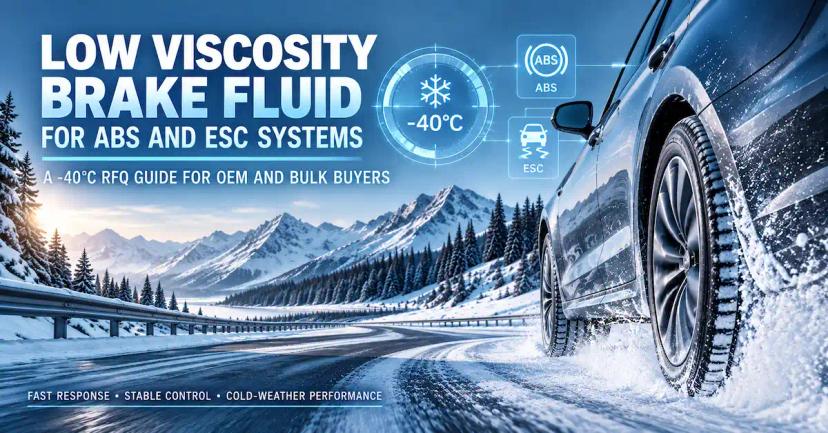
Low Viscosity Brake Fluid is often requested with only three words: “DOT 4 LV,” “for ABS,” or “winter fluid.” A purchasing team cannot approve any of those requests as written. Someone still has to fill in the temperature and method beside the viscosity limit. The file also needs the required DOT grade or ISO class, the vehicle requirement, and proof that ordinary production batches will stay inside the agreed window.
Here is the snag: low viscosity describes a measurement, not an independent brake-fluid grade. Two products carrying a DOT 4 claim may post quite different results at -40°C. A handsome cold figure can also sit beside a weak result elsewhere. The 100°C viscosity still counts, as do boiling behavior, corrosion protection, stability, effects on elastomers, and fit with the specified hydraulic system. The buyer is choosing the whole fluid, not one winning row in a spreadsheet.
This guide is written for vehicle programs, aftermarket importers, private-label brands, fleets, distributors, and buyers of drums or IBCs. It shows how to turn an ABS or ESC cold-response need into an enforceable request for quotation. It also separates public product-page information from documents that can support approval: a current technical data sheet, named methods, a signed master specification, qualification results, a certificate-of-analysis plan, and evidence tied to the actual lot.
The figures below are standard thresholds and reference values, not claimed test results for a named GAFLE product. Always follow the current vehicle or system-maker instruction. Destination-market law, the exact product documents, and a controlled validation program take precedence over a generic “low viscosity” label.
The sixty-second Low Viscosity Brake Fluid buying answer
Buy against the vehicle requirement and a complete, testable specification. State the maximum kinematic viscosity at the required temperature, name the method and standard edition, confirm the permitted chemistry and grade, then protect hot-temperature viscosity, dry and wet boiling performance, material compatibility, and batch control. For an ABS or ESC application, a low cold-viscosity result is relevant evidence; by itself it is not proof of faster stopping, universal system fit, or compliance with an OEM requirement.
A practical approval has five gates. First comes system permission: the exact vehicle, model year, controller, and service information must allow the fluid. Second is cold performance expressed as a numeric maximum at a stated temperature. Third is balance across the rest of the fluid profile. Fourth is repeatability, demonstrated through controlled samples, a production specification, and lot records. The final gate is delivery integrity. Brake fluid that absorbed moisture through open transfer, an unsuitable closure, or careless dispensing is no longer in the same condition as the sealed laboratory sample.
| Approval gate | Question to close | Useful evidence | Reason to stop |
|---|---|---|---|
| Vehicle and controller fit | What does the current manual, service data, or written OEM requirement permit? | Model-year application matrix and controlled technical requirement | Only a universal “ABS compatible” statement is offered |
| Cold-flow limit | Maximum viscosity at which temperature, by which method and edition? | Signed limit, method, dated report, sample identity, and COA plan | A “low” result appears without temperature, units, or status |
| Complete performance | Are hot viscosity, boiling, stability, corrosion, and materials also acceptable? | Current TDS, qualification file, and applicable conformity evidence | One cold number is presented as the entire specification |
| Production repeatability | Will the shipped lot match the sample that passed? | Formula revision, batch record, release result, COA, and retained sample | The sample and quotation carry different or unexplained codes |
| Delivery protection | Can filling, freight, storage, and dispensing keep the fluid sealed and dry? | Approved pack, closure control, dry-transfer procedure, and traceability | Bulk transfer and opened-container handling are undefined |
These gates make quotations easier to compare because they separate four statements that are often blended together: a marketing description, a representative laboratory result, a guaranteed production limit, and legal conformity. Each can be legitimate, but they answer different questions. A buyer should know which one is on the page before assigning it contractual weight.
A viscosity number needs a temperature, method, and acceptance rule
On most brake-fluid data sheets, kinematic viscosity appears in square millimetres per second, or mm²/s. Laboratory staff may call the same unit centistokes. Temperature is what gives the figure meaning. A -40°C reading describes a completely different condition from a 100°C reading. Put only “700 mm²/s” in an RFQ and every bidder is left to guess what the buyer intended.
The method matters for the same reason. An RFQ should identify the applicable standard and edition, or another agreed method detailed well enough for both parties to reproduce. Record the sample condition, equipment requirements, calculation, reporting precision, and any allowed repeat. When a buyer accepts “tested according to our internal method,” the method should be supplied, reviewed, and frozen. A private method that can change after approval is not a stable acceptance criterion.
A third qualifier is whether the figure is typical or guaranteed. A typical value describes expected or representative performance; it is not automatically the release boundary for every batch. A maximum written in the signed specification is enforceable only when the measurement method, rounding rule, sampling point, and disposition process are also agreed. For cold viscosity, the commercial requirement normally works as an upper limit: results must not exceed the stated value. Hot viscosity is often expressed as a lower limit. Mixing those directions in one unlabeled spreadsheet is an easy way to approve the wrong bid.
Test uncertainty and normal production variation deserve a short conversation before the first sample. Suppose the contract maximum sits directly on a supplier's historical average. A sample may pass while ordinary batches move above the limit. Ask for representative production data or a capability discussion, not only the best development result. Agree what happens when an initial measurement is near or over the line: which sample is retested, how many determinations are allowed, whose laboratory is decisive, and whether material remains on hold during the review.
Lower is not automatically better. A very low -40°C result can be desirable where the vehicle maker requires it, yet the formula still has to meet the hot-viscosity floor and every other applicable requirement. The proper target is not “the lowest number available.” It is a production-capable window that matches the system, climate, and standard without sacrificing the rest of the profile.
| Statement received | What is missing | Question to return | Contract-ready wording |
|---|---|---|---|
| “Low viscosity: 700” | Units, temperature, method, sample, and limit status | Is this mm²/s at -40°C, and is it typical or maximum? | Kinematic viscosity at -40°C: maximum X mm²/s by named method |
| “DOT 4 LV” | LV is not a separate FMVSS grade and has no stated limit here | Which DOT 4 and cold-viscosity requirements are independently guaranteed? | Manufacturer-certified DOT 4 conformity plus a separately stated cold limit |
| “Suitable for ABS” | Vehicle, controller, temperature range, and approval basis | Which exact application and technical requirement support the statement? | Approved only against the attached model-year application matrix |
| “Synthetic formula” | No numeric cold result or conformity evidence | What does the offered formula measure, and what is guaranteed? | Claim wording plus separate measurable specification and substantiation file |
| “Report available” | Identity, date, method, laboratory, formula revision, and lot link | Does the report belong to the exact product and sample being quoted? | Dated report code tied to sample, formula, method, and approval record |
Why ABS and ESC make cold-flow evidence relevant
An anti-lock braking system can command rapid pressure changes to manage wheel slip. Electronic stability control may request selective brake intervention as part of yaw control. Open a hydraulic-unit drawing and, depending on the vehicle, you may find pumps, valves, accumulators, and rather small fluid passages. Cold makes the fluid thicker. That is why a vehicle developer may write a tighter cold limit than the broad ceiling attached to a general grade: the hydraulic behavior after an overnight soak still has to remain inside the controller's validated range.
That relationship has a clear boundary. A low bench result is not a stopping-distance test. Put the same fluid in two vehicles and tire grip, pavement, hardware, control calibration, load, driver input, temperature, and maintenance condition can all change the outcome. One laboratory value cannot clear every ABS or ESC unit either. It does something more modest and useful: it helps the buyer check the stated fluid requirement for a named application.
A search for Low Viscosity Brake Fluid for ABS and ESC Systems ought to end with a model-year decision, not a universal recommendation. Begin with the vehicle range. Add the hydraulic-control supplier or system code if it is available, then the manual requirement, permitted grade or OEM specification, lowest start temperature, and service procedure. Keep different fleet generations on separate rows until someone has shown that their requirements really match.
Cold climate is only one reason to ask. Some modern brake architectures and OEM specifications control cold viscosity even in temperate markets. At the other extreme, a buyer operating in severe winter conditions cannot invent a substitution merely because another fluid has a lower published number. The approved fluid family and specification still govern. When the requested product differs from current service material, document who authorized the change, whether mixing is permitted, and what flushing or filling procedure applies.
A useful qualification request separates bench evidence from vehicle evidence. Bench testing can confirm viscosity and other fluid properties for an identified sample. Component, dynamometer, cold-chamber, or vehicle testing can address system-specific behavior if the program requires it. Supplier literature should not quietly turn the first category into the second. Ask exactly which evidence exists, what configuration was tested, and whether the result was qualification-only or part of routine production control.
FMVSS grades and ISO classes answer different parts of the question
U.S. buyers can check the public rule directly at 49 CFR §571.116, FMVSS No. 116. The few thresholds reproduced below show why the DOT label and a tighter cold target belong in separate columns. They are only part of the rule. Use the regulation itself for the full requirements and procedures.
| FMVSS label family | Minimum ERBP | Minimum wet ERBP | Maximum viscosity at -40°C | Minimum viscosity at 100°C |
|---|---|---|---|---|
| DOT 3 | 205°C / 401°F | 140°C / 284°F | 1,500 mm²/s | 1.5 mm²/s |
| DOT 4 | 230°C / 446°F | 155°C / 311°F | 1,800 mm²/s | 1.5 mm²/s |
| DOT 5 / DOT 5.1 | 260°C / 500°F | 180°C / 356°F | 900 mm²/s | 1.5 mm²/s |
The table exposes a point that surprises many purchasers: the general DOT 4 ceiling shown here is not tighter than the DOT 3 ceiling. A buyer cannot infer a Class 6-type cold result from the words DOT 4 alone. When a vehicle requires a tighter limit, write that additional limit into the RFQ and ask the supplier to show both the DOT 4 conformity basis and the separate cold-viscosity evidence. The common market phrase Low Viscosity DOT 4 Brake Fluid can be useful shorthand, but the signed documents must translate “LV” into a number, temperature, method, and production commitment.
Avoid “DOT approved” on the label or in the sales file. FMVSS No. 116 supplies the requirements and labeling provisions; conformity is certified by the manufacturer. This is not wordplay. It keeps responsibility clear in private-label artwork and importer records. A declaration and its test file can support the claim, while a logo or a sales phrase cannot replace them.
Keep DOT 5 and DOT 5.1 in different boxes. In FMVSS language, DOT 5 is silicone-base fluid; DOT 5.1 is non-silicone. That decimal has consequences. It is not permission to interchange the two or pour one on top of the other. Check what chemistry is already in the circuit, then follow the vehicle procedure for any mixing, flush, or conversion decision.
International and OEM programs may also reference ISO 4925:2026. It is the fourth edition; ISO has withdrawn the 2020 edition. Class 6 sets 750 mm²/s as the -40°C maximum, alongside minimum ERBP of 250°C and minimum wet ERBP of 165°C. Class 7 uses the same cold ceiling. Its boiling minimums are higher: 260°C ERBP and 180°C wet ERBP. A class reference therefore tells a buyer far more than an unsupported “LV” suffix, although the complete standard remains controlling.
Published product references can help a buyer understand how established suppliers present the class concept. For example, the ATE DOT 4 SL.6 technical data sheet identifies ISO 4925 Class 6, while the Bosch ENV6 product information illustrates an aftermarket low-viscosity positioning. They are useful third-party references, not specifications for GAFLE products and not permission to substitute one fluid for another.
Cold flow must remain balanced with hot viscosity and the full fluid profile
A sound High Performance Low Viscosity Brake Fluid specification treats cold flow as one part of a linked system. At high temperature, sufficient viscosity must remain. The formula must meet the applicable dry and wet equilibrium reflux boiling-point thresholds, resist excessive change during stability testing, control corrosion across specified metals, and behave acceptably with relevant rubber components. Water tolerance, fluidity, pH, evaporation, and other requirements may apply according to the claimed standard. Selecting only the lowest cold result is like approving a tire from one dimension.
Fresh ERBP and wet ERBP answer different questions. ERBP describes new fluid tested under the prescribed reflux procedure. Wet ERBP follows controlled humidification. Under FMVSS No. 116, the candidate fluid and SAE TEGME referee material are humidified separately in paired desiccators; the referee's average water content determines the stopping point, after which the candidate samples are measured. It is inaccurate to describe the test as simply adjusting every candidate to exactly 3.7 percent water. For procurement, cite the method rather than replacing it with a workshop shortcut.
Chemistry labels need the same discipline. The words Synthetic Low Viscosity Brake Fluid may describe product positioning, but “synthetic” does not disclose a -40°C value, prove an ISO class, or establish vehicle compatibility. Put the actual test result beside the controlled document that governs it. Two glycol-ether-based products can carry the same synthetic wording and still differ in additive package, supported claims, or OEM permission.
The package belongs in the technical review. Brake fluid takes up moisture, and the approved result came from a sealed sample at a particular time. A loose cap, torn foil, open drum vent, damp transfer line, or workshop bottle opened again and again can alter the material before it reaches a reservoir. Define the closure, seal check, relevant filling controls, shelf-life basis, storage limits, and practice for opened packs. In a slow-moving service network, smaller bottles may preserve more usable fluid than a cheaper large container.
Write compatibility down instead of leaving it implied. Confirm the base-fluid family, vehicle instruction, and any OEM standard. Silicone fluid, glycol-based fluid, mineral hydraulic oil, petroleum products, cleaners, and water-controlled laboratory materials need separate handling. Use dedicated equipment or document that it was cleaned and verified. Otherwise, the line itself can contaminate a formulation that looked perfectly sound in the original sample.
Build the vehicle, controller, and climate matrix before asking for price
A short application matrix usually produces a useful quotation faster than a long generic email. Give the make, model, year, market, and exact requirement found on the reservoir cap or in the owner's or service information. Where it is known, note whether the vehicle uses conventional hydraulic brakes with ABS/ESC, electro-hydraulic actuation, integrated brake control, or another layout. Record the coldest credible soak, not an annual average. Two vans in the same city face different starts when one sleeps outside and the other spends the night in a heated workshop.
Then describe duty and maintenance. Note gross mass, route, gradients, stop frequency, towing, regeneration strategy where relevant, service interval, current fluid, fill procedure, opened-pack turnover, and any recurring brake-system observations. Electric vehicles should be treated as specific applications, not a single fluid category. Their brake architectures, OEM requirements, regenerative-braking strategies, and service instructions differ. “For EV” is no more complete than “for ABS.”
| Application | Facts to collect | Cold-flow decision | Other gates | Common error |
|---|---|---|---|---|
| Airport ground fleet with outdoor winter parking | Vehicle IDs, overnight soak, minimum start temperature, low-speed duty, service data | Set the maximum at the required test temperature from the controlling specification | Model permission, moisture control, pack turnover, lot COA | Using regional average temperature instead of cold-soak exposure |
| Aftermarket importer covering several model years | Market, make, model, year, manual grade, OEM code, controller generation | Create separate approved rows until requirements are shown to match | Label claims, language, importer duties, application data maintenance | Turning “DOT 4” into one universal fitment list |
| Private-label program for cold and temperate markets | Country set, vehicle mix, claims, volume, pack sizes, channels, forecast | Choose one justified specification or control regional SKUs explicitly | Artwork approval, change control, pilot lot, shelf life, logistics | Printing an LV claim before formula and evidence are frozen |
| Modern electric or hybrid vehicle | Exact platform, brake architecture, OEM fluid code, service procedure, climate | Follow the platform requirement; do not infer it from propulsion type | Materials, control validation, service interval, sealed handling | Assuming every EV needs the same brake fluid |
The matrix also exposes commercial choices early. An importer may discover that one formula can cover the approved application set but needs two labels. A fleet may find that smaller bottles reduce opened-pack waste. A private-label buyer may learn that the cold-market claim needs an additional test and a longer approval schedule. These are cheaper discoveries in the RFQ than after artwork, production, or shipment.
Turn the requirement into an enforceable RFQ
“Low viscosity” is not a complete purchasing specification. A useful RFQ states what the fluid must do, how each result will be measured, and which evidence will be accepted. Without those details, one bidder may quote a typical development value, another a guaranteed production limit, and a third a catalogue phrase with no numerical support. The prices sit in adjacent spreadsheet columns even though the offers are technically different.
Start with the controlling requirement. List the vehicle platforms, model years, brake-control architecture, destination climates, current fluid, and OEM document. Where a statutory or consensus standard applies, record its full designation, edition, grade, and class. “DOT 4 LV” is common market language, but it is not a separate FMVSS grade. DOT 4 conformity does not automatically create an ISO Class 6 claim, and an ISO class does not establish approval for a particular vehicle.
Every viscosity entry needs the numerical limit, temperature, named method, units, and status. “Maximum kinematic viscosity at -40°C” can be a contract limit; “typical viscosity” is descriptive unless the supplier separately commits to it. Ask bidders to disclose method deviations and to use the same reporting units. Include the minimum at 100°C, ERBP, wet ERBP, and the rest of the required profile so that the cold target cannot be met by quietly weakening another property.
Check the edition printed on every report. ISO 4925:2026 is the current fourth edition, while ISO lists the 2020 edition as withdrawn. New pass/fail lubrication provisions address friction-induced noise and wear for Classes 3, 4, 5-1, 6, and 7. An older report can still tell you what an identified sample did under the 2020 text. It does not, on its own, support a claim to the 2026 edition. Have the bidder mark tested and untested clauses, dates, and the work needed to close the gap.
| RFQ field | Buyer should state | Bidder should return | Final approval record |
|---|---|---|---|
| Application | Vehicles, system, climate, service channel, and current fluid | Fit statement, exclusions, and assumptions | Approved application matrix with revision |
| Governing requirement | OEM code and revision; standard, edition, grade, and class | Clause-by-clause response with deviations marked | Signed requirement and conformity matrix |
| Viscosity | Cold maximum, hot minimum, temperatures, methods, and units | Guaranteed limits, recent results, and method details | Master specification and release panel |
| Balanced performance | ERBP, wet ERBP, stability, corrosion, materials, and other applicable tests | Product-specific reports and sample identity | Approved qualification file |
| Batch release | Required COA fields, frequency, retention, and stop rules | Quality plan and sample COA | Approved plan linked to purchase order |
| Supply and change control | Volume, pack, destination, shelf life, notice period, and reapproval triggers | MOQ, lead time, dispatch commitment, and written change procedure | Commercial schedule and quality agreement |
Make bidders mark every deviation. “Complies except where noted” is useful; a copied-and-pasted version of the buyer's requirement is not. Put the exact SKU and master-formula revision in the final specification rather than a family name. Settle the awkward cases as well: who decides a disputed result, where the affected material waits, and which changes send the program back for samples or testing?
Copy-ready RFQ request: Please quote the exact SKU proposed for our attached vehicle and climate matrix. State the manufacturer-certified grade and any claimed ISO class. Return guaranteed viscosity limits at -40°C and 100°C with the methods, plus ERBP and wet ERBP limits. Identify the standard edition, formula revision, report codes, and every deviation. Attach the current TDS, SDS, sample COA, package choices, MOQ, lead time, shelf life at dispatch, and change-notification procedure.
Send Your -40°C and ABS/ESC RequirementsBuild an evidence ladder that reaches the shipped lot
A tall document stack can still be weak evidence. A polished TDS helps with screening, but it rarely contains every acceptance limit. Read an SDS for hazards, handling, and regulatory information, not as proof of fluid performance. A quality-management certificate covers the stated system and site scope rather than conformity of a named product. The approval file starts to earn its keep when all of these records point to the same product, formula revision, sample, and batch path.
Begin with a signed master specification. Add a product-specific report that identifies the sample, methods, results, dates, and laboratory. Tie the coded approval sample to that report. The pilot batch then tests whether intended materials, equipment, and packaging can reproduce the approved formula. A production COA supplies the agreed release results for the lot actually shipped. Package codes, batch records, retained samples, and the complaint process keep the chain intact after delivery.
| Evidence | What it can establish | What it cannot establish alone | Identity check |
|---|---|---|---|
| Current TDS | Published positioning, selected properties, and declared limits | Conformity of the shipment | SKU, revision, issue date |
| Product-specific report | Results for the identified sample under named methods | Unchanged future production | Sample code, formula revision, laboratory, date |
| Management-system certificate | Certified site and management-system scope | Product conformity or vehicle approval | Legal entity, site, scope, validity |
| Production-lot COA | Agreed release status for one batch | Properties omitted from the release panel | Product, batch, specification revision, disposition |
| Package and filling record | Correct components, fill, closure, coding, and line | Chemical performance inside the pack | Filling run, bulk batch, finished-goods code |
Do not stop at the words “accredited laboratory.” Open the scope and see whether it covers the method in question. During review, follow the sample identity, conditioning, bath temperature and uniformity, viscometer and timer status, calculation, reporting precision, and treatment of replicates. For outside testing, retain the seal record, dispatch, receipt, and report link. A beautifully formatted result that cannot be tied to the quoted formula belongs with the brochures, not in approval.
Treat public GAFLE products as shortlist candidates, not certificates
Public product pages are a sensible place to begin a technical conversation, not where approval ends. In this review, none of the pages below paired a verified numeric -40°C value with a complete, product-specific low-viscosity conformity file. That does not tell us the product fails. It tells us the web page cannot carry the claim on its own, so the buyer needs the controlled evidence.
| Candidate | Public page indicates | Open questions | Buyer action |
|---|---|---|---|
| EV508 / E-008 | Energy-vehicle positioning, DOT 4 wording, and a 240°C boiling-point statement | Page title and body use different model names; no verified public -40°C result | Resolve identity and request current TDS, methods, full test file, and lot plan |
| EV608 | ERBP at least 268°C and wet ERBP at least 175°C; energy-vehicle and heavy-duty positioning | No public numeric cold-viscosity result or complete method set on the product page | Verify grade, formula, cold limit, test methods, tolerances, and COA fields |
| 703 / T703 | DOT 5.1 category, synthetic positioning, qualitative low-temperature fluidity, and modern hydraulic applications | No numeric public viscosity; 703/T703 naming and package claims need controlled-document confirmation | Request chemistry confirmation, current specification, class evidence, and vehicle-fit review |
| DOT407 | General DOT 4 positioning for hydraulic brake and clutch use | DOT 4 alone does not prove a tighter low-viscosity target | Obtain the cold limit, complete profile, formula identity, evidence, and availability |
The next useful inquiry asks GAFLE to map the application to one or more candidates, identify exclusions, and supply controlled documents for the exact proposed SKU. A boiling-point claim cannot be used to calculate cold response. Likewise, a phrase such as “low-temperature fluidity” does not reveal the temperature, method, numerical result, or guaranteed production maximum. The shortlist can change after the buyer supplies the OEM code, minimum temperature, market, pack, and volume.
Qualify both the commercial supplier and the production site
A Low Viscosity Brake Fluid Supplier may manage the quotation, export documents, inventory, and customer service without owning every production step. That arrangement can work when responsibilities are visible. Identify the legal seller, formula owner, blending site, filling site, laboratory, batch-release authority, and complaint owner. The quality agreement should say who may approve a deviation and who must notify the buyer of a change.
When assessing a Low Viscosity Brake Fluid Manufacturer, follow one recent lot through actual records. Review raw-material identity, moisture-sensitive handling, formula issue, charge record, blending controls, sample chain, laboratory result, filling, closure, coding, release, retained sample, and dispatch. Photographs show that equipment exists; records show what happened to the lot.
Give low-temperature testing a focused review. Ask how samples are conditioned, how bath temperature and uniformity are controlled, how viscometers and timing devices are calibrated, how calculations are checked, and what happens when replicate results disagree. For outsourced tests, verify the laboratory, method, sealed sample, dispatch chain, and report identity. Extend the audit to ERBP, wet ERBP, hot viscosity, stability, corrosion, water tolerance, compatibility, stroking, and effects on the relevant elastomers wherever the governing requirement calls for them.
Put OEM and private-label development behind approval gates
An OEM Low Viscosity Brake Fluid project links fluid performance to claims, destination rules, package integrity, and repeat production. Approving artwork before the liquid reverses the right order. A label containing “Class 6,” an OEM reference, a numeric viscosity claim, or broad ABS/ESC wording creates an evidence obligation that must belong to the final commercial formula.
Use five gates: application, formula, package, artwork, and production. The application brief defines markets, vehicles, climates, channels, volume, and exclusions. Formula approval freezes grade, class where required, limits, methods, compatibility, coded sample, TDS, SDS, and reports. Package work approves the container, cap, liner, tamper feature, filling checks, and freight trial. Artwork review matches every claim to evidence and destination obligations. Production release then checks the lot COA, physical codes, traceability file, quantity, and shipment authorization.
Keep a golden file connecting the formula revision, specification, approved sample, reports, package drawings, artwork, and quality plan. Define changes that force review: a formula adjustment, critical raw-material source change, production-site move, revised test method, packaging-material change, or new claim. A nearby catalogue grade is not an acceptable substitute merely because it appears commercially equivalent.
Bulk delivery must preserve the approved condition
A Bulk Low Viscosity Brake Fluid Supplier should qualify the receiving and repacking process as carefully as the outbound batch. Glycol-based brake fluids are moisture sensitive. A compliant sealed lot can be compromised after release by a damp hose, open vent, shared pump, unclean sampling tool, or repeatedly opened container.
Map every point where air, water, dirt, petroleum material, silicone fluid, mineral hydraulic oil, or a previous product could enter. Specify compatible container materials, closures, capped connections, clean and dry transfer equipment, line clearance, sampling, resealing, opened-container identification, and the supplier's product-specific rule for partial use. Do not invent one universal time limit for an opened drum or IBC; use validated storage and handling instructions for the offered product and the buyer's conditions.
When a contract packer fills retail containers, preserve batch genealogy from the incoming seal through transfer and filling to every finished-goods code. Define checks for fill quantity, appearance, cap application, tamper evidence, coding, leaks, carton condition, and retained samples. Compare quotations by landed usable volume. Freight, residue, sampling loss, repacking, equipment, damaged packs, disposal, stock turn, and remaining shelf life can erase a favorable ex-works price.
Validate the sample, pilot batch, and first commercial lot
Stage one is the coded laboratory sample. Record its code, formula revision, preparation date, seal condition, and linked documents before testing. Agree methods and pass/fail limits first. Test the complete required profile, not only cold viscosity. If system or vehicle evaluation is necessary, the responsible engineering team must define and authorize it; an informal road impression does not replace conformity testing.
Stage two is pilot production and packaging. Use intended commercial materials, equipment, and pack components wherever practical. Compare the pilot results with the signed specification. Inspect the actual container, closure, liner, tamper feature, print, batch code, carton, pallet pattern, and likely freight route. Record each adjustment and decide whether it changes the formula, claim, method, or approval basis.
Stage three is the first commercial lot. Apply enhanced review before routine release. Match physical codes to the COA and purchase order, inspect seals and transit condition, confirm remaining shelf life, and retain representative samples. Quarantine leaking packs, wet cartons, damaged closures, unreadable codes, unexpected appearance, or document mismatches until an authorized disposition is recorded. Acceptance should update the master file, not leave corrections scattered across email.
Three procurement cases where the same phrase creates different specifications
Case 1: an airport ground fleet with outdoor winter parking
The first request says “low-viscosity DOT 4 for winter.” The maintenance engineer replaces that sentence with vehicle IDs, model years, exact manual requirements, overnight cold-soak data, minimum start temperature, current fluid, service process, package turnover, and recent hydraulic-control faults. Vehicles with different requirements remain separate. The RFQ sets a cold maximum only where supported by the controlling document, while retaining hot viscosity, boiling, materials, and batch evidence.
The winning offer is not the bottle with the smallest isolated number. It is the candidate permitted for every approved row, capable at the specified cold condition, repeatable by lot, and manageable in the workshop. The fleet chooses smaller sealed packs where an opened large container would sit through several maintenance cycles.
Case 2: an aftermarket importer covering several model years
The importer wants one SKU with broad ABS/ESC fitment. Research shows that the vehicle population contains different OEM codes and controller generations. The buyer builds a model-year matrix, links each row to service information, and asks the supplier to mark fit, exclusion, or information needed. Marketing cannot add a vehicle to the list from DOT grade alone.
The result may be one validated product, two region-specific products, or a narrower claim than sales expected. Each is better than an unsupported universal list. The application database receives an owner, revision date, and change procedure so that a later model update does not quietly inherit an old decision.
Case 3: a private-label launch for cold and temperate markets
The design brief initially combines “DOT 4 LV,” “Class 6,” “high boiling point,” and general ABS/ESC language. Procurement finds that the proposed catalogue page has no complete public substantiation for those exact claims. Printing pauses. The buyer and factory agree the application, current standard editions, formula code, guaranteed limits, test plan, and permitted wording before artwork approval.
Filled pilots are checked for closure integrity and transport performance. The final claim matrix points every label statement to a controlled source. The extra gate takes longer than approving a mock-up, but it avoids relabeling finished stock or defending a promise that belongs to a different sample.
Eight comparison mistakes that can invalidate the decision
- No temperature: a viscosity number without -40°C, 100°C, or another defined condition cannot be compared.
- No method: results from undisclosed or changing procedures do not form a stable contract limit.
- Typical becomes guaranteed: a representative brochure value is copied into acceptance documents without supplier agreement.
- DOT 4 becomes proof of LV: the buyer assumes the grade alone guarantees the tighter cold profile needed by the application.
- One hand sample becomes production capability: no pilot, release plan, retained sample, or lot trend supports repeatability.
- “Synthetic” becomes certification: formulation wording is treated as evidence for a viscosity limit, class, or vehicle approval.
- ABS/ESC becomes universal fit: a component-level rationale is stretched into an application claim without model and controller evidence.
- Bulk condition is ignored: clean laboratory results are approved while transfer moisture, shared equipment, and partial containers remain uncontrolled.
Questions buyers ask before approval
What counts as low-viscosity brake fluid?
There is no useful answer without a temperature and requirement. In procurement, “low viscosity” should mean that the exact product meets a stated maximum kinematic viscosity at the stated temperature by a named method. The applicable vehicle specification, DOT grade, ISO class, hot viscosity, and complete performance profile still control approval.
Is low viscosity a separate DOT grade?
No. FMVSS No. 116 defines DOT 3, DOT 4, DOT 5 silicone-base, and DOT 5.1 non-silicone-base designations with performance requirements. “LV” is common OEM and market terminology, not another FMVSS label family. Ask for the claimed grade and the tighter cold-viscosity requirement as separate, supported statements.
Does DOT 4 automatically mean low viscosity?
No. The current FMVSS DOT 4 maximum at -40°C is 1,800 mm²/s, while ISO 4925:2026 Class 6 and Class 7 use 750 mm²/s. DOT 4 and ISO classes are not interchangeable labels. Read the exact vehicle requirement and verify each claimed standard separately.
Why is -40°C commonly shown?
It is a defined low-temperature test point used by major brake-fluid standards, which makes controlled comparisons possible. It is not a promise that every vehicle will operate identically at that ambient temperature. Buyers should connect the laboratory limit to the governing specification and their credible cold-soak condition.
Is the lowest -40°C viscosity always the best choice?
No. Choose a product that meets the required cold maximum while satisfying hot viscosity, dry and wet boiling limits, stability, corrosion, material effects, chemistry, and vehicle permission. A lower result can add margin, but only when it is repeatable and does not distract from a gap elsewhere.
Can low-viscosity fluid improve ABS or ESC operation?
At low temperature, a lower kinematic viscosity can support flow through small hydraulic passages and pressure modulation where the vehicle or controller specification calls for that profile. The fluid result alone does not prove a shorter stopping distance, a universal response improvement, or suitability for every system. Model-specific requirements and validation govern the claim.
Does every electric vehicle require the same low-viscosity fluid?
No. Some electrified platforms specify DOT 4 LV or ISO Class 6, while others name a different fluid or approval. Conventional vehicles may also require Class 6. Propulsion type, regenerative braking, or an “EV” label does not replace the exact platform's service information.
What is the difference between DOT 5 and DOT 5.1?
Under FMVSS terminology, DOT 5 is silicone-base brake fluid and DOT 5.1 is non-silicone-base. The decimal is consequential. Similar numbers do not authorize mixing or substitution. Identify the material already in the circuit, follow the vehicle procedure, and segregate incompatible fluids and equipment.
Can an LV DOT 4 replace conventional DOT 4?
Do not assume it can. A candidate may meet DOT 4 and offer lower cold viscosity, but the vehicle can impose chemistry, OEM, materials, warranty, or service requirements beyond that label. Obtain authorization for the exact vehicle or system and document any required flush or changeover process.
What should appear on a production COA?
The agreed COA should identify the supplier, exact product, batch, specification revision, reported release tests, methods where needed, units, limits, results, disposition, and authorized release. Its panel may not repeat every qualification test. An undated sample COA or a certificate for another formula is not shipment evidence.
What affects price and lead time?
Formula and test scope, documentation, sample rounds, package size and tooling, artwork languages, order quantity, production scheduling, destination requirements, freight, and required shelf life all matter. Compare quotations only after those assumptions match. A low unit price can hide separate testing, repacking, minimum-order, or handling costs.
How long should approval take?
Timing depends on whether a documented existing SKU fits, which reports are current, whether new testing is needed, and whether the buyer requires custom packaging or vehicle work. Ask the supplier to return a dated stage plan for document review, samples, tests, pilot filling, artwork, first production, and shipping rather than one unsupported delivery date.
What should a buyer send with the first inquiry?
Send the destination markets, vehicle or equipment matrix, OEM code, required grade and class, minimum operating or soak temperature, cold and hot viscosity limits, annual volume, trial quantity, pack size, branding need, documents, test expectations, and required date. Mark unknown fields openly so the technical discussion can close them.
Approve the complete cold-flow case, not the smallest number
The right Low Viscosity Brake Fluid is the candidate that matches the exact vehicle and controller requirement, performs at the credible cold condition, retains the required hot and boiling profile, and can be reproduced under controlled production. Read every viscosity figure with its temperature, method, units, qualifier, sample identity, and release status. Without those details, it is a lead for discussion rather than a specification.
For catalogue supply, confirm the exact SKU, current TDS and SDS, evidence, availability, package, and lot documents. For OEM or bulk business, freeze the application matrix, formula revision, limits, methods, test plan, artwork, package, quality agreement, and change process before mass production. Then protect the sealed condition through transport, storage, repacking, and dispensing.
A useful technical inquiry is specific without pretending to know every answer. Send the known vehicle requirement, cold condition, volume, pack, and market; ask the manufacturer to identify gaps and propose documented candidates. That gives both sides a defensible route from a search phrase to a sample, from a sample to a production lot, and from a lot to a traceable field product.
Request a Low-Viscosity Sample and OEM Quote