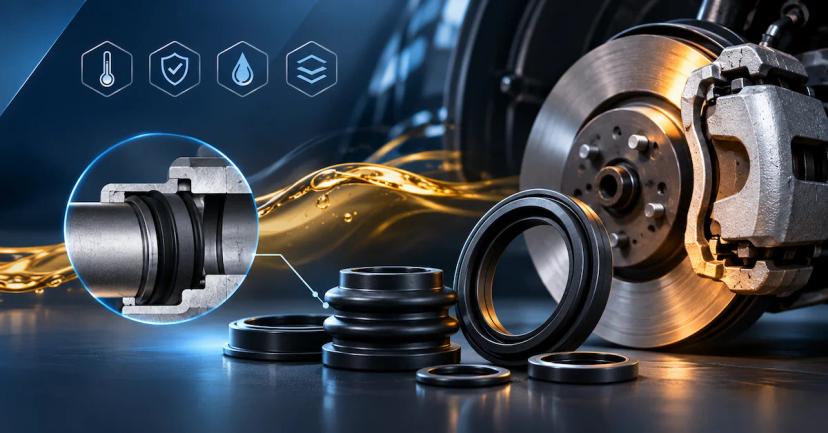
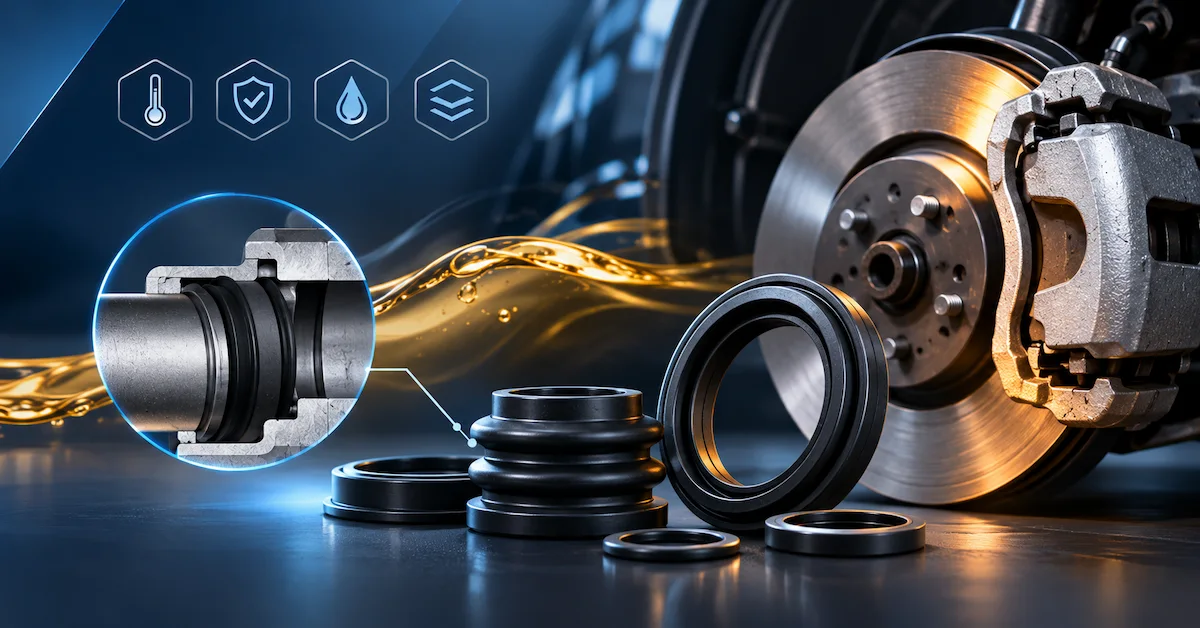
Quick Answer: Brake fluid rubber compatibility means that a specified hydraulic fluid does not cause unacceptable changes in the seals, cups and hoses used in its intended system. For OEM and bulk buyers, check the fluid chemistry and vehicle requirement first, then examine standardized SBR-cup test results, any relevant EPDM or production-seal testing, dimensional change, hardness and functional performance. A DOT label or an unsupported “rubber-safe” claim is not enough to approve a private-label order.
A brake fluid may meet an advertised boiling-point target yet still leave a purchasing team with an unanswered question: how was its interaction with the intended hydraulic seals verified? Automotive importers and OEM brand owners need to distinguish a laboratory pass against a specified reference rubber cup from evidence that a particular production elastomer, component assembly and fluid formulation work together.
That distinction matters across passenger-car service, motorcycle repair, light commercial hydraulic brakes and automotive brake-component supply. A complaint involving a sticking piston, a swollen cup or a leaking master cylinder can interrupt distribution and expose unclear responsibilities between fluid producer, component supplier and service organization. The right response is not to promise universal compatibility. It is to build a verifiable approval record before commercial launch.
For buyers considering GAFLE brake fluid products, this guide explains which questions to ask, which tests to request and how to translate the results into a realistic RFQ and repeat-order specification.
Buyer resources: Review DOT407 DOT 4 Brake Fluid | Ask GAFLE About Product-Specific Test Evidence
GAFLE TECHNICAL BUYER SUPPORT
Qualify the fluid before you qualify the order
Explore Brake Fluid Products ↗ Request Rubber Compatibility Evidence ↗1. What Does Brake Fluid Rubber Compatibility Actually Mean?
Rubber compatibility is controlled interaction, not the complete absence of change. Elastomers can absorb small amounts of fluid, undergo dimensional changes or change hardness during exposure. In a hydraulic seal, the right behavior depends on its compound, geometry, working pressure, temperature, motion and the fluid prescribed for the system.
An excessive dimensional increase can affect piston movement or sealing-lip behavior. Loss of hardness may indicate softening; excessive hardness or cracking can affect resilience. Stickiness, blistering and material sloughing are further warning signs. Too little expansion can also be relevant for a test whose specification requires a defined, limited amount of swelling. The acceptance criteria must come from the applicable test method and engineering requirements—not a general expectation that “zero swell is best.”
A lab result also has limits. It may show how a reference specimen behaves at defined conditions without proving indefinite performance in every vehicle. Brake-fluid approval should therefore address three questions: Is the chemistry right? Does the formulation meet its applicable standard? Is there evidence for any particular system or seal material being claimed?
This article concerns hydraulic systems designed for the specified brake fluid. A truck's conventional compressed-air service brake system, for example, should not be treated as a generic DOT-fluid application. Similarly, a component designed for mineral oil must not be assigned glycol-based fluid from appearance alone.
2. EPDM, SBR and Other Seal Materials: What Can Buyers Infer?
Ethylene-propylene-diene rubber (EPDM) is widely used in hydraulic braking systems designed around compatible glycol-based brake fluids. Styrene-butadiene rubber (SBR) has an important role in brake-fluid standards and standardized rubber cup testing. But the words EPDM and SBR do not identify a complete commercial rubber recipe. Fillers, cure systems, plasticizers, hardness grades and production methods may alter performance.
| Elastomer or fluid-system description | What a buyer can reasonably infer | What still needs confirmation |
|---|---|---|
| EPDM in a glycol-compatible braking system | Common seal-material family for appropriately designed hydraulic brakes | Actual compound, service temperatures, fluid specification and evidence |
| SBR reference cups | Used in specified brake-fluid laboratory methods | Exact test specification, specimen grade and measured change |
| NBR or other oil-oriented rubber | May be selected in certain petroleum-based fluid systems | Never assume compatibility with glycol-based DOT fluid |
| FKM, silicone rubber or other specialized elastomer | Material family may support certain engineered uses | Compatibility varies with formulation and service conditions |
| Mineral-oil hydraulic circuit | May use a different seal and fluid architecture | Exact manufacturer's specified fluid; not interchangeable with glycol DOT fluid |
| DOT 5 silicone-based brake fluid | Different chemistry from non-silicone DOT 5.1 | System design and vehicle manufacturer requirements |
The key source for standard scope is ISO 4925:2026, Road vehicles — Specification of non-petroleum-based brake fluids for hydraulic systems. Its published scope explicitly addresses non-petroleum-based fluids used in systems equipped with seals and cups made of SBR and EPDM. That statement does not mean every EPDM seal compound automatically passes every fluid in a catalogue.
An importer should request the composition family of the intended fluid, its applicable grade and any supporting seal-testing evidence. Proprietary additive ratios need not be disclosed for a meaningful audit, but claims should identify the tested fluid, standard and material. Use the actual vehicle or component maker's instruction as the compatibility decision authority.
3. DOT 3, DOT 4, DOT 5.1 and Silicone DOT 5 Are Not One Chemistry
DOT designations describe defined brake-fluid performance categories, but a higher number does not automatically create a safer substitute. DOT 3 and DOT 4 are commonly non-silicone glycol-based families; DOT 5.1 is also a non-silicone category, while DOT 5 is silicone-based. Hydraulic systems engineered for one chemistry must not be casually switched to another.
For rubber compatibility, the real decision tree is straightforward: identify the system and manufacturer's fluid requirement; classify the offered fluid; check the relevant standards; evaluate any special system or elastomer constraints; and approve only the intended product. Do not infer material compatibility from bottle color, marketing grade, “premium” wording or claimed racing use.
Particular care is needed with some motorcycle hydraulic clutches and specialist equipment that specify mineral oil. Such fluids are not generic DOT substitutes. Mixing incompatible hydraulic-fluid chemistries can damage seals or compromise the system, so maintenance work must follow the correct service documentation. This article is for sourcing and technical qualification, not a do-it-yourself brake-flushing procedure.
4. What Does FMVSS No. 116 Actually Test on Rubber Cups?
The U.S. FMVSS No. 116 motor vehicle brake fluid regulation specifies much more than boiling points. In S5.1.12 / S6.12, its effects-on-cups procedure evaluates standard SBR wheel-cylinder cups exposed to the brake fluid. That matters because online descriptions sometimes call the standard test an “EPDM test,” even though this particular procedure expressly uses SBR reference cups.
In the specified procedure, two standard SBR cups are exposed at 70 ±2°C for 70 ±2 hours, and another two at 120 ±2°C for 70 ±2 hours. Their dimensions, hardness and physical condition are assessed after conditioning and exposure. The standard also contains a stroking-properties evaluation of operation and component effects under controlled conditions.
| FMVSS No. 116 — selected S5.1.12 criterion | Stated acceptance limit | How to interpret it |
|---|---|---|
| Base-diameter increase of reference SBR cup | At least 0.15 mm and no more than 1.40 mm | A specified controlled swelling range, not a universal limit for all seals |
| Hardness decrease after 70°C exposure | No more than 10 IRHD | Reference-cup softening limit under the stated procedure |
| Hardness decrease after 120°C exposure | No more than 15 IRHD | Higher-temperature reference-cup limit |
| Increase in hardness | Not permitted by that criterion | Hardening is also evaluated, not only softening |
| Stickiness, blisters or sloughing | No disintegration permitted | Visible material failure is a rejection condition |
Important: These are selected requirements from the regulation, not test results for GAFLE T302, T407 or any other specific SKU. The full regulation governs specimen preparation, measurements and interpretation. Do not use the table as an instruction to run an abbreviated qualification test or as a guarantee of production EPDM seal performance.
The standard's S5.1.13 stroking provisions add functional considerations such as leakage, cup condition and operation during a prescribed simulated hydraulic test. This is a reason not to approve an aftermarket fluid based solely on one short immersion test or a photo of a rubber sample.
5. How Does ISO 4925:2026 Complement FMVSS Rubber Testing?
ISO 4925:2026, published in June 2026, addresses non-petroleum-based hydraulic brake and clutch fluids intended for systems using SBR and EPDM sealing materials. It replaced ISO 4925:2020. Suppliers referring to ISO 4925 should identify the actual edition and relevant class, and provide a product-specific conformity statement or evidence where the purchasing contract requires it.
The important distinction is between a standard's scope, its test requirements, and the sample actually evaluated. The ISO scope mentions both EPDM and SBR, while the particular FMVSS S6.12 cup procedure uses reference SBR cups. Buyers must not claim that one U.S. SBR-cup result alone proves compatibility with every commercial EPDM compound, hose or caliper assembly.
A technically robust dossier can combine grade-specific test results with additional material tests appropriate to the vehicle component or OEM project. Ask the supplier what standards and material specimens were used and which of the results are qualification tests versus routine lot checks. If a document cites only ISO 4925:2020, request an explanation of its current applicability before marketing conformance with the 2026 edition.
6. What Is the Role of ASTM D471 in Seal Qualification?
The official ASTM D471-16a(2021), Standard Test Method for Rubber Property—Effect of Liquids, provides a broad method for examining the effect of liquids on rubber specimens or suitable finished articles. It can help laboratories compare measured changes when an actual EPDM compound or a specialized seal is exposed to the proposed working fluid.
However, ASTM explains that accelerated immersion results provide comparative evidence and do not necessarily map directly to every in-service outcome. For a specific OEM program, the test plan must state the rubber compound, specimen dimensions, exposure fluid, temperature, duration, measurements and acceptance limits agreed between the parties.
An engineer might add volume or dimensional change, hardness change, tensile-property retention and visual examination to the test matrix. These are proposed engineering data fields, not a claim that every one is mandated for each DOT brake-fluid lot. A component supplier may also require more representative assembly-level or dynamic testing where system performance depends on lip geometry, motion or pressure.
The benefit to procurement is clarity: the buyer can compare evidence for the actual material rather than accepting generic “EPDM compatible” wording without knowing what was tested.
7. Seven Evidence Gates for a Rubber Compatibility Supplier Audit
For importers, technical purchasers and private-label distributors, a repeatable review prevents an attractive quotation from becoming an unsupported application claim.
Gate 1 — Identify the fluid and intended system. Require the precise product code, DOT or ISO class, fluid chemistry family, intended market, vehicle category and any manufacturer-specific requirement. Flag silicone DOT 5 and mineral-oil applications separately.
Gate 2 — Identify the sealing material. Ask the OEM or component supplier for the elastomer grade or approved material reference, not just “rubber.” Record whether EPDM, SBR or another formulation is involved; note seals in master cylinders, wheel cylinders, calipers and hydraulic clutch circuits as relevant.
Gate 3 — Match the standard and edition. Confirm whether the purchase specifies FMVSS No. 116, ISO 4925:2026, another applicable standard, an OEM approval or a special material test. Do not quietly substitute one for another.
Gate 4 — Inspect the laboratory evidence. Request the tested formula identity, method, sample or report number, date, temperature, duration, dimensional changes, hardness results and visible-condition assessment. Ask which criteria were met and who reviewed the report.
Gate 5 — Check the whole hydraulic-performance file. Rubber behavior is only one part of the brake fluid qualification. Corrosion, chemical stability, viscosity, boiling behavior, water tolerance and, where applicable, stroking performance also contribute to the technical decision.
Gate 6 — Approve samples and finished packaging. Confirm the actual fluid formula, bottle or can, closure, tamper evidence, label claims, lot code and market requirements. The test file and finished SKU must refer to the same material.
Gate 7 — Lock the repeat-order controls. Agree on formula revision, change notifications, routine batch-release checks, record retention and handling of a nonconforming lot. If a supplier changes a relevant additive package or source, determine whether requalification is required before the next order.
| Evidence gate | Minimum useful document or record | Typical purchasing decision |
|---|---|---|
| Chemistry and application | Product ID, vehicle/OEM requirement, grade | Reject wrong-fluid system candidates |
| Sealing materials | OEM material code, EPDM/SBR specification | Define the needed material tests |
| Standard verification | Claimed method, edition, class | Resolve ambiguous compliance statements |
| Material test results | Test report with specimen, conditions and measured changes | Compare results to contract criteria |
| Finished pack | Approved packaging sample, artwork, lot format | Prevent labeling or identity errors |
| Repeat-order assurance | Approved specification, COA plan, change process | Maintain the qualified product over time |
This seven-gate process is a buyer-recommended audit framework, not an official GAFLE factory procedure or a new regulatory certification. Use it to identify missing documentation before issuing a binding purchase order.
OEM & FACTORY SOURCING
Turn seal test evidence into an approved supplier specification
Explore Brake Fluid Products ↗ Request an OEM Review ↗8. What Should a Rubber Compatibility Test Report Show?
An engineering reviewer should be able to determine what was tested, under what conditions, against which limits, with what outcome. The document should connect the fluid to the same formula used in the sales quotation and connect the elastomer to the claimed application.
Useful fields include fluid code and revision, rubber compound or source, specimen preparation, baseline dimensions and hardness, exposure method, exposure duration and temperature, post-test measurements, visual observations and pass/fail criteria. For contract-specific testing, require a clearly described acceptance method rather than a laboratory statement such as “no abnormality found.”
The document should also identify whether the specimen was a standard reference SBR cup, a commercially representative EPDM test piece or an actual finished production seal. That single field prevents a surprisingly common misunderstanding in international brake-fluid purchasing.
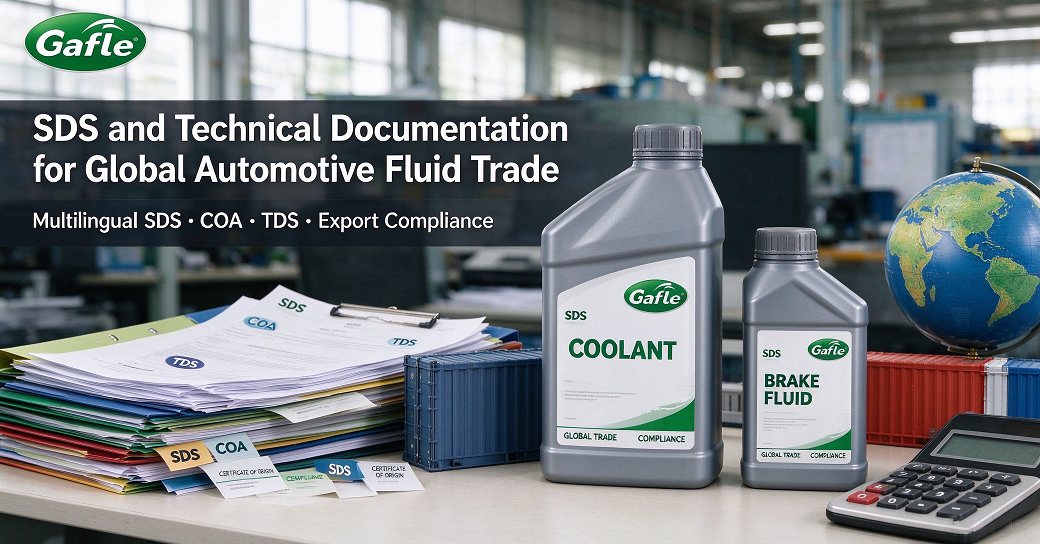
A summary TDS may not list all elastomer test details. Where the project justifies it, request the relevant qualification report or a carefully scoped technical statement. A Certificate of Analysis (COA) generally identifies selected properties of a defined lot; it need not reproduce every lengthy qualification test. Agree on routine and periodic test frequency rather than assuming an entire full-standard test suite is repeated for every bottle.
9. Why Temperature, Moisture and Repeated Motion Change the Risk
A bench immersion measurement is not the same as service in a brake caliper. Real systems experience thermal cycles, hydraulic pressure, movement, water exposure and long periods of storage or inactivity. A seal can behave differently in a dynamic lip contact than as a free rubber specimen. The correct validation scope therefore depends on the vehicle, component geometry and severity of the proposed application.
For a high-turnover passenger-car service market, the buyer may prioritize proven grade conformity and batch consistency. A specialized performance or OEM assembly project may require additional material and functional evidence. The customer should define those requirements before sampling rather than asking a fluid supplier to guarantee every operating condition generically.
Moisture control matters because many non-silicone glycol-based brake fluids are hygroscopic. Heat and moisture can affect fluid properties, but a visible leak alone does not establish that brake-fluid chemical attack caused the failure. Contamination, poor maintenance, worn components, installation errors and manufacturing variation can produce overlapping symptoms. Laboratory evidence is needed for a responsible root-cause claim.
10. How Should Distributors Respond to a Suspected Seal Compatibility Complaint?
For a complaint involving a soft seal, sticking piston or leak, stop making assumptions about chemistry from appearance alone. Treat the issue as a potentially safety-critical event and route it to qualified maintenance and technical staff. The appropriate immediate action, including inspection or withdrawal from service, must follow the vehicle or equipment manufacturer's guidance.
From the distributor's quality perspective, preserve the fluid batch identity, customer invoice, packaging and closure information, the vehicle or component specification, and any available retained sample. Ask a qualified laboratory or engineer to compare the suspect fluid and seal with reference materials under an agreed method. Record whether any contamination or unauthorized mixing is suspected, without asserting it as fact before investigation.
A useful complaint workflow is: contain and identify affected stock → collect vehicle and fluid evidence → inspect traceability and test reports → investigate with the relevant technical parties → document corrective action. The supplier should explain how it handles nonconforming materials and communicates changes to its customers.
This process protects downstream resellers from promising that one product is responsible for a fault that has not yet been established—and from overlooking genuine conformity problems when evidence does indicate them.
11. Which GAFLE Products Can Start a Seal-Compatibility Review?
Zhejiang Gafle Auto Chemical Co., Ltd. markets brake fluid and OEM/private-label automotive chemical services. Its catalogue includes DOT 3 and DOT 4 product directions, with public descriptions referring to corrosion protection and compatibility with common brake-system materials.
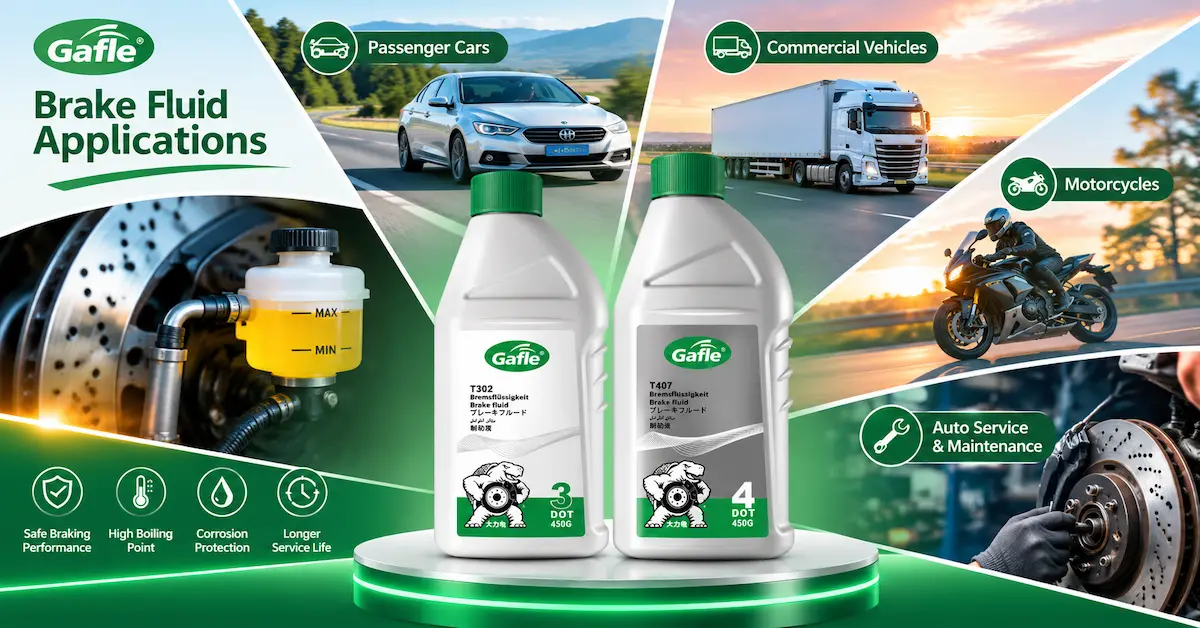
For a sourcing project, the relevant starting points are the GAFLE DOT3 range, the T302-related product listing, the DOT407 DOT 4 product page, and the complete brake-fluid collection.
| GAFLE public product direction | Appropriate buyer request | Evidence not established by a webpage alone |
|---|---|---|
| DOT 3 / T302 direction | Correct DOT 3 TDS, relevant rubber-cup test evidence, packaging | Vehicle-specific or seal-compound-specific approval |
| DOT407 DOT 4 | Exact fluid formulation, applicable FMVSS/ISO test documentation and seal data | Test values for every commercial EPDM formulation |
| Other brake-fluid categories | Confirm grade, chemistry and application; request targeted documentation | Assumed interchangeability with mineral-oil or silicone-fluid systems |
| OEM / Private Label | Discuss sample approval, test package, artwork, bulk supply and change control | Guaranteed MOQ, lead time or performance without a quote and evidence |
GAFLE has also published a general article, Brake Fluid Compatibility With Different Brake Seal Materials. It can serve as introductory background; the present guide goes further into how a technical buyer should verify test evidence and approve a formula for bulk procurement.
The company website's rubber-compatibility statements are manufacturer-provided product descriptions. They should not be treated as an independently verified approval for every seal formulation. Request test methods, the exact product identity, current reports and agreed contractual limits before making specific application claims.
Technical purchasing: Ask GAFLE for a DOT Fluid and Rubber Compatibility Review
GAFLE BRAKE FLUID PRODUCTS
Request a product-specific TDS and compatibility review
Explore Brake Fluid Products ↗ Request Rubber Compatibility Evidence ↗12. OEM and Private Label: How to Protect the Approved Formula
A private-label program adds opportunities for technical mismatches. A buyer may approve the fluid and sample but later request a new formulation, a different additive supplier or revised packaging. If changes are not controlled, the tested material and commercially supplied material may no longer be equivalent.
Before launch, agree which changes require notification and whether testing must be repeated. A fluid formulation or base-stock change may justify a different review from a label-color change; a new closure can require its own packaging checks. Maintain an approved reference to the TDS revision, applicable test evidence, packaging sample, label statement and lot-release plan.
Commercial terms also matter. Request MOQ, sample availability, delivery assumptions and packaging costs per formula and pack configuration. A single quoted price without identifying the qualified product can make supplier comparison misleading. For distributors with different market languages or bottle sizes, define whether each variation needs separate artwork or pack approval.
The aim is not to make qualification unnecessarily complicated. It is to secure a repeatable supply program where the product marketed to technicians matches the fluid and evidence originally approved by the purchasing team.
13. Copy-Ready RFQ: Rubber Seal Compatibility Evidence for Brake Fluid
Subject: Brake Fluid Rubber Compatibility Review — [Grade / Application / Destination]
Dear GAFLE Technical and Sales Team,
We are an automotive fluid [importer/distributor/private-label brand] serving [market]. We are evaluating [DOT grade or ISO class] brake fluid for [vehicle, hydraulic brake or clutch application]. Please identify the exact offered product code, fluid chemistry family and current TDS revision.
Our technical team would like to review the applicable FMVSS No. 116 or ISO 4925 test evidence, including available results on reference rubber cups. If you have qualification data involving EPDM or our specified production-seal compound, please identify the specimen, test method, temperature, duration, dimensional and hardness changes, and acceptance limits. Please also clarify which compatibility tests are part of product qualification and which records are provided routinely with production lots.
Our intended packaging is [format/size], first-order volume is [quantity per SKU], annual forecast is [volume], and destination is [country]. Please confirm available samples, packaging and label options, relevant documents, MOQ, estimated lead time, quote basis and the procedure for notifying buyers of material or formula changes.
We will review application requirements and technical evidence before approving the product for commercial use.
Kind regards,
[Name / Company / Email / Phone]
14. Common Technical and Purchasing Mistakes
Mistake 1 — Treating a DOT grade as universal rubber approval. Grade conformity and suitability for a particular proprietary elastomer or vehicle application are related but different issues.
Mistake 2 — Calling the FMVSS S6.12 reference-cup test an EPDM test. The prescribed reference cups in that procedure are SBR. Request separate EPDM evidence when justified by the project.
Mistake 3 — Assuming any swelling is a failure. Some standardized tests specify an allowable range, including a minimum dimensional increase. Use the proper criterion.
Mistake 4 — Treating DOT 5 and DOT 5.1 as the same fluid. They differ in silicone/non-silicone chemistry classification and require system-specific decisions.
Mistake 5 — Replacing a mineral-oil system fluid with ordinary DOT fluid. The correct hydraulic medium follows the equipment maker's instructions, not generic marketing advice.
Mistake 6 — Approving test reports without formula or specimen identification. An impressive numeric result is not useful if it cannot be traced to the quoted SKU.
Mistake 7 — Using an accelerated immersion test as a lifetime guarantee. It provides defined test or comparative evidence; real service conditions may require more validation.
Mistake 8 — Forgetting formula change control at reorder. The qualified batch and the delivered repeat order must remain connected by an agreed specification.
15. Frequently Asked Questions About Brake Fluid Rubber Compatibility
FAQ 1. Is DOT 4 brake fluid compatible with EPDM rubber?
EPDM is widely used in hydraulic brake systems designed for appropriate glycol-based fluids, including many DOT 4 applications. However, compatibility of a particular commercial EPDM compound and fluid formulation should be verified against the component requirements and applicable test evidence. A DOT 4 label alone is not vehicle or seal approval.
FAQ 2. What is the difference between EPDM and SBR in brake-fluid testing?
EPDM is a common engineering elastomer family in brake components. SBR is also used in brake-system contexts and in standardized reference-cup tests. FMVSS No. 116 S6.12 specifically tests standard SBR cups; ISO 4925:2026 covers fluids intended for systems using SBR and EPDM seals. Do not confuse test scope with actual specimen identity.
FAQ 3. How much rubber swelling is allowed under FMVSS No. 116?
For the specified S5.1.12 reference SBR cup test, base diameter must increase by at least 0.15 mm and no more than 1.40 mm. Those figures are not universal limits for all finished rubber parts; follow the full method and any applicable component-specific requirements.
FAQ 4. What happens if a brake seal swells too much?
Excessive swelling can change seal fit and friction and may contribute to impaired movement or leakage depending on component design. It is not possible to determine the failure cause from swelling alone. Qualified inspection, fluid identity review and material testing may be required.
FAQ 5. Can mineral oil and glycol-based DOT brake fluid be mixed?
Do not mix or substitute them unless the original equipment manufacturer explicitly specifies a compatible procedure and fluid. They are often designed for different hydraulic and elastomer systems. Mixing can compromise seal and brake-system performance.
FAQ 6. Does a brake-fluid TDS prove rubber compatibility?
A TDS is a useful product summary, but it may not contain specimen-level seal data. Ask for an applicable qualification test report or a technical declaration showing the product code, relevant standard, tested material, test conditions and results where the buying project requires that evidence.
FAQ 7. Is ASTM D471 a DOT brake-fluid certification?
No. ASTM D471 is a general method for evaluating the effect of liquids on rubber. It can support an engineering comparison for a selected EPDM compound, but using the method does not automatically establish FMVSS conformance or vehicle-maker approval.
FAQ 8. Must rubber compatibility be tested on every production batch?
Not necessarily. Full qualification tests and routine batch-release tests may have different schedules. Agree on the applicable product standard, inspection and testing plan, COA fields, change-notification rules and any periodic requalification triggers before ordering.
FAQ 9. Can GAFLE provide OEM brake fluid with rubber compatibility evidence?
GAFLE markets brake fluid and OEM/private-label services and describes material compatibility in public product content. Buyers should request the actual available TDS, test report and any proposed EPDM or SBR evidence for the selected formulation. Availability and scope must be confirmed directly for each project.
FAQ 10. What should I include in a brake fluid supplier RFQ?
Provide the target vehicle or hydraulic system, required fluid chemistry and grade, destination market, relevant seal material, technical standard, test and document requirements, packaging, anticipated volume and change-control expectations. This helps the supplier prepare a technically comparable proposal instead of only a bottle-price quotation.
Conclusion
Brake fluid rubber compatibility is a critical link between fluid formulation, hydraulic seal design and reliable aftermarket supply. For importers and OEM buyers, the strongest approach is to identify the system chemistry first, distinguish EPDM and SBR material evidence, and verify the precise meaning of standardized rubber-cup, immersion and functional tests. FMVSS No. 116, ISO 4925:2026 and ASTM D471 serve different purposes; none should be used to imply universal compatibility or unverified product approval.
A useful supplier qualification file connects the exact fluid SKU and formula revision to relevant test reports, approved packaging, batch controls and repeat-order change notifications. This reduces ambiguity in purchasing, technical support and complaint handling while allowing private-label brands to make defensible claims.
Begin with the GAFLE brake-fluid range and the DOT407 product page. Then contact GAFLE to request product-specific rubber compatibility evidence, sample conditions and an OEM/bulk quotation aligned with your application. Approve the chemistry, review the evidence and lock the specification before placing a bulk order.