Navigating Regulatory Fragmentation in Global Brake Fluid Sourcing
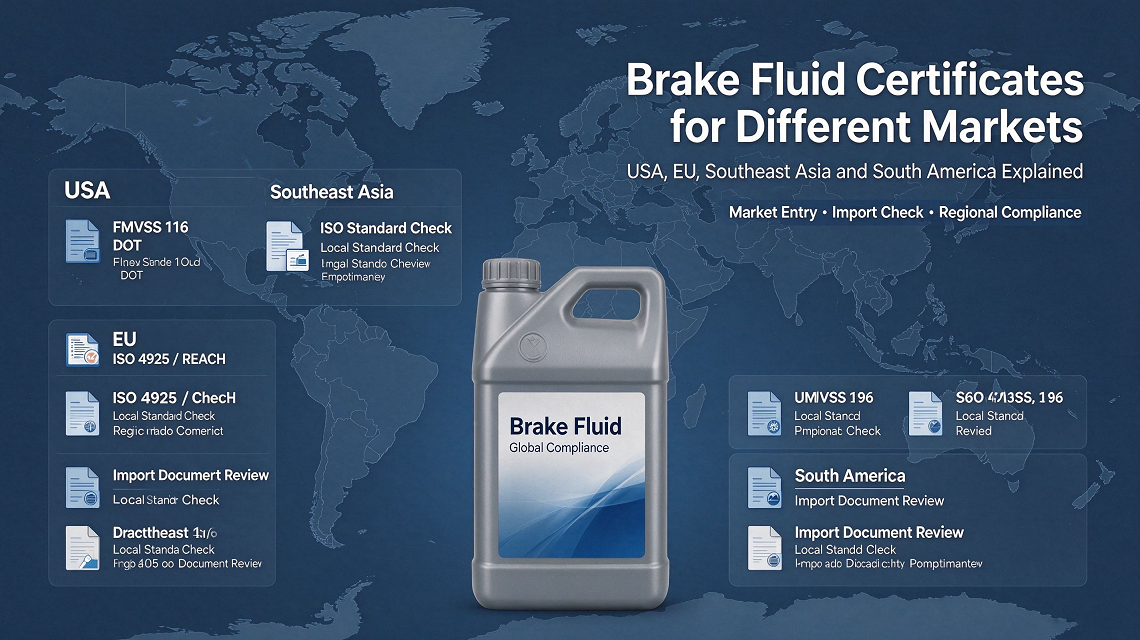
Sourcing hydraulic braking fluids internationally is rarely as straightforward as matching a technical data sheet to an SAE or ISO specification. Because hydraulic fluids directly impact vehicle stopping distances and crash prevention, customs authorities and transport ministries treat them as critical safety components rather than ordinary chemical formulations. Securing the correct Brake Fluid Certificates for Different Markets is often the difference between a smooth container discharge and weeks of demurrage charges while port authorities verify chemical declarations.
For procurement managers and automotive fluid distributors, the compliance burden is twofold: meeting mechanical and thermal performance thresholds (such as wet and dry equilibrium reflux boiling points) while simultaneously complying with national toxicological and environmental import certification requirements.
Major Regional Compliance Frameworks: A Geographic Breakdown
Every major economic bloc approaches brake fluid regulation through a distinct regulatory lens—some rely on mandatory third-party lab testing, while others operate on manufacturer self-certification backed by punitive market surveillance.
North America: FMVSS No. 116 and Canada's CMVSS 116
In the United States, the National Highway Traffic Safety Administration (NHTSA) enforces Federal Motor Vehicle Safety Standard (FMVSS) No. 116. This regulation governs DOT 3, DOT 4, and DOT 5.1 glycol-ether and borate-ester formulations, as well as DOT 5 silicone-based fluids.
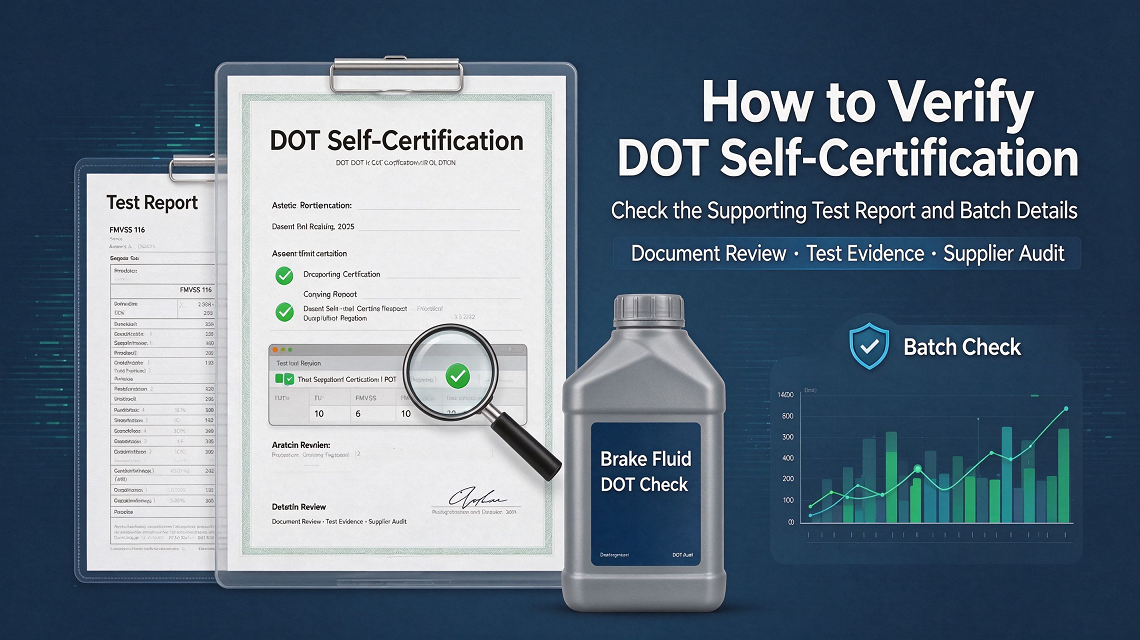
A frequent misconception among buyers is asking a supplier for an "official DOT brake fluid certificate." In reality, NHTSA does not issue compliance certificates. The manufacturer or importer legally self-certifies compliance by submitting an annual manufacturer identification report and product formulation notifications under 49 CFR Part 566. Buyers must verify compliance through independent laboratory test reports showing strict adherence to FMVSS 116 physical-chemical property tables.
Europe: REACH, CLP, and ISO 4925 Alignment
European Union imports prioritize chemical safety alongside functional performance. Rather than a single automotive safety certificate, European authorities demand:
- REACH Registration: Glycol ethers, additives, and corrosion inhibitors must be fully registered or pre-registered under EU REACH.
- CLP Regulation (EC No 1272/2008): Safety Data Sheets (SDS) and container labels must carry appropriate GHS pictograms, particularly concerning reproductive toxicity risks associated with certain borate esters or triethylene glycol monomethyl ethers.
- Technical Performance: Conformance to ISO 4925 (Classes 3, 4, 5.1, and Class 6 for low-viscosity ABS/ESP systems).
South America: INMETRO and Regional Border Checks
Clearing customs across Mercosur nations requires navigating strict local certification schemes. When preparing brake fluid documents for South America import, supply chain teams cannot rely solely on standard factory test sheets.
In Brazil, for instance, hydraulic brake fluid must hold certification through INMETRO (National Institute of Metrology, Standardization and Industrial Quality). This mandates testing by an accredited local or recognized laboratory, factory audits of the blending facility, and the application of the formal INMETRO conformity seal on consumer packaging. Importers in Argentina must satisfy equivalent safety benchmarks under IRAM standards, requiring verified chemical characterization prior to customs entry.
Asia-Pacific: National Standards and Mandatory Quality Marks
In Japan, fluids must demonstrate adherence to JIS K 2233 (Japanese Industrial Standard). In China, brake fluid falls under GB 12981-2012, requiring rigorous evaluation of kinematic viscosity at -40°C, evaporation loss, and corrosion resistance against cast iron, copper, and aluminum alloys.
Core Documentation Checklist for Import Clearance
To ensure smooth brake fluid compliance worldwide, your documentation package should be consolidated well before your cargo arrives at the destination terminal:
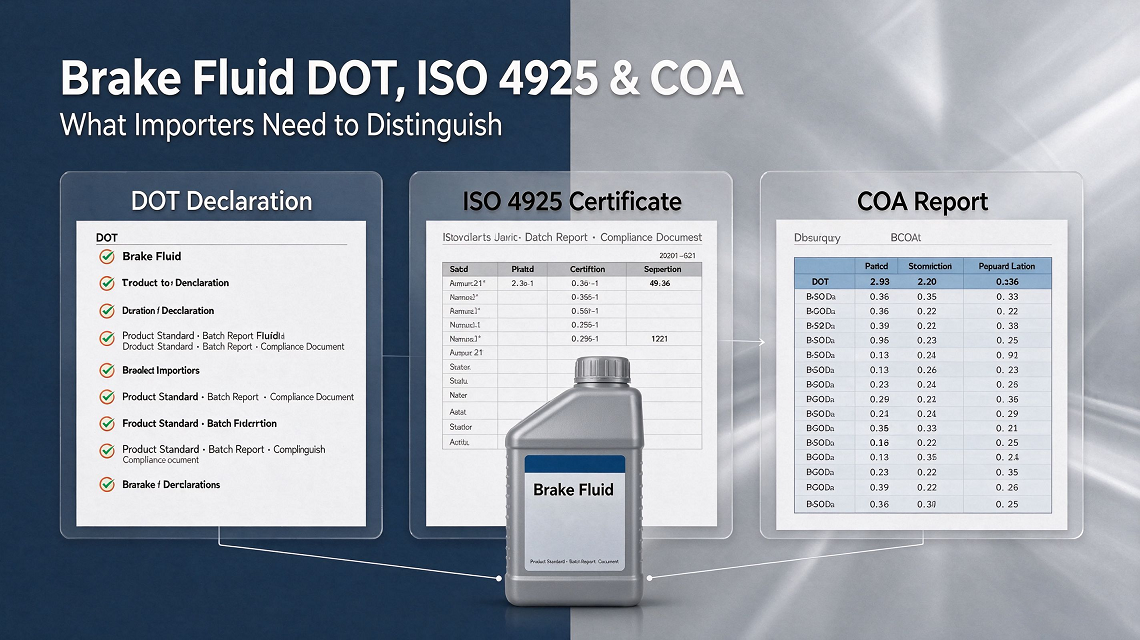
1. Batch-Specific Certificate of Analysis (CoA): Must cover critical baseline values, including Dry Equilibrium Reflux Boiling Point (Dry ERBP), Wet ERBP, Kinematic Viscosity at both -40°C and 100°C, pH values, and water content (tested via Karl Fischer titration).
2. Regionalized Safety Data Sheet (SDS): Translated into the destination country's official language, compliant with local GHS hazard classifications.
3. Manufacturer Quality Management System Certification: ISO 9001:2015 is standard, but tier-1 automotive suppliers will invariably require evidence of IATF 16949 certification from the blending plant.
4. Country of Origin Certificate: Essential for verifying preferential tariff treatment and confirming raw material traceability.
Common Compliance Traps Buyers Face
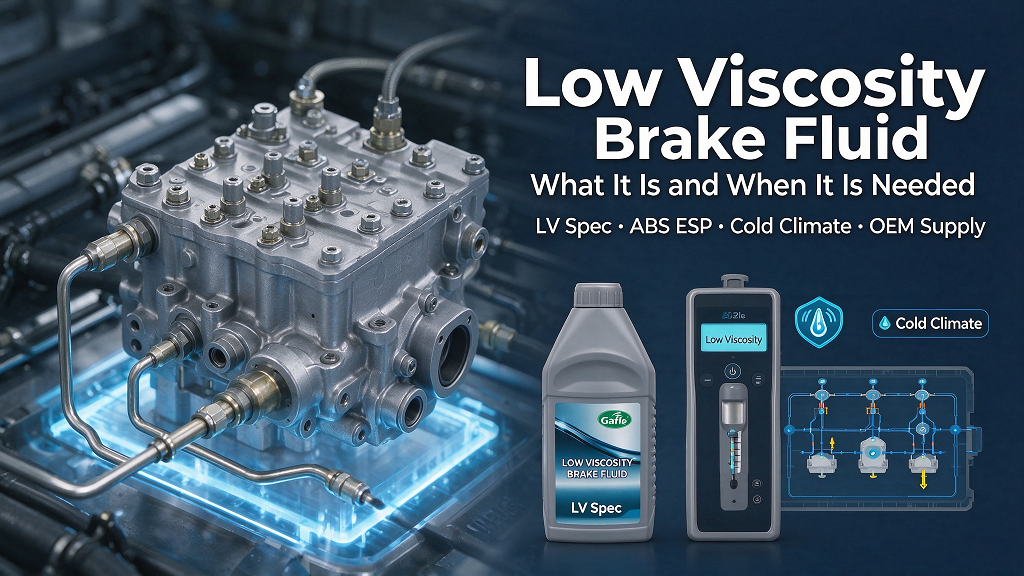
Even experienced buyers run into regulatory roadblocks when shifting production between global toll-blenders. One frequent oversight involves "low-viscosity" brake fluids engineered for modern electronic stability programs. A standard DOT 4 formulation will pass conventional boiling point tests but will fail the kinematic viscosity threshold (max 750 mm²/s at -40°C) required for ISO 4925 Class 6 without specialized synthetic bases.
Another pitfall involves packaging degradation. Glycol-based fluids are exceptionally hygroscopic; they pull moisture directly through micro-porous container walls if the resin barrier is sub-par. If customs inspections pull retention samples that have absorbed ambient moisture during lengthy ocean voyages, the batch may fail the mandated wet ERBP test at the port laboratory, leading to container rejection.
Frequently Asked Questions
Does a DOT 4 certificate automatically allow distribution in Europe?
No. While DOT 4 indicates performance equivalent to SAE J1704 or ISO 4925 Class 4, European entry requires strict compliance with REACH registration and EU CLP labeling regulations. The mechanical qualification does not waive chemical registration laws.
Can an overseas factory use its own laboratory to issue a brake fluid certificate?
While a factory-issued CoA is required for routine batch release, entry into markets like Brazil (INMETRO) or China requires testing and validation through an officially accredited third-party testing facility recognized by local regulatory authorities.
How often must full type-approval testing be renewed?
Most regulatory frameworks require full physical, chemical, and packaging compatibility re-testing annually, or immediately whenever the raw material base or additive inhibitor package is reformulated.
Welcome to contact GAFLE for more information & cooperation!
peter
ZHEJIANG GAFLE AUTO CHEMICL CO.,LTD
Tel:86-579-8222 1665
Fax:86-579-8246 4690
Cel/Wechart:86-13335993986
E-mail:peter@gafle.net
Web:www.gafle.net