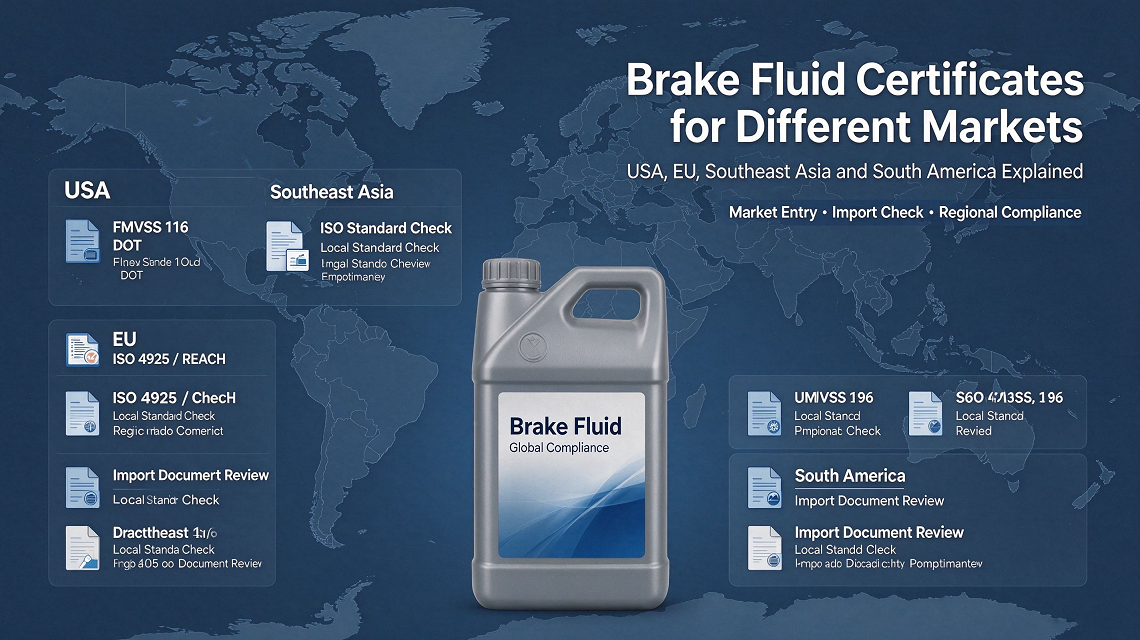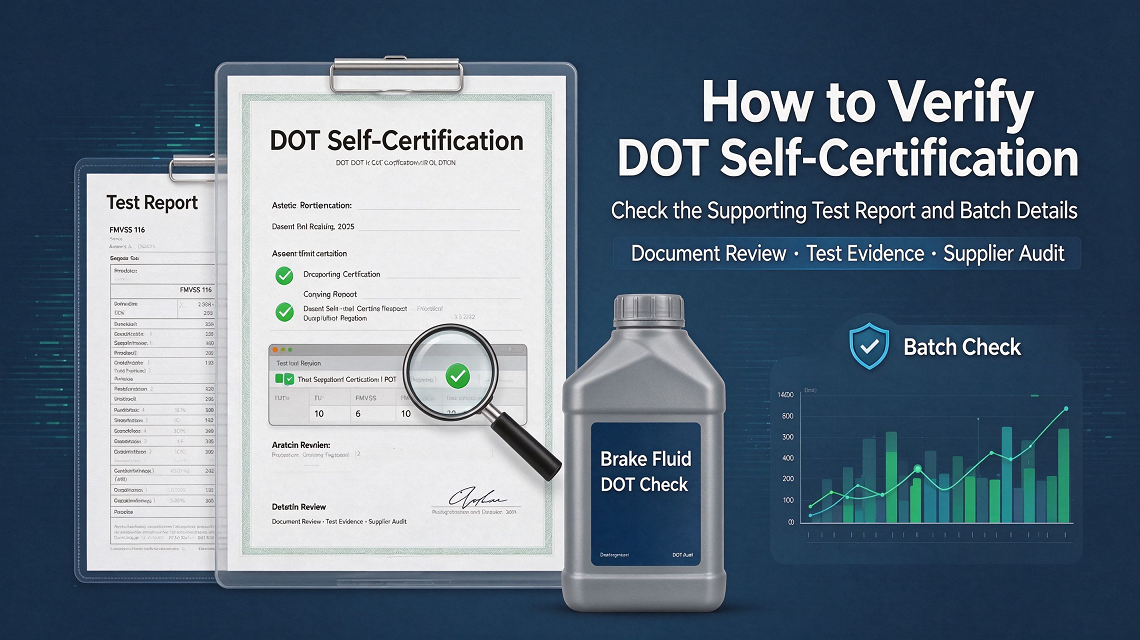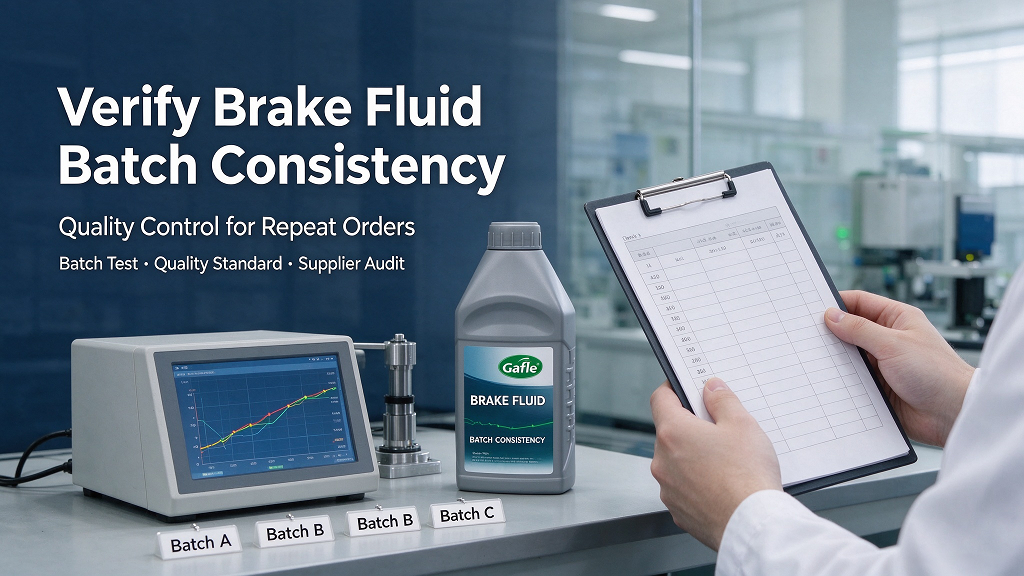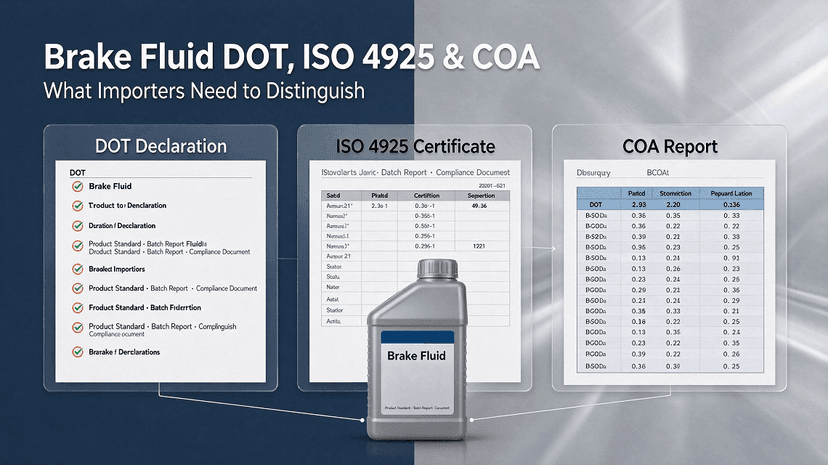
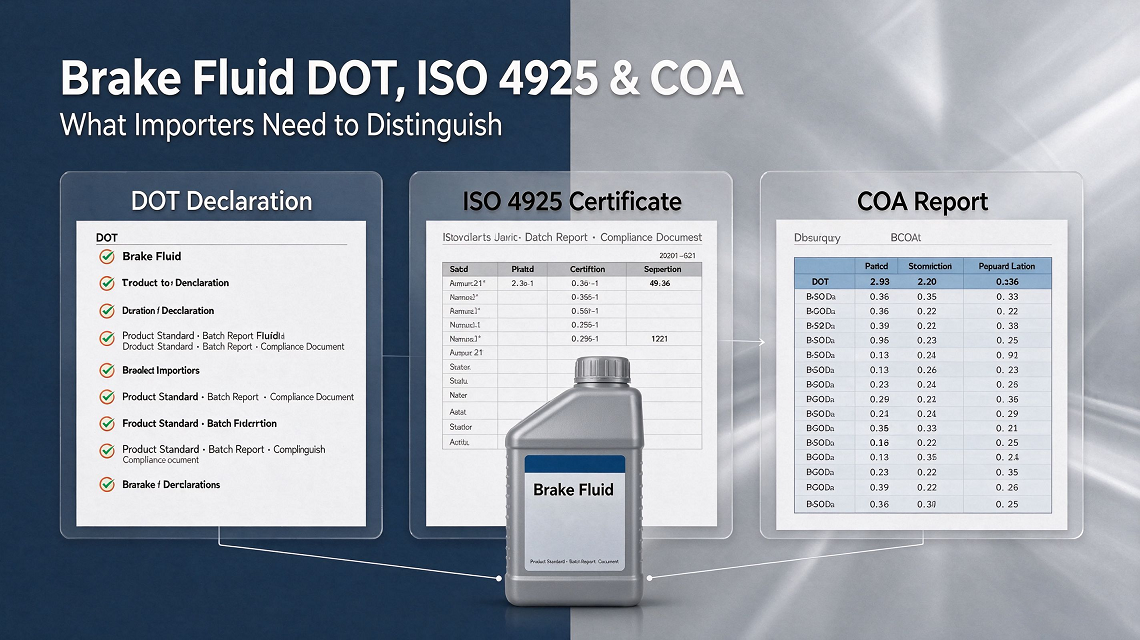
Customs rejections and port hold-ups in automotive chemical sourcing rarely happen because a formulation failed laboratory testing in real time. More often, shipments stall because the purchasing team submitted the wrong paperwork to the wrong authority. Understanding the difference between DOT declaration and COA brake fluid documentation is critical for any procurement team moving hydraulic fluids across borders. A laboratory test result showing compliant boiling points is useless if the border authority requires proof of manufacturer registration, just as a regulatory filing cannot prove that a specific pallet of fluid was blended correctly.
In the global supply chain, these two documents serve entirely different operational purposes. One is a regulatory self-certification of compliance with federal safety benchmarks; the other is an empirical quality record tied directly to an individual production lot.
The DOT Declaration: Legal Market Entry and Regulatory Responsibility
Under United States law, the Department of Transportation (DOT) does not test, endorse, or issue approvals for hydraulic brake fluids prior to market entry. Instead, Title 49 of the Code of Federal Regulations (49 CFR § 571.116), commonly known as Federal Motor Vehicle Safety Standard (FMVSS) No. 116, requires manufacturers and packagers to certify that their products meet specified safety performance criteria.
A DOT declaration—or manufacturer self-certification—is the formal legal assertion that the fluid formulation and packaging comply with FMVSS 116. To sell legally in the U.S., fluid blenders or brand packagers must submit manufacturing identification to the National Highway Traffic Safety Administration (NHTSA) before offering the fluid for sale.
Key characteristics of the DOT declaration include:
- Legal Scope: It represents manufacturer liability under federal statute. If a product fails audit testing conducted by NHTSA, the declaring party faces mandatory recalls and civil penalties.
- Time Horizon: It is tied to the formulation and manufacturing entity, not to a single production day or mixing tank.
- What it does not show: A DOT declaration does not list the real-time physical properties of the fluid sitting in a shipping container. It does not verify that a specific batch was protected against ambient humidity during packaging.
The COA Report: Verification of the Physical Batch
A Certificate of Analysis (COA report) is a batch-specific document issued directly by the blender's quality assurance laboratory. While the DOT declaration answers whether the product is legally authorized for commercial distribution, the COA answers whether this specific blend meets engineering specifications.
Brake fluid is hygroscopic; it naturally absorbs moisture from the atmosphere. A blender might have an active DOT filing on record, but if an operator leaves a storage tank unsealed or uses contaminated filling lines, the fluid can degrade before it ever leaves the blending facility.
A standard COA report documents measurable chemical and physical benchmarks verified prior to dispatch, including:
- Equilibrium Reflux Boiling Point (Dry ERBP): The boiling temperature of uncompromised, virgin fluid.
- Wet ERBP: The boiling point after the fluid absorbs approximately 3.7% water by weight, simulating aged performance in a vehicle.
- Kinematic Viscosity: Measured typically at -40°C and 100°C to guarantee consistent response across temperature extremes.
- pH and Reserve Alkalinity: Indicators of corrosion inhibitor strength and fluid stability.
- Appearance and Moisture Content: Confirming absence of particulate matter, cloudiness, or pre-packaging water uptake.
If your supplier provides a COA dated six months prior to the date on your bill of lading, you are looking at a generic product specification sheet, not a genuine batch COA.
Where ISO 4925 Fits into the Documentation Matrix
Procurement managers sourcing outside North America, or supplying platforms built to international standards, must also account for ISO 4925. This standard specifies performance requirements for non-petroleum-base fluids across multiple classes, such as Class 3, Class 4, and Class 6.
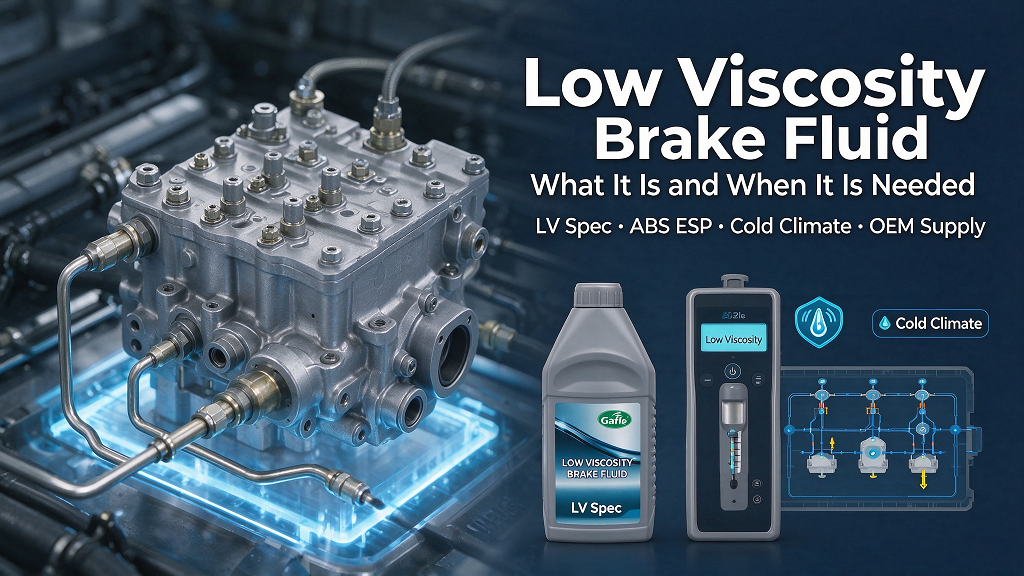
A brake fluid ISO4925 certificate typically comes from a qualified third-party testing house (such as SGS, TÜV, or an accredited independent laboratory) demonstrating that a given base formulation meets the standard. For modern electronic stability control (ESC) and anti-lock braking systems (ABS), low-viscosity fluids (ISO 4925 Class 6) are standard. Importers sourcing for global OEM platforms or European markets often need to present an ISO 4925 type-test certificate alongside the batch COA, whereas U.S. customs entry focuses heavily on the FMVSS 116 manufacturer identification.
Comparative Reference: DOT Filing vs. COA vs. ISO Certificate
| Document Type | Issuing Party | Primary Purpose | Validity Scope |
|---|---|---|---|
| DOT Declaration | Manufacturer / Importer to NHTSA | Statutory compliance with FMVSS 116 | Active formulation / facility lifecycle |
| COA Report | Internal Factory QC Laboratory | Batch-level empirical property verification | Single production lot / batch number |
| Brake Fluid ISO4925 Certificate | Accredited Third-Party Testing Lab | International baseline design homologation | Specific fluid formulation design |
Structuring Brake Fluid Compliance Documents for Importers
A common mistake among tier suppliers and private-label distributors is assuming that one comprehensive document covers all logistical checkpoints. In reality, customs clearance, legal liability, and quality assurance are reviewed by different stakeholders.
When compiling brake fluid compliance documents for importers, your dossier should be arranged in three distinct layers:
- Border Clearance Dossier: Includes the commercial invoice, bill of lading, manufacturer NHTSA registration code (for DOT compliance), and the relevant Safety Data Sheet (SDS) aligned with GHS and local transport standards.
- Quality Acceptance Dossier: Contains the batch COA matching the lot numbers stamped on the drums, IBC totes, or retail bottles, showing actual test results for dry/wet ERBP and viscosity.
- Technical Homologation Dossier: Houses full independent third-party test reports validating compliance with FMVSS 116, SAE J1703/J1704, or ISO 4925, typically reviewed during annual supplier audits rather than per-shipment clearance.
Frequently Asked Questions
Can a COA serve as a substitute for a DOT declaration at customs?
No. A COA only confirms laboratory measurements for that blending lot. It does not certify that the manufacturer has registered with NHTSA or that the packaging, labeling, and product formulation fulfill legal obligations under 49 CFR § 571.116.
Does the DOT issue a physical certificate when an application is approved?
No. NHTSA does not issue "DOT approved" certificates. The agency maintains a manufacturer registry and assigns an identification code upon receipt of complete submissions. Be wary of suppliers displaying ornate third-party certificates claiming official "DOT approval"—DOT does not endorse products.
How do I cross-reference a COA with physical shipments?
Every bottle, drum, or IBC must carry an indelible lot or batch number. This alphanumeric string must match the batch identifier on the laboratory COA exactly. If the numbers do not correlate, the COA cannot be used as a valid record of batch acceptance.
Auditing Your Brake Fluid Documentation
Before releasing final payment or authorizing shipment release for hydraulic fluids, verify that your supplier's batch paperwork directly reflects the cargo on the water. If you are reviewing new contract manufacturing partners or updating your compliance files, begin by auditing whether your current dossiers rely on passive supplier claims or verifiable batch laboratory data.
Welcome to contact GAFLE for more information & cooperation!
peter
ZHEJIANG GAFLE AUTO CHEMICL CO.,LTD
Tel:86-579-8222 1665
Fax:86-579-8246 4690
Cel/Wechart:86-13335993986
E-mail:peter@gafle.net
Web:www.gafle.net