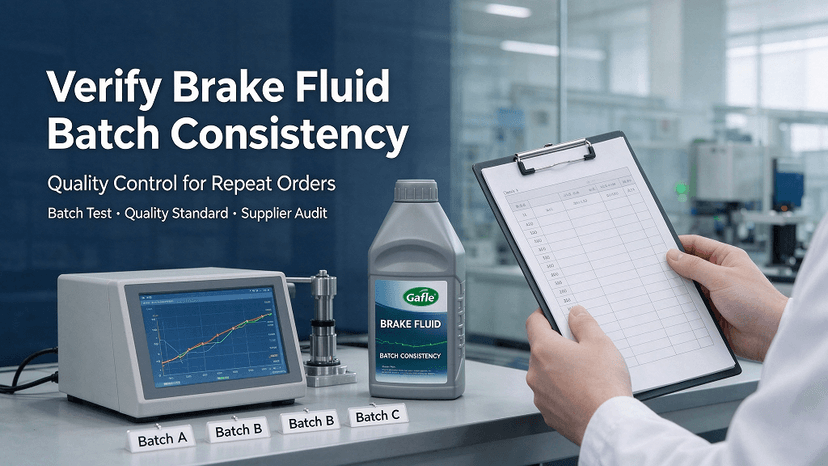
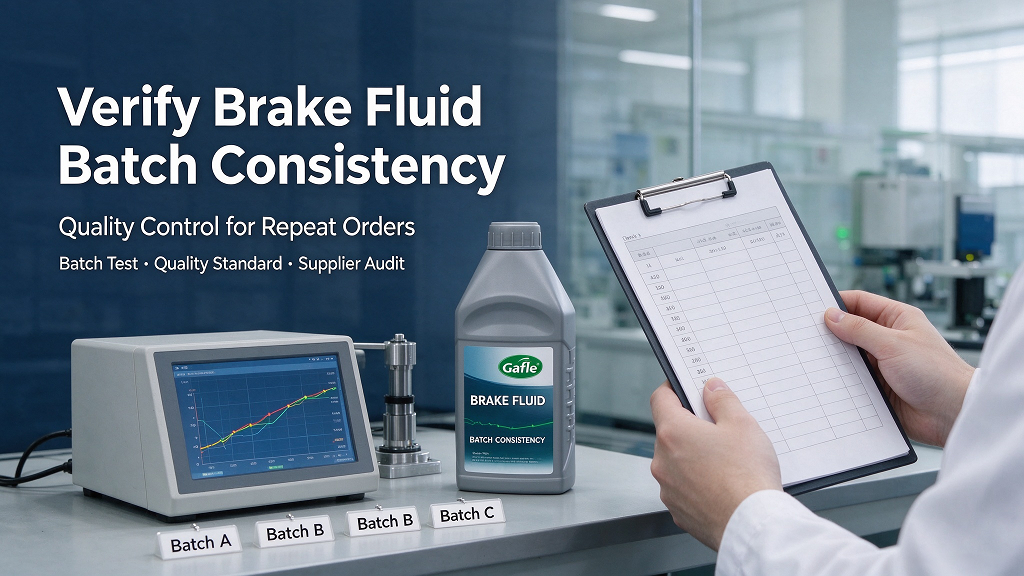
Procurement teams and plant chemical engineers know the pattern well: the initial 200-liter drum sample meets every spec sheet metric, but by the third or fourth tanker delivery, assembly technicians start noting variations in fill behavior, seal swelling, or moisture baseline. Knowing how to check brake fluid batch stability for bulk orders is not just an incoming-inspection formality; it is insurance against costly field recalls and system corrosion downstream. Hydraulic systems depend on predictable fluid compressibility, thermal margins, and elastomer compatibility, all of which hinge on chemistry that can subtly shift from one production run to the next.
The Chemistry That Drifts Between Batches
Polyglycol and borate-ester-based fluids (such as DOT 3, DOT 4, and DOT 5.1) are notoriously hygroscopic and sensitive to feedstock fluctuations. When assessing batch-to-batch variance, your lab should focus on the parameters most prone to drift:
- Equilibrium Reflux Boiling Point (ERBP) and Wet ERBP: Dry ERBP reflects virgin blend purity, but Wet ERBP—measured after controlled humidification—reveals how well the inhibitor package resists atmospheric degradation. A downward drift of more than 5°C across consecutive lots suggests changes in base glycol ether molecular weight distribution or under-dosing of borate esters.
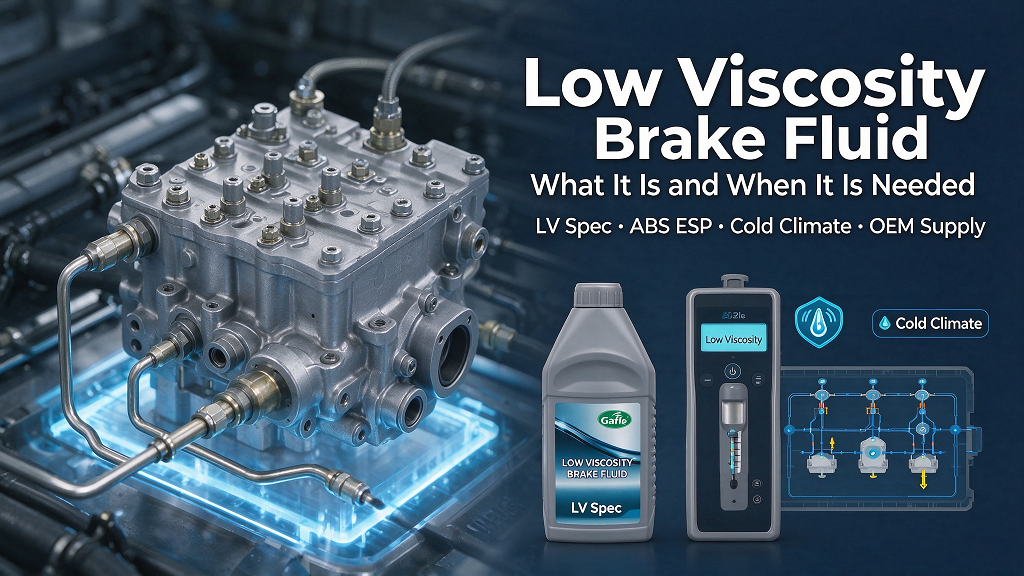
- Low-Temperature Kinematic Viscosity (-40°C): Cold viscosity is critical for ABS and ESC valve cycle times. A slight surplus of high-molecular-weight polyglycols can spike sub-zero viscosity while barely moving the needle on ambient measurements.
- Reserve Alkalinity and pH: The corrosion inhibitor package (typically amines, triazoles, and phosphates) dictates pH stability. If incoming lots show declining reserve alkalinity, the fluid will degrade faster under thermal cycling in service.
- Initial Water Content: Bulk hydraulic fluid should arrive well below 0.20% water by weight (often targeting under 0.10% at point of packaging).
Setting Up a Defensible Testing Protocol
Running a full compliance sweep per an international test standard—such as FMVSS 116, ISO 4925, or SAE J1703/J1704—on every incoming tote is financially and operationally impractical. A complete cycle takes weeks, largely due to long-term corrosion strip testing and humidification periods.
Instead, split verification into a tiered approach:
Tier 1: Rapid Release Screen (Every Batch)
Before offloading a bulk tanker or signing off on an IBC delivery, pull composite samples from top, middle, and discharge valves. Test immediately for:
1. Karl Fischer titration (coulometric method) for exact moisture content.
2. Refractive index at 20°C (gives a quick sanity check on base chemistry consistency).
3. Kinematic viscosity at 40°C and 100°C.
4. Visual clarity and sedimentation.
Tier 2: Fingerprint Verification (Every 3–5 Batches)
Fourier-Transform Infrared (FTIR) spectroscopy is your most powerful tool for repeat order brake fluid quality verification. By overlaying the absorbance spectrum of the new delivery against the signed-off golden sample, your chemistry lab can spot unannounced antioxidant substitutions, altered ether ratios, or surfactant shifts within minutes.
The Sampling Trap: Don't Blame the Manufacturer for Bad Sampling
Brake fluid will draw moisture directly out of humid ambient air in less than twenty minutes if an open beaker sits on a loading dock. When disputes arise between a buyer and a manufacturer regarding high moisture or depressed boiling points, the flaw is almost always traceable to improper sample drawing.
Always use dedicated, dry glass thief samplers or closed-loop sampling taps purged with dry nitrogen. Never pour fluid through ambient-air funnels, and ensure sample bottles are sealed with foil-lined or PTFE caps. If your baseline intake measurement shows 0.35% moisture while the supplier's Certificate of Analysis claims 0.08%, re-sample under controlled dry conditions before rejecting the lot.
Audit the Quality Control Process Behind the Blend
A reliable brake fluid supplier operates dedicated blending vessels with tightly monitored inert gas blanketing systems rather than shared batch tanks used for industrial coolants or general lubricants. During vendor audits, ask to see their raw material verification logs:
Do they synthesize their own borate esters, or do they purchase external additives? Are blending lines pigged and purged between grades? Does the factory perform continuous inline moisture monitoring during packaging? A rigorous quality control department will happily provide statistical process control (SPC) charts tracking dry ERBP and moisture trends over a rolling twelve-month window across all production shifts.
Frequently Asked Questions
Can we rely solely on the supplier's Certificate of Analysis (CoA)?
No. A CoA shows what left the blending tank, not what arrived in your storage facility. Cross-contamination in shared tanker trucks or micro-tears in container liners during maritime transit can compromise fluid integrity before delivery.
What variance in boiling point is acceptable between batches?
While DOT standards specify minimum floors (e.g., 230°C dry for DOT 4), your internal purchase specification should define an internal process window. A healthy supplier process should demonstrate batch variation within ±3°C of the established product baseline.
Moving Forward with Bulk Procurement
Protecting your operation starts with contract language. Embed clear delta limits for FTIR fingerprinting, moisture caps at receipt, and defined dispute-resolution procedures involving an independent ISO/IEC 17025 accredited laboratory into your master supply agreements. If your current supplier resists sharing multi-batch statistical variance data, it may be time to evaluate vendors who treat chemical consistency as an engineering requirement rather than an afterthought.
Welcome to contact GAFLE for more information & cooperation!
peter
ZHEJIANG GAFLE AUTO CHEMICL CO.,LTD
Tel:86-579-8222 1665
Fax:86-579-8246 4690
Cel/Wechart:86-13335993986
E-mail:peter@gafle.net
Web:www.gafle.net