Maintaining the Equilibrium: Why the Ideal Coolant pH Range Dictates System Longevity
Most fleet managers and mechanical engineers know that engine coolant prevents freeze-ups in winter and boil-overs in heavy summer cycles. Far fewer maintenance schedules give adequate attention to the chemical buffer system inside that fluid. The ideal coolant pH range sits between 8.5 and 10.5 for most heavy-duty formulations, though the exact window shifts slightly depending on whether your equipment runs on conventional inorganic additive technology (IAT) or newer organic acid technology (OAT). When fluid falls outside this narrow window, corrosion inhibitors drop out of suspension, leaving wet cylinder liners, radiators, and alloy components completely unprotected.
Why Coolant pH Value Matters
Coolant is primarily a mixture of ethylene or propylene glycol, deionized water, and a chemical inhibitor package. The glycol itself handles thermal transfer, but under repeated thermal cycles, it inevitably degrades into organic acids like glycolic, formic, and acetic acids. These degradation byproducts actively drag the pH value down over time.
To combat this, chemical formulators add alkaline reserves—typically borates, phosphates, or organic carboxylates. These buffers maintain an alkaline state to neutralize acidic breakdown products. If that reserve depletes and the solution turns acidic, the fluid stops acting as a protective barrier and begins operating as an electrolyte, expediting galvanic and cooling system corrosion across mixed metals.
Target pH Windows Across Coolant Chemistries
Not every cooling package should read identically on a digital meter. Setting a blanket threshold across an entire equipment fleet often leads to premature fluid dumping or, worse, ignored corrosion.
- Traditional IAT (Inorganic Additive Technology): Typically operates within a baseline pH of 9.0 to 10.5. These formulations rely on silicates and phosphates that require higher alkalinity to remain stable and form a protective boundary layer on cast iron and copper-brass systems.
- OAT (Organic Acid Technology): Usually formulated with an ideal coolant pH range between 8.0 and 8.8. Because OAT relies on carboxylate salts rather than heavy inorganic salts, the chemistry stabilizes at a lower, mildly alkaline plateau. Treating an OAT coolant reading 8.3 as 'depleted' simply because it does not match an old green-coolant standard is a frequent—and expensive—misinterpretation.
- Hybrid (HOAT / NOAT): Generally balances between 8.2 and 9.5. Nitrites are often blended in to protect heavy-duty diesel sleeves against cavitation erosion.
How Acidity Corrodes Your Engine Parts
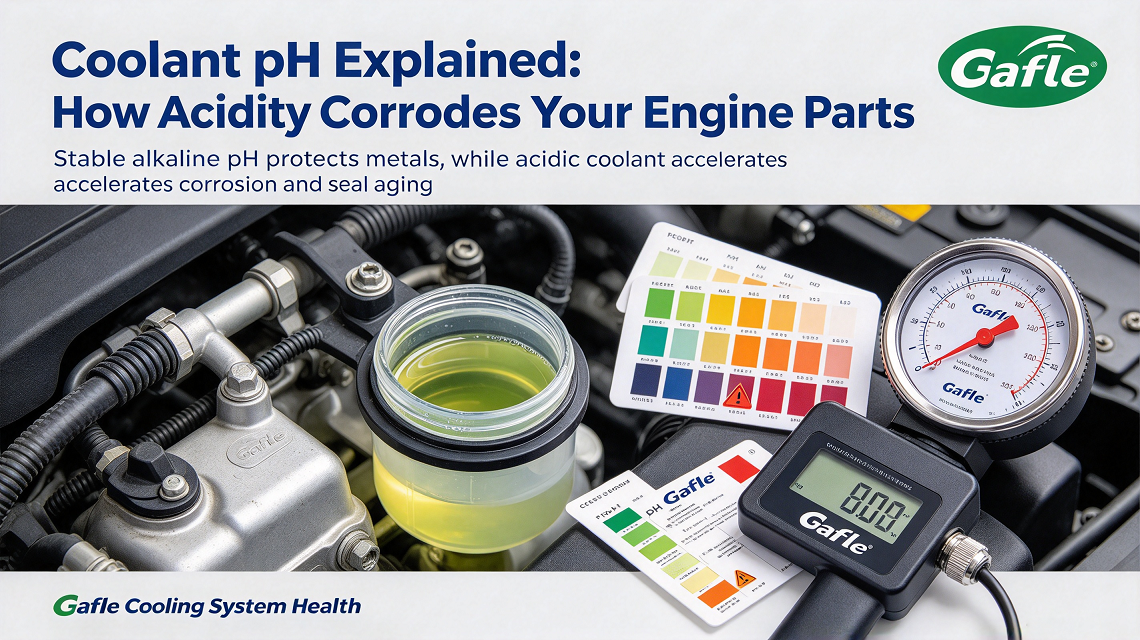
When the pH value drops below 7.5, passivation layers on internal metal surfaces collapse. Understanding How Acidity Corrodes Your Engine Parts requires looking at the micro-environment inside cooling passages. Acidic fluid attacks softer solder joints first, creating what mechanics recognize as 'solder bloom'—cauliflower-like deposits that choke narrow radiator tubes.
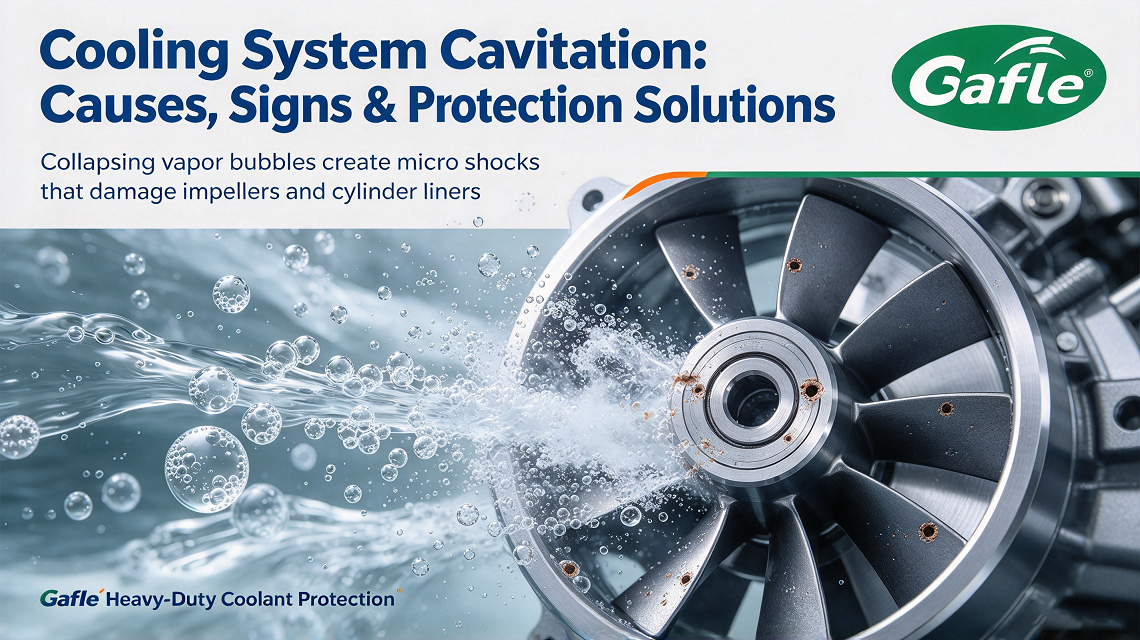
Next comes cast iron leaching and wet liner pitting. In high-output diesel applications, piston slap causes cylinder liners to vibrate at high frequencies, forming microscopic vacuum bubbles along the liner exterior. When these bubbles implode, they strip away microscopic layers of metal. In a properly buffered, alkaline engine coolant, the inhibitor layer reforms almost instantaneously. In acidic fluid, bare metal is continuously exposed to oxygen and acid, boring pinholes directly through the cylinder wall into the combustion chamber.
Conversely, letting alkalinity climb unchecked above 11.0 is equally hazardous. Highly caustic solutions aggressively attack cast aluminium components, dissolving the natural oxide skin on cylinder heads and modern heat exchanger cores.
Field Testing and Maintenance Protocols
Relying solely on color or optical clarity to judge fluid health is an outdated habit. A fluid can look vibrant and clean while harboring a dangerously depleted reserve. Implementing consistent bench or field testing keeps cooling system corrosion under control before metal loss occurs.
Handheld digital pH meters provide the most accurate readings, provided they are calibrated regularly with standard buffer solutions. Chemical test strips offer a quick, low-cost field screening method, though operators must verify that the strips match the specific chemistry (IAT vs. OAT) being monitored. Check the coolant temperature before sampling; taking a pH measurement from fluid straight off a working engine skew readings downward due to temperature-dependent chemical dissociation.
If testing reveals that your coolant has dipped below 8.0 in an IAT system or below 7.5 in an extended-life formulation, replenishment with fresh supplemental coolant additives (SCAs) may restore the buffer capacity. However, if the fluid shows discoloration, suspended particulate, or significant glycol breakdown, attempting to raise the pH manually is usually a poor economic choice compared to a complete system drain, flush, and refill.
Frequently Asked Questions
Can I use tap water to top up the cooling system if the level is low?
Never in heavy-duty or industrial systems. Tap water contains dissolved minerals such as calcium, magnesium, and chlorides. Chlorides aggressively drive down alkalinity, while calcium precipitates out to form scale, drastically reducing thermal conductivity and throwing off the ideal coolant pH range within weeks.
What causes engine coolant pH to drop rapidly?
A sudden, sharp drop in pH often indicates an exhaust gas leak past a cracked cylinder head or failing head gasket. Exhaust gases introduce sulfur and nitrogen oxides into the cooling passages, forming aggressive acids that exhaust the alkaline reserve far faster than standard thermal degradation ever could.
Welcome to contact GAFLE for more information & cooperation!
peter
ZHEJIANG GAFLE AUTO CHEMICL CO.,LTD
Tel:86-579-8222 1665
Fax:86-579-8246 4690
Cel/Wechart:86-13335993986
E-mail:peter@gafle.net
Web:www.gafle.net