What Is Brake Fluid Vapor Lock and Why Does It Happen?
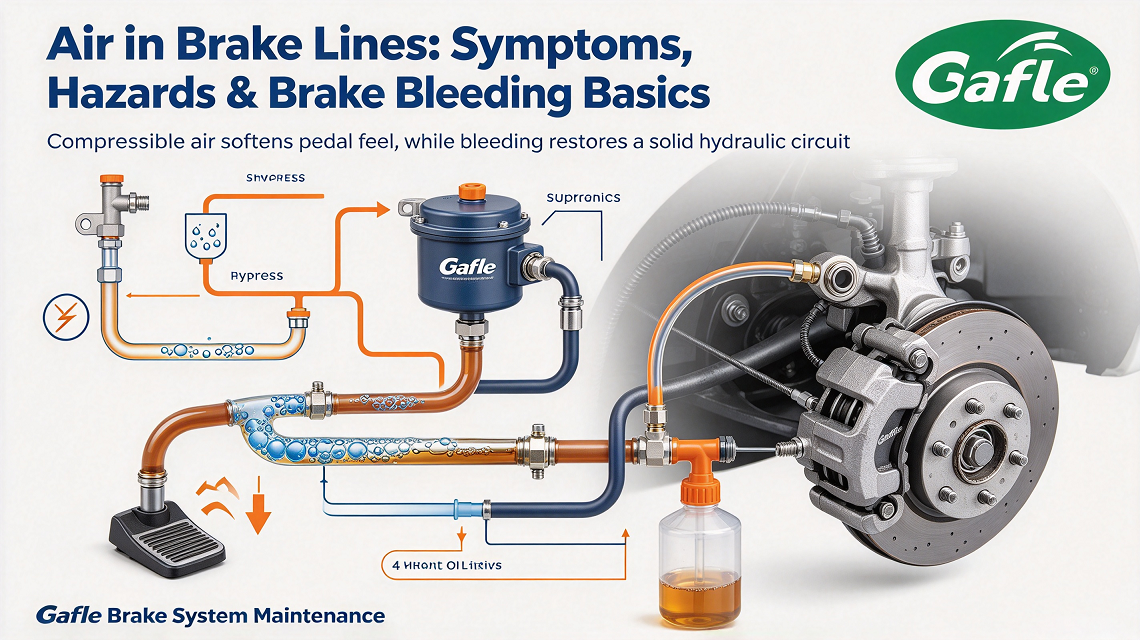
When an operator presses down on a vehicle’s brake pedal under severe operating conditions—such as sustained downhill hauling or aggressive circuit driving—the expectation is instant hydraulic resistance. When that pedal suddenly sinks to the floorboards with zero resistance, the cause is rarely mechanical breakage of the pedal assembly. Instead, the failure is usually hydraulic. Understanding what is brake fluid vapor lock begins with the basic physical law of hydraulics: liquids are virtually incompressible, but gases compress with minimal effort.
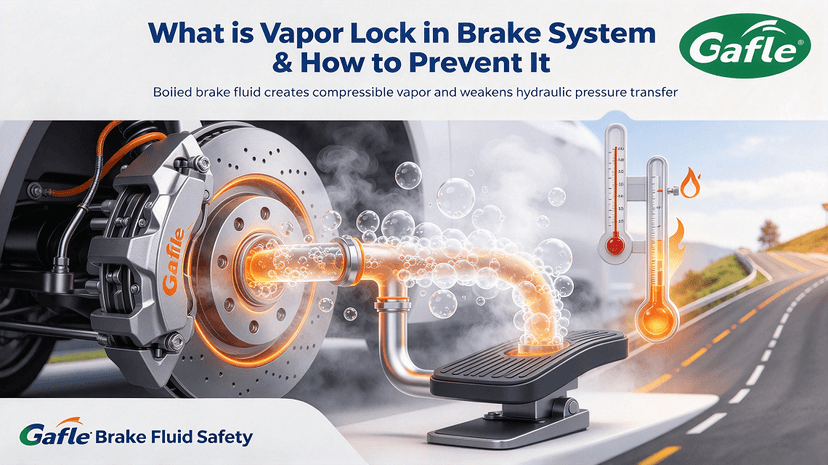
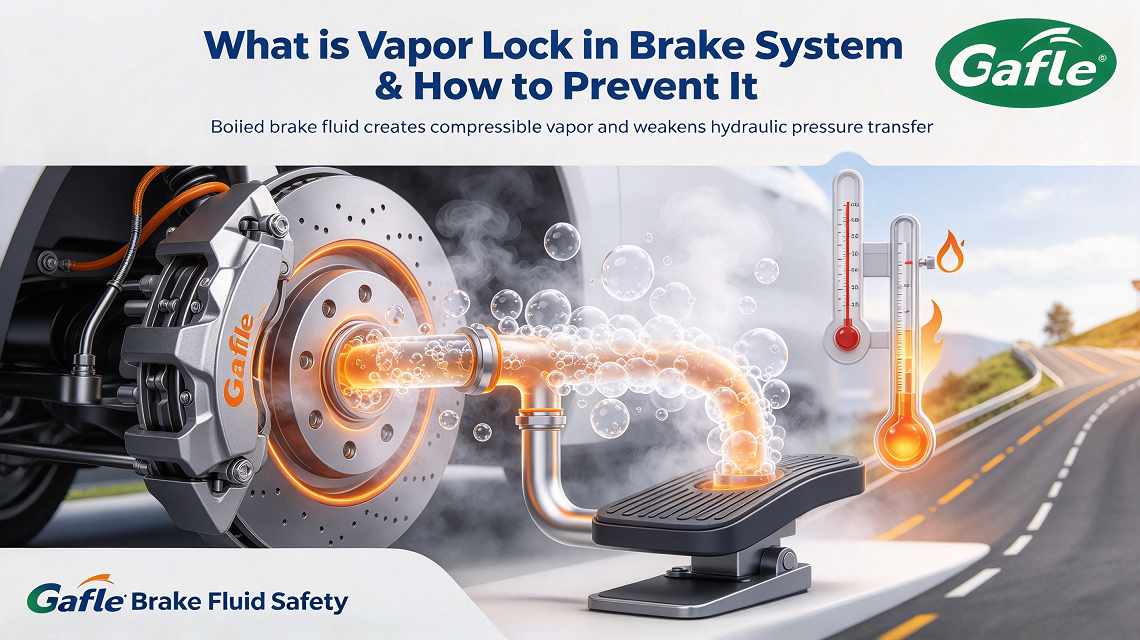
In a standard hydraulic braking circuit, mechanical pedal pressure is converted via the master cylinder into hydraulic pressure, transmitted through the fluid lines to actuate the caliper pistons. Friction generated between the brake pads and the rotor creates massive thermal energy, often reaching well over 500°C (932°F) at the interface. Much of this heat dissipates into ambient air, but a measurable percentage conducts through the backing plate, into the caliper piston, and directly into the hydraulic line. If that fluid reaches its boiling point, it undergoes a phase transition from liquid to gas. When gas bubbles form in the closed hydraulic system, pedal movement simply compresses the vapor pocket rather than pushing the caliper pistons. The hydraulic system collapses, resulting in severe degradation of braking safety.
The Mechanics of High Temperature Brake Fluid Vapor Lock
High temperature brake fluid vapor lock is uniquely hazardous because it often strikes without warning. Unlike mechanical pad fade—where the pedal remains firm while braking friction degrades gradually—vapor lock causes an immediate loss of pedal travel.
Most modern automotive and industrial vehicles rely on polyglycol-ether-based brake fluid (categorized under DOT 3, DOT 4, and DOT 5.1 classifications). Glycol formulations are preferred because they maintain stable viscosity across extreme temperature gradients and preserve elastomeric internal seals. However, they share a critical vulnerability: they are hygroscopic. They actively absorb moisture from atmospheric humidity through microscopic pores in flexible rubber hoses, master cylinder breather ports, and reservoir seals.
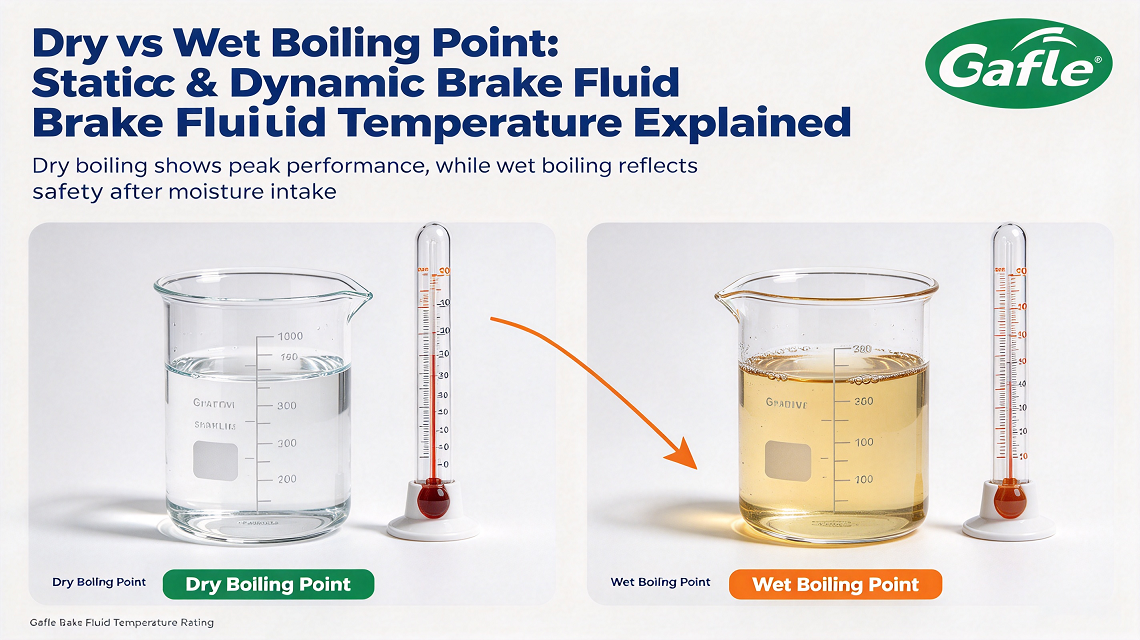
As ambient water enters the fluid, the thermal boiling threshold drops sharply. The automotive industry classifies this through two standardized metrics defined by SAE J1703 and FMVSS 116:
- Dry Boiling Point: The boiling point of fresh, uncontaminated fluid straight from an airtight bottle (containing 0% moisture).
- Wet Boiling Point: The boiling point after the fluid has absorbed approximately 3.7% water by volume, roughly equivalent to two to three years of real-world operational exposure.
For example, standard DOT 4 has a minimum dry boiling point requirement of 230°C (446°F), but its wet boiling point mandate plummets to 155°C (311°F). In heavy-duty towing, descending mountain passes, or prolonged stop-and-go driving with dragging calipers, caliper temperatures can easily surpass 160°C. If water-saturated fluid is present near the caliper housing, vapor lock occurs almost instantaneously.
Brake Fade vs. Vapor Lock: Diagnostic Differences
Engineers, test drivers, and fleet technicians frequently conflate pad fade with vapor lock because both stem from thermal overload. Yet diagnosing them accurately is critical for implementing the correct countermeasure.
With friction fade, the resin bonding materials in the friction pads outgas at elevated temperatures, effectively acting as an air bearing between the pad surface and the rotor face. The brake pedal stays high, stiff, and firm, but the vehicle refuses to decelerate proportional to the pedal effort.
By contrast, vapor lock manifests primarily as a structural loss of hydraulic pressure. The pedal drops smoothly to the floor with virtually no deceleration. Notably, after the vehicle sits stationary and the caliper cools below the fluid's boiling threshold, the gas bubbles condense back into a liquid state. The pedal may suddenly feel normal again once cool, leaving inexperienced mechanics puzzled when the vehicle functions properly during a cold shop inspection.
How to Prevent Vapor Lock in Demanding Applications
Preventing hydraulic failure requires managing fluid contamination, operational thermal load, and fluid selection. Knowing how to prevent phase change boils down to regular maintenance protocols and appropriate fluid specifications.
1. Implement Moisture-Based Service Intervals
Relying solely on odometer readings to schedule brake servicing is inadequate for safety-critical systems. Ambient humidity and storage conditions dictate moisture absorption rates far more than mileage. Maintenance technicians should use optical refractometers or conductivity pens to measure moisture content at every major service interval. When water content exceeds 2.5% to 3%, a complete flush of the hydraulic circuit is warranted, regardless of elapsed mileage.
2. Choose the Correct Fluid Specification
Not every application demands the highest numeric DOT rating, but severe-duty machinery benefits from fluids engineered with higher wet boiling thresholds. DOT 5.1 (a glycol formulation, distinct from silicone-based DOT 5) provides elevated wet boiling resistance while retaining compatibility with anti-lock braking (ABS) and electronic stability control (ESC) valving due to low cold-viscosity properties. For dedicated racing or severe payload duty, specialized high-temp racing fluids offer dry ratings exceeding 315°C (600°F), though their hygroscopic rates are often higher, requiring more frequent replacement intervals.
3. Mitigate Mechanical Drag and Heat Transfer
Fluid does not boil in a vacuum; it requires excessive heat transfer from the hardware. Sticking caliper slider pins, seized piston seals, or warped backing plates force friction surfaces to maintain contact with the disc even when the driver releases the pedal. This constant friction keeps caliper temperatures elevated, dramatically reducing the thermal headroom before the fluid boils.
Frequently Asked Questions
Can pumping the brake pedal restore pressure during vapor lock?
If boiling is localized and minor, rapid pumping of the pedal may temporarily displace a portion of the compressed vapor pocket and engage the pads slightly. However, if significant boiling has occurred throughout the caliper chamber, pumping will not restore effective stopping distance until the fluid cools.
Is silicone-based DOT 5 fluid immune to vapor lock?
DOT 5 is silicone-based and hydrophobic—it does not absorb water. While this sounds advantageous, any moisture entering the system remains unblended as free-floating water pockets. Because pure water boils at 100°C (212°F), moisture pools in the lowest point of the system (typically the caliper) can boil much sooner than glycol-water mixtures, making DOT 5 unsuited for modern ABS units and hard-service road vehicles.
Welcome to contact GAFLE for more information & cooperation!
peter
ZHEJIANG GAFLE AUTO CHEMICL CO.,LTD
Tel:86-579-8222 1665
Fax:86-579-8246 4690
Cel/Wechart:86-13335993986
E-mail:peter@gafle.net
Web:www.gafle.net