In any heavy machinery or automotive platform, kinetic energy must be converted to heat reliably and instantly. At the heart of this energy exchange is the hydraulic column, where understanding why brake fluid is incompressible becomes essential for mechanical safety and component design. When an operator depresses a pedal, there cannot be a lag phase caused by volume reduction within the hydraulic lines. The fluid must act like a solid steel rod running through a flexible conduit, transmitting foot pressure directly to the friction surfaces.
The Physics of Force Transfer: How Hydraulic Brakes Work
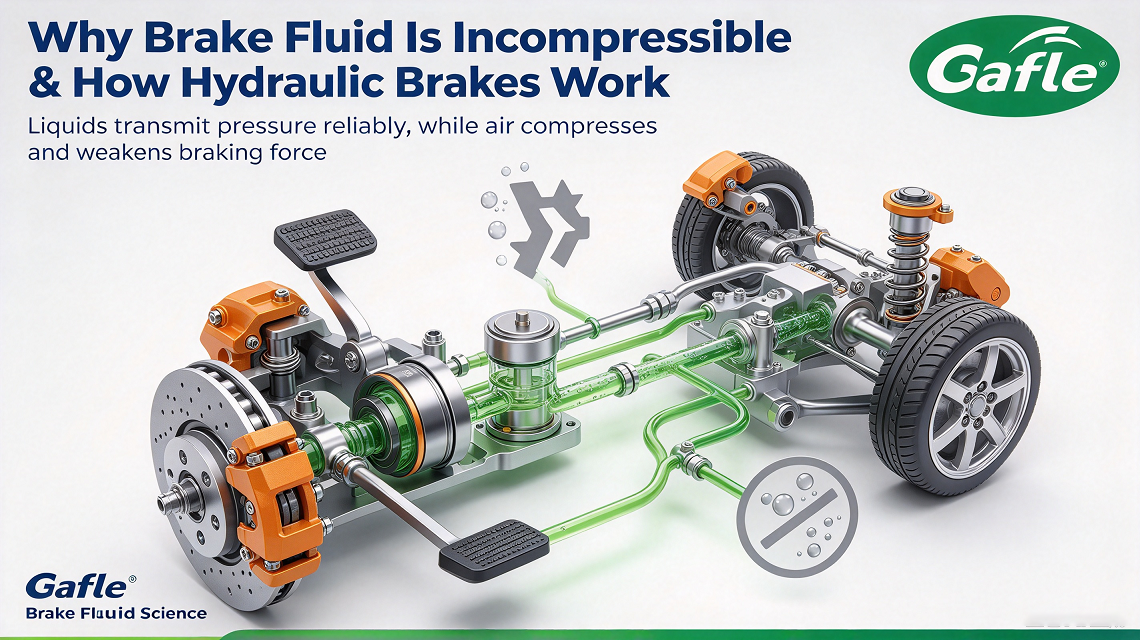
To grasp the role of the medium, one has to examine how hydraulic brakes work under Pascal’s principle. Pascal stated that pressure applied to an enclosed, static liquid is transmitted equally and undiminished in all directions throughout that liquid.
In a typical vehicle setup, mechanical leverage pushes a piston into the master cylinder. Because liquid molecules are closely packed together, the master cylinder displaces a specific volume of liquid through rigid lines and flexible hoses to the slave cylinders or calipers at the wheels. If the transfer medium were a gas or an aerated mixture, applying force would merely compress the molecular spacing rather than moving the caliper pistons. The non-yielding property of the liquid ensures that displacement at input converts directly into mechanical clamping force at output.
The Physical Chemistry: Why Brake Fluid Is Incompressible
Technically speaking, no fluid in nature is 100% incompressible. In fluid mechanics, we measure a substance's resistance to compression using its bulk modulus—the measure of volumetric elasticity under hydrostatic pressure. Modern brake fluid operates with an extremely high bulk modulus across its standard working envelope, meaning the volumetric change under several thousand pounds per square inch (PSI) is negligible for practical engineering purposes.
The formulation typically relies on glycol ethers, borate esters, or silicone-based compounds (such as in military-grade DOT 5 applications). At a molecular scale, these dense, interconnected liquid chains resist structural collapse. When mechanical stress is applied, the electrostatic repulsive forces between neighboring electron shells prevent the molecules from being forced into smaller volumes. This yields instantaneous response times through the braking system, ensuring that the driver's foot feel corresponds directly to rotor clamping force.
Can Water Replace Brake Fluid?
A classic engineering thought experiment—and an occasional field question from cost-cutting operators—is: can water replace brake fluid if both are liquids? After all, pure water also possesses a high bulk modulus and resists compression.
The short answer is no, absolutely not. Substituting water into a hydraulic brake circuit leads to three catastrophic failures:
- Thermal Vaporization: Heavy friction generates localized temperatures easily exceeding 200°C (392°F) at the caliper body. Water boils at 100°C under atmospheric conditions. The moment water boils inside a closed line, it turns to steam. Steam is a gas, and gases are highly compressible, resulting in total pedal drop and zero braking force.
- Corrosion: Standard glycol-based brake fluids contain specialized anti-corrosion packages and pH buffers designed to protect cast iron, steel line bores, aluminum valves, and copper seals. Water rapidly corrodes ferrous internals, creating pitting and particulate contamination.
- Sub-Zero Freezing: Pure water freezes at 0°C, expanding as it forms a crystalline structure. Frozen water ruptures lines and locks pistons, whereas formulated hydraulic oils remain viscous and functional down to -40°C.
The Primary Hazard: Moisture-Induced Vapor Lock
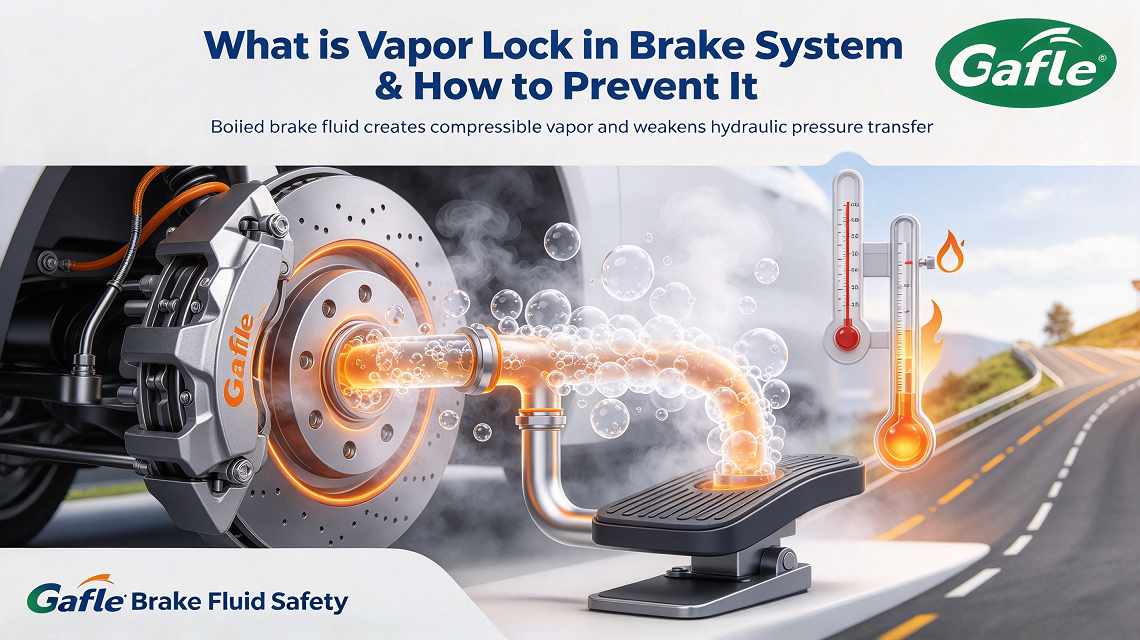
Even though the factory fluid is virtually incompressible, real-world service introduces challenges. DOT 3, DOT 4, and DOT 5.1 fluids are hygroscopic—they actively draw ambient moisture through microscopic pores in EPDM rubber hoses and reservoir seals over time.
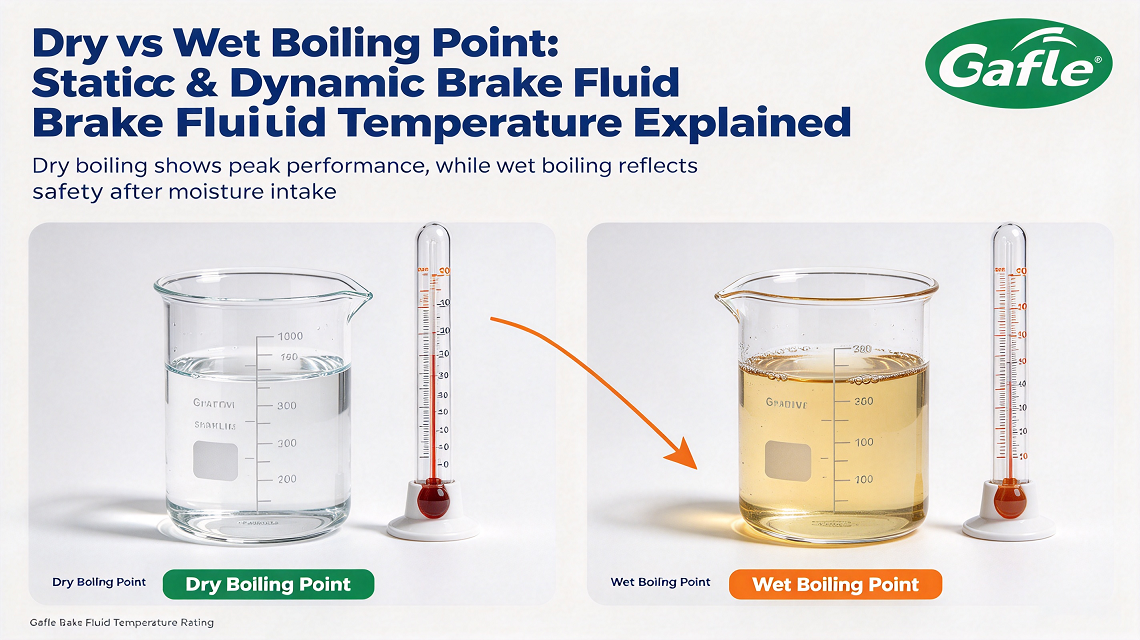
As water percentage climbs inside the line, the fluid's boiling point degrades drastically. For example, fresh DOT 4 fluid features a dry boiling point above 230°C. With just 3.7% water content absorbed over two years, its wet boiling point can plunge down near 155°C. Under continuous downhill hauling or track conditions, this water fraction turns into steam pockets. Once vapor enters the closed circuit, you are no longer compressing an incompressible liquid; you are compressing steam bubbles, a condition commonly diagnosed as a spongy pedal or vapor lock.
Best Practices for Fleet and Equipment Maintenance
Ensuring fluid integrity requires proactive maintenance protocols rather than reactive repairs after a pedal goes soft:
- Perform Routine Boiling Point Tests: Rely on conductivity or thermal testers during scheduled servicing rather than judging fluid condition solely by dark color. Color indicates thermal aging, but boiling point determines functional safety.
- Complete Fluid Flushes Every 24 to 36 Months: Regular exchange cycles purge moisture build-up before it corrodes internal ABS valving or causes vapor lock during severe stopping events.
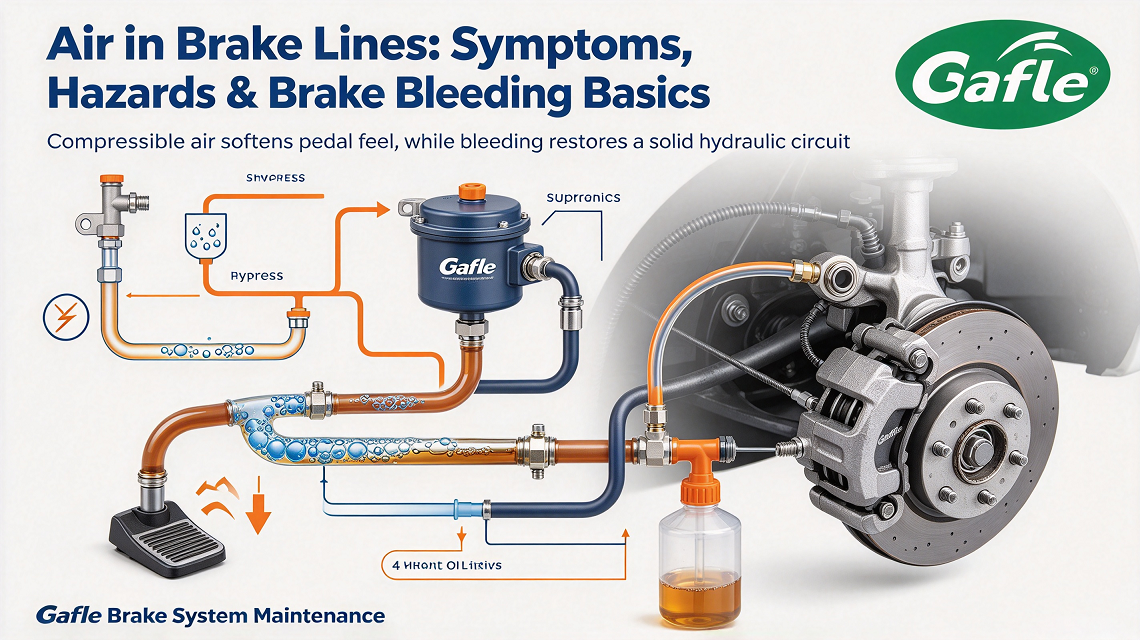
- Eliminate Trapped Air: Air in lines behaves identically to vapor pockets. Proper pressure bleeding is mandatory whenever lines, calipers, or master cylinders are opened to the atmosphere.
Frequently Asked Questions
Does cold ambient weather make brake fluid more compressible?
No. Lowering the temperature increases fluid viscosity, which might slightly stiffen initial pedal resistance, but it actually maintains or slightly increases the fluid’s bulk modulus. Cold fluid does not introduce compressibility.
Can I top up DOT 4 fluid with DOT 5?
Never mix DOT 5 with DOT 3, 4, or 5.1. DOT 5 is silicone-based, while the others are polyglycol derivatives. Mixing them leads to chemical separation, seal swelling, and erratic hydraulic response.
Why does air cause brake failure while fluid does not?
Gas molecules have large intermolecular distances, allowing them to collapse under pressure without transmitting force. Liquid molecules sit in close contact, forcing the liquid to transfer applied pressure rather than absorbing it through volume reduction.
Welcome to contact GAFLE for more information & cooperation!
peter
ZHEJIANG GAFLE AUTO CHEMICL CO.,LTD
Tel:86-579-8222 1665
Fax:86-579-8246 4690
Cel/Wechart:86-13335993986
E-mail:peter@gafle.net
Web:www.gafle.net